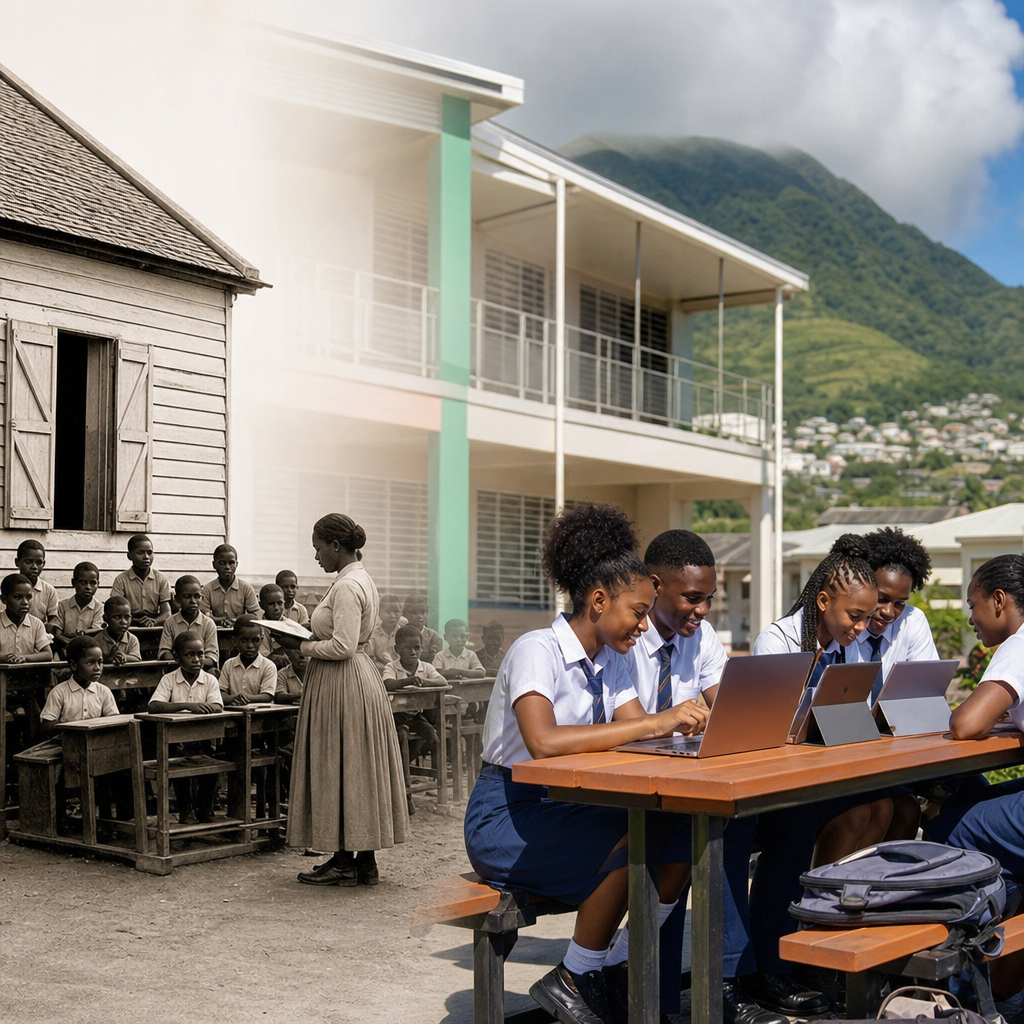
The evolution of education in Saint Kitts mirrors the island’s broader social history, moving from colonial control and church-led instruction to a more inclusive national system shaped by independence, regional cooperation, and modern workforce demands. In this context, education means more than classroom teaching. It includes early childhood development, primary and secondary schooling, teacher preparation, technical and vocational training, adult literacy, and the cultural transmission that happens through families, churches, and community institutions. Saint Kitts, formally part of the Federation of Saint Christopher and Nevis, has built its education system through centuries of adaptation, responding to slavery, emancipation, plantation economics, migration, state formation, and globalization.
This subject matters because schools in Saint Kitts have always done double duty. They have provided literacy and numeracy, but they have also served as instruments of social mobility, nation building, and cultural continuity. When I study Caribbean education systems, Saint Kitts stands out for the way its small size makes every policy choice visible. A curriculum change, a new teacher training initiative, or investment in digital access can affect a significant share of the population quickly. That makes the island an important case for understanding how education develops in small states with limited resources but strong community networks.
For readers exploring the wider Culture and History topic, this article works as a hub for the miscellaneous dimensions of education in Saint Kitts: the colonial foundations, the role of churches, post-emancipation expansion, state reforms, examinations, vocational pathways, higher education links, and the challenges of equity and modernization. It also connects naturally with related subjects such as language, labor history, migration, religion, public policy, and youth development. To understand education in Saint Kitts is to understand how the island has defined opportunity across generations, and how it continues to prepare citizens for local participation and global competition.
Colonial beginnings and the foundations of formal schooling
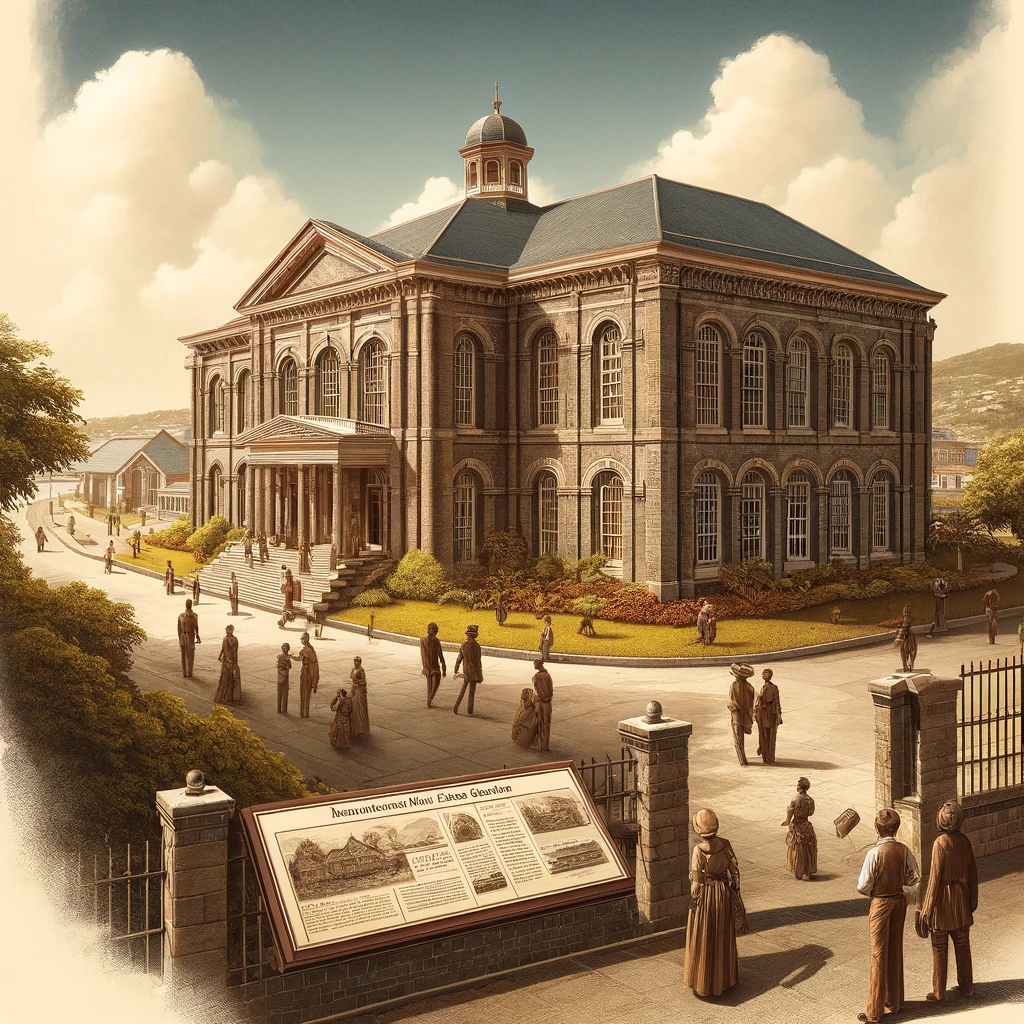
Formal education in Saint Kitts began under British colonial rule and was tightly linked to plantation society. In the earliest period, educational opportunity was highly unequal. White planter families and a small free colored elite had the greatest access to literacy, often through private tutors, church schools, or arrangements influenced by British models. Enslaved Africans were largely excluded from formal schooling, not by accident but by design. Colonial economies relied on labor control, and widespread literacy among the enslaved was often viewed as politically dangerous. As a result, education functioned first as a marker of status rather than a universal public good.
Religious bodies played a central role in changing that pattern. Anglican, Methodist, Moravian, and Catholic institutions were among the main channels through which organized teaching spread. Across the British Caribbean, missionary education often combined religious instruction with basic literacy, and Saint Kitts followed that pattern. These early schools were uneven in quality and access, but they laid the groundwork for broader public expectation that children should learn to read. In practice, attendance was irregular, facilities were modest, and instruction often depended on a limited number of trained teachers. Still, the church-school tradition established the first durable educational infrastructure on the island.
Emancipation in 1834, followed by apprenticeship and full freedom, changed the meaning of education significantly. Formerly enslaved families often saw schooling as a path away from plantation dependence, while colonial administrators saw it as a way to encourage social order. Those goals were not identical, but both increased pressure to expand provision. In post-emancipation Saint Kitts, elementary schooling gradually broadened, though resources remained constrained and many children balanced school attendance with agricultural labor and household work. The expansion was real, but it was slow, unequal, and shaped by the island’s sugar economy.
From church influence to a public system
The major long-term shift in the evolution of education in Saint Kitts was the movement from largely denominational schooling toward a more structured public system. This was not a sudden break. For decades, government support and church administration overlapped. Public funds, inspection mechanisms, and curriculum requirements increased even when schools retained religious affiliations. That hybrid model was common in Caribbean territories and remains influential today in institutional culture, school traditions, and community expectations.
By the late nineteenth and early twentieth centuries, colonial governments across the region were paying greater attention to elementary education, partly because literacy was increasingly tied to administrative efficiency and economic modernization. In Saint Kitts, schooling expanded through village institutions, teacher appointments, and more regular supervision. Yet access still depended on geography, family income, and social standing. Secondary education remained especially limited, and progression beyond the elementary level was not available to most children. The educational ladder existed, but only a small minority could climb very far.
What changed over time was the idea that the state had a direct obligation to organize and fund education. That change accelerated in the twentieth century, especially as labor movements, constitutional reform, and democratic politics gained strength. Education became a policy field rather than a charitable or purely religious undertaking. Government ministries, standardized exams, school-building programs, and teacher service structures all contributed to that transition. In my experience reviewing education histories in small island states, this administrative shift is often the turning point that separates scattered schooling from a coherent system. Saint Kitts followed that trajectory clearly.
As the public role grew, educational aims also widened. Schools were no longer expected only to teach reading, writing, arithmetic, and religion. They began to incorporate civic learning, practical subjects, and eventually science, social studies, and arts education. This broadening mattered because it reflected a deeper shift in how childhood and citizenship were understood. A schooled child was increasingly seen as a future worker, voter, parent, and community member, not simply as labor for the estate economy.
Secondary education, examinations, and social mobility
One of the most important chapters in the evolution of education in Saint Kitts is the expansion of secondary education. For much of the colonial period, secondary schooling was selective and often concentrated in a few institutions. Places were limited, entry was competitive, and costs could be prohibitive. That structure reproduced inequality because students from better-resourced families had more preparation and stronger chances of success. Over time, however, broader access to secondary education changed life trajectories across the island.
The examination system played a major role. In Saint Kitts, as in other English-speaking Caribbean territories, external exams became gateways to advancement. Later, regional examination bodies such as the Caribbean Examinations Council, established in 1972, became central to certification through CSEC and CAPE. These credentials matter because they influence access to sixth form, university study, technical training, public sector employment, and migration opportunities. Exams can reward strong teaching and clear standards, but they can also narrow learning if schools focus too heavily on test preparation.
Secondary expansion also shaped gender patterns. Across much of the Caribbean, girls often achieved strong outcomes in formal schooling, while boys were sometimes more vulnerable to disengagement, discipline issues, or pressure to enter work early. Saint Kitts has experienced versions of these regional dynamics. Effective policy therefore requires more than building schools; it requires attendance monitoring, guidance counseling, literacy intervention, and practical pathways for students whose strengths are not captured by traditional academic measures.
| Period | Main educational feature | Why it mattered in Saint Kitts |
|---|---|---|
| Colonial era | Church-led elementary instruction | Created early literacy access but kept opportunity unequal |
| Post-emancipation | Broader elementary enrollment | Linked schooling to freedom, mobility, and social discipline |
| Twentieth century | Growth of government oversight | Turned education into a public system with standards and inspection |
| Late twentieth century | Expanded secondary schooling and regional exams | Opened routes to jobs, training, and higher study |
| Contemporary period | Digital learning, inclusion, and skills focus | Connects education to resilience and a modern service economy |
For many families, secondary schooling became the hinge between generations. A parent who had only primary education could see a child move into teaching, nursing, public administration, hospitality management, or overseas study. That upward mobility is one reason education holds such symbolic power in Saint Kitts. It has long represented discipline, respectability, and the possibility of a different future.
Teacher training, curriculum reform, and regional integration
No education system improves beyond the quality of its teachers, and Saint Kitts has repeatedly had to invest in teacher preparation to sustain reform. Early schooling often relied on teachers with limited formal training, especially in rural areas. Over time, normal school models, in-service programs, and regional teacher education expanded the professional base. Institutions connected to the wider Eastern Caribbean and the University of the West Indies system have been important in strengthening qualifications, curriculum delivery, and leadership development. In a small state, teacher shortages are felt quickly, so training, retention, and professional support are not side issues; they are system-defining concerns.
Curriculum reform has also been central. Colonial syllabi were heavily British in orientation, often giving limited space to Caribbean history, local geography, Creole language realities, and regional literature. As political consciousness developed, educators across the Caribbean pushed for curricula that reflected local society more accurately. In Saint Kitts, that meant increasing attention to Caribbean history, civic identity, environmental awareness, and practical subjects relevant to island life. A student should learn Shakespeare and standard grammar, but also understand emancipation, federation, hurricane risk, tourism, public health, and the economic legacy of sugar.
Regional integration has strengthened these reforms. The Caribbean Examinations Council standardized important credentials, while CARICOM cooperation, OECS collaboration, and UWI networks helped smaller states share expertise. This matters because Saint Kitts does not need to build every institution alone. It can use regional frameworks for quality assurance, subject standards, teacher education, and tertiary pathways. In practical terms, this makes the system more resilient. A small island can offer globally recognized learning outcomes by participating in trusted regional structures rather than duplicating every resource domestically.
Technology has added a new layer to curriculum and instruction. Digital platforms, online assignments, and blended learning became more prominent, especially during and after the COVID-19 disruption. That period exposed inequalities in devices, internet access, and home study environments, but it also accelerated change that was already underway. Schools, ministries, and families saw that digital competence is no longer optional. For Saint Kitts, where service industries, finance, tourism, and global communication matter, digital literacy now sits alongside traditional literacy as a core educational priority.
Technical education, lifelong learning, and the road ahead
A complete view of education in Saint Kitts must go beyond academic schooling. Technical and vocational education has long been essential, even when it was undervalued socially compared with grammar-school pathways. An island economy needs electricians, mechanics, hospitality workers, health aides, construction specialists, information technology technicians, and entrepreneurs. When vocational routes are weak, employers face skill gaps and young people face frustration. Strong systems treat technical education as a first-choice pathway for many students, not a fallback for those who struggle with exams.
That is especially important in Saint Kitts and Nevis, where economic change has altered the skills landscape. The decline of sugar as the dominant industry and the rise of tourism and services required educational adaptation. Training in hospitality, customer service, business administration, marine services, and digital tools became more relevant. The Clarence Fitzroy Bryant College has been one of the key institutions in this transition, offering academic, technical, and professional programs that help bridge secondary school and employment or further study. For a small federation, such institutions are strategically important because they anchor local human capital development.
Adult education and lifelong learning also deserve attention. Not every learner moves smoothly through school at the expected age. Some need second-chance programs, literacy support, professional certification, or workforce retraining. This is where community programs, continuing education, and employer partnerships matter. In my assessment, small states perform best when they treat education as a lifelong public system rather than a child-only service. That approach is especially valuable in periods of economic transition, natural disaster recovery, or technological change.
Current challenges are clear. Schools must raise literacy and numeracy consistently, support students with special educational needs, improve counseling and mental health services, maintain teacher morale, and ensure equitable access across communities. They must also preserve cultural grounding while preparing students for an increasingly global labor market. The answer is not to copy larger countries mechanically. Saint Kitts needs policies sized to its own realities: strong early intervention, data-informed teaching, regional partnerships, reliable infrastructure, and pathways that respect both academic and practical excellence.
The evolution of education in Saint Kitts shows how a small island society can transform schooling from an instrument of exclusion into a central pillar of opportunity, identity, and national development. The journey began in a colonial order that restricted knowledge and preserved hierarchy. It moved through missionary expansion, post-emancipation demands for access, growing state responsibility, the spread of secondary education, regional examination systems, and modern efforts to align learning with economic and civic needs. Each stage changed who could learn, what they could study, and what education could make possible.
The key takeaway is that education in Saint Kitts has never been separate from history. It has been shaped by slavery and freedom, religion and government, sugar and tourism, local ambition and regional cooperation. Its strongest achievements came when policymakers, teachers, families, and communities treated schooling as a shared national project. Its biggest challenges have appeared when inequality, limited resources, or narrow definitions of success blocked that vision. That pattern offers a practical lesson for anyone studying the island’s culture and history: education is one of the clearest ways to trace social change across generations.
As a hub within the broader Culture and History topic, this page points readers toward the many connected stories behind classrooms in Saint Kitts, from church influence and labor reform to youth opportunity, language, and nation building. If you are exploring Saint Kitts in depth, use education as a guide to the island’s past and future, then continue into related articles on religion, migration, public life, and cultural identity.
Frequently Asked Questions
How has education in Saint Kitts changed from the colonial era to the present?
Education in Saint Kitts has undergone a major transformation, reflecting the island’s political, social, and economic development. In the colonial period, schooling was limited in access and heavily influenced by church missions and the needs of the plantation economy. Instruction often served a narrow purpose, with strong emphasis on religious teaching, basic literacy, and social discipline rather than broad intellectual or professional advancement for the wider population. Opportunities were uneven, and education was shaped by class, race, and colonial authority.
Over time, however, education became more inclusive and more closely tied to national development. As public institutions expanded and government took a stronger role, schooling moved beyond church-led structures toward a formal national system that sought to reach larger portions of the population. This shift included greater access to primary and secondary education, stronger teacher preparation, and broader state responsibility for curriculum, school administration, and educational planning.
After independence, education increasingly came to be viewed not simply as a colonial inheritance but as a tool for nation-building. Policies placed more emphasis on equity, citizenship, cultural identity, and economic readiness. The system evolved to include early childhood development, technical and vocational pathways, adult education, and links to regional institutions in the Caribbean. Today, education in Saint Kitts reflects a blend of historical legacy and modern priorities, balancing academic learning with practical skills, cultural continuity, and preparation for participation in a changing global economy.
What role did churches and colonial institutions play in the early development of education in Saint Kitts?
Churches were central to the earliest forms of formal education in Saint Kitts. Missionary groups and religious organizations often established some of the first schools, and these institutions provided instruction in reading, writing, scripture, and moral behavior. In many cases, church-run education was the main available option, especially before the state developed a broad public system. This meant that the values, priorities, and teaching methods of religious authorities had a lasting influence on the educational culture of the island.
Colonial institutions also shaped the structure and purpose of education. Under colonial rule, schooling was often designed to maintain social order and support the wider colonial economy rather than to encourage equal advancement for all. Access to quality education could be restricted, and curriculum content frequently reflected British models, ideals, and administrative goals. Students were taught within a framework that emphasized obedience, hierarchy, and the cultural standards of the colonial power.
Even so, these early systems laid part of the foundation for later expansion. Church schools introduced literacy and organized instruction to many communities, while colonial administration helped establish formal patterns of school governance and examination. The long-term evolution of education in Saint Kitts involved both building on and moving beyond these early influences. As the island progressed, education gradually shifted away from being a tool of religious and colonial control toward becoming a public good intended to support social mobility, civic participation, and national self-definition.
Why is education in Saint Kitts considered part of the island’s wider social and cultural history?
Education in Saint Kitts is deeply connected to the island’s wider social and cultural history because it has always been about more than classroom instruction. Schools have been places where power, identity, language, values, and opportunity are negotiated across generations. The way education developed on the island tells an important story about colonialism, emancipation, class relations, community aspiration, and the long movement toward self-governance and independence.
As Saint Kitts changed socially and politically, its educational system changed with it. Expanding access to schooling reflected efforts to create a more inclusive society. Reforms in curriculum often signaled attempts to move beyond imported colonial models and make room for local history, Caribbean perspectives, and national identity. In that sense, education became a way of preserving and transmitting culture, not just delivering academic content. It helped shape how young people understood their community, their region, and their place in the world.
This broader meaning of education also includes informal and community-based learning. Families, churches, cultural traditions, and local institutions all contribute to the transmission of values, memory, and practical knowledge. Adult literacy efforts, teacher training, early childhood development, and vocational instruction are all part of the same historical arc. When people speak about the evolution of education in Saint Kitts, they are really speaking about the evolution of society itself—how the island has worked to expand opportunity while protecting cultural continuity and adapting to modern realities.
How have independence and regional cooperation influenced education in Saint Kitts?
Independence brought a significant shift in how education was understood and managed in Saint Kitts. Once the island moved toward full national self-determination, education became a key instrument of public policy rather than simply a legacy system inherited from colonial administration. National leaders increasingly viewed schools as essential to citizenship, economic progress, social development, and the strengthening of local identity. This encouraged reforms aimed at widening access, improving standards, and aligning education with the needs of an independent nation.
Regional cooperation has also played a major role. As part of the wider Caribbean, Saint Kitts has benefited from collaboration in curriculum development, teacher education, examinations, and higher learning. Regional bodies and institutions have helped create shared academic standards and opened pathways for students and educators to participate in a broader Caribbean educational community. This has been especially important for a small island state, where partnerships can strengthen capacity, improve resource-sharing, and support policy development.
Together, independence and regional cooperation have helped shape an education system that is both nationally rooted and regionally connected. Saint Kitts has been able to preserve its own priorities while drawing on Caribbean expertise and shared frameworks. The result is an educational approach that supports local cultural identity, encourages academic and professional mobility, and prepares students to function not only within Saint Kitts and Nevis, but also within the wider Caribbean and international environment.
What challenges and priorities define modern education in Saint Kitts today?
Modern education in Saint Kitts is shaped by the need to balance access, quality, relevance, and cultural continuity. One major priority is ensuring that students are prepared for a rapidly changing economy. This means that education must go beyond traditional academic instruction and include digital literacy, technical and vocational training, problem-solving, communication skills, and adaptability. As workforce demands evolve, schools and training institutions are expected to equip learners for employment sectors that may differ greatly from those of earlier generations.
Another important priority is inclusion across the full educational spectrum. Policymakers and educators increasingly recognize that a strong national system begins with early childhood development and extends through primary and secondary schooling into adult literacy, continuing education, and teacher preparation. Ensuring that all learners have meaningful opportunities, including those who may need additional academic or social support, remains a central concern. In small societies, educational outcomes are closely tied to national development, so issues such as school resources, teacher retention, curriculum relevance, and student engagement carry broad social importance.
At the same time, Saint Kitts faces the ongoing task of modernizing without losing sight of its history and identity. Education must help learners compete in a global environment while also grounding them in local heritage, civic values, and Caribbean culture. That makes the contemporary system both practical and deeply symbolic. Its success is measured not only by exam results or job readiness, but also by how well it supports informed citizens, resilient communities, and a society that understands where it has come from and where it hopes to go.