Saint Kitts’ colonial past is written most clearly in stone, timber, street grids, churches, forts, and plantation houses, making the island one of the Caribbean’s richest places for reading history through architecture. In practical terms, an architectural journey means tracing how buildings, infrastructure, and settlement patterns reveal power, trade, religion, labor, war, adaptation, and daily life across four centuries. Saint Kitts, formally Saint Christopher, was among the earliest and most contested English and French colonies in the Lesser Antilles, and that early struggle left an unusually dense built environment. From Brimstone Hill Fortress National Park to Basseterre’s Georgian traces, from sugar estates to village churches, the island preserves evidence of colonial ambition and local resilience. For travelers, students, preservationists, and anyone exploring Culture and History, this hub matters because architecture turns abstract dates into tangible experience. You can stand inside a gun emplacement, walk a former estate yard, or notice volcanic stone blocks reused in later houses and immediately understand how empire shaped the landscape. I have toured these sites in heat, rain, and weekday quiet, and the lesson is consistent: buildings on Saint Kitts are not decorative leftovers. They are records. They show how military planners used elevation, how planters organized labor, how enslaved and later free communities inhabited constrained spaces, and how hurricane risk, humidity, and imported styles forced adaptation. Understanding Saint Kitts’ colonial architecture also helps connect the island’s wider historical themes, including sugar, slavery, emancipation, migration, religion, and conservation.
To follow this journey well, it helps to define the main architectural categories. Military architecture includes forts, batteries, ramparts, magazines, guardhouses, and signaling points built to defend coastlines and harbors. Civic architecture covers markets, courthouses, administrative buildings, roads, and urban plans that imposed colonial order. Religious architecture includes Anglican, Catholic, Moravian, Methodist, and other churches that often doubled as social anchors. Plantation architecture extends beyond the great house to mills, boiling houses, curing houses, warehouses, overseers’ lodgings, stone aqueducts, and workers’ villages. Domestic colonial architecture refers to townhouses, verandah houses, service yards, and merchant premises shaped by climate and trade. On Saint Kitts, these categories overlap. A church can hold memorials to plantation families; a port town can carry military logic in its street orientation; an estate can combine industrial engineering with domestic hierarchy. That complexity is why this subject deserves hub status. It links archaeology, genealogy, landscape history, architecture, and tourism. It also raises harder questions. Preservation cannot stop at admiring facades, because many elegant structures were funded by enslaved labor and imperial extraction. Any serious reading of the island’s colonial past must hold both truths together: the architecture is historically significant, and the system that produced much of it was violent and unequal.
Why Saint Kitts became a colonial architectural archive
Saint Kitts became a colonial architectural archive because geography, rivalry, and sugar profits concentrated resources on a relatively small island. English and French settlers arrived in the early seventeenth century, and the island quickly became a template for later Caribbean colonization. Fertile volcanic soils supported sugar cultivation, while strategic position encouraged fortification. Repeated conflict, including raids, fires, and changing control, required rebuilding with stronger materials and more formal planning. That cycle often preserved rather than erased evidence, because sites were expanded in layers instead of abandoned entirely.
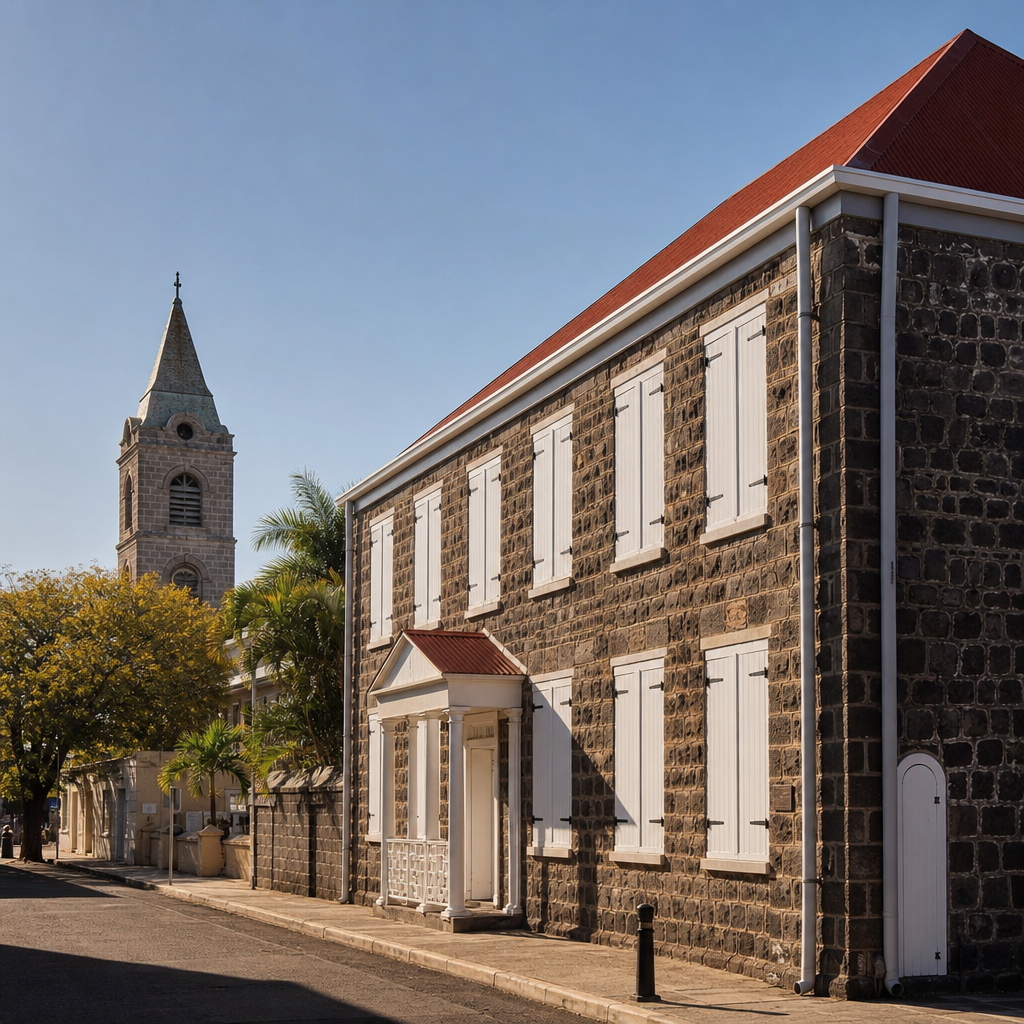
The island’s topography shaped design decisions at every scale. Elevated ridges offered artillery advantage, low coastal zones favored warehouses and ports, and inland valleys supported estates linked by roads for cane transport. Builders used locally available volcanic stone extensively, especially in foundations, walls, retaining structures, and industrial works. Imported brick, lime mortar, timber framing, slate, and metal fittings supplemented local material where budgets allowed. In my site visits, the physical weight of this geology is impossible to miss: thick masonry walls moderated heat, resisted attack, and endured storms better than lighter construction.
Climate also shaped style. Caribbean colonial architecture was never a simple copy of Britain or France. High ceilings, galleries, shutters, deep eaves, arcades, and cross ventilation were practical responses to heat and humidity. On Saint Kitts, after hurricanes or earthquakes, rebuilding often mixed metropolitan taste with local knowledge. That is why the island’s architecture is best understood as adaptation under pressure, not imitation.
Brimstone Hill Fortress and the military landscape
No architectural journey through Saint Kitts is complete without Brimstone Hill Fortress, the island’s defining military monument and a UNESCO World Heritage Site. Built principally in the seventeenth and eighteenth centuries, the fortress occupies a steep volcanic hill on the western side of the island and commands broad sea views. It is frequently called the Gibraltar of the West Indies, a phrase that can sound promotional, but in engineering terms the comparison points to its formidable defensive siting, layered walls, bastions, and integrated support structures.
What makes Brimstone Hill so instructive is that it is not just one building. It is a defensive complex with ramparts, cisterns, barracks, magazines, parade grounds, gun emplacements, and carefully controlled circulation. Military architecture here reflects standard European fortification principles adapted to Caribbean realities. Thick masonry absorbed bombardment better than thinner walls; water storage was essential during siege; elevated batteries extended surveillance and firing range. The labor behind the fortress included enslaved Africans, soldiers, and skilled artisans, and any interpretation that omits that fact is incomplete.
Other military sites around Saint Kitts deepen the story. Smaller batteries, coastal defenses, and lookout points formed a network protecting anchorages and warning of attack. Even where structures survive only in fragments, the placement still reveals colonial priorities: protect trade, secure ports, and defend sugar wealth. For visitors, Brimstone Hill provides the clearest overview, but the wider military landscape shows that fortification was an island system, not a single monument.
Basseterre, urban planning, and civic colonial design
Basseterre, the capital, offers the best lens on civic colonial architecture and urban planning. Founded by the French in the seventeenth century and later reshaped under British rule, the town developed around a grid and waterfront functions typical of colonial ports. Fires, earthquakes, and hurricanes repeatedly damaged the urban fabric, so present-day Basseterre is a layered town rather than a frozen museum. Yet the underlying colonial logic remains visible in street alignments, square formation, government precincts, and mixed commercial-residential building types.
Independence Square is a key example of how public space can carry difficult memory. Originally associated with market activity and, historically, with the slave trade, the square later evolved into a civic landmark framed by mature trees and surrounding buildings. Nearby churches, administrative buildings, and merchant properties reveal the interdependence of governance, commerce, and religion. The Co-Cathedral of the Immaculate Conception, Anglican churches, and surviving Georgian-influenced facades show how imported stylistic language was localized through materials and climate-sensitive detailing.
In Basseterre, look for practical colonial features rather than only ornament. Arcades shade pedestrians. Tall windows improve airflow. Ground floors often supported retail or storage, with living quarters above. Stone walls and timber upper sections reflect both seismic caution and construction economy. These details make the town a useful starting point for understanding how colonial architecture operated as everyday infrastructure, not just as elite display.
Plantation estates, sugar works, and domestic hierarchy
The plantation landscape is where Saint Kitts’ colonial architecture becomes most comprehensive, because estates were industrial, residential, agricultural, and coercive systems at once. A typical sugar estate included the great house, boiling or engine house, mill, curing house, storage buildings, stables, kitchens, water systems, and laborers’ quarters. On Saint Kitts, many estate ruins remain legible enough to show process flow: cane arrived from fields, was crushed in mills, juice moved to boiling houses, then sugar was cured, packed, and sent toward the coast. The architecture organized labor and reinforced hierarchy spatially.
The great house usually occupied elevated ground, benefiting from breezes, views, and symbolic authority. Service buildings sat nearby but clearly subordinate. Industrial structures were sturdier, often in stone, because fire, machinery vibration, and weather demanded durability. Workers’ villages were more constrained, frequently built with fewer resources and less permanence. Reading these sites on the ground makes the social order unmistakable. Distance, visibility, and access were designed.
| Estate element | Primary function | Typical architectural features | What it reveals |
|---|---|---|---|
| Great house | Planter residence and oversight | Elevated siting, verandahs, thick walls, formal rooms | Status, surveillance, climate adaptation |
| Mill | Cane crushing | Round stone tower or later engine building | Industrial investment and technology shifts |
| Boiling house | Sugar processing | Ventilated masonry, heavy floors, furnace areas | Scale of production and fire risk management |
| Curing house | Drying and storage | Robust walls, controlled openings | Export orientation and quality control |
| Workers’ quarters | Housing labor force | Small footprints, basic materials, repetitive layout | Inequality built into the landscape |
Several restored or interpreted estates on Saint Kitts help explain these patterns to modern audiences. Even when only ruins survive, estate archaeology can identify drainage systems, lime production, road alignments, and later technological transitions from wind to steam power. For a hub article, the essential point is this: colonial architecture on Saint Kitts cannot be separated from sugar production, and sugar architecture cannot be understood without confronting slavery and its aftermath.
Churches, cemeteries, and the architecture of belief
Churches and cemeteries provide a different but equally revealing layer of Saint Kitts’ colonial past. Anglican parish churches often served the planter establishment, while Catholic, Methodist, and Moravian sites trace different communities, missions, and social networks. Architecturally, these buildings range from restrained Georgian proportions to later Gothic Revival influences, but their most important features are often practical: buttressed walls, timber roofs designed for ventilation, and yards positioned as communal anchors.
Inside many colonial churches, plaques and memorial tablets document family names, military ranks, epidemics, and maritime losses. Outside, grave markers reveal class distinctions through material quality, inscription length, and location. I have found that church compounds often preserve a continuity missing elsewhere, because congregations maintained them long after plantations declined. They are among the best places to see how colonial society organized memory.
Religious buildings also complicate a simple elite narrative. Mission churches and schools sometimes became pathways to literacy and community formation for formerly enslaved people, even while operating inside colonial systems. As architecture, they show negotiation: imported liturgical form meeting local labor, local weather, and local congregations.
Preservation, adaptive reuse, and how to explore responsibly
Preservation on Saint Kitts involves constant tradeoffs among authenticity, safety, tourism, and limited funding. Salt air, tropical rainfall, vegetation growth, earthquakes, hurricanes, and deferred maintenance all accelerate decay. Masonry needs repointing with compatible lime mortar, not hard modern cement that traps moisture and damages historic stone. Timber needs pest management and ventilation. Interpretation needs accuracy, especially regarding enslavement and labor history. The best preservation work on the island respects original fabric while making sites understandable to the public.
Adaptive reuse can support survival when done carefully. Historic buildings can function as museums, inns, cultural venues, or administrative spaces without losing character, provided alterations remain reversible and documented. Poorly handled reuse, by contrast, strips interiors, removes context, and turns heritage into scenery. Travelers can help by choosing guided tours that explain both architecture and social history, paying site fees where they exist, and avoiding damage to ruins through climbing or souvenir collecting.
If you want a strong self-guided route, begin in Basseterre for civic and religious buildings, continue to former estate districts to understand sugar infrastructure, and end at Brimstone Hill for the military overview. Bring water, sun protection, and time to look closely at masonry joints, drainage, rooflines, and site orientation. On Saint Kitts, the details are the history. They show how colonial systems were built, contested, and eventually inherited by an independent nation that now decides what to preserve, reinterpret, and teach next.
Saint Kitts’ colonial past is best understood not as a list of old buildings, but as a connected architectural landscape that explains how the island developed. Forts reveal military rivalry and strategic geography. Basseterre shows how colonial powers organized trade, public space, and administration. Plantation estates expose the industrial logic of sugar and the unequal social order that sustained it. Churches and cemeteries preserve memory, belief, and community across centuries. Together, these places make the island an unusually powerful setting for historical interpretation.
The main benefit of approaching Saint Kitts through architecture is clarity. Buildings provide evidence that is visible, spatial, and difficult to abstract away. You can see climate adaptation in galleries and shutters, economic power in estate layouts, and coercion in the separation of great houses from workers’ quarters. You can also see continuity, because many communities still live around, worship in, or work beside colonial-era structures. That living context keeps the past relevant.
As a hub within Culture and History, this overview should lead naturally into deeper reading on forts, churches, estates, urban heritage, emancipation, and conservation across Saint Kitts. Use it as your map: start with the major sites, ask what each building was designed to do, then ask who built it, who benefited, and who paid the human cost. If you are planning a visit or building a research list, make Saint Kitts’ architecture your entry point and explore the related articles in this section next.
Frequently Asked Questions
Why is Saint Kitts considered such an important place for understanding colonial architecture in the Caribbean?
Saint Kitts holds a central place in the architectural history of the Caribbean because its built environment preserves the story of early European colonization with unusual clarity. As one of the earliest English and French settlement zones in the region, the island became a proving ground for competing imperial ambitions, plantation agriculture, military engineering, missionary activity, and port development. Those forces did not remain abstract political events; they were physically expressed in fortifications, road networks, town plans, churches, estate houses, sugar works, and service buildings that still shape the landscape today.
What makes Saint Kitts especially valuable is the way architecture there reveals multiple layers of power and adaptation across four centuries. Defensive structures were positioned to command sea routes and protect harbors. Plantation compounds were organized to control labor, production, and movement. Churches and public buildings signaled authority, religious influence, and civic order. Even ordinary materials such as volcanic stone, lime mortar, timber framing, and clay roofing reflect the island’s responses to climate, resource availability, hurricanes, and earthquakes. In other words, Saint Kitts is not important merely because old buildings survive; it is important because those buildings form a readable historical record of colonization, trade, conflict, and daily life.
For visitors and readers, this means an architectural journey through Saint Kitts is also a journey through the mechanics of empire. The island’s streets, walls, elevations, and ruins help explain how colonial society was organized, who held power, how wealth was generated, and how architecture adapted over time to both environmental realities and social change.
Which architectural landmarks best illustrate Saint Kitts’ colonial past?
The most iconic landmark is Brimstone Hill Fortress National Park, one of the finest surviving military complexes in the Americas. Built and expanded over many decades, the fortress demonstrates how military architecture was used to project power, defend territory, and monitor strategic sea lanes. Its massive stone ramparts, bastions, parade grounds, and elevated placement reveal both European engineering principles and the intensive labor required to construct such a site in the Caribbean. Brimstone Hill is often the starting point for understanding colonial Saint Kitts because it makes visible the island’s military importance in regional struggles between imperial powers.
Beyond the fortress, plantation landscapes are equally important. Great houses, sugar mills, boiling houses, storage structures, and workers’ quarters together show how plantation estates functioned as economic and social systems. These sites help explain the central role of sugar in shaping Saint Kitts’ architecture. The arrangement of buildings on an estate was rarely accidental; it reflected hierarchy, surveillance, production needs, and the realities of labor under colonial rule. Even when only ruins remain, the relationship between the mill, factory buildings, house, and surrounding fields tells an essential story.
Churches and civic buildings also deserve close attention. Anglican and other ecclesiastical structures often anchored communities and represented moral and institutional authority. Their proportions, masonry, bell towers, and siting within settlements reveal how religion and governance were woven into the colonial fabric. In Basseterre and other historic areas, street grids, commercial buildings, and public spaces show how ports and administrative centers developed over time. Together, these landmarks create a broad architectural map of colonial life, from defense and commerce to worship and domestic routine.
How did colonial architecture in Saint Kitts adapt to the island’s climate, geography, and natural hazards?
Colonial builders in Saint Kitts had to work within a demanding tropical environment, and that necessity shaped much of the island’s architectural character. Heat, humidity, heavy rainfall, strong sunlight, hurricanes, and seismic risks all influenced building design. As a result, many structures incorporated thick masonry walls for stability and temperature control, steeply pitched roofs to shed rain, deep verandas or galleries for shade, and elevated openings for ventilation. These features were practical responses to climate, but over time they also became part of the region’s recognizable architectural vocabulary.
Local geography mattered just as much. Saint Kitts’ volcanic terrain provided stone that could be used in forts, retaining walls, foundations, churches, and industrial buildings. Lime mortar and plaster helped protect masonry surfaces, while timber was often used for upper stories, roof framing, shutters, and interior elements. Builders learned to combine imported European ideas with local materials and construction knowledge. This blending produced forms that were neither strictly European nor entirely vernacular, but instead tailored to Caribbean conditions.
Settlement placement also reflected environmental adaptation. Fortifications occupied commanding high points and coastal defensive positions. Plantation estates were organized according to topography, access to arable land, prevailing winds, and transport routes. Town planning in lower coastal areas had to consider trade access while also managing drainage and exposure. When buildings were damaged by storms, fire, or earthquakes, reconstruction often introduced modifications, so the architecture of Saint Kitts became a record of repeated adaptation. Studying these details helps explain not just what colonial buildings looked like, but why they were built the way they were.
What can plantation houses and sugar estate ruins tell us about everyday life and social hierarchy in colonial Saint Kitts?
Plantation houses and sugar estate ruins are among the most revealing architectural sources for understanding colonial society because they expose the relationship between wealth, labor, and control. The great house was typically positioned to command views of the estate and symbolically reinforce the planter’s authority. Its size, materials, and decorative elements often contrasted sharply with the more utilitarian buildings around it. Nearby industrial structures such as mills, boiling houses, curing houses, cisterns, and storage areas reflected the economic engine of the plantation: sugar production on a large and demanding scale.
Just as important is the spatial arrangement of the estate. Distances between the great house, work areas, and laborers’ quarters can reveal how surveillance and hierarchy were built into the landscape. Architecture here is not simply aesthetic; it is evidence of a system that depended on unequal power and coerced labor. Ruins therefore should not be read romantically. They are valuable precisely because they help modern audiences understand how colonial prosperity was constructed materially and socially, often through violence, exploitation, and rigid social ordering.
At the same time, estate sites also offer glimpses of daily life beyond elite households. Kitchens, wash areas, service yards, workshops, roads, boundary walls, and water systems can all reveal routines of cooking, maintenance, transport, and production. When interpreted carefully, these places help reconstruct the lives of the many people who lived and worked on plantations, not just the owners. In that sense, plantation architecture in Saint Kitts is one of the clearest ways to read the island’s colonial past in human terms.
How should travelers approach an architectural tour of Saint Kitts to get the deepest historical understanding?
The best approach is to treat the island as a connected historical landscape rather than a collection of isolated monuments. Start with major defensive and civic sites such as Brimstone Hill Fortress and historic urban areas, because they establish the broader context of war, trade, governance, and imperial rivalry. Then move outward to plantation zones, churches, roads, bridges, and rural ruins, where the economic and social foundations of colonial life become clearer. Looking at these places together helps visitors understand how military defense, commerce, agriculture, and settlement planning worked as parts of one larger colonial system.
It is also important to pay attention to details that are easy to overlook. Street alignments, building orientation, window placement, wall thickness, construction materials, drainage channels, staircases, and outbuildings can all carry historical meaning. Ask why a structure sits where it does, who built it, who used it, and what forms of labor sustained it. A church may speak to religious authority and community formation; a warehouse may reflect trade networks; a road may indicate how plantations were connected to ports. The richest architectural journeys come from reading these physical clues with curiosity and historical awareness.
Finally, travelers should approach Saint Kitts’ colonial architecture with both admiration and critical perspective. Many sites are visually impressive, but they also belong to histories of conquest, enslavement, inequality, and resistance. A deeper understanding comes from acknowledging both the craftsmanship of the structures and the systems that produced them. Guided tours, heritage interpretation, museum resources, and local historical expertise can greatly enrich the experience. When viewed this way, an architectural tour of Saint Kitts becomes far more than sightseeing; it becomes a meaningful way to engage with the island’s layered past.