Saint Kitts and the sugar trade are inseparable subjects because sugar shaped the island’s land, labor system, economy, politics, architecture, and memory for more than three centuries. On Saint Kitts, often called the mother colony of the British West Indies, sugar was not simply an export crop. It was the organizing force behind settlement patterns, plantation ownership, maritime commerce, imperial rivalry, and social hierarchy. To understand the island’s history, readers need to understand how cane cultivation expanded, how mills and boiling houses worked, how enslaved Africans were forced into production, and why the industry later declined. The sugar trade connected a small Caribbean island to London financiers, Liverpool merchants, African slave traders, neighboring islands, and North American markets. Its effects remain visible in surviving estates, village names, railway lines, and family histories. This history matters because it explains both Saint Kitts’ colonial wealth and its enduring inequalities. It also provides the context for modern heritage tourism, land use debates, and national identity. When people ask what built Saint Kitts, the direct answer is sugar, but that answer is incomplete without the human cost, environmental change, and political consequences that accompanied it from the seventeenth century into the twenty-first.
How Sugar Took Root on Saint Kitts
European settlement on Saint Kitts began in the early seventeenth century, with English and French colonists establishing footholds on an island already inhabited by Indigenous Kalinago people. Early colonists experimented with tobacco, indigo, and other crops, but sugar cane quickly proved more profitable. By the mid-1600s, as planters adopted methods refined in Portuguese Brazil and elsewhere in the Caribbean, Saint Kitts shifted toward plantation agriculture. Cane required large tracts of land, substantial capital, specialized equipment, and a dependable labor force. That combination favored wealthy planters and accelerated the concentration of property. Small farmers often sold out, moved inland, or left the island.
The appeal of sugar was straightforward. European demand was rising sharply as sugar moved from luxury spice to everyday sweetener. Profit margins could be high when yields were strong and shipping lanes secure. Saint Kitts had fertile volcanic soils, a warm climate, and rainfall patterns suitable for cane. Planters divided estates into cane fields, pasture, provision grounds, factory zones, and housing areas. Once the plantation model took hold, nearly every commercial decision on the island revolved around sugar production schedules, shipping timetables, and credit arrangements tied to future harvests.
In practical terms, the transition to sugar also changed infrastructure. Roads linked estates to coastal landing places. Windmills and animal mills appeared across the countryside. Warehouses, wharves, curing houses, and merchant offices multiplied around Basseterre and other points of export. From the beginning, Saint Kitts’ sugar trade was international. Planters relied on imported machinery, barrels, food supplies, clothing, and enslaved laborers, then shipped raw or partially refined sugar and molasses outward. The island became a node in a wider Atlantic system rather than a self-contained economy.
The Plantation System and Forced Labor
No history of Saint Kitts and the sugar trade is credible without centering slavery. Sugar plantations were labor-intensive operations, and planters met that demand through the transatlantic slave trade. Enslaved Africans cleared land, planted cane, weeded fields, cut stalks, transported harvests, fed mills, boiled juice, tended livestock, repaired buildings, and performed domestic labor. During crop time, work could continue around the clock because cane had to be processed quickly after cutting. The entire plantation operated on coercion, surveillance, punishment, and the legal denial of freedom.
On estates I have studied through maps, ruins, and records, the built landscape still reflects this system. Great houses stood apart and uphill where possible, while enslaved villages were arranged for control rather than comfort. Boiling houses were hot, dangerous spaces with constant risk of burns and injury. Skilled enslaved workers such as sugar boilers, coopers, masons, and drivers held crucial knowledge, yet that expertise never translated into autonomy under slavery. Mortality rates were high, and reproduction often did not keep pace with deaths, which is one reason imported captives remained central to plantation labor for long periods.
Saint Kitts followed patterns seen across the British Caribbean, but local conditions mattered. Estates varied in size, rainfall, and access to ports, and managers adjusted labor routines accordingly. Still, the fundamentals were consistent: maximum extraction from land and people. Enslaved communities resisted in many ways, including work slowdowns, sabotage, flight, preservation of cultural practices, and occasional revolt. Their resistance is part of the sugar trade’s history, not a side note. Sugar profits existed only because violence enforced production.
How the Sugar Trade Worked
The sugar trade began in the field but depended on a carefully staged processing chain. Cane was planted in setts, grown for many months, and cut when the sugar content peaked. Workers hauled stalks to mills where rollers crushed them to extract juice. The juice passed into clarifying vats, then through a series of coppers in the boiling house where heat concentrated it into syrup. From there it moved into curing pots or hogsheads so crystals could separate from molasses. The resulting raw sugar was packed for shipment, often still containing impurities that would be refined elsewhere.
Merchants advanced credit to planters before harvest, sometimes secured against future crops. That credit financed supplies, machinery, imported provisions, and debt servicing. In return, merchants gained strong influence over shipping and sales. Insurance, freight charges, brokerage fees, and interest all reduced planter margins. A bumper crop could still leave an estate in financial trouble if prices fell in London or if storms disrupted export schedules. That volatility is why plantation wealth looked impressive from the outside yet often sat on a foundation of debt.
| Stage | Main Activity | Key Risk | Trade Impact |
|---|---|---|---|
| Cultivation | Planting, weeding, and growing cane | Drought, pests, soil exhaustion | Determined future output and quality |
| Harvest | Cutting and hauling cane rapidly | Labor shortages, rain delays | Affected juice quality and recovery rate |
| Milling | Crushing cane to extract juice | Mechanical failure, low extraction | Reduced sugar yield per acre |
| Boiling and curing | Concentrating juice and crystallizing sugar | Fire, spoilage, poor boiling technique | Influenced grade and market price |
| Shipping and sale | Loading hogsheads for export | Storms, war, price swings | Determined final revenue and debt repayment |
Saint Kitts exported sugar, molasses, and later rum, but sugar remained the flagship commodity. Trade routes linked the island to Britain above all, though North America and inter-island commerce were also important. Molasses could be distilled locally or shipped for rum production elsewhere. The byproducts of sugar increased the value of every acre under cane and reinforced the plantation economy’s grip on the island.
War, Empire, and Commercial Power
Saint Kitts was strategically valuable because profitable sugar islands attracted imperial competition. English and French settlers both claimed parts of the island in the seventeenth century, and repeated wars disrupted cultivation, damaged estates, and shifted political control. The island changed hands more than once before Britain secured permanent possession in the eighteenth century. Each military contest threatened the sugar trade through blockades, raids, confiscations, and uncertainty in shipping. Yet the same profitability that made sugar vulnerable to war also made the island worth defending at high cost.
Once British control stabilized, Saint Kitts benefited from imperial trade networks, naval protection, and access to metropolitan markets. Protection was never absolute, and wartime freight costs could surge, but empire created legal and commercial frameworks that favored plantation exports. Preferences in British markets, merchant houses in London and Glasgow, and established insurance systems all helped sustain the trade. Basseterre’s growth as a port town reflected this integration into imperial commerce.
Political power on the island tracked sugar ownership. Planters and merchants influenced legislation, taxation, policing, and land policy. Public institutions often served plantation interests first. That pattern helps explain why social reform was limited for so long and why emancipation, when it came, did not immediately redistribute opportunity. The wealth generated by sugar did not circulate evenly; it concentrated in estates, mercantile firms, and metropolitan networks.
Emancipation, Labor Change, and Long Decline
The abolition of the British slave trade in 1807 and emancipation in the 1830s transformed the legal structure of labor but did not end the sugar economy. Formerly enslaved people sought wages, land, family stability, and freedom from plantation discipline. Planters, determined to preserve cane output, used apprenticeship, contract controls, and limited access to land to keep labor tied to estates. The post-emancipation period was therefore not a simple break. It was a contested transition in which freedom expanded while economic dependence often persisted.
Over the nineteenth century, Saint Kitts faced mounting pressure from global competition. Beet sugar in Europe, larger and more mechanized producers elsewhere, falling prices, hurricanes, plant disease, and chronic indebtedness all weakened profitability. Some estates modernized with steam power and centralized factories, but modernization required capital many planters lacked. The sugar trade survived by adapting, consolidating, and leaning on government support, yet the long trend was downward.
By the twentieth century, centralization became more pronounced. The Saint Kitts Sugar Manufacturing Corporation eventually played a major role in processing cane, and the island’s narrow-gauge railway, completed in the early twentieth century, helped move harvests from estates to the central factory. That railway later became one of the clearest physical reminders of the sugar era. Even so, world market conditions remained difficult. Production costs on a small island were high, and protected prices could not last forever.
The industry formally ended in 2005 when the government closed the sugar sector after years of losses. That decision marked the end of commercial sugar production on Saint Kitts, but not the end of its historical influence. Villages, labor patterns, property boundaries, and family stories still bear its imprint.
Culture, Landscape, and Memory
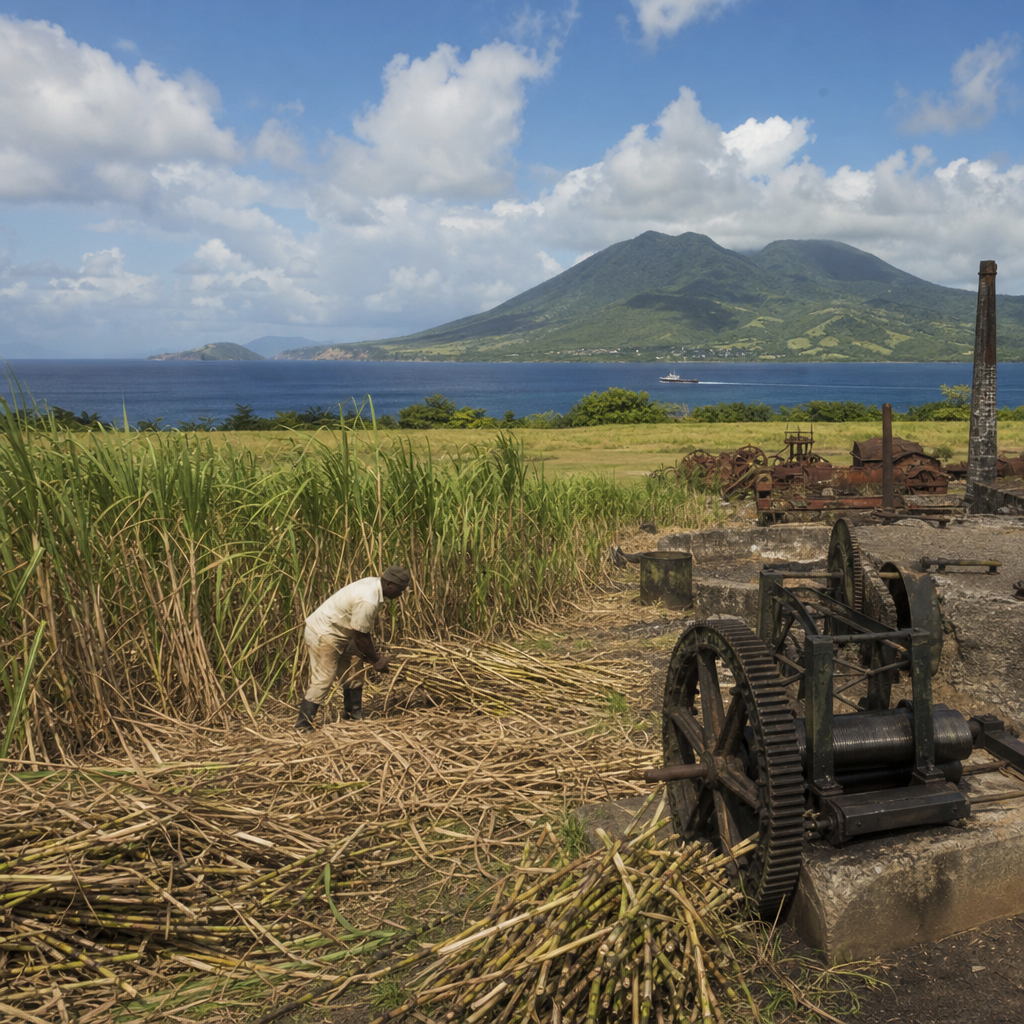
Today, the history of Saint Kitts and the sugar trade survives in estate ruins, chimneys, mill towers, stone aqueducts, and place names scattered across the island. These sites are not decorative remnants. They are evidence of how thoroughly sugar reorganized the landscape. Cane cultivation reduced forest cover, reshaped drainage, and promoted monoculture across large areas. At the same time, enslaved and later freed communities created enduring cultural forms under oppressive conditions, blending African, European, and Caribbean influences in foodways, language, religion, and music.
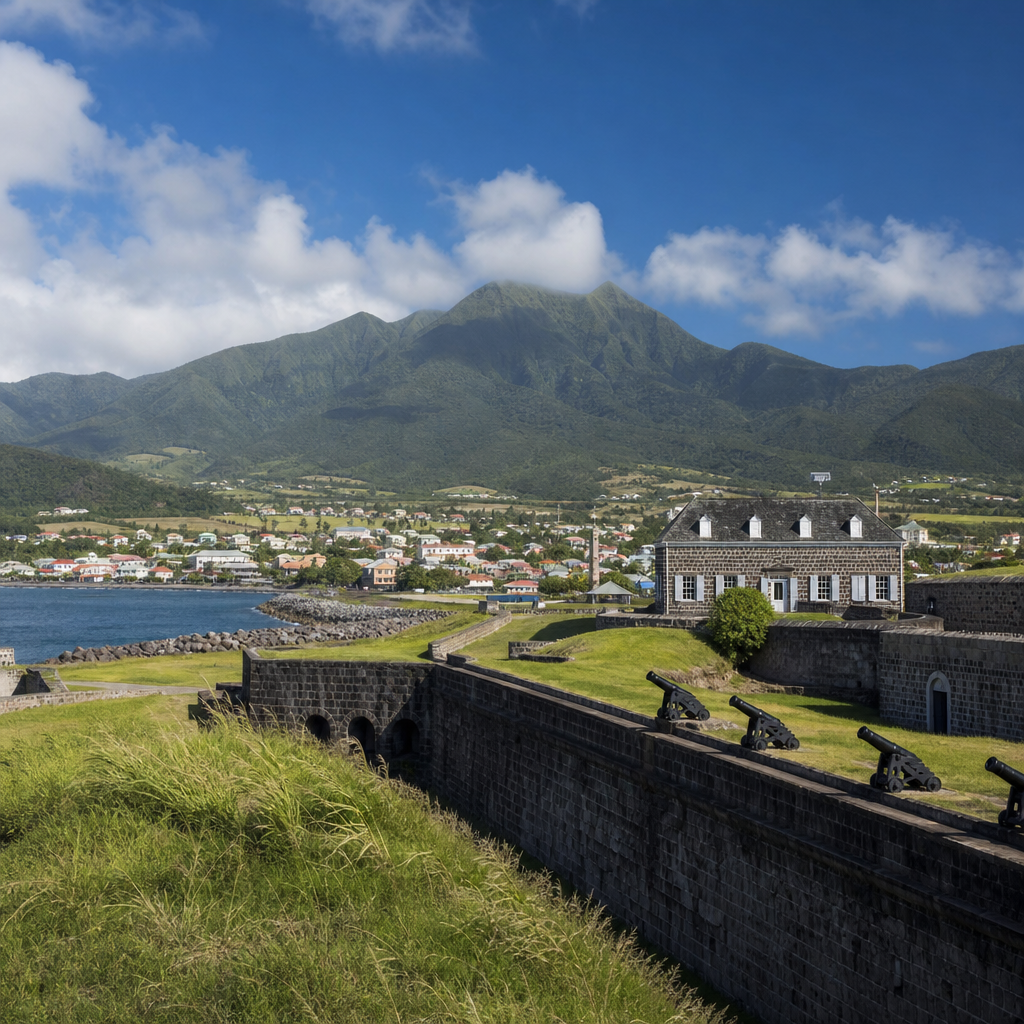
Heritage interpretation on Saint Kitts increasingly treats sugar history with greater honesty than older plantation narratives did. Brimstone Hill Fortress, while primarily a military site, cannot be understood apart from the sugar wealth that justified its defense. Former estates and railway heritage tours also offer entry points into the island’s past, though the quality of interpretation varies. The best public history connects industrial processes with lived experience, explaining not only how sugar was made but who suffered, who profited, and how descendants continue to carry that legacy.
For a hub page under Culture and History, the key point is that sugar links nearly every miscellaneous historical thread on Saint Kitts. It connects Indigenous displacement, colonial rivalry, slavery, emancipation, migration, transport, trade, architecture, and tourism. Anyone exploring family genealogy, estate archaeology, Basseterre’s mercantile development, or the island’s political evolution will encounter sugar sooner rather than later. It is the central archive of Saint Kitts in economic form.
Saint Kitts was built, enriched, divided, and ultimately transformed by the sugar trade. Sugar made the island strategically important, financed estates and ports, and tied local life to Atlantic markets, but it did so through slavery, land concentration, and long-lasting inequality. The clearest way to read the island’s past is to follow sugar from field to mill to ship and then trace its effects on labor, law, war, environment, and memory. That approach reveals both the scale of the industry and the people whose forced work sustained it. For readers using this page as a hub within Culture and History, sugar is the thread that connects seemingly separate topics across Saint Kitts’ past. Explore the related estate histories, slavery and emancipation stories, heritage sites, and transport records next, because each one adds another layer to the island’s most consequential historical industry.
Frequently Asked Questions
Why was sugar so important to the history of Saint Kitts?
Sugar was central to Saint Kitts because it shaped nearly every part of the island’s development from the seventeenth century onward. Once planters realized that sugar cane could generate far greater profits than earlier crops such as tobacco, the island’s economy was reorganized around plantation agriculture. Landholding patterns changed, with fertile acreage increasingly consolidated into large estates designed for cane cultivation, milling, boiling, and export. Roads, ports, warehouses, and shipping networks were expanded to serve the sugar trade, and commercial ties with Britain and other Atlantic markets deepened.
Its importance went far beyond economics. Sugar influenced who held power, how wealth was distributed, and how society was structured. A small planter and merchant elite accumulated land and political influence, while the labor system became increasingly dependent on enslaved Africans, whose forced labor sustained the entire plantation economy. This meant that sugar was directly linked to the island’s demography, social hierarchy, and legal order. In practical terms, sugar determined where people lived, how estates were built, what kinds of labor were demanded, and which institutions mattered most.
Over time, sugar also became a force in Saint Kitts’s cultural memory and physical landscape. Windmills, estate houses, boiling houses, and cane fields became defining features of the island. Even after the sugar industry declined, its legacy remained visible in settlement patterns, class divisions, family histories, and public memory. That is why sugar is not just one topic in the history of Saint Kitts; it is one of the main frameworks through which the island’s past can be understood.
How did the sugar trade transform land, labor, and everyday life on Saint Kitts?
The rise of sugar transformed Saint Kitts at the most basic level: the land itself was reorganized to support plantation production. Large tracts were cleared and planted with cane, and estate infrastructure was built to process the crop quickly after harvest. Sugar required a coordinated agricultural and industrial system, so plantations included fields, mills, curing houses, boiling houses, storage areas, animal works, and transport routes connecting estates to coastal shipping points. This changed the island’s geography, as the best land was absorbed into sugar estates and rural life came to revolve around the rhythms of planting, cutting, grinding, and export.
The labor system changed even more dramatically. Sugar production was labor-intensive, physically punishing, and continuous. To meet these demands, plantation owners relied heavily on the transatlantic slave trade, importing enslaved Africans in large numbers. Enslaved men, women, and children were forced to perform agricultural labor, factory work, domestic service, skilled trades, and transport tasks under harsh discipline. Daily life on plantations was structured by coercion, surveillance, long hours, and the constant threat of punishment. Sugar was profitable in part because it extracted maximum labor while denying workers freedom, wages, and legal rights.
For the free population, everyday life was also shaped by sugar. Merchants, ship captains, estate managers, overseers, artisans, and officials all depended in some way on the plantation economy. Markets, port activity, taxation, and local politics were tied to the success or failure of sugar harvests. Food supplies, imported goods, and credit networks often rose and fell with the industry. In this sense, sugar was not just a commodity produced on Saint Kitts; it was the system around which ordinary life, social expectations, and economic survival were organized.
What role did slavery play in Saint Kitts’s sugar economy?
Slavery was the foundation of Saint Kitts’s sugar economy. The plantation system depended on large amounts of disciplined labor, and colonial planters turned to enslaved Africans to supply that labor on a massive scale. Sugar cultivation involved clearing land, planting cane, weeding fields, cutting the crop, transporting cane to mills, operating machinery, boiling juice, curing sugar, and handling byproducts such as molasses and rum. These processes were exhausting and often dangerous, and plantation owners used slavery to ensure a labor force they could control completely and exploit intensively.
Enslaved people were not simply workers within the sugar economy; they were treated by the colonial system as property and capital assets. Their labor generated planter wealth, financed estate expansion, and supported the wider Atlantic trade system linking Saint Kitts to Britain, Africa, and the Americas. Laws and institutions were designed to protect slaveholders and suppress resistance. Families were vulnerable to separation, mobility was restricted, and violence was built into the structure of plantation life. The prosperity associated with sugar on Saint Kitts cannot be understood honestly without recognizing that it was produced through forced labor and profound human suffering.
At the same time, enslaved people were never passive. They resisted in many ways, including work slowdowns, sabotage, escape, cultural survival, and open rebellion. They created families and communities under brutal conditions and preserved beliefs, skills, and traditions that shaped the island’s society. After emancipation, the legacies of slavery remained deeply embedded in land ownership, wages, labor relations, and social inequality. Any serious discussion of Saint Kitts and the sugar trade must therefore place slavery at the center, not the margins, of the story.
How did the sugar trade affect Saint Kitts’s politics and its place in the British Empire?
The sugar trade gave Saint Kitts strategic and economic importance within the British Empire. Because sugar was one of the most valuable commodities in the Atlantic world, islands capable of producing it were fiercely contested. Saint Kitts, as an early and significant British colony in the Caribbean, became part of a larger imperial system focused on protecting plantation wealth, securing trade routes, and defending profitable territories from rival European powers, especially France. Military conflict, diplomacy, taxation, and colonial administration were all influenced by the need to preserve sugar production and export.
Locally, the sugar economy shaped politics by concentrating power in the hands of planters and allied merchants. Those who controlled estates often also held influence in colonial assemblies, legal institutions, and administrative offices. Political decisions about trade, labor laws, land policy, militia organization, and infrastructure were often made with planter interests in mind. This meant that governance on Saint Kitts was deeply connected to the priorities of the plantation class, and public policy frequently served the needs of sugar over the welfare of the broader population.
The island’s place in imperial trade networks also tied it closely to British commercial regulation. Markets, shipping arrangements, and credit systems were shaped by imperial preferences and restrictions. When sugar prices rose, Saint Kitts could prosper; when wars disrupted commerce or global competition intensified, the island could suffer. In this way, Saint Kitts was never isolated. Its fortunes were linked to imperial demand, overseas finance, naval power, and the wider Atlantic economy. The sugar trade made the island both valuable and vulnerable within that system.
What is the legacy of the sugar industry in Saint Kitts today?
The legacy of sugar in Saint Kitts is still visible in the island’s landscape, institutions, and collective memory. Old plantation estates, stone windmills, factory ruins, estate houses, and former cane lands remain physical reminders of centuries during which sugar dominated the island. Many roads, district boundaries, and settlement patterns reflect the earlier organization of plantation property. Even where cane is no longer grown, the arrangement of land and the built environment still tell the story of a society shaped for generations by export agriculture.
That legacy is also social and political. Sugar helped create long-lasting inequalities in land ownership, wealth, and opportunity. The end of slavery did not erase the structures that plantation society had established, and many post-emancipation struggles over labor, wages, and access to land were rooted in the old sugar economy. Modern debates about heritage, identity, reparative justice, and historical memory often return to the question of how to interpret and acknowledge this past. For many people, the story of sugar is inseparable from the story of enslavement, survival, resistance, and nation-building.
At the same time, sugar is part of Saint Kitts’s historical identity in a broader sense. It explains why the island became so important in the colonial Caribbean, why its society developed as it did, and why certain historical tensions persisted for so long. Museums, heritage sites, academic research, and public commemorations increasingly present sugar not as a nostalgic symbol of plantation wealth, but as a complex legacy involving exploitation, economic transformation, and cultural endurance. Understanding that legacy helps readers see Saint Kitts not just as a former sugar island, but as a society still engaging with the consequences of that history.