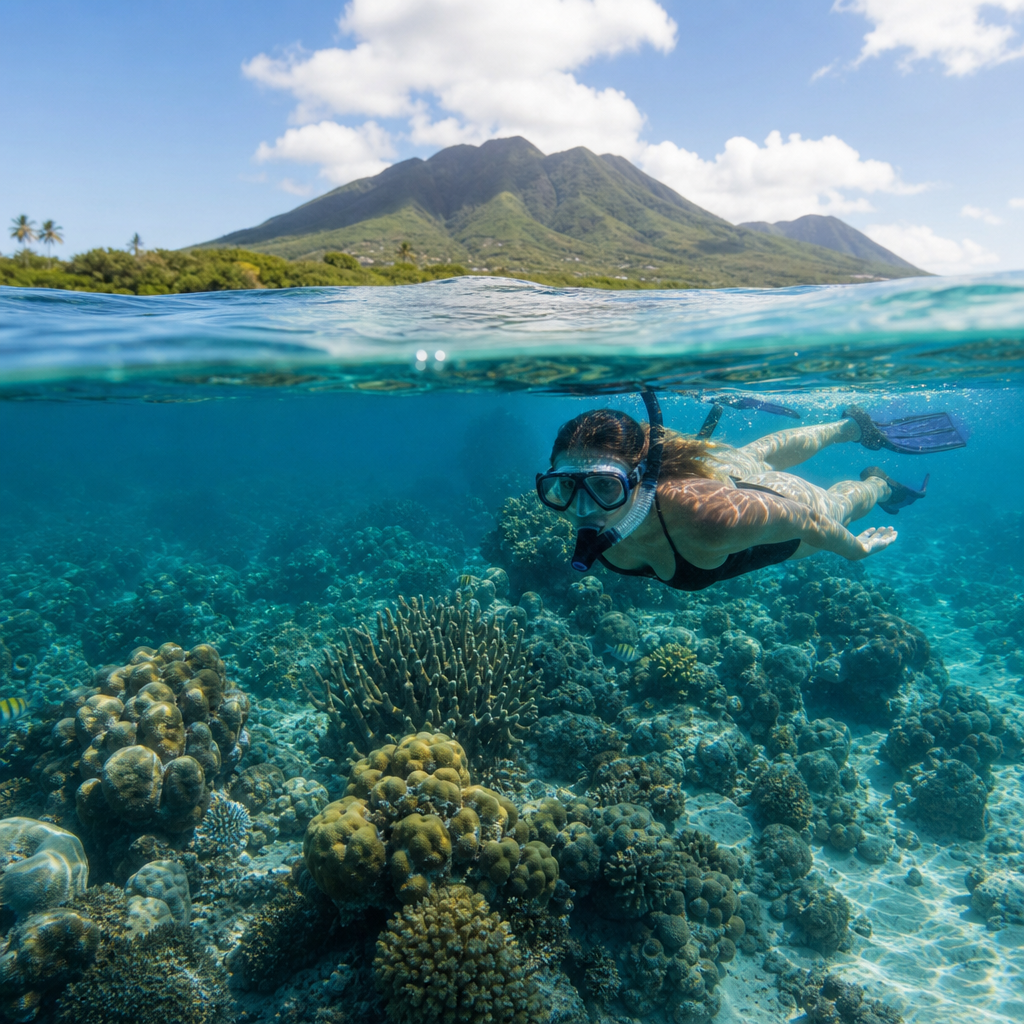
Nevis is often introduced through its volcanic peak, plantation inns, and quiet beaches, yet the island’s most fragile treasure lies just offshore in the coral reefs of Nevis. These reefs form living underwater structures built by tiny coral polyps, sheltering fish, sea turtles, spiny lobsters, sea fans, and countless invertebrates that shape the island’s marine food web. For travelers, they create some of the most rewarding snorkeling in the eastern Caribbean. For residents, fishers, dive operators, and conservation groups, they are natural infrastructure that supports tourism, shoreline stability, biodiversity, and local identity. Understanding the coral reefs of Nevis means looking at both sides of that equation: how to enjoy them responsibly and how to protect them as ocean conditions become more difficult.
When people ask what makes a reef healthy, I explain it in practical terms. A healthy reef usually has strong live coral cover, varied reef fish populations, low levels of disease, and water clear enough for sunlight to reach the corals’ symbiotic algae. Around Nevis, reef habitats include shallow fringing reefs, patch reefs, sandy channels, seagrass meadows, and rocky areas created by the island’s volcanic geology. Those habitats are linked. Juvenile fish often shelter in seagrass before moving to coral structures, and reef predators help maintain ecological balance by controlling smaller species. Because these systems are connected, damage in one area can reduce resilience in another.
This matters now because Caribbean reefs face overlapping pressures. Marine heat waves can trigger coral bleaching, a stress response in which corals expel the algae that provide much of their energy. Strong storms can break reef structures. Sediment runoff from land can smother corals and reduce visibility. Unsustainable fishing can alter food chains. Sunscreen chemicals, anchor damage, trampling, and careless snorkeling add smaller but cumulative impacts. Nevis still offers memorable reef experiences, but the best way to keep them available is to treat snorkeling and preservation as part of the same story. This hub article explains where reef life thrives around the island, what snorkelers can expect, what threats are most significant, and which practices genuinely help protect coral reefs over time.
Where Nevis’s reef ecosystems are found
Nevis is a small island, but its nearshore marine environments are surprisingly varied. Much of the accessible snorkeling is found along the leeward coast, where calmer water and beach access make entry easier for beginners. Pinney’s Beach is best known for its resorts and sunsets, yet nearby waters can reveal juvenile fish, sandy-bottom species, and scattered coral formations when conditions are good. Oualie Beach, on the northwestern side, is often a practical launching point for boat trips to more developed reef areas. Cades Bay and other western and southwestern stretches may offer clearer structure, especially where rocky substrate allows coral colonies and sponges to establish more firmly.
Offshore, patch reefs and deeper coral formations support a broader range of species than many casual visitors expect. Brain corals, elkhorn remnants in suitable shallows, star corals, sea rods, and sea fans can all appear depending on depth, exposure, and recent storm history. Reef fish commonly seen around Nevis include blue tangs, sergeant majors, parrotfish, wrasses, trumpetfish, grunts, damselfish, and occasional angelfish. Green turtles and hawksbill turtles may feed in nearby seagrass or move across reef edges. Southern stingrays, eagle rays, and octopus are less predictable but not unusual in healthy mixed habitat. Snorkelers who look slowly and keep a respectful distance usually see far more than those who rush.
One of the biggest misconceptions about Caribbean reefs is that every excellent snorkeling spot looks dramatic from shore. In reality, some of Nevis’s best marine life appears where the surface seems quiet and unremarkable. Slightly darker patches may indicate coral heads. Sand channels can host garden eels, flounders, and juvenile fish. Transition zones between seagrass and reef often hold the highest activity because predators and herbivores move through them constantly. This is why local guides matter. They know how wind direction, tide, swell, and recent rainfall affect visibility and current, and they understand which sites suit first-time snorkelers versus confident swimmers.
What snorkeling in Nevis is really like
Snorkeling in Nevis is generally defined by warm water, manageable depths, and a slower pace than busier Caribbean destinations. Water temperatures typically remain comfortable year-round, often hovering in the upper seventies to mid-eighties Fahrenheit depending on the season. Visibility can be excellent during settled weather, though it changes quickly after heavy rain or rough seas. Most visitors do best in the morning, when winds are lighter, boat traffic is lower, and surface chop has not yet built. I always advise travelers to think less about checking off a famous site and more about matching conditions to their skill level on that day.
Beginners should look for protected entries with minimal surf, use a flotation vest if they are not fully comfortable in open water, and spend the first few minutes adjusting mask fit and breathing rhythm. Experienced snorkelers can cover more ground, but they should still conserve energy and avoid pushing beyond the support range of a buddy or guide. Fins improve efficiency and reduce the temptation to stand, which is critical because a single misplaced foot can crush living coral or stir sediment over fragile colonies. A rash guard or sun shirt is often better than relying on heavy sunscreen, especially when trying to reduce chemical exposure in the water.
Wildlife encounters are usually subtle rather than theatrical, and that is part of Nevis’s appeal. You may notice a school of silversides flashing over a coral head, then realize a trumpetfish is using the school as cover to hunt. You may spot parrotfish scraping algae from dead coral surfaces, a process essential to reef health because unchecked algae can overwhelm coral recruits. If a turtle appears, the best response is to float quietly and let it choose the distance. Chasing wildlife changes behavior and increases stress. Good snorkeling is not measured by how close you get, but by how little your presence alters the scene.
| Area | Typical Conditions | Best For | Common Marine Life |
|---|---|---|---|
| Pinney’s Beach vicinity | Easy shore access, variable reef structure, calmer on good weather days | Beginners and casual snorkelers | Sergeant majors, juvenile reef fish, rays over sand |
| Oualie Beach launch sites | Useful boat access to nearby reefs, often guided | Travelers wanting support and site selection | Grunts, wrasses, turtles, mixed coral heads |
| Cades Bay and west coast patches | Potentially clearer structure, conditions depend on swell and wind | Confident snorkelers and small guided groups | Parrotfish, angelfish, sea fans, sponges |
| Seagrass and reef transition zones | Shallow mixed habitat, easy to overlook from surface | Patient observers and wildlife photographers | Juvenile fish, conch, turtle feeding areas |
How coral reefs support Nevis beyond tourism
Coral reefs are often marketed as beautiful attractions, but their real value is broader and more measurable. Reefs dissipate wave energy, helping reduce coastal erosion and storm damage. For a small island state, that protective function matters economically as much as ecologically. Reef-associated fisheries support livelihoods directly through catch and indirectly through food security. Tourism businesses, from boat operators to hotels and restaurants, benefit when reefs remain attractive and biologically rich. In practical destination planning, healthy reefs raise the quality of the visitor experience while lowering vulnerability along parts of the coast.
The biodiversity function is equally important. Coral colonies create three-dimensional habitat, which is why reef complexity often predicts fish abundance better than simple area does. Herbivores such as parrotfish and surgeonfish keep algae in check. Predators shape prey behavior and maintain balance. Invertebrates recycle nutrients and occupy crevices that would otherwise stay empty. Seagrasses and mangrove-linked nursery functions, where present in the broader marine landscape, increase recruitment to reef zones. Once structural coral is lost, that complexity is hard to rebuild quickly. Even if fish remain visible for a while, the system becomes less stable and less productive.
There is also a cultural dimension that visitors sometimes miss. On islands like Nevis, the sea is not separate from community life. It influences local cuisine, recreation, weather awareness, and family memory. I have found that conservation efforts gain traction when reefs are discussed not only as scientific assets but also as places people know personally. A reef where someone learned to swim, caught fish with a parent, or guided guests for twenty years carries social meaning. Preservation succeeds when policy, tourism, and local stewardship align around that lived connection instead of treating reefs as scenery alone.
Main threats to the coral reefs of Nevis
The greatest long-term threat is warming water. Elevated sea temperatures can cause bleaching, and repeated bleaching reduces coral growth, reproduction, and disease resistance. Across the Caribbean, marine heat stress events have become more frequent, leaving less recovery time between disturbances. Coral disease has also become more serious in the region, with outbreaks capable of killing large colonies quickly. Because coral growth is slow, especially for massive species, losses that happen in one hot season may take decades to reverse, if they reverse at all.
Local pressures intensify those climate stresses. Sediment runoff after land clearing, road work, or heavy rainfall can reduce light and settle on corals. Nutrient pollution from wastewater or poorly managed drainage can fuel algal growth, especially when herbivore populations are low. Physical damage from anchors, discarded fishing gear, or visitors standing on coral is immediate and entirely avoidable. Overfishing creates a subtler problem. Removing too many herbivorous fish allows algae to expand, while reducing predators can alter reef behavior in ways that weaken ecological resilience. Good management therefore has to combine climate adaptation with better local controls.
Storms are a natural part of Caribbean ecology, but stronger storms hitting already stressed reefs create compounding effects. Branching corals can snap, sediment can shift onto colonies, and recovery can be interrupted by post-storm runoff. Invasive species and marine debris add further strain. None of these pressures means Nevis’s reefs are beyond help. It means preservation must focus on resilience: protecting herbivores, reducing pollution, guiding tourism practices, and monitoring reef condition consistently enough to respond before decline becomes severe.
Best practices for responsible snorkeling and reef preservation
The simplest preservation rule is also the most important: never touch, stand on, kick, collect, or chase anything on the reef. Coral may look like rock, but it is living tissue over a calcium carbonate skeleton. Even light contact can remove protective mucus, break delicate growth, or introduce pathogens. Maintain horizontal body position, keep fins clear of the bottom, and stay aware of surge so you do not drift into coral heads. If you are carrying a camera, secure it close to your body rather than extending yourself into confined spaces.
Use reef-safer habits on land and in the water. Wear protective clothing to reduce sunscreen demand, and if sunscreen is needed, choose products that avoid ingredients commonly linked to marine harm, while recognizing that no sunscreen alone solves reef impacts. Book with operators who use moorings instead of anchors where available, give pre-snorkel briefings, cap group size, and intervene when guests behave carelessly. Ask whether guides adjust site choice for weather, wildlife sensitivity, and snorkeler ability. Responsible operators usually answer these questions clearly because they already work that way.
Visitors can contribute beyond a single excursion. Report wildlife harassment, avoid buying souvenirs made from coral or turtle shell, support businesses involved in coastal cleanups or education, and learn basic fish and coral identification before entering the water. Small actions matter because reef damage is cumulative, and so is reef protection. If enough travelers choose guided, low-impact experiences and enough local stakeholders back monitoring, water quality improvement, and fisheries management, coral reefs of Nevis retain the resilience they need to survive a harsher century.
Planning your Nevis reef experience and exploring related wildlife topics
If your goal is to experience the coral reefs of Nevis well, plan around weather, guidance, and realistic expectations. The best snorkeling day is usually not the day with the fullest itinerary but the one with calm seas, patient observation, and enough time to enter slowly. Bring a properly fitted mask, anti-fog solution, hydration, and a dry bag. If you are prone to seasickness, choose shore snorkeling or take medication early. Families should prioritize shallow sites and flotation support. Photographers should remember that clear water, stable buoyancy, and morning light improve images more than expensive equipment does.
As a hub within a broader Nature and Wildlife section, this topic also connects to the rest of Nevis’s natural world. Reef outings often overlap with turtle watching ethics, seabird observation from boats, coastal geology, beach ecology, and the relationship between upland rainfall and marine water quality. Travelers interested in miscellaneous wildlife subjects should use coral reefs as an entry point rather than an isolated activity. Understanding how mangroves, seagrass, beaches, reefs, and human communities interact makes every nature experience on Nevis more meaningful and more responsible.
The central lesson is straightforward. The coral reefs of Nevis are not just places to snorkel; they are living systems that protect coastlines, support marine life, and deepen the island’s appeal for anyone who values nature. Enjoy them with care, choose operators and habits that reduce harm, and treat every reef encounter as a chance to preserve what you came to see. If you are planning a visit, make snorkeling part of a wider commitment to respectful wildlife travel and support the local efforts keeping Nevis’s underwater heritage alive.
Frequently Asked Questions
What makes the coral reefs of Nevis so important?
The coral reefs of Nevis are important because they are far more than scenic underwater attractions. They are living ecosystems built by coral polyps over long periods of time, creating complex structures that provide food, shelter, and breeding grounds for a wide range of marine life. Around Nevis, these reefs support reef fish, juvenile species that depend on protected habitat as they grow, sea turtles, spiny lobsters, sea fans, crustaceans, and many other organisms that together sustain the island’s coastal food web. Healthy reefs also help buffer shorelines by reducing wave energy, which can lessen erosion and provide a natural layer of coastal protection.
For local communities, the value of coral reefs is practical as well as ecological. Fishers benefit from marine habitats that help maintain fish populations, while tourism operators rely on reefs to support snorkeling and diving experiences that attract visitors to Nevis. In that sense, the reefs contribute to jobs, recreation, biodiversity, and the island’s identity. Their importance lies in this combination of natural beauty, habitat function, shoreline defense, and economic support, which is why preservation matters so much.
Why is snorkeling in Nevis considered such a special experience?
Snorkeling in Nevis stands out because it offers a chance to experience vibrant reef life in relatively calm, inviting Caribbean waters without the complexity of scuba diving. Many visitors come to Nevis expecting beaches and mountain views, then discover that just offshore there is another world filled with coral formations, swaying sea fans, schools of tropical fish, and occasional sightings of turtles or other marine species. The island’s quieter atmosphere compared with busier Caribbean destinations can make the snorkeling feel more intimate and less crowded, which is part of its appeal.
Another reason the experience is special is the educational value of the reefs themselves. Snorkelers are not simply looking at rocks or plants; they are observing living reef communities in action. Coral colonies provide structure, small fish dart between protective spaces, and different species interact in ways that reveal how interconnected the marine environment is. Even a short outing can help visitors understand why coral reefs are often described as biodiversity hotspots. In Nevis, that sense of discovery is paired with the island’s relaxed character, making snorkeling both memorable and meaningful.
What kinds of marine life can snorkelers see around the reefs of Nevis?
Snorkelers exploring the reefs of Nevis may encounter a broad variety of marine life, especially in healthy reef zones where coral structure creates habitat for many species at once. Reef fish are often the most visible, moving among coral heads and sea fans in search of food and shelter. Depending on conditions and location, visitors may also spot sea turtles gliding through the water, spiny lobsters tucked into crevices, and numerous invertebrates that are essential to reef health even if they are less immediately noticeable. Sea fans and soft corals add motion and color to the scene, while hard corals form the physical framework of the reef.
What makes these sightings especially rewarding is the diversity packed into a relatively small area. Tiny organisms, juvenile fish, grazing species, predators, and shelter-seeking animals all use the reef differently, which means every snorkeling trip can reveal something new. Visibility, weather, season, and the specific reef site all influence what people will see, but the overall experience is often rich because reefs function like underwater neighborhoods. The more respectfully snorkelers move through that environment, the better their chances of noticing the full range of life that depends on it.
What are the biggest threats facing the coral reefs of Nevis?
Like coral reefs across the Caribbean, the reefs of Nevis face a combination of local and global pressures. Climate change is one of the most serious long-term threats because warmer ocean temperatures can stress corals and lead to bleaching, a condition in which corals expel the symbiotic algae they rely on for much of their energy. Reefs also face risk from stronger storms, disease, and shifts in ocean chemistry associated with rising carbon dioxide levels. When corals are repeatedly stressed, they become less able to grow, reproduce, and recover from damage.
Local impacts can be equally important. Physical contact from careless snorkeling or boating can break corals that took years to form. Poor anchoring practices, sediment runoff, pollution, and marine debris can smother or damage reef habitats. Overfishing or the removal of key species can disrupt ecological balance and weaken reef resilience. Because reefs are interconnected systems, even small disturbances can have larger effects over time. Protecting Nevis’s reefs therefore requires both broad environmental action and consistent local stewardship, including responsible tourism, community education, and habitat management.
How can visitors help protect the coral reefs of Nevis while snorkeling?
Visitors can play a major role in reef preservation by treating the underwater environment as a fragile living habitat rather than a backdrop for recreation. The most important rule is simple: do not touch, stand on, or kick coral. Even brief contact can scrape away living tissue or break delicate structures. Snorkelers should maintain good body control in the water, keep fins away from reef surfaces, and avoid chasing or handling marine life. If using a boat, they should choose operators who follow responsible mooring and anchoring practices so reef structures are not damaged.
There are also broader ways to reduce impact. Choosing reef-safe habits, avoiding litter, never collecting shells or coral pieces, and supporting guides or tour companies that emphasize marine education all help protect the ecosystem. Visitors can also respect fishing regulations, marine protected areas, and local conservation initiatives designed to preserve biodiversity for future generations. Perhaps most importantly, they can leave with a better understanding of what they have seen and share that awareness with others. In Nevis, reef preservation depends not only on policy and science, but also on everyday choices made by the people who enjoy these waters.