Traditional clothing of Nevis tells the story of the island’s people more clearly than any museum label. From the checked madras headwraps seen at festival time to the practical cotton garments once worn on estates, dress in Nevis has always reflected climate, labor, faith, status, migration, and celebration. When people ask what Nevisian fashion really is, the answer is not a single costume frozen in the past. It is an evolving set of garments, fabrics, colors, and ways of wearing them that grew from African heritage, European colonial rule, Caribbean trade, and local craftsmanship. As someone who has worked on Caribbean heritage content and compared festival dress across the Leeward Islands, I have found that Nevis stands out for how strongly ceremonial clothing still connects everyday identity with historical memory.
Nevis, part of the Federation of Saint Kitts and Nevis, is small in size but culturally dense. Clothing traditions developed under hard conditions: plantation economies, imported textiles, limited local manufacturing, and constant adaptation to tropical heat. Traditional clothing therefore means more than “old clothes.” It includes workwear, Sunday best, church attire, wedding dress, mourning garments, school-influenced formal wear, and the stylized folk costumes used in dance, pageantry, and Culturama, the island’s signature festival. Understanding these layers matters because clothing is one of the clearest ways a community preserves intangible heritage. Fabric choices, skirt cuts, embroidery, hats, jewelry, and head ties reveal how Nevisians interpreted world influences on local terms. For a culture and history hub, this topic also opens the door to wider articles on music, dance, craft, religion, festivals, colonial society, and family life.
At the core of traditional Nevis clothing are three practical realities. First, the tropical environment favored breathable fabrics such as cotton and linen. Second, imported goods shaped what was available, so local style often came from combining purchased cloth with home sewing. Third, clothing carried social meaning. A well-pressed outfit for church signaled respectability; a decorated carnival ensemble signaled creativity and communal pride. These meanings changed over time, yet the underlying pattern remained constant: Nevisians used dress to balance survival, dignity, and self-expression. That is why the history of clothing on Nevis is not a marginal subject. It is a reliable guide to the island’s broader cultural history.
Origins of Nevisian Dress in the Colonial Caribbean
The earliest clothing traditions on Nevis emerged in a colonial setting shaped by Indigenous displacement, European settlement, African enslavement, and Atlantic commerce. Very little survived from the pre-colonial clothing systems of the island’s original inhabitants because colonization disrupted local life so thoroughly. By the seventeenth and eighteenth centuries, clothing on Nevis largely reflected plantation hierarchy. European landowners and officials wore imported wool, linen, silk, waistcoats, jackets, stays, and full skirts adapted as best they could to tropical weather. Enslaved Africans, by contrast, were typically issued coarse osnaburg or other inexpensive fabrics for basic garments, often in restricted quantities. Estate records across the British Caribbean commonly mention annual cloth allowances, hats, blankets, and shoes, though actual provision was often inadequate.
Even under these constraints, African-descended people transformed dress into a site of agency. Women altered issued cloth into headwraps, petticoats, aprons, and fitted bodices; men adapted shirts, trousers, and brimmed hats for labor and market use. On provision grounds, in villages, and at Sunday gatherings, garments could be patched, dyed, trimmed, or restyled. Across the Caribbean, madras and other checked cottons became especially important in women’s dress, and Nevis followed that regional pattern. Madras was originally linked to Indian textile production and entered Caribbean wardrobes through imperial trade networks. Over time it became naturalized as part of Afro-Caribbean ceremonial clothing, especially in head ties and skirts. This is a crucial point: traditional Nevisian dress is local not because every material was made on the island, but because Nevisians gave imported materials local meaning.
Everyday Wear, Work Clothes, and Respectability
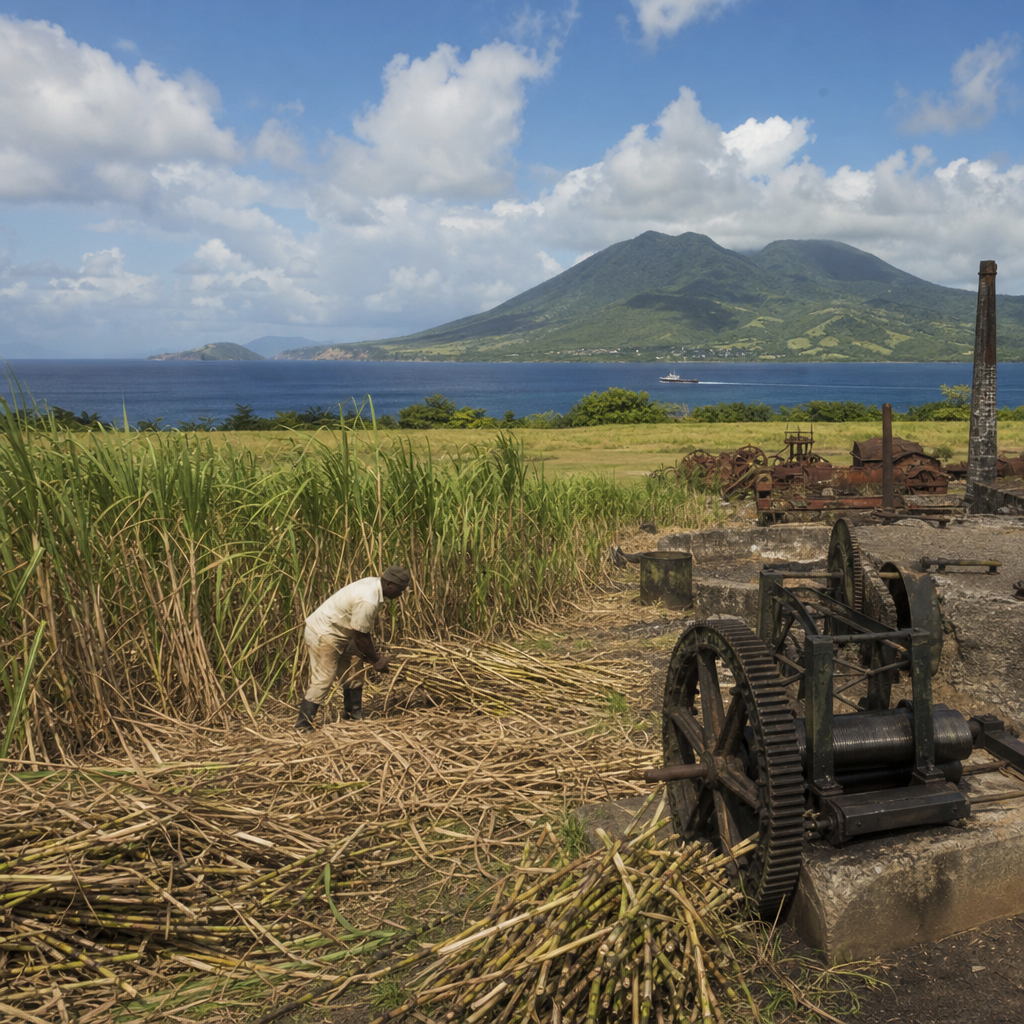
For most Nevisians through the eighteenth, nineteenth, and early twentieth centuries, clothing had to serve hard daily use. Agricultural labor on sugar estates, in small plots, and later in village economies required garments that allowed movement and tolerated heat. Men commonly wore loose shirts, trousers, rolled sleeves, and practical hats for sun protection. Women wore simple dresses, skirts with blouses, aprons, and head coverings that kept hair neat and shielded them from dust and sun. Going barefoot was common among poorer people, especially children, when shoes were too expensive or reserved for church and formal occasions.
Yet everyday dress was never only functional. Respectability mattered deeply in Nevisian society, especially after emancipation in 1834 and full apprenticeship termination in 1838. Formerly enslaved people and their descendants used clothing to claim dignity in a social world that still ranked people by race, class, and occupation. Cleanliness, ironing, mending, and fit became powerful markers. I have seen this same pattern in oral histories from across the Eastern Caribbean: families with limited means often invested disproportionate effort in keeping Sunday clothes immaculate because appearance signaled discipline, morality, and aspiration. On Nevis, churchgoing amplified that standard. White dresses, dark suits, hats, gloves, polished shoes, and carefully styled children’s outfits all formed part of a culture where dress expressed self-respect.
Home sewing was central. Before ready-made clothing became common, many women cut and stitched garments at home or with the help of local seamstresses and tailors. Flour sacks and feed sacks could be repurposed; imported cotton prints were treasured; lace or ribbon might be added for special events. This practical creativity belongs in any serious discussion of traditional clothing because it explains how style survived despite limited resources. Clothing knowledge itself was a form of heritage passed from one generation to the next.
Signature Elements of Traditional Clothing in Nevis
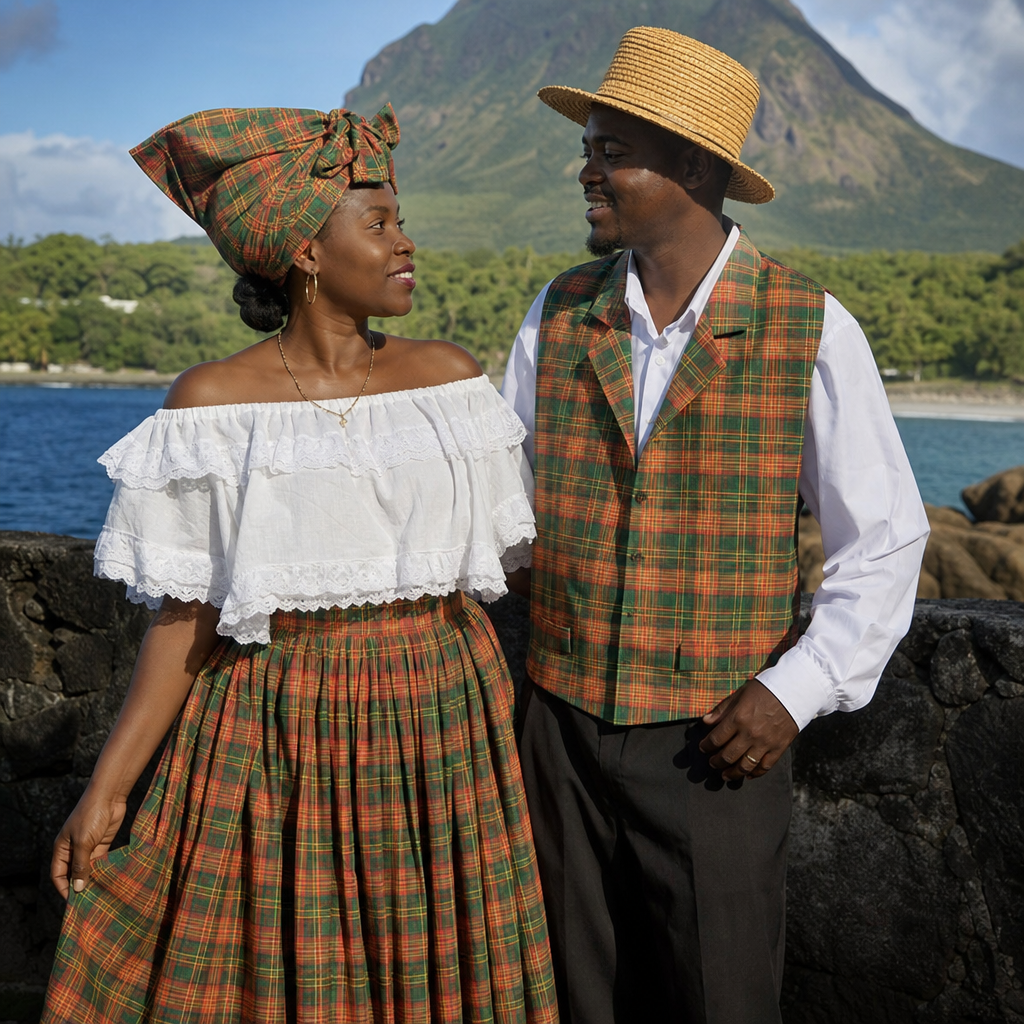
Although no single outfit can represent all periods of Nevisian history, several recurring elements define the island’s traditional clothing vocabulary. Women’s folk dress often includes a full skirt, blouse or fitted bodice, apron, and headwrap. Madras checks, floral cottons, and strong solid colors are common, with red, yellow, green, blue, and white appearing frequently in festival and dance contexts. The headwrap is especially significant. In the wider Caribbean, methods of tying it can communicate style, maturity, occasion, and regional identity. On Nevis, it frames the face, completes the silhouette, and carries strong African diasporic resonance.
Men’s traditional attire tends to be less ornate but equally expressive. White or light-colored shirts, dark trousers, waist sashes, vests, straw hats, and neckerchiefs appear in folk performance and heritage presentations. For quadrille or other staged traditional dances, coordinated costumes help visually distinguish gender roles and movement patterns. Jewelry also matters. Earrings, beads, brooches, and bracelets may be used in women’s ceremonial dress, while men’s formal presentation often relies more on tailoring, hat choice, and color coordination than adornment.
| Element | Typical Use in Nevis | Cultural Meaning |
|---|---|---|
| Madras fabric | Headwraps, skirts, trims | Caribbean creolization, festive identity |
| Head tie | Women’s ceremonial and folk dress | African heritage, elegance, status, occasion |
| Apron | Workwear and folk costume | Domestic labor, modesty, tradition |
| Straw hat | Men’s outdoor and performance wear | Practicality, rural life, craftsmanship |
| White cotton garments | Church, school events, formal use | Respectability, cleanliness, discipline |
These items should not be mistaken for a rigid national uniform. Traditional clothing in Nevis varies by era, parish, family memory, and occasion. What makes these elements meaningful is repetition across community life and their continued visibility in heritage events.
Festival Dress, Dance, and the Public Performance of Heritage
No discussion of traditional clothing of Nevis is complete without Culturama. Established in 1974 to revive local customs and replace fading Christmas sports traditions, Culturama became the island’s strongest public stage for heritage dress. During the festival, folk groups, dancers, masquerades, beauty contestants, school performers, and community troupes wear garments that draw directly from older village styles while also adapting them for spectacle. Skirts become fuller, colors brighter, trims more theatrical, and headpieces more elaborate. This is not inauthentic. It is how living tradition works: clothing moves from private use into curated public symbolism.
Dance is one of the best places to see these traditions in motion. Quadrille costumes, for example, highlight the relationship between dress and choreography. Wide skirts enhance turns and curtsies; men’s structured shirts and hats sharpen line and posture. In masquerade and carnival-adjacent performance, costume may blend folk motifs with sequins, feathers, and satin. The result shows two timelines at once: memory of plantation-era village culture and the modern Caribbean festival economy. I have repeatedly found that visitors understand Nevisian history more quickly when they see these garments worn, danced, and narrated, rather than displayed flat on mannequins.
Music and clothing are closely linked here. String band traditions, drum rhythms, and call-and-response performance all shape how dress is presented. An apron, sash, or head tie gains meaning when it appears alongside specific songs, steps, and spoken introductions. In that sense, traditional clothing belongs to a wider cultural system, not an isolated fashion archive.
Church, Ceremony, and the Best Clothes Tradition
Beyond festivals, some of the most influential clothing customs in Nevis developed around religion and life-cycle ceremonies. Church attire has long been among the island’s most disciplined forms of dress. Across Anglican, Methodist, Moravian, Pentecostal, and other congregations, people often reserved their best garments for worship. Women’s hats became especially important, echoing both biblical ideas of head covering and British-Caribbean standards of decorum. Men wore jackets when possible, or at minimum a pressed shirt and formal trousers. Children learned early that neat dress reflected not vanity, but respect for God, family, and community.
Weddings, funerals, baptisms, and anniversaries reinforced this value system. White wedding garments followed broad Christian and colonial-era fashion currents, but local adaptation remained visible in fabric choice, tailoring, and the use of seamstresses rather than imported couture. Funeral wear tended toward black, white, or subdued tones, with careful attention to propriety. Mourning dress could communicate solidarity and seriousness even when wardrobes were limited. These ceremonial habits matter because they preserved formal clothing practices long after everyday wear became increasingly globalized through imported shirts, denim, and synthetic fabrics.
Modern Change, Tourism, and Revival Efforts
Like every Caribbean society, Nevis experienced major wardrobe changes in the twentieth century. Cheap ready-made imports, migration to the United Kingdom, the United States, and neighboring islands, school uniforms, hotel employment, and global media all reduced the use of older garments in daily life. Polyester replaced some cotton; Western businesswear gained prominence; younger people adopted international fashion trends. By the late twentieth century, traditional clothing was less likely to appear in ordinary village routines and more likely to be seen at festivals, heritage days, school programs, and cultural performances.
That shift does not mean tradition disappeared. It changed function. Today, traditional clothing in Nevis operates as a heritage language. Tourism has played a complicated role in this process. On one hand, hotels, heritage sites, and cultural showcases can flatten dress into a photo opportunity. On the other hand, tourism creates demand for craft markets, folk demonstrations, and historically informed costume design. The best revival efforts avoid costume fantasy and instead work from oral history, archived photographs, church memory, and regional comparison. Cultural organizations, teachers, designers, and festival committees have helped keep sewing techniques, headwrapping skills, and dance costumes alive. For readers exploring this miscellaneous subtopic hub, clothing is therefore an ideal starting point: it connects directly to articles on festivals, foodways, migration, religious life, music, and local craft traditions.
Traditional clothing of Nevis is best understood as a timeline you can wear. It begins with survival under colonial rule, grows through emancipation and village life, takes public form in church and ceremony, and continues today in festival revival and cultural education. The key takeaway is simple: Nevisian dress is not merely decorative. It records labor, ancestry, trade, belief, and creativity in visible form. Madras headwraps, aprons, straw hats, pressed white garments, and carefully tailored formalwear all carry meanings shaped by the island’s history.
For anyone studying Nevis under the wider culture and history umbrella, clothing offers one of the clearest entry points because it links material culture with lived experience. It shows how people adapted imported textiles to local needs, how communities used dress to claim dignity, and how festivals like Culturama transformed inherited styles into living heritage. It also reminds us to be precise: there is no single timeless outfit that speaks for every Nevisian. Tradition here is layered, dynamic, and tied to occasion.
If you want to understand Nevis more deeply, follow the clothing outward. Look next at its dances, church customs, crafts, music, and family ceremonies. Each of those subjects expands what traditional clothing already reveals: fashion on Nevis has always been history in motion. Explore the related articles in this hub to see how the island’s wider cultural life is stitched together.
Frequently Asked Questions
What defines the traditional clothing of Nevis?
Traditional clothing of Nevis is best understood as a living cultural expression rather than a single fixed outfit. Nevisian dress developed through the island’s history of African heritage, European colonial influence, Caribbean climate, plantation labor, church life, trade, and community celebration. In practical terms, traditional clothing often includes lightweight cotton garments suited to heat and humidity, along with colorful fabrics such as madras that became strongly associated with festive and ceremonial wear. Women’s dress has historically included skirts, blouses, aprons, headwraps, and carefully coordinated accessories, while men’s clothing has often featured simple shirts, trousers, jackets, hats, and other pieces shaped by both work and formal public life.
What makes Nevisian traditional fashion distinctive is the meaning attached to how garments are worn. Dress could communicate respectability, marital status, social standing, religious commitment, or readiness for celebration. Clothing for estate work was designed for durability and comfort, while church and holiday garments reflected dignity, pride, and a desire to present oneself well in the community. Over time, these traditions did not disappear; they adapted. That is why traditional clothing in Nevis should be seen as an evolving set of garments, fabrics, colors, and styling practices that continue to reflect the island’s identity across generations.
Why is madras fabric so important in Nevisian traditional dress?
Madras holds a special place in Nevisian traditional clothing because it symbolizes the blending of history, trade, identity, and celebration. The brightly checked cotton fabric became widely used across the Caribbean and, in Nevis, came to be closely associated with festive dress, folk presentation, and cultural pride. Its appeal is both practical and visual. Cotton is breathable and well suited to the island climate, while the vivid checks and color combinations create a striking appearance during public events, dances, festivals, and heritage celebrations.
Madras is especially significant in headwraps and coordinated garments because it transforms ordinary clothing into something ceremonial and culturally expressive. A madras headwrap is not just decorative; it can signal tradition, elegance, and continuity with earlier generations of Nevisians who used dress as a marker of identity. In contemporary cultural contexts, madras often appears in revival wear, school performances, independence or festival costumes, and tourism imagery, but its deeper meaning goes beyond spectacle. It represents the endurance of Caribbean creole fashion traditions and the way imported fabrics were reinterpreted locally to become part of Nevis’s own visual language.
How did everyday work and the island’s climate influence traditional clothing in Nevis?
The climate of Nevis and the realities of labor played a major role in shaping what people wore. As a warm Caribbean island with strong sun, seasonal rains, and humid conditions, Nevis required clothing that was lightweight, breathable, and functional. Cotton became especially important because it allowed airflow and was more comfortable for daily wear than heavier materials. For people working on estates, in fields, or in domestic service, garments had to withstand repeated use while allowing freedom of movement. This meant practical shirts, simple dresses, skirts, aprons, and trousers that could handle demanding physical tasks.
Work clothing also reflected economic conditions. Many people owned a limited wardrobe, so garments needed to serve more than one purpose, be repaired easily, and last over time. At the same time, people still paid attention to neatness, modesty, and presentation. Even practical clothing could express self-respect and social values. Head coverings offered protection from the sun and were useful during labor, while sturdier footwear or going barefoot depended on the task and the wearer’s circumstances. The contrast between workwear and Sunday best is especially revealing in Nevisian history: one set of clothes reflected endurance and labor, while another reflected faith, aspiration, and communal dignity. Together, they show how traditional clothing developed from the demands of daily life as much as from ceremony or aesthetics.
Did traditional clothing in Nevis differ for festivals, church, and everyday life?
Yes, very much so. Traditional clothing in Nevis has long varied according to occasion, and those differences reveal a great deal about the island’s social and cultural life. Everyday dress tended to be practical, modest, and shaped by work, climate, and household responsibilities. People wore garments suitable for movement and comfort, often made from accessible fabrics and constructed for repeated use. By contrast, church attire carried strong expectations of cleanliness, respectability, and decorum. For many Nevisians, dressing for church was not only about religion but also about presenting one’s best self in a valued community setting. Women might wear carefully pressed dresses, blouses, skirts, hats, or head coverings, while men often appeared in collared shirts, jackets, or neatly tailored trousers.
Festival and celebratory clothing introduced even more color, symbolism, and performance. On these occasions, garments could be brighter, more decorative, and more intentionally tied to heritage. Madras fabrics, coordinated headwraps, jewelry, and folkloric styling became especially important when representing Nevisian culture in public. Clothing worn for dance, Carnival-related events, or cultural showcases often emphasized movement, visual impact, and historical memory. These distinctions matter because they show that traditional dress in Nevis has never been one-dimensional. It has always changed according to context, allowing people to express practicality in one setting, reverence in another, and communal pride in another still.
Is traditional Nevisian fashion still relevant today?
Absolutely. Traditional Nevisian fashion remains relevant because it continues to serve as a visible link between history, identity, and modern cultural expression. While most people in Nevis do not wear historical garments in everyday life, the influence of traditional dress remains present in festival clothing, heritage events, school programs, church celebrations, national observances, and contemporary design. Elements such as madras prints, headwrap styles, modest silhouettes, and coordinated ceremonial wear continue to be used, adapted, and reinterpreted by new generations. This keeps the tradition active rather than allowing it to become a static museum piece.
Its relevance also lies in what it teaches. Traditional clothing helps explain how Nevisians navigated climate, labor, colonial society, migration, and changing ideas of beauty and respectability. For designers, historians, and cultural practitioners, it offers a source of inspiration rooted in lived experience rather than imitation. For the wider public, it provides a powerful way to understand that fashion in Nevis is not simply about style trends; it is about memory, resilience, and belonging. When traditional clothing appears today, whether in a formal cultural performance or in modern garments inspired by older forms, it reminds people that Nevisian identity has been shaped through adaptation. That ability to preserve meaning while embracing change is exactly why traditional fashion in Nevis still matters.