Traditional farming practices in Saint Kitts reveal how land, labor, weather, and culture shaped everyday life on the island for centuries. A historical perspective on agriculture in Saint Kitts is not only about crops and tools; it is about settlement patterns, family survival, colonial economics, food security, and the ways rural communities adapted to steep terrain, tropical rainfall, drought, storms, and changing export markets. When historians discuss traditional farming on Saint Kitts, they usually mean the locally rooted methods used before full mechanization and before imported food displaced many homegrown staples. Those methods included hand-clearing fields, mixed cropping, seasonal planting timed to rain, animal traction, kitchen gardens, provision grounds, small livestock keeping, and community labor exchange. Together, these practices formed an agricultural system that was practical, resilient, and deeply tied to social history.
Saint Kitts, the larger island of the Federation of Saint Kitts and Nevis, is often remembered for sugar. That emphasis is understandable because sugar dominated the colonial economy for generations and shaped land ownership, transport, and labor relations. Yet traditional farming practices in Saint Kitts were broader than plantation cane production. Alongside estates, enslaved Africans, later freed people, tenant farmers, and smallholders cultivated cassava, yam, sweet potato, tannia, eddoes, pigeon peas, corn, plantain, banana, pumpkin, peanuts, and medicinal herbs. Fishing supplemented diets, but farming remained the backbone of inland village life. In my work reviewing Caribbean rural history sources and agricultural records, one pattern stands out clearly: the island’s food traditions survived because households balanced export agriculture with subsistence farming. That balance explains why traditional methods mattered long after plantation power peaked.
The topic matters today for three reasons. First, it helps explain modern land use, including why some fertile valleys were dedicated to cane while upland and marginal areas supported provisions and grazing. Second, it shows how cultural memory developed through farming routines, from planting by season to sharing labor at harvest. Third, it provides practical lessons for current debates about sustainability and food resilience. Many techniques once seen as old-fashioned, such as crop diversity, composting, contour planting, and saving planting material from prior harvests, align closely with present ideas about climate-smart agriculture. To understand Saint Kitts fully within culture and history, traditional farming must be treated as a hub topic that links labor history, cuisine, village development, ecology, folklore, and economic change.
A historical overview also requires clear definitions. Plantation agriculture referred to large-scale, export-oriented production, especially sugar cane, organized under centralized ownership and intensive labor control. Provision farming referred to the cultivation of food crops for household consumption or local sale, often on small plots allocated to laborers or held informally. Smallholding described independent or semi-independent peasant farming on limited acreage. Traditional practices, in this context, means methods transmitted locally across generations using hand tools, animal power, seed saving, observation of seasonal rhythms, and practical experimentation rather than industrial inputs. These categories often overlapped. A family might work on an estate, tend a provision ground after hours, raise a few goats, and sell surplus produce in a village market. That mixed livelihood was typical, not exceptional.
Indigenous foundations and early colonial adaptation
Before European colonization, Indigenous peoples in the wider Lesser Antilles practiced forms of cultivation suited to tropical islands, including root crops, maize, and managed use of forest resources. Evidence from the region indicates familiarity with cassava processing, mound cultivation, and the careful selection of well-drained sites. On Saint Kitts, early colonial settlers entered an environment that had already been shaped by human knowledge, even if much of that knowledge was disrupted by violence, displacement, and disease. The first sustained European settlement in the 1620s brought English and French colonists who initially grew tobacco, indigo, cotton, and food crops before sugar cane became dominant. In this early phase, farming was more varied, and colonists relied heavily on adapting Caribbean methods to local conditions.
Adaptation was unavoidable because Saint Kitts has volcanic soils, short but intense rainfall patterns, and terrain ranging from coastal flats to steeper interior slopes. Farmers learned quickly that timing mattered as much as technique. Fields had to be cleared ahead of rains, drains maintained to prevent washouts, and planting staggered to reduce risk. Cassava and sweet potato tolerated conditions that might damage more demanding crops, while bananas and plantains thrived in moister pockets. This period established a pattern that lasted for centuries: successful farming on Saint Kitts depended less on abstract theory than on reading the land carefully. Farmers watched cloud build-up over the central mountains, checked soil moisture by hand, and chose crops according to slope, shade, and wind exposure. Those are traditional practices in the most literal sense—skills built through repeated observation.
Sugar estates, provision grounds, and parallel food systems
By the eighteenth century, sugar reshaped the island. Estates expanded, mills multiplied, and cane occupied prime lowland acreage. The plantation system demanded coordinated field preparation, cane planting, ratooning, cutting, and milling, all tied to labor regimes imposed on enslaved Africans. Yet even within this system, provision grounds remained crucial. Estate owners often allocated plots because feeding laborers entirely through imports was costly and unreliable. Enslaved people used these grounds to grow staple foods and maintain some limited economic autonomy through surplus sales. After emancipation in 1834 and full freedom in 1838, these plots became even more important as freed communities sought independence from plantation control.
Provision grounds were rarely ideal lands. They might be on steeper hillsides, stonier sections, or less accessible margins. Even so, they supported remarkably diverse output. Farmers intercropped tall and low-growing plants to maximize space and spread risk. A plot might combine corn with pigeon peas, cassava along the edge, pumpkins covering bare soil, and banana serving as both food and shade. This diversity reduced total crop failure and improved household nutrition. It also reflects a principle modern agronomists recognize: mixed cropping can suppress weeds, improve soil cover, and stagger harvests.
| Traditional practice | How it worked in Saint Kitts | Historical benefit |
|---|---|---|
| Intercropping | Root crops, legumes, and fruit plants grown together on small plots | Reduced risk, improved diet, used land efficiently |
| Provision grounds | Household plots cultivated beside estate labor obligations or village life | Supported subsistence and small market trade |
| Hand-tool cultivation | Hoes, cutlasses, digging sticks, and forks used instead of machinery | Worked on steep or rocky terrain where machines were impractical |
| Animal husbandry | Goats, pigs, poultry, and some cattle kept near homes or on common areas | Added protein, manure, and occasional cash income |
| Seasonal planting | Planting timed to expected rains and hurricane patterns | Improved establishment and reduced losses |
The plantation and the provision ground therefore existed side by side, but they served different purposes. One extracted wealth for export; the other sustained communities. That distinction matters when evaluating traditional farming practices in Saint Kitts. The most historically significant methods were often not those used on the best land with the most capital, but those that kept ordinary people fed when wages were low and imported food was expensive.
Tools, labor systems, and everyday field techniques
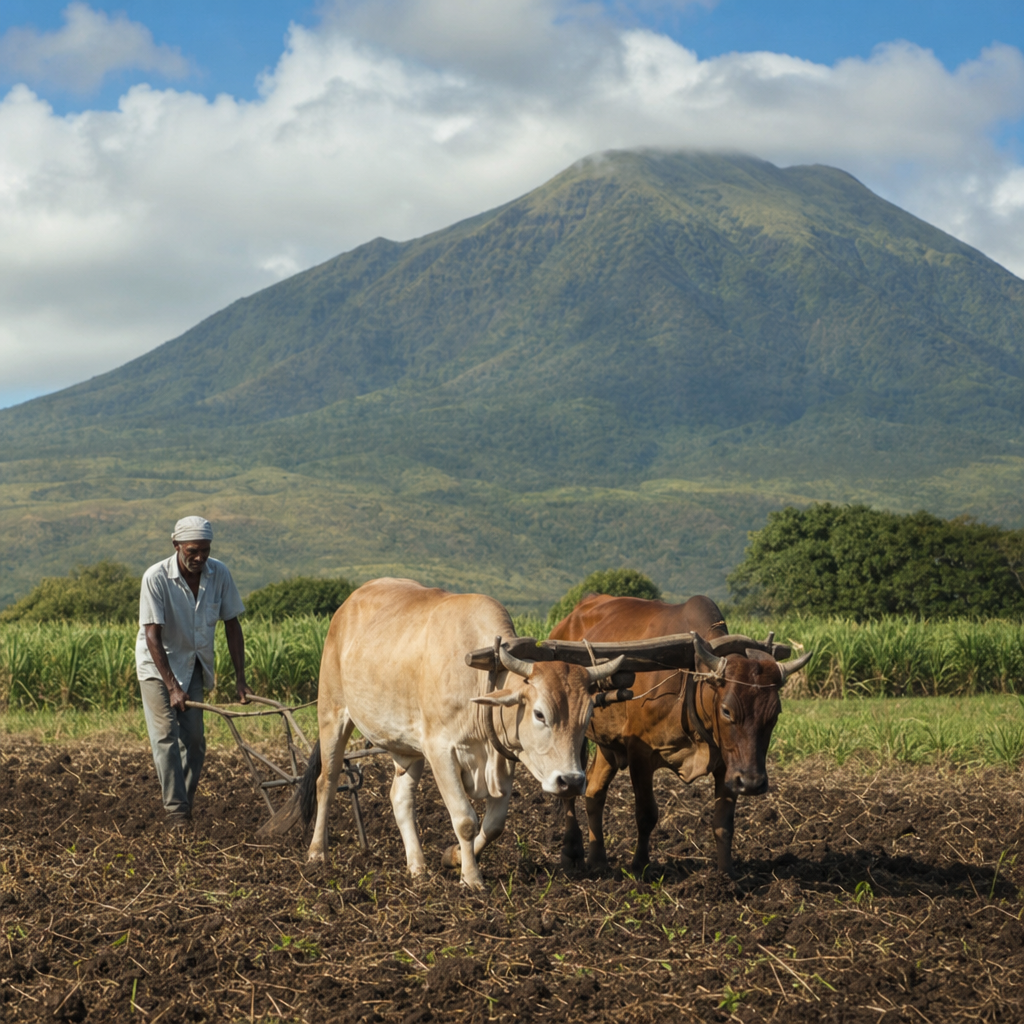
Traditional farming relied on labor-intensive methods. The cutlass was indispensable for clearing brush, chopping cane trash, pruning, and harvesting certain crops. Hoes were used to make hills, break clods, and control weeds. Digging forks loosened heavier soils, while baskets, trays, and head loads moved produce from field to roadside. Oxen and donkeys sometimes assisted with hauling, especially on estates, but many small plots were worked entirely by hand. On slopes and in fragmented holdings, hand cultivation was not a sign of backwardness; it was often the only efficient option.
Labor organization was just as important as tools. Families divided tasks by age, gender, and season. Men often cleared land and handled heavier digging, though women also performed substantial field labor and were central to planting, weeding, harvesting, processing, and market selling. Children learned by doing, starting with bird-scaring, carrying water, gathering fodder, and helping with shelling peas or preparing cassava. In many villages, neighbors pooled labor for demanding tasks. This kind of cooperative work, found across the Caribbean under different local names, allowed households with limited cash to complete planting or harvest quickly when timing was critical.
Soil management was practical rather than formalized, but it was not careless. Farmers recognized that repeated cropping exhausted ground. They shifted plots where possible, left sections fallow, added animal manure, and incorporated plant residues. In cane areas, trash management influenced soil moisture and weed pressure. In provision grounds, leaf litter and household organic waste could be returned to beds. Stone lining, simple drains, and planting across slope helped slow erosion in vulnerable places. These measures were unevenly applied, and not every farmer had equal access to land or manure, but the underlying knowledge was real and widespread.
Food crops, livestock, and market exchange
The classic food crops of Saint Kitts were chosen because they matched local conditions and household needs. Cassava was valued for drought tolerance and versatility; it could be boiled, baked, or processed into flour and bread. Yam provided reliable bulk calories and stored reasonably well. Sweet potato matured faster than yam and fit shorter production windows. Tannia and eddoes performed well in moist soils. Pigeon peas contributed protein and could handle dry spells. Plantains and bananas offered year-round food, though storms posed a constant threat. Peanuts, sorrel, okra, and pumpkin added dietary range and saleable surplus.
Livestock integrated with crop farming. Goats thrived on rough forage and were common among smallholders, although uncontrolled grazing could damage crops. Pigs converted scraps into meat and were important for festive meals and occasional sale. Chickens supplied eggs and meat with relatively low investment. Cattle were less common for poorer households but mattered for milk, traction, and status where resources allowed. Manure from penned animals, though limited in quantity, improved garden fertility. This mixed system gave families flexibility. If a storm flattened bananas, goats or poultry could still be sold. If wages dropped, ground provisions cushioned the shock.
Market exchange connected rural production to town life. Basseterre and village markets gave women in particular a vital economic role as hucksters and vendors. They sold bunches of plantain, baskets of peas, ground provisions, herbs, and small livestock products. These local circuits kept money circulating outside the estate system. They also preserved crop diversity because markets rewarded freshness, seasonality, and household specialties rather than standardized monoculture. In practical terms, traditional farming in Saint Kitts was never purely subsistence. Even very small producers made decisions based on price, transport, demand, and household labor availability.
Weather, risk, and the transition into the modern era
No historical perspective is complete without climate risk. Saint Kitts farmers always worked under the threat of drought, intense rain, hurricanes, pests, and plant disease. Traditional practices evolved as risk management. Staggered planting dates reduced the chance that one weather event would wipe out everything. Crop diversity spread exposure. Root crops offered security because some could remain in the ground until needed. Farmers stored seed, selected hardy planting material, and rebuilt quickly after storms using local knowledge rather than waiting for external inputs. These habits were born from necessity, but they also created resilience.
The twentieth century changed the agricultural landscape. Sugar remained influential for decades, supported by central factory processing after the decline of individual estate mills. At the same time, roads, wage labor, schooling, migration, and imported food altered village farming. Some traditional practices persisted because they still worked; others declined as younger generations left agriculture or as land access narrowed. After the closure of the sugar industry in Saint Kitts in 2005, interest in diversified farming increased again. Policymakers, historians, and growers began revisiting root crops, small-scale vegetable production, and local food traditions once overshadowed by cane.
The historical lesson is clear. Traditional farming practices in Saint Kitts were not static relics. They were adaptive systems built by people navigating unequal land access, colonial pressure, environmental limits, and the constant need to eat. They linked plantation history to peasant survival, kitchen gardens to market exchange, and ecological knowledge to cultural identity. For anyone exploring the wider Culture and History landscape, this subject functions as a hub because it touches foodways, emancipation, rural labor, oral tradition, land tenure, and environmental change at once.
Understanding this history offers practical value today. It explains why certain crops remain culturally important, why village landscapes look the way they do, and why resilience on a small island depends on diversity rather than dependence on a single export. Traditional farmers in Saint Kitts used mixed cropping, family labor, seed saving, seasonal timing, and local marketing not because those methods were romantic, but because they were effective under real conditions. Their experience deserves careful study and wider recognition.
If you are building a deeper understanding of Saint Kitts, use traditional farming as a starting point for related topics such as sugar estates, emancipation, village markets, heritage cuisine, medicinal plants, and land settlement patterns. Read local histories, visit former estate landscapes, talk with older growers, and trace how agricultural memory survives in food and language. The island’s past is written in its fields as clearly as in its archives.
Frequently Asked Questions
What were the main features of traditional farming practices in Saint Kitts?
Traditional farming practices in Saint Kitts were shaped by the island’s geography, colonial history, and the daily realities of rural life. At the broadest level, agriculture developed along two connected but very different paths: large-scale plantation farming focused mainly on sugar production, and small-scale provision farming carried out by enslaved people, freed families, and later peasant households for local food and survival. This dual structure is essential to understanding the island’s agricultural past. Plantation estates organized land, labor, and infrastructure around export crops, while small farmers and laborers relied on kitchen gardens, provision grounds, and mixed cropping to feed their families and generate modest income.
In practical terms, traditional farming involved hand labor, locally adapted knowledge, and careful use of limited land. Farmers worked steep slopes, valley bottoms, and marginal plots, often without mechanized equipment. Tools were simple but effective, including hoes, cutlasses, digging forks, and axes. Planting methods reflected hard-earned experience with tropical conditions. Farmers paid close attention to rainfall patterns, soil moisture, drainage, and exposure to wind. They often planted a range of crops rather than depending on one alone, reducing the risk of failure during drought, excessive rain, or storms.
Mixed cultivation was one of the defining features of traditional farming on the island. Alongside major estate crops such as sugar cane, smaller plots produced yams, sweet potatoes, cassava, eddoes, tannias, corn, pigeon peas, pumpkins, plantains, bananas, and other staples. Fruit trees and medicinal plants were also commonly integrated into the farming landscape. This diversity supported food security and reflected a practical understanding of seasonality, nutrition, and resilience. In many rural communities, farming was not simply an economic activity; it was woven into household organization, community cooperation, and cultural continuity.
How did sugar plantations influence the history of farming in Saint Kitts?
Sugar plantations had a profound and long-lasting influence on farming in Saint Kitts, affecting everything from land ownership and labor systems to settlement patterns and environmental change. During the colonial period, sugar became the dominant export crop and the central engine of the island’s economy. As a result, large tracts of fertile land were consolidated into estates dedicated to cane cultivation, milling, and processing. This concentration of land under plantation control limited access to arable acreage for many ordinary people and structured the island’s countryside around the needs of export agriculture rather than local food production.
The plantation system also shaped labor in deeply consequential ways. First through enslavement and later through various forms of controlled wage labor, generations of people were compelled to work within a rigid agricultural economy designed for overseas profit. This meant that traditional farming in Saint Kitts cannot be discussed only in terms of crops and techniques; it must also be understood through the realities of coercion, inequality, and survival. Enslaved Africans and their descendants brought agricultural knowledge, adapted to local conditions, and cultivated provision grounds whenever possible, creating an important parallel tradition of food production that existed alongside the plantation system.
Even after emancipation, sugar’s dominance continued to influence how farming evolved. Many families had limited land available to them and had to combine estate work with subsistence cultivation. Rural households often depended on small plots to grow food, maintain some degree of independence, and buffer themselves against fluctuations in wages and employment. Over time, changes in international prices, competition, and market instability exposed the vulnerability of a system built around a single export. This helps explain why discussions of traditional farming in Saint Kitts often focus not just on plantation agriculture itself, but on how ordinary people navigated, resisted, and adapted to an economy organized by sugar.
Which crops were most important in traditional agriculture in Saint Kitts?
The most important crops in traditional agriculture in Saint Kitts can be divided into export crops and food crops, each serving very different purposes in the island’s historical development. Sugar cane was by far the most significant export crop for much of the colonial and post-colonial era. Its importance came not only from the volume of land devoted to it, but also from the fact that it shaped labor arrangements, transportation routes, factory development, and the broader island economy. In historical terms, cane dominated the agricultural landscape in ways that overshadowed many other crops.
At the same time, food crops were essential to everyday life and often mattered more directly to household survival. Traditional farmers grew root crops such as yam, sweet potato, cassava, dasheen, tannia, and eddoe because they were relatively hardy, filling, and well suited to local diets. These crops could be planted in mixed plots and provided a measure of security in uncertain times. Plantains and bananas were also important, both as staple foods and as useful crops in diversified holdings. Corn, beans, pigeon peas, and pumpkins frequently appeared in small-scale farming systems because they offered dietary variety and could be grown together in practical combinations.
Fruit trees and supplementary crops also played a notable role. Breadfruit, mangoes, guavas, coconuts, and citrus often contributed to the rural food supply, while herbs and medicinal plants were part of household knowledge systems. The importance of these crops lay in their adaptability and their contribution to self-provisioning. In many cases, what made a crop “important” in traditional Saint Kitts farming was not just commercial value, but reliability, nutritional usefulness, and suitability to local environmental conditions. This broader view is crucial because it reminds us that traditional agriculture on the island was as much about sustaining communities as it was about producing for export.
How did Saint Kitts farmers adapt to weather, terrain, and other environmental challenges?
Farmers in Saint Kitts had to work within a demanding natural environment, and traditional farming practices developed in response to those realities. The island’s terrain includes steep slopes, volcanic soils, and areas vulnerable to runoff and erosion, so cultivation required close observation and practical adaptation. Farmers selected planting sites carefully, understanding which areas held moisture, which drained quickly, and which were most exposed to heavy rain or drying winds. On sloping land, the arrangement of crops and the timing of planting could make a major difference in whether a harvest succeeded or failed.
Weather posed another constant challenge. Tropical rainfall could be both beneficial and destructive, while drought periods could sharply reduce yields. Farmers responded by planting a range of crops with different levels of tolerance to moisture stress and varying harvest periods. This diversity spread risk. If one crop suffered from excessive rain, another might still survive; if drought damaged one provision, another might endure longer in the soil. Traditional agricultural knowledge therefore emphasized flexibility rather than total dependence on a single planting cycle or one marketable crop outside the plantation framework.
Storms and hurricanes also shaped farming decisions. In exposed landscapes, farmers had to think about wind damage, flooding, and soil loss. Tree crops, ground provisions, and mixed plots often offered more resilience than uniform planting. Knowledge passed through families and communities included when to clear land, when to plant, how to recognize changing seasonal patterns, and how to preserve enough food or planting material after bad weather. These practices were not “primitive” responses; they were informed, place-based strategies developed over generations. They reflected an intimate understanding of the island’s ecology and the need to balance productivity with survival in an environment that could be generous one season and destructive the next.
Why is it important to study traditional farming in Saint Kitts from a historical perspective?
Studying traditional farming in Saint Kitts from a historical perspective matters because agriculture on the island is tied to much more than rural technique. It opens a window into how people lived, worked, ate, moved, and endured under changing social and economic conditions. Farming history reveals patterns of settlement, family labor, access to land, class divisions, colonial control, and the strategies ordinary people used to secure food and maintain dignity. In Saint Kitts, the story of agriculture is closely connected to the history of slavery, emancipation, plantation society, and the long transition toward new economic realities.
A historical perspective also helps explain why food security and land use remain meaningful issues in the present. When historians examine traditional farming, they are not only reconstructing what crops were grown or what tools were used. They are asking who controlled the best land, who performed the labor, how rural households balanced wage work with self-provisioning, and how communities adapted when export markets rose or collapsed. These questions make farming history central to understanding the island’s social development. They show how agricultural systems shaped inequality, opportunity, and resilience across generations.
Just as importantly, studying traditional farming preserves local knowledge that might otherwise be overlooked. The experience of working difficult terrain, reading seasonal change, selecting hardy crops, and organizing household production contains valuable lessons about sustainability and adaptation. In a time when climate risk, import dependence, and interest in local food systems are all growing concerns, the historical record of farming in Saint Kitts offers useful perspective. It reminds readers that the island’s agricultural past was never just about production figures. It was about survival, ingenuity, community, and the enduring relationship between people and land.