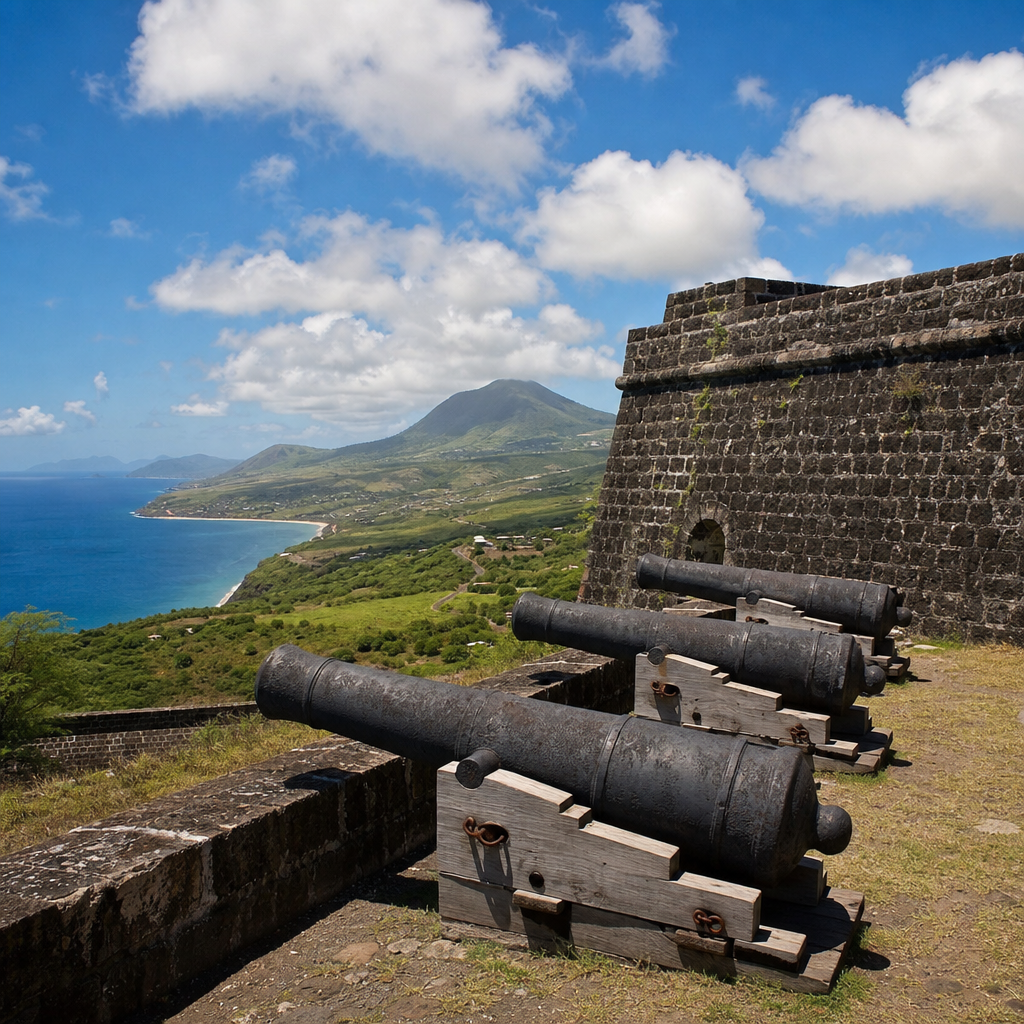
Nevis is often introduced through beaches, thermal springs, and the peak that dominates its skyline, yet the island’s historical forts reveal the clearest record of how this small Caribbean territory defended trade, protected settlements, and negotiated empire. Exploring Nevis’ historical forts and their stories means tracing military architecture, colonial rivalry, local labor, and community memory across a compact landscape where every ridge and shoreline once carried strategic value. In practical terms, a fort on Nevis was not always a massive stone citadel. It could be a battery guarding a bay, an earthwork overlooking Charlestown, or a fortified house adapted for defense during periods of conflict.
That broader definition matters because many visitors expect intact ramparts and formal museums, then miss the island’s subtler defensive heritage. On Nevis, the remains are often fragmentary: a surviving gun platform, dressed stone built into later walls, a hilltop position chosen for line of sight, or archival references that explain why a site mattered even when masonry has faded. Together these places form a network rather than a single monument. They connect the era of early English colonization in the seventeenth century with later French attacks, privateering threats, plantation expansion, and the political transformation that eventually led to modern Saint Kitts and Nevis.
As someone who has worked with heritage-driven travel content and compared site reports, maps, and on-the-ground interpretation across the Eastern Caribbean, I have found that Nevis rewards a slower, more contextual approach. The island’s forts are important not because they rival Brimstone Hill in scale, but because they show how a smaller island adapted defense to geography, limited resources, and changing military technology. They also serve as a hub for understanding related subjects across Nevisian history: sugar estates, churches, ports, roads, slavery, emancipation, and preservation challenges. This guide covers that miscellaneous field comprehensively, giving you the historical framework needed before drilling into individual sites in related articles.
Why Forts Mattered on Nevis
Nevis became one of the early English footholds in the Caribbean during the 1620s. Its value came from fertile volcanic soils, a growing plantation economy, and maritime position within the Leeward Islands. Those advantages also made it vulnerable. Rival European powers, especially France, contested regional control throughout the seventeenth and eighteenth centuries. Merchant shipping moved sugar, rum, and supplies through nearby waters, attracting privateers and naval interest. In that environment, fortifications on Nevis were not ornamental. They were part of an island-wide defense system intended to warn, deter, and, when necessary, fire upon approaching ships or invading forces.
Military planning on Nevis followed a straightforward logic. High ground protected settlements inland and gave defenders visibility over anchorages. Coastal batteries defended the most likely landing points and helped shield Charlestown, the administrative and commercial center. Plantation wealth funded some local improvements, while imperial military priorities shaped others. The result was a patchwork network rather than a single continuous wall. This is typical for smaller Caribbean islands. Defense depended on overlapping observation points, artillery placement, militia mobilization, and quick communication between settlements.
The major threats changed over time. In the seventeenth century, loosely organized raids and imperial competition dominated. By the eighteenth century, more formal naval warfare and amphibious operations required stronger batteries and better coordination. Hurricanes, earthquakes, humidity, and salt air also affected fort survival, which explains why documentary records are often as important as masonry. To understand Nevisian forts, you need to read landscape and archive together.
Key Fort Sites and Defensive Landscapes
The best-known military landscape on Nevis centers on Charlestown and the western coast. Fort Charles, also called Charles Fort in many references, stood near the harbor and became the island’s principal defensive work. Although less visually imposing today than major Caribbean fortresses, its location was strategic. It guarded Charlestown roadstead, monitored seaborne approach, and anchored the island’s political center. Historical descriptions note guns mounted to command the anchorage, with nearby buildings serving administrative and military functions. When reading old maps, the placement makes immediate sense: protect the port, protect the capital, protect customs revenue.
Saddle Hill Fortress is the other essential site in any serious overview of Nevis fortifications. Positioned on elevated terrain, it offered wide surveillance over sea lanes and neighboring islands. Hilltop forts in the Caribbean were invaluable because artillery range and sight lines could shape an entire defensive strategy. Saddle Hill is associated with substantial remains compared with many other Nevisian sites, and it helps visitors visualize how engineers used volcanic topography to compensate for limited manpower. Standing there, the relationship between terrain and defense becomes tangible. You see why troops needed warning time, how signal communication likely operated, and why controlling heights often mattered more than building thicker walls at sea level.
Other batteries and minor fortifications historically complemented these primary works. Some defended specific bays; others secured approaches to estates or supported militia action during emergencies. Not all have extensive surviving fabric, but they remain part of the island’s fortified story. This broader view is vital for a hub page under culture and history because the subject is not only about named forts. It includes roads that moved men and munitions, storehouses linked to the port, churches used as landmarks, and estate landscapes whose wealth made fortification necessary in the first place.
| Site or landscape | Primary role | Why it matters today |
|---|---|---|
| Fort Charles, Charlestown | Harbor defense and administrative protection | Explains how the capital and port were secured |
| Saddle Hill Fortress | High-ground surveillance and artillery position | Best place to understand strategic use of terrain |
| Coastal batteries | Guarding landing points and anchorages | Shows layered defense beyond one major fort |
| Estate-linked defensive points | Local refuge, militia coordination, observation | Connects forts to plantation economy and settlement |
The Stories Behind the Stones
A fort’s real story is never just masonry. On Nevis, each defensive site reflects labor systems, imperial politics, and local adaptation. Construction relied on skilled and unskilled workers, including enslaved Africans whose labor underpinned both plantations and public works. That fact should not be treated as a footnote. The island’s military infrastructure existed because a plantation colony generated wealth and because colonial authorities could compel labor. When visitors encounter a wall or gun emplacement, they are also encountering the social order that made it possible.
French attacks provide another crucial layer. Nevis suffered major disruption during periods of Anglo-French conflict, especially in the late seventeenth and early eighteenth centuries. Invasions, raids, and occupation fears shaped investment in fortification and militia readiness. These events were not abstract imperial episodes; they changed local lives, damaged property, displaced residents, and altered the island’s economy. Forts became symbols of resilience, but also reminders that prosperity built on sugar was always exposed to violence.
There is also a personal scale to these sites. Governors inspected them. Gunners maintained them. Merchants depended on them. Families in Charlestown listened for alarm signals from them. In heritage interpretation, this human dimension makes a huge difference. A cannon platform is more meaningful when you explain that it stood between a lightly defended anchorage and a fleet on the horizon, or that a hilltop watch point gave only limited time to move civilians and supplies. These stories are why fort heritage belongs within the wider cultural narrative of Nevis rather than in a narrow military category.
How Forts Connect to Nevisian Culture and History
For a culture and history hub, forts are useful because they link seemingly separate topics into one coherent island story. Start with sugar. The plantation economy financed public authority, attracted foreign attack, and required export infrastructure. That leads directly to Charlestown’s harbor defenses. Move to religion and settlement patterns, and forts reappear as landmarks near churches, roads, and civic spaces. Consider slavery and emancipation, and the same landscapes become evidence of coercion, labor organization, and changing power after abolition.
Forts also intersect with architecture and material culture. Caribbean military construction often used locally available stone, lime mortar, and practical adaptations suited to climate. On Nevis, surviving remains illustrate durability, but also improvisation. Unlike grand metropolitan fortifications, island works were shaped by budget constraints, weather exposure, and urgent need. That makes them historically valuable. They show what defense looked like in a real colonial environment, not on an idealized engineering plan.
Tourism adds another modern layer. Heritage travelers increasingly want place-based interpretation rather than quick photo stops. Nevis has an advantage here because its scale allows visitors to connect a fort visit with the Museum of Nevis History, estate ruins, Charlestown architecture, and oral history in a single day. This integrated experience is what makes the island compelling. A fort stop is not isolated sightseeing; it is an entry point into the full historical ecology of Nevis.
Preservation, Research, and Visiting Responsibly
Preserving Nevis’ forts is challenging. Tropical vegetation can obscure walls within a season. Salt-laden air accelerates decay. Storms destabilize exposed masonry, and development pressure can detach heritage from context even when a ruin itself survives. Effective preservation therefore requires more than clearing brush. It depends on documentation, site mapping, controlled access, drainage management, and interpretation that discourages casual damage. Standards used across the heritage sector, including condition surveys and conservation management planning, are especially relevant on islands where resources are finite and climate risks are rising.
Research remains equally important because many visitors will encounter partial ruins rather than fully restored complexes. Archaeology, old military maps, estate records, and travel accounts help reconstruct what stood where and why. Local institutions, heritage advocates, and regional historians all contribute to that work. In my experience, the most reliable understanding comes from combining site observation with documentary sources instead of relying on a single legend or tourism summary. That approach protects accuracy while still leaving room for local storytelling.
If you plan to explore these sites, go prepared. Wear sturdy shoes, expect uneven ground, and respect barriers or signage. Hire a knowledgeable local guide when possible, especially for less obvious locations where interpretation on site may be limited. Ask not only what happened there, but how the fort related to trade, slavery, and settlement. Those questions lead to richer answers. They also support local heritage economies by rewarding serious interpretation rather than superficial sightseeing.
Nevis’ historical forts matter because they turn the island’s past into something visible, spatial, and understandable. They show how a small Caribbean colony defended wealth, faced external attack, and organized daily life around risk as well as opportunity. Fort Charles, Saddle Hill Fortress, and the island’s lesser-known batteries are not isolated ruins. They are anchors for the broader story of Nevis, linking military history with sugar, labor, religion, politics, architecture, and memory. That is why this miscellaneous hub belongs at the center of any serious exploration of Nevis culture and history.
The key takeaway is simple: to understand Nevis, follow its defensive landscapes. Start at Charlestown, look at the harbor, move to the heights, and read each site in relation to the communities and systems around it. You will see that forts on Nevis are less about monumental scale than strategic intelligence and human consequence. Their stories explain not only how the island protected itself, but also how colonial society functioned and changed over time.
Use this hub as your foundation, then continue into deeper articles on individual forts, Charlestown heritage, estate history, and preservation efforts across the island. When you visit Nevis, make time for the forts and ask better questions while you stand there. The landscape will answer many of them.
Frequently Asked Questions
What makes Nevis’ historical forts so important to understanding the island’s past?
Nevis’ forts are important because they provide one of the most direct and visible records of how the island functioned during centuries of colonial competition in the Caribbean. While beaches, plantations, and churches tell part of the story, fortifications show where power was concentrated, what threats were feared, and how local geography shaped decisions about defense, trade, and settlement. On a small island like Nevis, every coastal approach, elevated ridge, and harbor entrance mattered. Forts were not built randomly; they were placed to monitor shipping lanes, deter attacks, and protect the economic interests tied to sugar, maritime trade, and imperial authority.
These sites also reveal that Nevis’ history was never only military. The forts connect to wider stories of labor, engineering, politics, and daily life. Building and maintaining them required materials, skilled planning, and the work of local people, including enslaved and free laborers whose contributions were essential but often underemphasized in older histories. At the same time, the remains of batteries, walls, and gun platforms help modern visitors understand that Nevis was part of a larger Caribbean world shaped by French and British rivalry, privateering, and the constant need to defend wealth concentrated in plantation colonies. In that sense, the forts are not just ruins; they are historical documents in stone, earth, and placement.
Which forts or fortification sites should visitors pay special attention to when exploring Nevis?
Visitors should pay close attention to Charlestown and the areas around former coastal defenses, because the capital and its shoreline were central to the island’s military and commercial history. Many of Nevis’ fortifications were designed less as massive inland castles and more as practical batteries and defensive positions that guarded anchorages, roads, and settlement corridors. Because of this, some of the most meaningful sites may appear modest at first glance. A low stone platform, remnants of a wall, or a strategic hilltop can carry significant historical weight once you understand what it once overlooked and defended.
Fort Charles is among the best-known examples associated with Nevis, particularly in relation to Charlestown’s harbor defense. Sites like this help explain how the island tried to protect its administrative and trading center from naval threats. Beyond named forts, visitors should also remain alert to surviving batteries, elevated lookout points, and ruins integrated into the modern landscape. On Nevis, fort history is often dispersed rather than concentrated in one monumental structure. That makes interpretation especially important. A guide, heritage map, or local historical context can transform partial remains into a vivid account of how the island’s defense network once operated as a system rather than as a collection of isolated buildings.
How did Nevis’ forts reflect colonial rivalry and the wider politics of the Caribbean?
Nevis’ forts reflected the fact that the Caribbean was one of the most contested regions of the early modern Atlantic world. European empires did not view islands like Nevis as remote outposts; they saw them as valuable assets tied to shipping routes, agricultural production, and regional influence. As British and French interests clashed across the Lesser Antilles, islands were fortified not only against full-scale invasion but also against raids, privateers, and opportunistic attacks during wartime. The design and placement of Nevis’ forts therefore mirrored larger geopolitical realities. Defensive works had to respond to threats arriving by sea, and they had to protect places where imperial wealth was stored, exported, and administered.
This broader political context helps explain why even a relatively small island invested in layered defenses. Forts embodied the anxieties of empire: fear of losing territory, fear of disrupted trade, and fear of attack during periods of European war that spilled into the Caribbean. They also remind us that colonial rivalry affected local communities directly. When tensions increased, the island’s residents faced military pressure, economic uncertainty, and the physical consequences of defense-building. In practical terms, Nevis’ forts were local structures shaped by global conflict. They are valuable precisely because they allow visitors to see how world events materialized in a compact island setting through gun batteries, lookout positions, and fortified coastal zones.
What can the architecture and layout of Nevis’ forts tell us about military strategy on the island?
The architecture and layout of Nevis’ forts show that military strategy on the island was deeply responsive to terrain. Rather than relying on a single dominant fortress, Nevis used a network of defensive positions adapted to shoreline contours, harbor access, and elevated viewpoints. This kind of planning was typical of Caribbean islands where control of the coast was often more important than inland defense. Batteries were positioned to command approaches from the sea, and fortified sites were selected for visibility, range, and connection to settlements that needed protection. In many cases, what survives today may seem understated, but that simplicity reflects function. These were often practical military installations designed to maximize strategic advantage, not necessarily to impress through scale.
The surviving elements can also reveal changes over time. As artillery technology evolved and as the island’s political circumstances shifted, fortifications could be modified, expanded, or neglected. Construction materials, wall thickness, orientation, and platform placement all help historians reconstruct how defenders expected an attack to unfold. They also hint at the realities of weather, supply limits, and maintenance on a small island. Tropical conditions, erosion, and later redevelopment may have erased some features, but even fragmentary remains can still speak clearly. When read in context, Nevis’ forts illustrate a defensive strategy rooted in observation, coastal control, and efficient use of limited space and resources.
How should travelers explore Nevis’ forts responsibly and get the most from the experience?
The best way to explore Nevis’ forts responsibly is to treat them as heritage sites first and scenic viewpoints second. Many fort locations are appealing because they offer dramatic coastal views, but their historical importance deserves equal attention. Visitors should follow local guidance, respect barriers or signage, avoid climbing on fragile masonry, and refrain from removing stones or artifacts. Even small disturbances can damage sites that have already endured centuries of weathering, vegetation growth, and human activity. Responsible exploration also means recognizing that these places are connected to difficult histories, including colonialism, militarization, and labor systems that shaped life on the island in unequal ways.
To get the most from the experience, travelers should combine on-site visits with interpretation from local historians, guides, museums, or archival resources. Nevis’ military history becomes far more compelling when you understand how a particular battery related to Charlestown, how a ridge controlled a sea approach, or how local memory has preserved the story of a ruined site long after its tactical role faded. It is also worth approaching these forts as part of a broader cultural landscape. Nearby churches, plantation remains, cemeteries, and roads often deepen the story by showing how defense, commerce, and community were intertwined. In practice, the richest experience comes from slowing down, asking questions, and seeing the forts not as isolated ruins but as gateways into the island’s layered and often surprising past.