Historical festivals of Nevis reveal how a small Caribbean island has preserved memory, reshaped identity, and welcomed change without losing its cultural center. Nevis, part of the Federation of Saint Kitts and Nevis, has long expressed its history through public celebration: village feasts, church calendars, emancipation observances, pageantry, music competitions, and community gatherings that turn streets and playing fields into shared historical stages. In this context, a festival is more than entertainment. It is a structured public ritual where music, food, costume, sport, religion, and storytelling carry values from one generation to the next. Transformation matters because Nevisian festivals have never been frozen in time. They have adapted to colonial rule, emancipation, migration, tourism, digital media, and the practical economics of organizing large events on a small island. Having worked on Caribbean cultural programming, I have seen that the strongest festivals survive by balancing heritage and relevance. That balance defines Nevis. For readers exploring culture and history, this hub explains the island’s major historical festivals, the traditions behind them, and the ways they continue evolving.
Culturama and the modern restoration of Nevisian identity
No discussion of historical festivals of Nevis can begin anywhere other than Culturama, the island’s signature celebration and the clearest example of tradition meeting transformation. Launched in 1974, Culturama was created to revive local customs that older residents feared were fading as Christmas sports, folk performance, and village-centered practices lost ground to imported entertainment and migration. Its timing around the Emancipation season was deliberate. Organizers connected the festival to the memory of freedom, labor, and survival after slavery, giving it a social purpose beyond spectacle. In practical terms, Culturama became the annual mechanism through which Nevis documented itself in public.
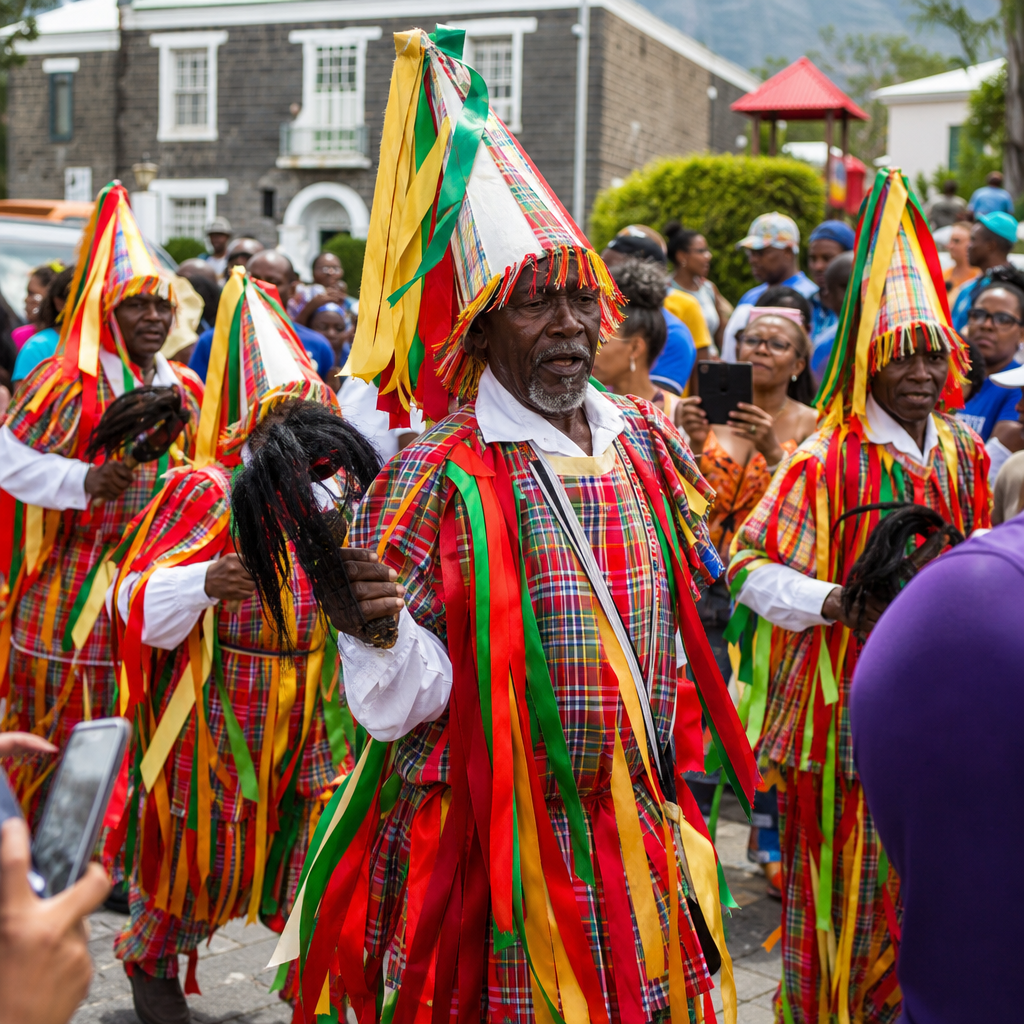
The festival now includes street parades, calypso and soca competitions, drama, folklore presentations, swimming events, pageants, food fairs, and J’ouvert-style revelry, yet its historical value lies in how these pieces knit together. Traditional masquerades, clowns, stilt walkers, drummers, and Big Drum-influenced rhythms preserve performance vocabularies with African Caribbean roots. At the same time, modern stage production, sponsorship deals, recorded music, and social media promotion have changed the delivery. This is not cultural loss by default. In well-run years, the newer format extends the reach of older forms. A schoolchild may first encounter local folklore through a stage competition, then learn its deeper meaning from grandparents or community elders. That intergenerational relay is exactly how living heritage works.
Culturama also functions as the hub for many related topics within Nevis culture and history. It links directly to folk music, costume traditions, oral history, local cuisine, village rivalries, migration patterns, and the island’s postcolonial identity. For a sub-pillar hub page, that matters because readers looking into “miscellaneous” cultural history often need one anchoring event that connects multiple strands. On Nevis, Culturama is that anchor.
Religious feast days, village customs, and the older festival calendar
Before large branded festivals dominated attention, Nevisians marked time through church feasts, seasonal holidays, market gatherings, and village customs tied to harvest cycles, patron saints, and family reunion patterns. Anglican, Methodist, Moravian, Catholic, and other Christian traditions shaped much of the island’s social calendar. Christmas and Easter were not simply liturgical milestones. They generated house visits, special meals, music-making, horse racing in some periods, athletic contests, and the return of relatives from overseas. These recurring observances created a rhythm of belonging. You knew where you came from because the calendar told you when to gather, whom to honor, and what to cook.
Village life gave these celebrations local texture. Gingerland, Charlestown, Cotton Ground, and other communities built reputations around specific social styles, choirs, sports clubs, or family networks. On islands like Nevis, festivals often grow from these smaller units rather than from top-down cultural policy. A church anniversary can become a village fair. A harvest thanksgiving can turn into a broader community food event. A youth talent night can evolve into a formal competition. In archival work and oral accounts across the Eastern Caribbean, this pattern appears repeatedly: institutions provide the frame, but ordinary residents generate the energy. Nevis follows that model closely.
Transformation entered through education, migration, and media. As residents moved to Saint Kitts, the United Kingdom, the United States, the U.S. Virgin Islands, and elsewhere, return visits began influencing local expectations. Amplified sound systems, new dress styles, and imported genres changed the atmosphere of public gatherings. Yet the underlying structure remained familiar: worship, reunion, food, music, and public recognition. That continuity explains why historical festivals of Nevis still feel rooted even when the soundtrack or staging looks contemporary.
Emancipation memory, folklore, and performance traditions
Emancipation is one of the deepest historical currents beneath Nevisian festival culture. Slavery shaped the island’s plantation economy, settlement patterns, labor system, and social hierarchy for centuries. Public celebration after emancipation was therefore never neutral. Dance, drumming, satire, and masquerade became ways to assert personhood in spaces once controlled by plantation power. Across the British Caribbean, post-emancipation festivals often blended African survivals, creolized performance, and European carnival elements. Nevis shares this layered inheritance, and its festivals continue to carry those meanings whether audiences articulate them explicitly or not.
Folklore performance on Nevis has historically included masquerade characters, clowns, mock combat, whip cracking, stylized dance, and costuming that mixes humor with discipline. These forms entertain, but they also encode memory. The discipline of a troupe, the route of a parade, and the role of drums are not random details; they are inherited systems. In my experience, younger organizers sometimes focus first on visual impact, then later realize that timing, costume construction, and musical phrasing are where heritage actually lives. When elder performers insist on proper sequence or rhythm, they are protecting historical knowledge, not resisting innovation for its own sake.
Folklore also answers a practical question many readers ask: why preserve difficult traditions when modern audiences prefer faster content? The answer is that festivals are one of the few public spaces where embodied history survives. Archives can store photographs and programs, but only performance preserves movement, call-and-response, crowd interaction, and the social authority of elders. Once those are lost, reconstruction becomes guesswork. Nevis has done better than many places by keeping folk elements visible within broader festival programming.
Music, pageantry, and competition as engines of change
Competition has been one of the most effective tools for sustaining Nevisian festivals. Calypso tents, soca monarch contests, queen pageants, talent shows, and school performances create a reason for preparation, rehearsal, and public investment. This matters historically because festivals thrive when communities expect annual excellence, not just annual attendance. Calypso in particular deserves attention. As in Trinidad and across the Eastern Caribbean, calypso is both music and social commentary. On Nevis, calypsonians have used the stage to critique government, praise communities, mock vanity, and document current events with a precision that newspapers sometimes miss. A strong calypso season becomes an oral political archive.
Pageantry is more complicated but equally important. Critics sometimes dismiss Caribbean festival queens as imported colonial residue, and there is truth in that lineage. Beauty competitions were shaped by European standards and later by nationalist reinvention. Yet on Nevis, pageants also became platforms for scholarship, poise, public speaking, and cultural representation. Over time, successful organizers shifted emphasis from appearance alone to talent, historical knowledge, and ambassadorship. That transition is a textbook example of transformation rather than abandonment. The format stayed recognizable while the values inside it changed.
Modern production has intensified all of this. Digital sound, livestreaming, recorded archives, and diaspora viewing have raised expectations. A performer now competes not only for the audience in Charlestown but also for relatives watching abroad. That broader audience can strengthen quality, though it can also reward spectacle over substance. The best festival committees understand the tradeoff and protect content standards accordingly.
Food, craft, and the economics of festival heritage
Historical festivals of Nevis are inseparable from food and craft because heritage survives through things people make, sell, and consume together. Goat water, conch dishes, coconut tarts, johnny cakes, drinks flavored with sorrel or ginger, and other local specialties turn festival grounds into edible history. Recipes communicate class history, agricultural availability, and family adaptation. A dish associated with a festival is not just “traditional food.” It records what people could grow, trade, preserve, and afford. On Nevis, where plantation legacies and small-scale farming both shaped daily life, festival food preserves that practical history in a direct way.
Craft has a similar function. Costume design, headpieces, fabric work, woodcraft, and decorative stalls support festival identity while circulating local income. In small-island economies, festivals often operate as temporary marketplaces for seamstresses, cooks, musicians, drivers, printers, photographers, and vendors. That economic dimension is sometimes underestimated in cultural writing. It should not be. A festival with no pathway for local earning becomes harder to defend politically and harder to sustain socially. When residents can point to jobs, commissions, and business exposure, heritage gains material support.
| Festival element | Historical function | Modern transformation |
|---|---|---|
| Folk costume | Marks troupe identity and inherited symbolism | Uses lighter materials, brighter branding, and stage lighting design |
| Calypso competition | Documents public opinion and social critique | Reaches diaspora audiences through livestreams and recorded releases |
| Village food stalls | Preserve recipes and community fundraising | Support culinary tourism and small business visibility |
| Pageants | Public honor and representation | Include interviews, advocacy themes, and cultural knowledge segments |
Tourism agencies have recognized this value for decades. A visitor may arrive for beaches and heritage sites such as Hamilton-related landmarks, but festivals convert passive tourism into active cultural participation. Done carefully, that creates revenue without flattening local meaning. Done poorly, it turns culture into background décor. Nevis has generally been strongest when community priorities set the terms and tourism follows.
Documentation, diaspora, and the future of Nevis festivals
The future of Nevisian festival culture depends on documentation as much as performance. Many older Caribbean festivals suffer from weak records: missing photographs, scattered newspaper clippings, unlabelled audio, and fading personal memories. Nevis has an opportunity to do better by treating programs, posters, costume sketches, judging sheets, interviews, and video recordings as historical assets. Institutions such as local cultural departments, libraries, schools, and heritage organizations should preserve these materials systematically. UNESCO’s 2003 Convention for the Safeguarding of the Intangible Cultural Heritage offers a useful framework here, especially its emphasis on transmission, community participation, and documentation.
The diaspora is central to this work. Nevisians abroad are not outside the festival story; they are part of it. They fund costume sections, sponsor contestants, return for reunion seasons, and circulate clips that shape the island’s image internationally. Diaspora involvement can also distort priorities if festival planning becomes too dependent on external tastes or short holiday windows. The solution is not exclusion. It is governance: clear cultural goals, transparent budgeting, and year-round education that anchors the festival in local schools and communities.
Climate and infrastructure also affect festival transformation. Outdoor events face heat, rain, and hurricane-season uncertainty. Organizers now have to think about crowd management, emergency planning, waste disposal, and digital ticketing in ways previous generations did not. These are operational changes, but they influence culture. A parade route altered for safety or a venue changed for capacity can reshape tradition over time. Good leadership recognizes that preservation is not the same as replication. Sometimes the authentic choice is to adapt carefully so the tradition remains viable.
Historical festivals of Nevis matter because they show how a community remembers in public. From older church-centered observances to the island-defining force of Culturama, Nevisian festivals have preserved emancipation memory, village identity, folklore performance, music, cuisine, and local enterprise while continually adjusting to new realities. That is the central lesson of tradition and transformation on Nevis: continuity does not require cultural stillness. It requires communities strong enough to decide what must be kept, what can be updated, and what new forms genuinely serve the island’s identity. For readers using this page as a hub within Culture and History, the key themes are clear. Start with Culturama, then explore the connected strands of religion, emancipation, masquerade, calypso, pageantry, foodways, craft, tourism, and diaspora exchange. Together, they explain why Nevisian festivals are not side attractions but primary historical sources. If you are building deeper knowledge of Nevis, use these festivals as your guideposts and follow each tradition to the people, places, and stories that keep it alive today.
Frequently Asked Questions
What makes the historical festivals of Nevis more than simple entertainment?
On Nevis, festivals have traditionally functioned as public expressions of memory, identity, and belonging rather than as entertainment alone. A historical festival on the island often carries layers of meaning tied to family history, village life, religion, emancipation, labor, migration, and national pride. Public celebrations create a space where people do not just watch culture; they actively perform and renew it through music, dress, storytelling, food, processions, competitions, and communal ritual. Streets, churchyards, playing fields, and village centers become historical stages where the past is not locked away in monuments or archives but brought into living use.
This is especially important in a place like Nevis, where community life has long been shaped by close social networks and shared historical experience. Festivals help preserve inherited forms such as seasonal observances, church-based calendars, and commemorative gatherings, while also making room for modern influences in pageantry, amplified music, and organized public programming. In that sense, they do cultural work: they pass knowledge between generations, affirm local values, create a sense of continuity, and allow communities to interpret change on their own terms. That is why Nevisian festivals are best understood as social memory in motion, not simply as scheduled amusement.
How have festivals in Nevis helped preserve the island’s history and cultural memory?
Festivals in Nevis preserve history by translating major experiences of the island into repeatable public practice. Annual observances connected to church traditions, emancipation, harvest rhythms, village celebrations, and national milestones give historical memory a recurring place in community life. Instead of history being encountered only through formal education, it becomes visible and audible in song selections, ceremonial speeches, costume design, folk performance, food preparation, and collective participation. These recurring events help communities remember who they are, where they came from, and which struggles and achievements deserve continued recognition.
They also preserve memory through participation across generations. Older residents often carry stories, customs, and performance styles that younger people absorb through rehearsal, attendance, competition, and family involvement. A festival might preserve a hymn tradition in one setting, a local masquerade style in another, or a village-specific way of marking a holiday in yet another. Even when the format changes over time, the historical core often remains. That continuity matters because it keeps cultural memory from becoming abstract. It gives history sound, movement, flavor, and emotion.
Equally important, festivals preserve not only triumphant moments but also complex histories. Observances related to emancipation and post-emancipation identity, for example, can acknowledge hardship, resilience, and transformation at the same time. In this way, Nevisian festivals serve as community archives made up of living practices. They store memory not on shelves, but in performance, gathering, repetition, and shared recognition.
In what ways have Nevisian festivals changed over time while still keeping their traditional core?
The historical festivals of Nevis have changed in format, scale, and presentation as the island has responded to social, economic, and technological shifts. What may once have been primarily village-based, church-centered, or informally organized gatherings can now include broader island-wide coordination, stage production, formal competitions, media promotion, tourism visibility, and contemporary music influences. Amplified sound systems, pageant structures, branded events, and digital promotion have all altered the look and reach of many celebrations. These changes reflect a modern Caribbean reality in which local festivals must often speak to residents, returning nationals, regional visitors, and international audiences at the same time.
Yet the traditional core often survives because the purpose of the festival remains rooted in community recognition. The names may evolve, schedules may expand, and performances may become more polished, but the essential functions remain familiar: honoring ancestors, marking sacred or historical time, strengthening village identity, showcasing local talent, and gathering people into a shared cultural space. In many cases, transformation has helped traditions survive by making them adaptable. A festival that accepts new musical styles or new forms of public performance does not necessarily abandon its history; it may be finding fresh ways to keep that history visible and meaningful.
This balance between preservation and adaptation is one of the defining strengths of Nevisian festival culture. Tradition on the island is not usually frozen. It is interpreted, rearranged, and re-presented in ways that allow communities to remain recognizably themselves even as circumstances change. That is why transformation should not be mistaken for loss. Often, it is the very mechanism through which continuity becomes possible.
Why are community spaces so important to the meaning of festivals in Nevis?
Community spaces are central because Nevisian festivals have historically depended on shared physical environments that bring people together across age, class, family lines, and neighborhoods. Streets, village squares, church compounds, school grounds, and playing fields are not neutral venues; they are places already charged with local memory. When a festival unfolds in these settings, the event gains emotional and historical weight. A procession through a village street, a gathering on a field, or a celebration tied to a church calendar links the present moment to many earlier moments held in the same space.
These public settings also help define the democratic quality of festival life. Unlike highly restricted or private forms of celebration, community festivals invite broad visibility and participation. People can perform, observe, support, debate, and remember together. That openness is one reason festivals have remained so powerful on Nevis: they convert ordinary spaces into collective stages where identity is negotiated in public. A playing field can become a site of music and pageantry; a roadside can become a corridor of procession and reunion; a churchyard can become a point where devotion, remembrance, and social gathering meet.
There is also a practical cultural significance to these spaces. They allow traditions to be experienced communally rather than individually. Food is shared, music is heard collectively, ritual is witnessed together, and stories circulate in conversation as much as in formal programming. In that way, community space helps turn festival into social glue. The location itself becomes part of the meaning, reinforcing the idea that Nevisian history is something lived among people, not merely displayed to them.
What do the festivals of Nevis reveal about the island’s identity in the modern Caribbean?
The festivals of Nevis reveal an identity that is deeply rooted yet flexible, proudly local yet open to change. As part of the Federation of Saint Kitts and Nevis, the island has developed forms of celebration that reflect its own historical texture while also participating in wider Caribbean traditions of carnival, public performance, emancipation remembrance, and seasonal festivity. What stands out is the way Nevis uses festival to articulate self-understanding. Celebrations become a way of saying that history matters, community matters, and modernity does not have to erase inherited values.
These festivals also show that Nevisian identity is built through participation rather than slogan alone. Identity emerges in the work of organizing events, preparing costumes, mentoring young performers, sustaining church observances, honoring elders, and making room for returning families and new audiences. The island’s cultural center remains strong because it is repeatedly activated through public celebration. Even when festivals adopt newer formats or respond to tourism and media, they often continue to express familiar concerns: memory, resilience, dignity, creativity, and local pride.
In the broader Caribbean context, this makes Nevis a compelling example of how a small island society can preserve cultural distinctiveness without isolating itself from change. Its historical festivals demonstrate that transformation and continuity are not opposites. On Nevis, they frequently work together, allowing the island to welcome new forms of expression while keeping its historical voice clearly recognizable.