Traditional boat building in Nevis preserves far more than old craft techniques; it safeguards a living record of trade, fishing, migration, weather knowledge, and island identity. On a small Caribbean island where the sea has always shaped daily life, wooden boats once connected villages, supplied markets, carried families, and supported generations of fishers. Traditional boat building in Nevis refers to the design, selection of timber, hand shaping of hulls, joinery, caulking, launching, and maintenance practices passed from experienced builders to apprentices over decades. It also includes the local vocabulary of ribs, stem, keel, planking, sheer, and transom, plus the unwritten judgment used to read currents, balance a hull, and choose a boat form suited to nearshore reefs and changing Atlantic conditions.
This matters because maritime heritage disappears quietly. When an elder builder dies without teaching lofting methods, wood selection standards, or repair techniques, an entire body of practical knowledge can vanish in one generation. I have seen this pattern in island communities where fiberglass skiffs replace wooden craft quickly: the boats may become cheaper to maintain, yet communities lose the stories, tools, and apprenticeship systems attached to wooden construction. In Nevis, preserving traditional boat building supports cultural continuity, heritage tourism, education, and local pride. It helps younger residents understand how marine economies developed before engines and imported materials changed working life.
Boat building heritage also matters economically and environmentally. Restored and newly built traditional boats can serve regattas, museum interpretation, waterfront events, school programs, and small-scale visitor experiences. A working boat on a beach or jetty explains history better than a display panel alone. Preservation can also encourage practical conservation skills: repairing a wooden vessel teaches timber care, corrosion control, fastener selection, and preventive maintenance. While no heritage craft economy should be romanticized, maritime skills can create niche jobs in restoration, interpretation, guiding, and cultural programming. For Nevis, where history and landscape are major visitor draws, traditional boat building strengthens a distinctive story that cannot be imported or copied easily.
Understanding this subject requires seeing boat building as part of a wider heritage network. It links fishing traditions, carpentry, sail and engine adaptation, waterfront settlement patterns, oral history, and community rituals around launching and racing. As a hub within culture and history, this overview brings those miscellaneous strands together and explains why preserving traditional boat building in Nevis is both a heritage duty and a practical opportunity.
Historical Roots of Boat Building in Nevis
Traditional boat building in Nevis developed from necessity. Islanders needed vessels that could handle short coastal trips, fishing grounds, cargo movement, and inter-island travel. Before modern roads and regular ferry systems, small craft were essential infrastructure. Builders responded by creating sturdy wooden boats suited to local sea states, beach landings, and the realities of limited materials. Across the eastern Caribbean, working boats often blended influences from Indigenous watercraft traditions, European naval carpentry, African woodworking knowledge, and later adaptations driven by trade and available hardware. Nevis fit within that regional pattern while producing local variations shaped by shoreline conditions and community need.
Much of the island’s maritime economy centered on artisanal fishing. Fishers needed vessels with enough freeboard for safety, enough beam for stability, and hull shapes that could launch and recover from beaches without complex harbor facilities. Builders made choices based on practical performance rather than formal naval architecture calculations. Yet experienced craftsmen understood displacement, weight distribution, and structural reinforcement intuitively. They knew where a plank would twist under strain, how much rocker improved handling, and when a transom needed extra support for a small engine once outboard motors became common.
Historical preservation in Nevis therefore cannot focus only on famous landmarks or plantation sites. Maritime workboats belong in the same historical frame. They reveal how ordinary people moved through the island economy. A restored hull, old adze, or builder’s pattern can tell historians about timber trade, labor organization, dietary change through fishing, and the spread of engines and industrial materials. In practical terms, traditional boats are mobile archives.
How Traditional Nevisian Boats Were Built
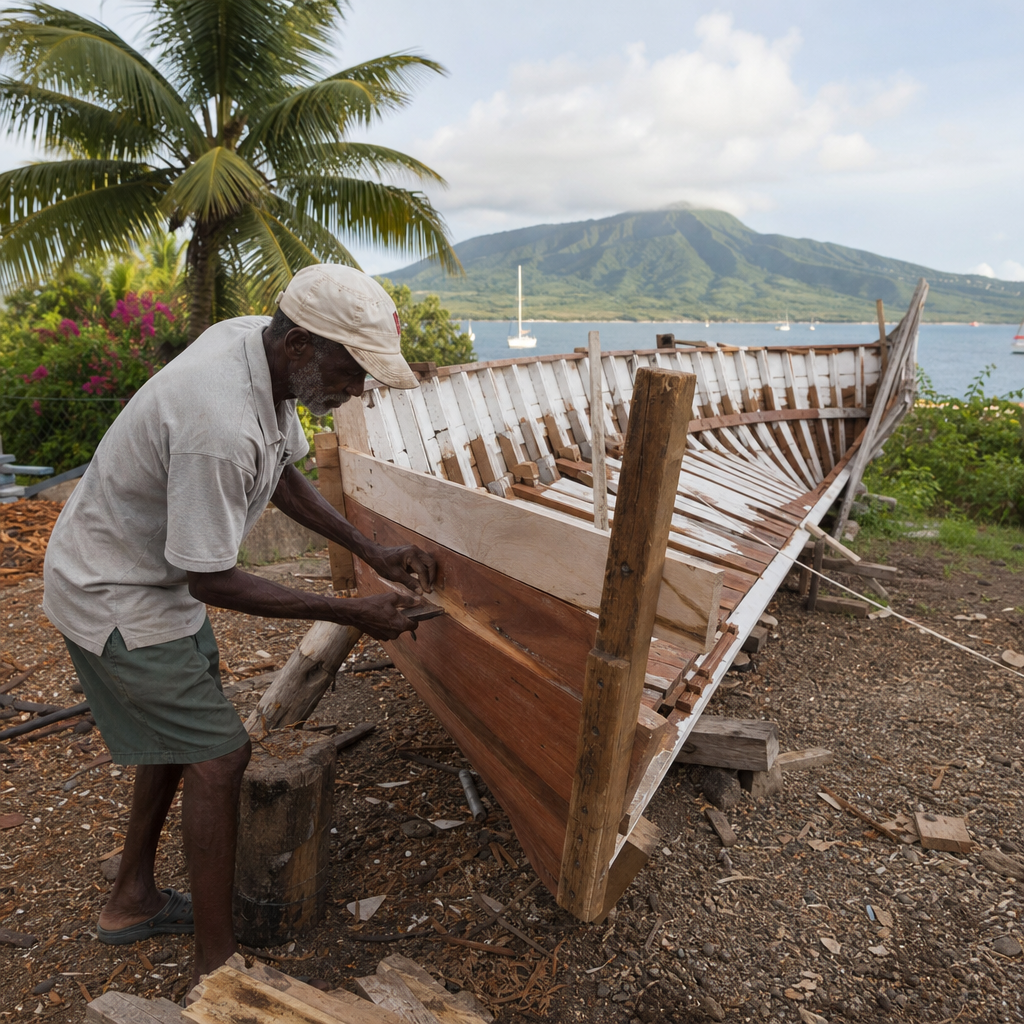
The process began with material choice. Builders typically favored durable local or regionally available hardwoods for keels, stems, frames, and planking, selecting pieces for grain orientation, resistance to rot, and bending qualities. Good timber selection was never random. A builder would inspect knots, moisture, straightness, and natural curves before deciding whether a piece belonged in a frame, stem, or sheer plank. That judgment is one of the hardest skills to preserve because it is visual, tactile, and learned slowly beside an experienced hand.
Construction usually started with the backbone: keel, stem, and stern structure. Frames or ribs established the hull’s form, then planks were fastened to create the skin. Depending on local practice, builders used nails, screws, roves, bolts, and traditional sealants. Caulking was critical. If seams were poorly packed or poorly maintained, the boat would leak, swell unevenly, and deteriorate quickly. Builders also had to consider weight. An overbuilt boat might last, but it could become difficult to launch or inefficient under power. An underbuilt one would work briefly and then fail in rough conditions.
Traditional construction was not static. Nevisian builders adapted as engines, imported fasteners, marine paints, and fiberglass entered the market. Many wooden workboats were modified for outboards, changing stern design and internal reinforcement. This is an important point for preservation: heritage does not mean freezing a boat in an imagined pure form. Real boat yards changed with technology. The goal is to document and sustain the craft tradition honestly, including the moments when builders modernized a proven wooden design.
| Boat building element | Traditional purpose | Why it matters for preservation |
|---|---|---|
| Keel and backbone | Provides structural alignment and strength | Shows core design logic and builder skill in hull balance |
| Frames or ribs | Shape the hull and distribute loads | Reveals local methods for strength, spacing, and timber use |
| Planking | Forms the outer skin and affects speed and buoyancy | Displays joinery, fastening techniques, and finishing practice |
| Caulking and sealing | Keeps the vessel watertight | Preserves maintenance knowledge often absent from written records |
| Stern adaptations | Supports sail, oars, or engines depending on era | Documents how Nevisian craft evolved with new technology |
Skills, Apprenticeship, and Oral Knowledge
Boat building knowledge in Nevis has historically been transmitted person to person, not manual to manual. Apprentices learned by sweeping shavings, carrying timber, holding planks in place, and listening closely while older builders explained why one board would split and another would bend cleanly after steaming or soaking. Measurements mattered, but so did proportion by eye. Many accomplished builders could sight a hull and identify imbalance before any formal testing. That kind of tacit skill is common in heritage trades and especially vulnerable when younger workers leave for other sectors.
Oral knowledge extends beyond workshop technique. Builders and fishers often shared information about swells, landing beaches, seasonal weather, and how different hulls behaved under load. These discussions shaped design choices. A boat intended for lobster traps or nearshore net fishing required different handling characteristics from one used for cargo or inter-island runs. In my experience documenting traditional craft communities, the richest details emerge not from official archives but from launch-day stories, repair debates, and remembered failures. Asking why a certain bow shape was preferred often opens a complete history of a coastline.
Preservation efforts should therefore record speech as carefully as objects. Audio interviews, filmed demonstrations, measured drawings, and photo documentation of repairs are all essential. If a heritage project saves one boat but ignores the builder’s explanations, it preserves the shell and loses the method. For Nevis, apprenticeship programs linked to schools, community workshops, and heritage organizations can turn memory into teachable practice.
Why Wooden Boat Traditions Declined
The decline of traditional boat building in Nevis followed patterns seen across the Caribbean. Fiberglass hulls became widely available, often requiring less day-to-day maintenance than wood. Imported materials changed cost structures. Younger workers found employment in construction, tourism, transport, or overseas migration, leaving fewer apprentices in workshops. Marine engines standardized some vessel needs, reducing the market for locally customized wooden boats. At the same time, access to quality timber became harder and more expensive, especially where environmental regulation, land-use change, or import costs limited supply.
Wooden boats also demand disciplined upkeep. Owners must monitor seams, fasteners, rot, marine borers, paint systems, and storage conditions. If boats are left uncovered, hauled improperly, or neglected between fishing seasons, deterioration accelerates. Fiberglass can crack and delaminate, but many owners perceive it as easier and cheaper over time. That practical judgment is understandable, which is why preservation advocates need balanced arguments. Traditional boats should be preserved because they carry irreplaceable heritage value, not because they are always the most efficient modern working craft.
Another challenge is status. In some communities, old wooden workboats came to be seen as signs of hardship rather than craftsmanship. Heritage work must address that perception directly. A hand-built wooden boat is not evidence of backwardness; it is evidence of adaptive engineering, local knowledge, and disciplined craft labor. Reframing that story is crucial if Nevis wants younger generations to value maritime heritage seriously.
Preservation Strategies That Work in Practice
Effective preservation starts with documentation. Nevis should identify surviving builders, repair specialists, fishers, and boat owners, then record hull types, dimensions, terminology, tools, and workshop practices. Measured surveys used by maritime museums and heritage trusts are especially useful because they create a permanent reference for future reconstructions. Standards from organizations such as UNESCO for safeguarding intangible cultural heritage, and guidance used by maritime museums in Britain, North America, and the wider Caribbean, show that craft traditions survive best when skills, stories, and objects are documented together.
Next comes active use. Boats preserved only as static artifacts often lose public relevance. Working demonstrations, community regattas, waterfront festivals, and school boatbuilding projects create visible value. A small heritage workshop where visitors can watch plank shaping or caulking would do more for public understanding than a text panel alone. Partnerships with the Nevis Historical and Conservation Society, local schools, tourism operators, fishers, and regional museums could support that work. Even a single pilot project, such as restoring one representative fishing boat with full video documentation, can establish a repeatable model.
Funding should be mixed. Heritage grants, tourism sponsorship, diaspora donations, and vocational training support can all contribute. The strongest projects tie preservation to education and economic use: internships for young carpenters, interpretive signage on beaches and jetties, oral history archives, and guided heritage tours centered on maritime life. This hub topic also connects naturally to related articles on fishing traditions, coastal settlements, island trade, oral history, and vernacular carpentry. Together, those subjects explain why traditional boat building in Nevis is not miscellaneous at all. It is a core part of how the island remembers work, skill, and survival by sea.
Traditional boat building in Nevis deserves recognition as a central part of the island’s culture and history because it preserves knowledge that cannot be replaced once lost. Wooden boats embody practical design, local materials, fishing economies, inter-island movement, and generations of observation about wind, surf, and shoreline conditions. They also reveal how communities adapted over time, from sail and oar to engine power, without abandoning the craftsmanship that made those vessels dependable. When preservation includes boats, builders, tools, vocabulary, and oral testimony, it protects both the object and the intelligence behind it.
The strongest lesson is simple: maritime heritage survives through use, teaching, and documentation together. Nevis does not need dozens of museum pieces to make progress. It needs a clear inventory of surviving craft, recorded interviews with experienced builders and fishers, at least one visible restoration project, and regular public programming that connects young people to the waterfront. Those steps can anchor broader work across the culture and history category, linking this hub to articles on fishing, trade, architecture, community memory, and traditional livelihoods. In that sense, preserving boat building strengthens the whole historical narrative of the island.
For residents, educators, researchers, and heritage organizations, the next step is practical: document what remains now, support the people who still hold the knowledge, and create opportunities for the craft to be seen and learned. If Nevis invests in that work, traditional boat building will remain more than a memory. It will continue as a visible, teachable expression of maritime heritage.
Frequently Asked Questions
What does traditional boat building in Nevis include beyond simply constructing a wooden boat?
Traditional boat building in Nevis involves far more than assembling timber into a seaworthy vessel. It includes the full chain of knowledge that surrounds the craft: choosing the right wood for strength, flexibility, and resistance to salt and sun; shaping the keel and hull by hand; fitting ribs and planks with careful joinery; sealing seams through caulking; balancing the boat for local waters; and preparing it for launching and long-term use. Each step reflects practical experience built over generations. Builders have historically understood how local currents, reef conditions, fishing grounds, and weather patterns influence design, so the final boat is closely matched to the island’s maritime environment.
Just as important, the craft preserves cultural memory. These boats were not isolated objects; they supported fishing livelihoods, short-distance trade, inter-village travel, family movement, and everyday exchange. As a result, traditional boat building carries stories about how Nevisians lived, worked, and related to the sea. The methods, tools, terminology, and even the rhythm of the work connect present-day communities to earlier generations. In that sense, preserving boat building means preserving a living archive of maritime heritage, not just an old technique.
Why is traditional boat building considered an important part of Nevis’s cultural and maritime heritage?
Traditional boat building matters in Nevis because it sits at the intersection of history, identity, and survival. On a small island, the sea has never been a backdrop; it has been a route, a workplace, a food source, and a defining force in community life. Wooden boats once linked settlements, carried produce and supplies, supported fishers, and enabled people to navigate daily needs long before modern transport and imported materials became common. The designs and construction methods developed in response to those realities, making each vessel a reflection of local conditions and local ingenuity.
It is also important because the craft preserves intangible heritage. Skills such as judging timber by feel, understanding hull balance through experience, reading shifting weather, and knowing how to launch and maintain a boat safely are rarely captured fully in manuals. They are typically passed from builder to apprentice, elder to youth, and family to community. When that chain of transmission is broken, a great deal disappears with it: vocabulary, techniques, work songs, problem-solving habits, and community values tied to patience, precision, and respect for the sea. Preserving traditional boat building therefore helps Nevis protect both its physical heritage and the knowledge system that shaped island life.
How were traditional wooden boats used in everyday life in Nevis?
Traditional wooden boats played a practical and often essential role in everyday life in Nevis. They were central to fishing, allowing generations of fishers to reach nearshore and offshore grounds, bring in catches for family use and local sale, and maintain a dependable connection to the island’s marine resources. In earlier periods, these boats also helped transport goods such as produce, provisions, and materials between coastal communities and to nearby markets. For many families, boats were part of the basic infrastructure of life, supporting income, food security, and local trade.
Beyond economics, boats were woven into social and cultural life. They carried people to visit relatives, attend events, and maintain relationships across coastal areas. Launching a boat, repairing it, or preparing it for a fishing trip often involved shared labor and community cooperation. In this way, boats were not just tools; they were part of a network of social exchange and mutual support. Their design reflected these functions, balancing durability, cargo capacity, stability, and handling in local sea conditions. Understanding how these vessels were used helps explain why traditional boat building remains so significant: it speaks directly to how Nevisian communities adapted to island geography and marine life.
What traditional knowledge is at risk if boat building practices in Nevis are not preserved?
If traditional boat building in Nevis is not preserved, the loss would extend well beyond the disappearance of handcrafted wooden vessels. At risk are generations of practical knowledge related to timber selection, shaping and bending wood, hull proportions, fastening methods, seam sealing, and the maintenance routines needed to keep a boat safe in a harsh marine environment. These are highly specialized skills, often learned through observation and repeated hands-on work rather than formal instruction. Once experienced builders are gone, recreating that depth of embodied knowledge becomes extremely difficult.
Equally vulnerable is the environmental understanding tied to the craft. Traditional builders and seafarers often possess detailed knowledge of seasonal winds, currents, coastal hazards, wave behavior, and weather signs that influence how a boat should be designed and used. They know why one form handles chop better, why another suits fishing in a particular area, and how construction choices affect performance and safety. Also at risk are the cultural dimensions of the tradition: local terminology, oral histories, community practices around building and launching, and the pride associated with making something durable by hand. Preserving boat building in Nevis therefore protects technical skill, ecological knowledge, and cultural identity all at once.
How can Nevis preserve and promote traditional boat building for future generations?
Preserving traditional boat building in Nevis requires both documentation and active practice. Recording interviews with elder builders, photographing and measuring surviving boats, and documenting tools, materials, and construction stages are all important first steps. However, preservation is strongest when the craft remains in use rather than only in archives. Apprenticeship programs, school partnerships, community workshops, and heritage demonstrations can help younger generations learn directly from experienced craftsmen. Creating opportunities for hands-on learning is especially valuable because boat building depends on tactile judgment, patience, and repetition.
Promotion also matters. Heritage festivals, museum exhibits, waterfront demonstrations, and cultural tourism programs can raise public awareness while giving builders recognition and economic support. Local institutions can encourage restoration projects, sponsor model-building and maritime education programs, and incorporate Nevis’s seafaring history into broader cultural initiatives. Support for sustainable access to appropriate timber and traditional materials may also be necessary, as modern supply challenges can make heritage construction harder to sustain. Most importantly, preservation efforts should treat traditional boat building as a living community practice rather than a frozen relic. When residents, educators, heritage groups, and policymakers work together, Nevis can protect this maritime tradition in a way that honors the past while keeping it relevant for the future.