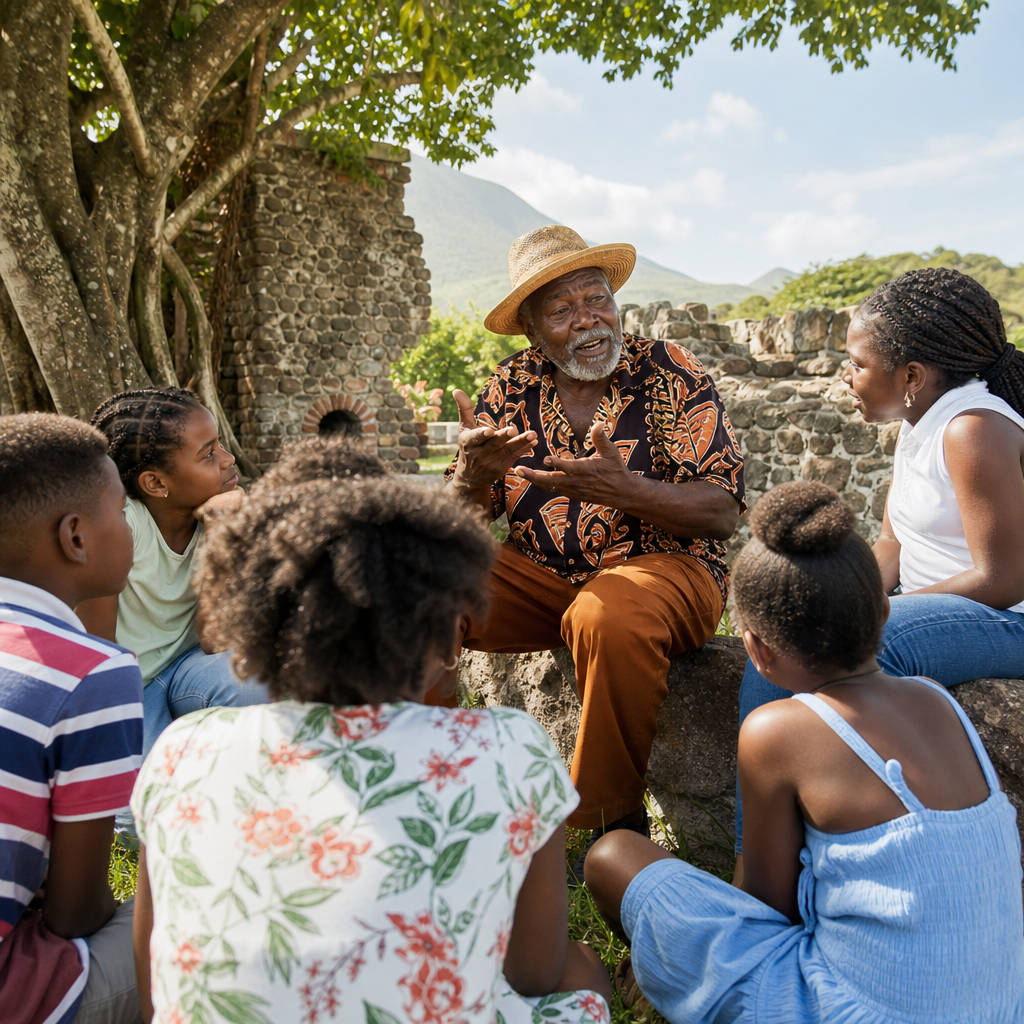
Saint Kitts’ folklore and storytelling traditions preserve the island’s memory in forms that are vivid, communal, and deeply tied to everyday life. Folklore includes legends, folktales, proverbs, songs, masquerade characters, ghost stories, work chants, and the small moral lessons embedded in ordinary conversation. Storytelling is the practice that keeps those materials alive: a grandmother on a gallery at dusk, a market vendor repeating a cautionary saying, a festival performer dramatizing ancestral memory, or a teacher using an old tale to explain character and consequence. On Saint Kitts, these traditions matter because they connect African inheritance, European colonial history, Christian influence, plantation society, migration, and modern nationhood into a living cultural archive. They do not survive only in books or museums. They continue through speech, performance, humor, ritual, and community gatherings. In my experience working with Caribbean cultural material, Saint Kitts stands out for how naturally folklore moves between generations and settings, from village conversation to classroom projects and national celebrations. For readers exploring the island’s culture and history, this subject is a useful hub because it touches language, religion, music, carnival arts, oral history, and social values all at once.
What Saint Kitts folklore includes and where it comes from
Saint Kitts folklore is best understood as a layered tradition shaped by encounter and survival. The island, formally known as Saint Christopher or Saint Kitts, experienced Indigenous presence, British and French contestation, plantation expansion, slavery, emancipation, and later labor change and migration. Folklore developed within that history. Many stories carry patterns found across the wider Afro-Caribbean world: the clever trickster who defeats stronger opponents, spirits that warn against arrogance or disrespect, and cautionary tales about greed, gossip, jealousy, and wandering at night. These motifs were not random entertainment. They offered encoded instruction in communities where formal power was unequally distributed and literacy was once limited by design.
African retentions are especially important. In Saint Kitts, as elsewhere in the Caribbean, enslaved Africans and their descendants preserved worldview, rhythm, oral technique, and symbolic thinking even when direct ethnic continuities were fragmented by the slave trade. The trickster tradition, animal wisdom tales, call-and-response storytelling, performative exaggeration, and proverb-rich speech all reflect that heritage. European ballad forms, Biblical references, and colonial ghost lore entered the mix as well, producing stories that feel distinctly Kittitian rather than simply imported. This blending explains why one tale may sound African in structure, Christian in moral framing, and local in setting, naming an actual village road, ravine, estate, or silk-cotton tree.
Folklore on Saint Kitts also includes verbal forms beyond narrative. Proverbs and sayings are central because they condense social knowledge into memorable speech. Older speakers often settle an argument or advise a child with a line that carries more force than a direct lecture. Riddles once played a larger role in evening gatherings, sharpening memory and wit while entertaining children. Songs connected to labor, religion, seasonal celebration, and carnival performance function as storytelling too, because they preserve names, events, emotions, and local commentary. When researchers document folklore responsibly, they look beyond “once upon a time” tales and treat the full oral environment as evidence of how a society explains itself.
Key characters, supernatural beliefs, and recurring story patterns
Several recurring figures organize Saint Kitts storytelling. The trickster is among the most durable. Sometimes represented through animals, sometimes through a sly human character, the trickster survives by intelligence rather than force. In plantation societies, that pattern carried practical emotional value. Listeners living under restriction understood the appeal of someone who outtalked authority, escaped punishment, or turned a stronger rival’s pride against him. The laughter these stories generated was part of their function. Humor became a social release and a subtle commentary on power.
Supernatural beings and haunted places also feature strongly. Stories about jumbies, duppies, or restless spirits remain familiar across many Caribbean islands, and Saint Kitts has its own localized versions. Such tales often attach to crossroads, cemeteries, abandoned estate buildings, old great houses, deep gullies, and large trees. They are cautionary in several senses. They discourage children from roaming after dark, reinforce respect for the dead, and mark certain places as morally charged because of history. An abandoned plantation site, for example, is never just an empty ruin in folklore. It is a space where labor, violence, wealth, and memory linger together.
Another recurring pattern is metamorphosis or disguise. A harmless-looking traveler may become something else at night. A beautiful woman may be associated with danger. A boastful man may discover that he has challenged forces beyond ordinary understanding. These plots teach restraint. They remind listeners that appearances can deceive and that confidence without wisdom is risky. In oral performance, storytellers heighten these turns with pause, lowered voice, repetition, and strategic use of dialect, making the revelation feel immediate rather than literary.
The moral center of Saint Kitts folklore is rarely simplistic. Good is not always rewarded quickly, and wrongdoing is not always punished in a tidy way. Instead, stories stress consequences, reputation, reciprocity, and community judgment. A person who mocks elders, disrespects custom, wastes food, or betrays trust may not face legal punishment, but folklore ensures that such behavior has narrative cost. That makes the tradition practical. It trains social perception by showing how private choices become public memory.
| Folklore element | Typical function | Saint Kitts context |
|---|---|---|
| Trickster tale | Rewards wit over strength | Echoes plantation-era inequality and survival skills |
| Jumbie or spirit story | Warns, disciplines, explains danger | Linked to estates, roads, cemeteries, and night travel |
| Proverb | Condenses advice into memorable speech | Used in homes, markets, schools, and disputes |
| Masquerade character | Performs history through costume and movement | Visible in carnival and Christmas traditions |
| Riddle or wordplay | Tests intelligence and memory | Traditionally shared in family and village gatherings |
Performance traditions: masquerade, festivals, and spoken memory
To understand Saint Kitts storytelling, it is not enough to read collected tales; you must also look at performance. The island’s masquerade traditions, carnival expressions, and Christmas season practices carry narrative meaning in costume, rhythm, choreography, and comic exchange. Performers do not simply entertain. They embody cultural memory. Costumed groups can reference social rank, colonial spectacle, African-derived performance logic, and village pride at the same time. The result is storytelling without a single narrator.
Masquerade on Saint Kitts has long been one of the clearest examples of this embodied folklore. Distinctive costumes, headdresses, whips, ribbons, and dance patterns create a dramatic language that audiences learn to read. The performance often combines elegance and force, discipline and improvisation. In practical terms, it tells a story about continuity: a people taking inherited fragments and turning them into a recognizable national form. That is why carnival arts belong in any serious discussion of folklore. They are archives in motion.
Music strengthens that archive. Drum-led performances, string band influences, choruses, and call-and-response structures keep oral tradition participatory. A story told in a ring, on a roadside, or during a community event invites interruption, laughter, correction, and repetition. That collective shaping is essential. Unlike printed literature, folklore remains open to local emphasis. A storyteller in one district may frame a ghost story as a lesson in respect; another may play up the comedy; a third may anchor it to a known family anecdote. Variation does not weaken authenticity. It proves that the tradition is active.
Festivals create particularly strong conditions for transmission because they bring generations together. Children encounter characters first as spectacle, then later learn the histories behind them. Adults fill gaps with explanation: why a costume matters, what a chant once meant, why a route passes a certain place, why an old joke still lands. This intergenerational annotation is how folklore survives modernization. Even when phones, streaming media, and tourism alter attention spans, festival performance still creates memorable cultural contact that written summaries alone cannot replace.
Language, proverbs, and the social work of oral tradition
Language is one of the strongest carriers of Saint Kitts folklore. Kittitian Creole, alongside standard English, shapes rhythm, tone, humor, and authority. Certain ideas work best in the local speech register because meaning depends on cadence, emphasis, and social context. A proverb delivered in dialect can settle a conversation with precision that translation often dulls. Researchers and educators who ignore this point miss the core of oral tradition: the message is inseparable from the way it is spoken.
Proverbs do important social work. They guide behavior without direct confrontation, which is especially useful in close communities where preserving relationships matters. Instead of saying someone is impatient, wasteful, or disrespectful, a speaker may use a proverb that lets the listener reach the conclusion personally. That indirectness is not evasive. It is culturally efficient. It protects dignity while still delivering criticism or guidance. In village life, workplaces, churches, and family networks, this form of speech helps maintain order and mutual understanding.
Storytelling also preserves local history where formal archives are incomplete or silent. Older residents may remember estate names, labor struggles, migration routes, storms, fires, unusual deaths, or community disputes through stories that circulate informally for decades. Oral accounts require careful handling because memory can compress timelines or embellish events. Yet they remain indispensable. On islands where written records were often produced by colonial administrators, planters, missionaries, or later officials, folklore provides perspective from below. It records how ordinary people interpreted the same world.
In practical cultural work, I have seen proverbs and oral narratives function as bridges in heritage education. Students who seem indifferent to a list of historical dates often engage immediately when a teacher starts with a local saying, a family ghost story, or a carnival character they recognize. From there, deeper discussions become possible: enslavement, emancipation, land use, class hierarchy, migration, and identity. Folklore opens the door because it feels owned rather than imposed.
Preservation, research, and why this hub matters today
Preserving Saint Kitts folklore now requires more than nostalgia. Oral traditions everywhere face pressure from urbanization, migration, changing family structure, and the dominance of digital media. When fewer children spend evenings listening to elders, transmission weakens. When performers age without apprentices, embodied knowledge can disappear quickly. Preservation therefore depends on active documentation and use. Schools, cultural organizations, libraries, festival committees, community historians, and media producers all have roles to play.
Good preservation starts with recording elders accurately and respectfully. Audio and video interviews should capture not just plot but voice, pronunciation, gesture, setting, and audience reaction. Transcription matters, but so does contextual annotation: where the tale was heard, who usually told it, what words are difficult to translate, and what event or place the story references. Regional institutions such as the University of the West Indies, national archives, heritage departments, and local museums can help standardize collection methods, but community trust is the deciding factor. People share better material when they believe it will not be distorted or stripped of meaning.
This hub matters because “miscellaneous” cultural material is often where the deepest connections live. A single folktale may lead readers to articles on carnival, language, rural life, plantation history, religion, music, education, and family structure. A ghost story attached to an estate can lead into architecture and slavery-era memory. A proverb can open questions about social etiquette and conflict resolution. That is why folklore works so well as a sub-pillar under culture and history: it links subjects that are too often treated separately.
Saint Kitts’ folklore and storytelling traditions remain valuable because they teach the island from the inside out. They show how people remembered hardship, mocked power, disciplined children, honored ancestors, and made meaning from place. For readers, the key takeaway is simple: to understand Saint Kitts fully, pay attention to the stories people tell, the sayings they repeat, the characters they perform, and the silences they mark with respect. Explore related articles across this culture and history hub, and use folklore as your guide to the wider life of the island.
Frequently Asked Questions
What makes Saint Kitts’ folklore and storytelling traditions so important to the island’s culture?
Saint Kitts’ folklore and storytelling traditions matter because they preserve the island’s memory in forms people can actually live with, repeat, and recognize in everyday life. Folklore is not limited to old tales told for entertainment; it includes proverbs, songs, ghost stories, masquerade performances, cautionary sayings, work chants, and small moral lessons passed along in ordinary conversation. Together, these forms carry values, humor, survival strategies, social criticism, and community history. In a place where so much knowledge has historically been transmitted orally, storytelling becomes one of the main ways people keep the past present.
These traditions are also important because they connect generations. A story told by an elder on a gallery at dusk is not just a performance; it is a transfer of worldview. Children learn how to listen, when to laugh, what to fear, and what kinds of behavior the community respects or rejects. Adults hear familiar themes repeated in new ways, which keeps old lessons adaptable rather than frozen in time. In that sense, storytelling is both preservation and renewal. It keeps cultural memory active by making it social, vivid, and emotionally memorable.
Just as importantly, folklore in Saint Kitts reflects the island’s lived realities. The stories often emerge from labor, family life, spirituality, celebration, hardship, and resilience. They can warn against pride, praise cleverness, expose greed, or explain why people should move carefully through both the visible and invisible worlds. Because these lessons are wrapped in memorable images and dramatic characters, they remain powerful long after a formal lecture would be forgotten. That is why folklore and storytelling continue to hold cultural authority: they speak in the language of community experience.
What kinds of folklore are commonly found in Saint Kitts’ storytelling traditions?
Saint Kitts’ folklore is broad, layered, and highly communal. It includes legends rooted in place, folktales featuring trickery or moral reversals, ghost stories that blur the line between spiritual warning and entertainment, and proverbs that condense generations of practical wisdom into a few striking words. Songs and work chants also belong to this tradition, especially because they preserve shared rhythms of labor, movement, and memory. In addition, festival expressions such as masquerade characters carry folklore through costume, dance, performance, and symbolic behavior rather than through spoken narrative alone.
One of the most important things to understand is that folklore does not exist only in special ceremonial settings. It appears in daily speech. A market vendor repeating a cautionary phrase, a parent using a proverb to settle a dispute, or an elder slipping a short moral lesson into casual conversation are all participating in the same cultural process. That everyday quality is part of what gives Kittitian folklore its strength. It is woven into the ordinary, so it remains familiar rather than distant.
There is also a strong performative element. Some stories are told quietly and intimately, while others are dramatized in public during festivals or communal gatherings. Masquerade traditions, for example, do more than entertain; they embody memory, identity, movement, and historical continuity. Even ghost stories and supernatural accounts often serve multiple functions at once: they thrill listeners, mark certain places as meaningful, and reinforce codes of caution or respect. Altogether, the folklore of Saint Kitts is best understood not as a single set of old tales, but as a living system of narrative, music, performance, and spoken wisdom.
How is storytelling traditionally passed down in Saint Kitts?
Storytelling in Saint Kitts has traditionally been passed down through oral transmission, which means people learn it by hearing, repeating, adapting, and performing it within family and community settings. The classic image is an elder telling stories in the evening, but the process is wider than that. Storytelling happens on galleries, in yards, at roadside gatherings, in markets, during work, and at festivals. It is learned through listening closely to timing, tone, repetition, gesture, and audience response. In oral cultures, the story itself matters, but so does the way it is delivered.
This method of passing stories down allows tradition to remain stable while still changing with each generation. A grandmother may tell a ghost story one way, while a younger storyteller retells it with different details, updated language, or added humor. The core lesson or emotional effect often remains intact, but the form stays flexible enough to speak to new audiences. That adaptability is one reason oral traditions endure. They are not preserved by remaining untouched; they survive by remaining useful and memorable.
Communal participation is another key feature. Storytelling is often interactive rather than one-directional. Listeners respond with laughter, surprise, caution, or correction. Someone may interrupt to add a proverb, challenge a detail, or confirm that a certain place or person is connected to the tale. In this way, the community helps authorize the story while also shaping it. Storytelling is therefore both inheritance and performance. It teaches not only content, but also social belonging: who gets to speak, who remembers, who listens, and how shared memory is kept alive through repetition.
What role do moral lessons and proverbs play in Kittitian folklore?
Moral lessons and proverbs are central to Kittitian folklore because they distill experience into forms that are easy to remember and hard to ignore. A full folktale may illustrate the consequences of greed, pride, carelessness, dishonesty, or arrogance, while a proverb captures that same lesson in a sharp, portable phrase. These sayings are practical tools. People use them to advise children, comment on behavior, settle disagreements, and point out truths without giving a long lecture. In that way, proverbs make folklore instantly usable in daily life.
What makes these moral elements especially effective is that they rarely feel abstract. The lesson is usually grounded in familiar situations: how to treat others, when to be cautious, why humility matters, or how foolishness can bring trouble. Even ghost stories and supernatural tales often carry a moral center, warning listeners not to wander carelessly, disrespect certain boundaries, or ignore community wisdom. The message may be delivered humorously, dramatically, or indirectly, but it is still teaching something important.
There is also a cultural sophistication in how these lessons are delivered. Folklore does not simply tell people what to think; it invites them to interpret. A proverb may sound simple, but its meaning depends on context. A folktale may entertain children while offering adults a deeper commentary on power, deception, or social behavior. This layered quality is part of the authority of Kittitian storytelling. It respects the listener’s intelligence while still providing guidance. That is why moral lessons and proverbs remain enduring features of the tradition: they carry wisdom in forms that are conversational, memorable, and deeply rooted in community life.
How are Saint Kitts’ folklore and storytelling traditions kept alive today?
These traditions are kept alive today through a combination of family memory, public performance, community celebration, and cultural pride. Elders still play a major role by passing along stories, sayings, and beliefs in informal settings, but preservation no longer depends on the household alone. Festivals, school programs, heritage events, performers, musicians, and cultural organizations all help keep folklore visible and meaningful. Masquerade traditions, dramatic retellings, song, and oral performance continue to give old materials new life in public spaces.
Another reason these traditions endure is that they still speak to current realities. Folklore survives best when it is not treated as a museum object. In Saint Kitts, storytelling remains relevant because it continues to offer humor, warning, identity, and perspective. A proverb can still summarize a modern dilemma. A traditional character can still carry symbolic meaning in a festival setting. A ghost story can still shape how people think about place, memory, and the unseen. When folklore remains connected to lived experience, people do not just preserve it; they use it.
There is also growing recognition that storytelling is a form of cultural heritage worth documenting and celebrating. As communities become more aware of the need to protect intangible heritage, oral traditions gain new importance. Recording stories, teaching younger generations about local expressive forms, and making space for traditional performance all strengthen continuity. At the same time, the heart of the tradition remains the same: one person telling, another listening, and a shared sense that these stories carry more than entertainment. They carry the voice of the island itself.