Saint Kitts’ historical festivals reveal the island’s identity more clearly than any brochure, because each celebration carries traces of African heritage, European colonial rule, Christian ritual, labor history, and modern nationhood. On an island of roughly 47,000 people, public festivities are not minor calendar notes; they are communal stages where memory is performed, argued over, and renewed. When travelers ask what to see beyond beaches and fortresses, I often point them to the festival calendar first, because it explains how Kittitians understand themselves.
In Saint Kitts, a historical festival is more than an annual party. It is a recurring event shaped by the island’s past, usually tied to emancipation, Christmas customs, carnival arts, church traditions, agricultural rhythms, or national milestones. Some are highly organized national productions with committees, pageants, and parade routes. Others survive through village practice, family participation, drumming, masquerade performance, street food, and church observance. Together, they form a living archive. You can read dates in a museum, but you hear history in iron bands, taste it in goat water, and watch it in the steps of masqueraders.
This matters because Saint Kitts has undergone profound transitions: Indigenous displacement, plantation expansion, slavery, emancipation, indentureship, the rise and closure of the sugar industry, and independence in 1983. Festivals help people process these changes. They preserve local vocabulary, costume traditions, dance forms, and social hierarchies, while also making room for revision. A national carnival can celebrate resilience and simultaneously expose tensions about commercialization, class, tourism, and authenticity. Understanding the festival year therefore gives readers a practical guide to the island and a deeper understanding of Caribbean cultural continuity.
As a hub for Saint Kitts culture and history, this overview maps the major annual celebrations, explains what each one commemorates, and shows how seemingly miscellaneous events connect into one cultural system. If you want the short answer, here it is: the island’s historical festivals matter because they turn the past into public experience, and they remain one of the clearest ways to understand Saint Kitts today.
Carnival and the Christmas season: the island’s biggest historical stage
The most important festival cycle in Saint Kitts is the Christmas season carnival, officially known as Sugar Mas. Although visitors often see it simply as a Caribbean street party, its historical layers are substantial. The season usually opens in November and builds through December into New Year celebrations, including pageants, jouvert-style revelry, calypso and soca competitions, parades, and folklore performances. The very name “Sugar Mas” points directly to the island’s plantation past. Sugar dominated the Kittitian economy for centuries, structuring labor, land ownership, social rank, and settlement patterns until the sugar industry closed in 2005.
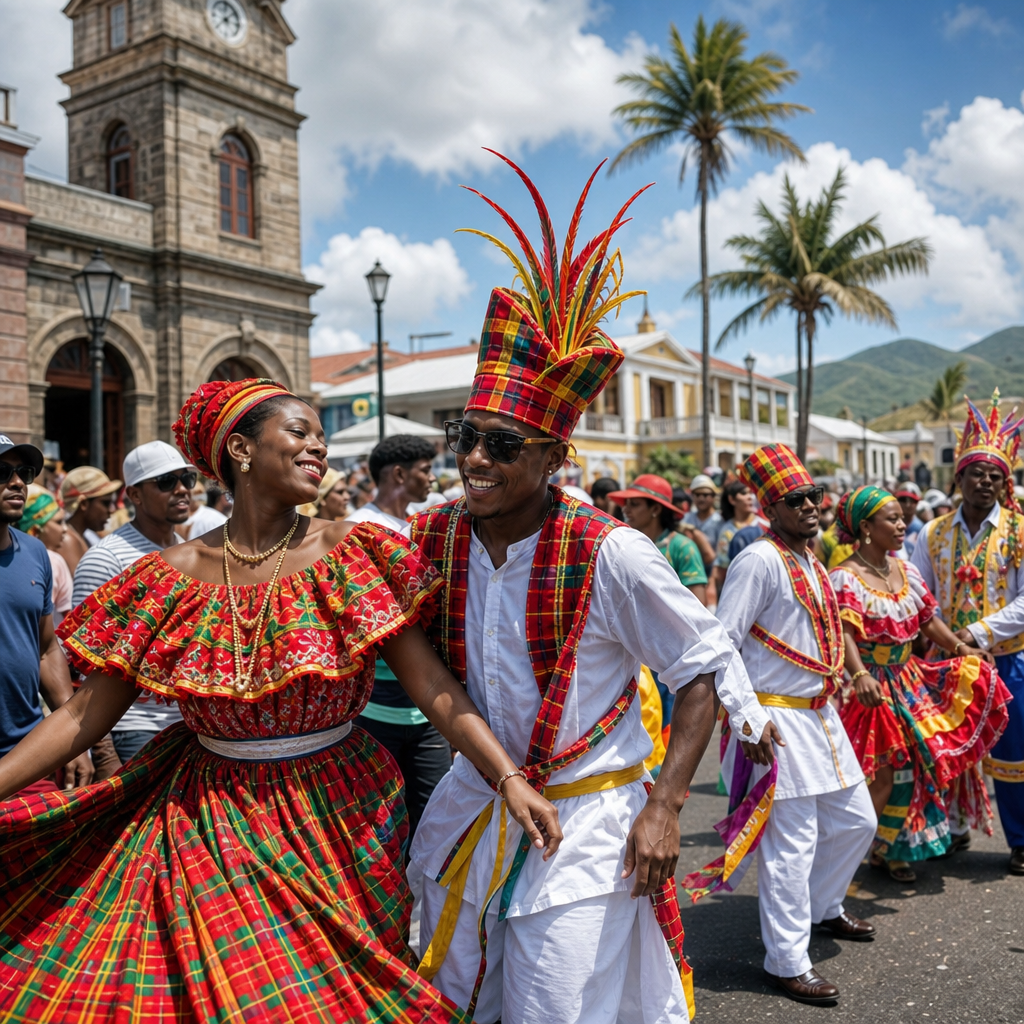
Carnival developed through the encounter between European pre-Lenten masquerade traditions and African expressive forms carried and reshaped by enslaved people. In Saint Kitts, this blend created a festival language that includes satire, costuming, dance, drumming, and processional display. What makes the local version especially valuable historically is the persistence of traditional masquerade troupes alongside modern carnival bands. On parade days, audiences may see elaborately feathered sections inspired by contemporary Caribbean carnival aesthetics, then turn and find clowns, moko jumbies, actors, and masquerades whose movements preserve older community practice.
From years of observing Caribbean festival organization, I have found that Sugar Mas functions as both archive and adaptation machine. The state, private sponsors, schools, villages, and artistic associations all use the season to project an idea of national culture. Yet the most memorable moments often come from grassroots performance traditions that do not feel curated for outsiders. A children’s costume troupe, an iron band on a roadside, or a calypsonian delivering social critique can express the island’s history with more force than an official speech.
For readers planning around the calendar, Sugar Mas is the best single entry point into Saint Kitts’ historical festivals because it gathers multiple strands at once: colonial legacy, emancipation memory, folk performance, Christian seasonality, and modern nation branding.
Traditional masquerade, clowning, and street performance
To understand Saint Kitts’ festival culture, you need to understand the traditional performers who animate it. The island’s masquerade is not merely decorative entertainment. It is a disciplined form with specific costume elements, rhythms, and choreographic patterns. Performers commonly wear brightly colored shirts and trousers, ribbons, mirrors, masks, and decorated headdresses. Their dance combines military-style formations with agile footwork, body bends, and dramatic gestures, a mixture scholars across the Eastern Caribbean connect to both West African retention and colonial-era martial display.
Clown troupes and stilt walkers, often grouped within the same broad festive universe, also carry historical meaning. Moko jumbies, the famous stilt performers found across parts of the Caribbean, are widely associated with West African spiritual and protective symbolism. In Saint Kitts, their height transforms them into commanding public figures, able to survey the crowd and create spectacle at once. Clowns, meanwhile, can embody mischief, inversion, and social release. Their colorful costumes and energetic movement bring a comic force that lightens the parade while echoing older ritualized play traditions.
These performers matter because they preserve community knowledge that is hard to document in text alone. A masquerade routine is learned through repetition, correction, and memory. Costume construction requires local craft knowledge. Drum patterns and fife accompaniment depend on musicians who know exactly how to support movement. When a troupe appears at carnival, village feasts, or holiday events, it is transmitting inherited technique. If that chain breaks, recovery is difficult.
In practical terms, anyone studying Saint Kitts’ historical festivals should look beyond the headlining concerts and watch how these street forms are staged, who teaches them, and where young performers enter. That is where continuity is most visible.
National dates, public memory, and civic celebration
Not every historical festival in Saint Kitts is a carnival event. Several important commemorative dates structure the national year and reveal how public memory is organized. Independence Day, observed on 19 September, marks the federation’s separation from Britain in 1983. While it is a state occasion rather than a folk festival in the narrow sense, it includes ceremonies, cultural showcases, school activities, music, and civic displays that reinforce national identity. In a small island state, these events are not abstract protocol. They are highly visible moments when flags, uniforms, speeches, and performances combine to define belonging.
Emancipation observances also matter deeply, even when they are less commercially visible than carnival. Across the British Caribbean, emancipation on 1 August 1834 ended slavery legally, though apprenticeship systems and structural inequality persisted. In Saint Kitts, emancipation memory appears through lectures, church services, heritage programming, ancestral reflection, and artistic performance. The point is not simply to remember a date. It is to interpret how freedom was won, limited, and expanded over generations.
Public holidays such as National Heroes Day similarly contribute to the historical festival landscape by elevating specific figures and values. They create recurring opportunities for schools, heritage groups, and media outlets to revisit stories of leadership, struggle, and reform. This matters because festivals are not always loud. Some of the island’s most important commemorations operate through ceremony, assembly, and educational programming rather than road marches.
| Celebration | Typical Time | Historical focus | What visitors and residents see |
|---|---|---|---|
| Sugar Mas | November to early January | Plantation legacy, folk arts, Christmas season | Parades, calypso, pageants, masquerades, street celebrations |
| Emancipation observances | Late July to early August | End of slavery in 1834 and freedom struggles | Lectures, services, cultural programs, heritage reflection |
| Independence activities | September | Nationhood since 1983 | Ceremonies, performances, school and civic events |
| Easter traditions | March or April | Christian ritual and family custom | Church events, community gatherings, seasonal foods |
Taken together, these occasions show that Saint Kitts commemorates history through both spectacle and ceremony. Anyone researching miscellaneous cultural celebrations should include national days, because they shape how the island narrates itself to citizens and to the wider Caribbean.
Religious festivals and seasonal customs
Christian observances are essential to Saint Kitts’ annual rhythm, not only because churches remain influential, but because many secular festivals grew around religious calendars. Christmas in particular is inseparable from the island’s wider festive culture. Church services, family gatherings, music, food sharing, and neighborhood visiting all contribute to the season in ways that support the public carnival. The result is a blended celebration in which sacred observance and popular festivity coexist rather than cancel each other out.
Easter is another significant marker. Across Saint Kitts, Holy Week and Easter weekend bring church attendance, family meals, and local recreation. Even when the activities appear quiet compared with Sugar Mas, they carry historical continuity. These observances reflect the long imprint of Anglican, Methodist, Catholic, Moravian, and other Christian traditions established during the colonial period and localized over generations. They also show how Kittitian cultural life has never been only performance-based; it is equally rooted in worship, kinship, and seasonal repetition.
Village patronal celebrations, harvest thanksgivings, and church anniversaries may seem minor from outside, but they often preserve very old patterns of social organization. A church anniversary can become a de facto village homecoming, complete with special dress, communal cooking, music, speeches, and remembrance of elders. That blend of devotion and reunion is historically important because churches frequently served as centers of education, mutual aid, and leadership, especially in communities shaped by plantation inequality.
When readers explore Saint Kitts festivals comprehensively, these religious and seasonal events belong in the picture. They may not dominate travel advertising, yet they sustain the island’s deepest habits of collective time.
Food, music, and the afterlife of the sugar economy
No account of Saint Kitts’ historical festivals is complete without food and music, because they carry history in forms people immediately feel. Festival menus often feature dishes such as goat water, saltfish, cook-up style combinations, provisions, black pudding, and seasonal sweets. These foods reflect scarcity, ingenuity, African culinary inheritance, and plantation-era provisioning systems. They also mark celebration. What appears on a table during a major holiday says a great deal about class mobility, agricultural change, and family memory.
Music does the same. Calypso remains one of the island’s strongest vehicles for historical commentary. At its best, it is journalism, satire, and political analysis set to melody. A good calypsonian can summarize a year’s controversies, expose hypocrisy, and preserve public sentiment in a way formal archives rarely can. Soca, while more oriented toward dance energy, still anchors communal release and carnival identity. Brass, drumming, string-band influences, and iron-band textures further enrich the soundscape.
The sugar economy’s afterlife is especially visible here. Even after the industry’s closure, its vocabulary, labor history, and social geography remain embedded in festivals. Former estate villages still produce performers and audiences whose family histories are tied to cane work. The term Sugar Mas itself keeps that memory in circulation. This is one reason historical festivals in Saint Kitts are not nostalgic relics. They are active ways of processing an economy that built the island and left deep inequalities behind.
For cultural travelers and researchers alike, listening closely to lyrics and watching what is cooked, sold, and shared can reveal as much as any formal monument. Festivals turn economic history into something audible and edible.
Why these celebrations remain central to Saint Kitts today
Saint Kitts’ historical festivals endure because they do several jobs at once. They entertain, educate, attract diaspora returnees, support vendors, train young performers, and keep difficult history visible without freezing it in museum language. They also create a sense of continuity on an island navigating tourism development, migration, and changing media habits. A teenager entering a masquerade troupe, a family attending an emancipation lecture, and a visitor watching Independence performances are all participating in the same broad civic process: the annual reassembly of collective memory.
There are tradeoffs. Commercial sponsorship can push festivals toward spectacle at the expense of tradition. Imported music trends can overshadow local forms. Tourism marketing can flatten complex history into easy imagery. Yet the strongest Kittitian celebrations have proven adaptable precisely because communities insist on retaining recognizable local elements. That resilience is the main lesson of the island’s festival year.
If you want to understand Saint Kitts beyond scenery, follow its celebrations month by month. Start with Sugar Mas, pay attention to traditional masquerade, include emancipation and independence observances, and do not ignore church-centered seasonal customs. Together they explain how history lives in public. Use this hub as your starting point, then explore each festival in greater detail to see how Saint Kitts turns remembrance into celebration year after year.
Frequently Asked Questions
What makes Saint Kitts’ historical festivals so important to understanding the island?
Saint Kitts’ historical festivals matter because they do far more than entertain. They act as living archives of the island’s past, preserving layers of experience that stretch from African cultural inheritance and European colonialism to Christian observance, plantation labor, emancipation, and independence-era identity. In a small society, public celebration has unusual weight. Festivals are places where history is not simply remembered in museums or monuments, but sung, danced, paraded, debated, and reinterpreted in front of the community itself.
That is especially true in Saint Kitts, where celebrations often blend sacred and secular traditions. A holiday might include church services, folkloric performance, family gatherings, street revelry, and national symbolism all at once. This overlap reflects the island’s real history: no single influence stands alone. Instead, historical festivals reveal how Kittitians have continuously adapted outside influences and transformed them into something local, resilient, and distinctly their own.
For visitors, this means festivals provide a fuller picture of the island than a scenic tour alone ever could. Beaches and heritage sites show where history happened, but festivals show how that history still lives in people’s voices, food, costume, music, and public rituals. They are among the clearest windows into Saint Kitts’ identity because they turn memory into a shared annual event rather than a distant chapter in a book.
Which festival best represents Saint Kitts’ blend of history, culture, and modern identity?
If one festival most clearly captures Saint Kitts’ ability to carry its past into the present, it is usually Carnival, locally known as Sugar Mas. While it is often associated with bright costumes, music, and high-energy street celebration, its roots are much deeper than spectacle. Sugar Mas developed in a society shaped by the sugar plantation economy, colonial hierarchy, African-descended creativity, and the social transformations that followed emancipation and modern nationhood. Its very name points back to the central economic force that defined life on the island for centuries.
What makes Sugar Mas historically rich is its layered character. It includes masquerade traditions, performance forms tied to African and Creole expression, and public pageantry that reflects both inherited customs and newer national pride. The festival season often unfolds around Christmas and New Year, connecting it to older religious calendars while also making it a major civic and cultural event. In that sense, it is not just a party; it is a yearly negotiation between memory and reinvention.
For travelers trying to understand Saint Kitts, Sugar Mas offers a concentrated view of how the island presents itself to itself. You see elegance and satire, discipline and spontaneity, community pride and historical echo. It is one of the most powerful examples of how a festival can be both celebratory and historical at the same time, carrying traces of plantation-era realities, postcolonial confidence, and the ongoing creativity of Kittitian society.
How do Saint Kitts’ festivals reflect African heritage and European colonial influence at the same time?
Saint Kitts’ historical festivals reflect both African heritage and European colonial influence because the island’s culture was formed through centuries of contact, conflict, coercion, adaptation, and survival. African-descended communities preserved rhythmic traditions, movement styles, oral performance, communal celebration, and ways of turning public festivity into expression, resistance, and identity. At the same time, colonial rule introduced Christian feast days, formal civic ceremonies, military pageantry, and seasonal observances tied to the European calendar.
Rather than existing separately, these influences became intertwined over time. A single celebration may carry the structure of a church feast or colonial holiday while being animated by music, dance, costume, and social meaning rooted in African and Creole practice. This is one of the defining realities of Caribbean culture more broadly, and Saint Kitts offers a particularly vivid example of it. Festivals are therefore not “pure” survivals of one tradition or another; they are historical hybrids shaped by local people making inherited forms speak to their own experience.
This blending also explains why festivals can feel so complex. What looks to a visitor like simple entertainment may actually contain traces of colonial power, religious observance, labor history, and African cultural continuity. That complexity is precisely what makes Saint Kitts’ celebrations so revealing. They show how the island absorbed difficult histories without being defined only by them, creating festival traditions that acknowledge the past while asserting community agency in the present.
When is the best time to visit Saint Kitts for historical festivals, and what should travelers expect?
The best time depends on what kind of historical experience a traveler wants. If the goal is to witness the island’s most visible and socially expansive celebration, the Christmas-to-New-Year Carnival season is usually the strongest choice. This period offers the greatest concentration of performance, public energy, and cultural symbolism. It is also a time when residents at home and abroad are deeply engaged, giving the festivities a strong communal feel rather than a purely tourist-oriented atmosphere.
Travelers should expect festivals in Saint Kitts to be immersive rather than passive. These are not events you simply observe from a distance; they often involve street movement, crowd participation, layered schedules, and a strong sense of local ownership. There may be formal components such as pageants, parades, or church-related observances, but there is also usually an informal social dimension shaped by food, music, reunion, conversation, and neighborhood pride. In a small island setting, that intimacy can make even large celebrations feel personal.
It is wise to plan early, especially for major festival periods, since accommodations and transportation can become more limited. Visitors should also arrive with curiosity and respect. Learning a bit about the meaning behind the celebration greatly improves the experience. The most rewarding festival visits happen when travelers understand they are entering a cultural space where history is being performed by the community itself, not staged solely for outside consumption.
How can visitors experience Saint Kitts’ festivals respectfully and get more historical meaning from them?
The best approach is to treat festivals as cultural heritage in motion, not just entertainment. That means asking what a celebration commemorates, who participates, what symbols appear in costumes or performances, and how local people talk about the event. A respectful visitor pays attention to context. If a festival includes religious elements, solemn remembrance, or traditions tied to emancipation, labor, or national identity, those dimensions deserve the same attention as the music and spectacle.
It also helps to listen to residents, guides, performers, and vendors, because much of the historical meaning of a festival is carried through conversation and local interpretation. On an island like Saint Kitts, where community ties are strong, personal stories often reveal as much as official descriptions. Someone may explain how a holiday changed over generations, how a masquerade tradition connects to older customs, or why a particular parade route matters. Those details turn a pleasant outing into a much deeper understanding of place.
Practically speaking, visitors should support local businesses, follow event etiquette, ask before photographing individuals in close-up settings, and avoid reducing complex traditions to social media backdrops. The reward for that respect is a richer experience. Saint Kitts’ historical festivals are most meaningful when encountered as expressions of memory, resilience, and identity. If you approach them with openness and attention, they reveal the island in a way no brochure ever can.