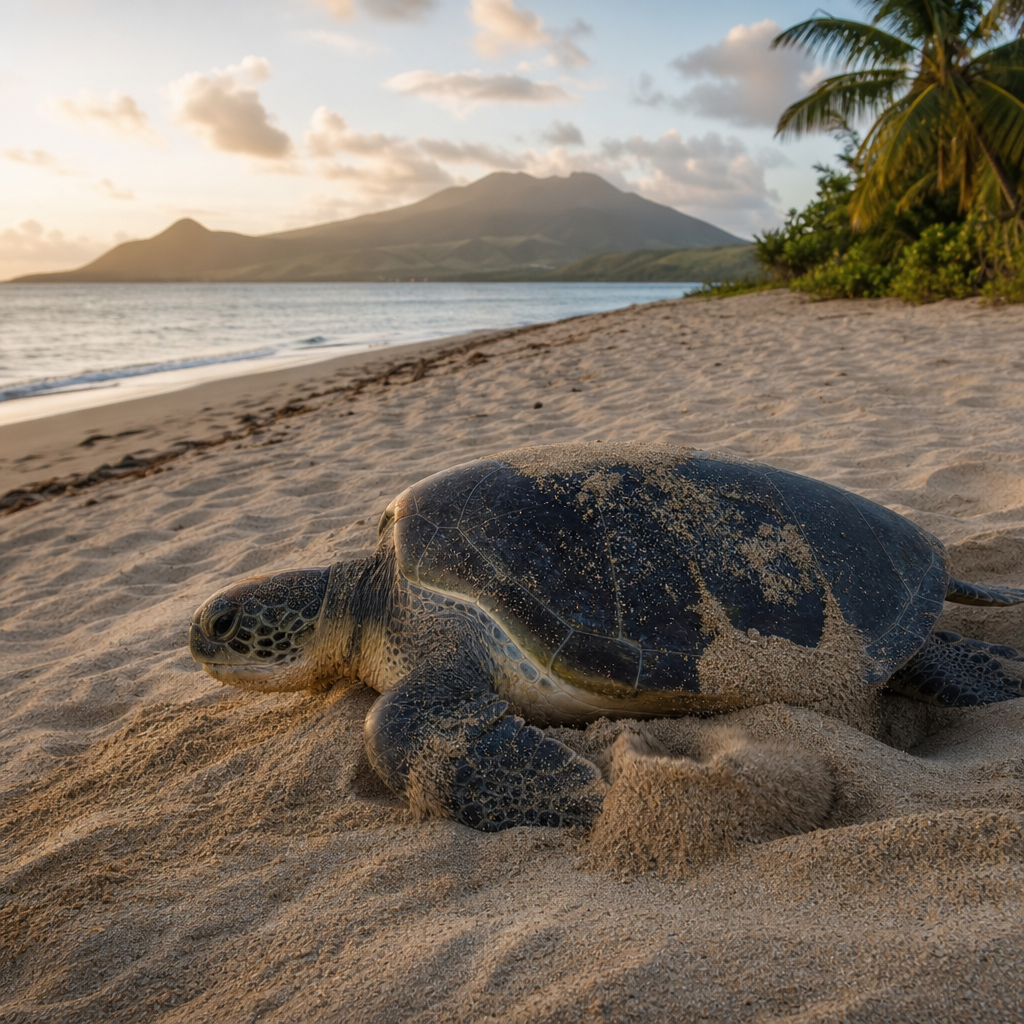
Turtle nesting season in Nevis is one of the island’s most important wildlife events, drawing attention from conservationists, residents, and travelers who want to witness a rare natural cycle without harming it. In Nevis, nesting activity generally peaks between March and November, when female sea turtles come ashore at night to lay eggs on quiet beaches. The most commonly discussed species are hawksbill, green, and leatherback turtles, all of which face pressure from habitat loss, coastal lighting, marine pollution, fishing gear entanglement, and climate-related changes to beach conditions. Understanding turtle nesting season in Nevis means knowing more than when turtles arrive. It means understanding the beaches they use, the laws and volunteer programs that protect them, the signs of a nest, the risks hatchlings face, and the simple rules that allow people to observe responsibly.
I have worked on coastal interpretation projects in the Caribbean, and turtle nesting is always the subject visitors ask about first because it combines beauty, rarity, and real conservation urgency. Nevis matters because it still offers relatively small-scale coastal development compared with larger tourism markets, giving the island a genuine opportunity to protect nesting beaches before avoidable damage becomes permanent. For a Nature and Wildlife hub, this topic also links naturally to broader subjects including beach ecosystems, marine biodiversity, responsible tourism, local environmental policy, seasonal travel planning, and citizen science. A hub page on turtle nesting season in Nevis should answer practical questions directly: when to go, where turtles nest, what species are present, how monitoring works, what not to do on the beach, and how visitors can support conservation beyond taking photos. Those answers help readers plan better trips and help the island protect a globally threatened resource.
Sea turtle nesting follows a predictable biological process. Adult females return, often near the region where they hatched, haul themselves above the high-tide line, dig a body pit and egg chamber, lay eggs, cover the nest, and return to sea. Incubation commonly lasts around fifty to seventy days depending on species, moisture, and sand temperature. Temperature is especially important because it influences hatchling sex ratios; warmer nests generally produce more females. After hatching, young turtles emerge together, usually at night, and orient toward the brightest natural horizon, historically the moonlit sea. Artificial beachfront lighting interrupts that instinct and is a major cause of disorientation. This is why responsible observation on Nevis is not just etiquette. It is a conservation requirement rooted in turtle biology.
When turtle nesting season happens in Nevis and what visitors should expect
In practical travel terms, turtle nesting season in Nevis spans much of the year, but activity is not uniform from month to month. Leatherbacks often begin earlier in the regional cycle, while hawksbills and greens are frequently associated with later peaks, though exact timing varies annually. Weather, beach profile, storm erosion, and sea conditions all influence how many crawls are recorded. Visitors should understand the difference between a crawl and a confirmed nest. A crawl is any turtle track from sea to shore and back again. Not every crawl results in eggs; turtles sometimes abandon an attempt if the sand is too compact, roots block digging, the beach is too narrow, or disturbance causes them to return to the water.
If you are planning specifically to observe turtles, the highest chance is usually on warm, dark, quiet nights on beaches known for past nesting. Even then, sightings are never guaranteed. Ethical conservation groups avoid promising wildlife encounters because unpredictability is normal. What is more reliable is the chance to learn from guided patrols, beach walks that identify tracks from the previous night, and hatchling monitoring when nests are close to emergence. This matters for trip planning. A traveler who expects a zoo-like experience will be disappointed. A traveler who understands that observation depends on turtle behavior, moon phase, beach conditions, and strict no-disturbance protocols will have a much better experience and will contribute less pressure to the sites.
Species that nest in and around Nevis
Nevis is associated most strongly with hawksbill turtles, green turtles, and leatherbacks, the three species visitors are most likely to encounter in conservation messaging and field reports. Hawksbills are critically endangered globally according to the International Union for Conservation of Nature and are known for their narrow, pointed beak and overlapping shell scutes. They often use smaller pocket beaches and are closely linked to coral reef ecosystems where they feed on sponges. Green turtles are larger, more rounded in profile, and are famous for shifting to seagrass and algae as adults. Their health is tied directly to nearshore seagrass beds, making turtle conservation inseparable from wider marine habitat protection. Leatherbacks are the largest sea turtles in the world, lacking a hard shell and instead having a leathery carapace with distinct ridges. They are powerful long-distance migrants and can nest on wider beaches.
For readers using this page as a hub, those species descriptions matter because each opens a different branch of the wider Miscellaneous wildlife story. Hawksbills connect Nevis to reef conservation, marine protected areas, and illegal tortoiseshell trade history. Green turtles connect directly to seagrass ecology, water quality, and the role of herbivores in coastal systems. Leatherbacks connect the island to wider Atlantic migration routes, jellyfish prey dynamics, and international conservation agreements. On the beach, trained guides can often identify a species from track width, flipper marks, and nest placement. That level of detail is valuable because it turns a simple beach walk into real ecological interpretation.
Key nesting beaches, habitat needs, and common threats
Not every beach in Nevis is suitable for nesting. Turtles need a combination of accessible slope, stable sand above the high-tide line, limited artificial light, and enough width to reduce washout risk. Beaches with severe erosion, heavy nighttime activity, seawalls, or dense furniture placement are less attractive and more dangerous. Across the Caribbean, development has repeatedly shown the same pattern: once dune vegetation is cleared, lighting expands, and hard shoreline structures are added, nesting success declines. In Nevis, that means conservation is as much about managing beachfront design as it is about protecting individual nests.
Common threats on nesting beaches are well documented and easy to explain in plain terms. Light pollution disorients both adults and hatchlings. Free-roaming dogs can dig up nests or attack turtles. Vehicles compact sand and crush eggs. Beach bonfires alter sand temperature and can destroy unseen nests. Plastic debris blocks hatchlings or is mistaken for food at sea. Sargassum accumulation can also complicate access in some periods, although clearing practices must be careful not to disturb nests or dune vegetation. The table below summarizes the issues most often discussed during beach management planning.
| Threat | How it affects turtles | Best response in Nevis |
|---|---|---|
| Artificial lighting | Disorients nesting females and hatchlings | Use shielded amber lights, close curtains, reduce beachfront glare |
| Coastal erosion | Causes nest washout and beach loss | Protect dunes, avoid hard armoring where possible, restore vegetation |
| Loose dogs | Predate eggs and disturb nesting turtles | Leash enforcement and patrol monitoring during season |
| Beach furniture and obstacles | Blocks access and traps hatchlings | Remove or stack items away from nesting zones at night |
| Human disturbance | Causes false crawls and nest abandonment | Guided viewing only, no flash, no crowding, no touching |
| Marine debris | Entangles adults and harms hatchlings | Regular cleanups with nest-safe procedures |
How turtle conservation works on a small island
Effective turtle conservation in Nevis depends on repeated fieldwork, not occasional awareness campaigns. The core tasks are beach patrols, nest identification, tagging where permitted, public reporting systems, hatchling emergence monitoring, and coordination with government agencies, hotels, fishers, and local communities. On islands with limited resources, data quality improves when trained volunteers use standardized methods. That includes recording crawl direction, measuring track width, marking GPS points, assessing whether a crawl likely produced a nest, and revisiting vulnerable sites after storms or unusually high tides.
Relocation of nests is sometimes necessary, but it should never be treated as routine. In well-run programs, moving eggs is reserved for clear threats such as imminent inundation, severe erosion, or direct development conflict, because relocation can reduce success if done poorly. The established standard is to interfere as little as possible and to document every action carefully. The most credible turtle projects in the Caribbean also invest in outreach because enforcement alone rarely works. Hotel staff need to know why beachfront lights should be screened. Residents need a number to call when they see a nesting turtle. Children need school programs that explain why a dark beach is not an inconvenience but a survival condition for hatchlings.
Responsible turtle watching in Nevis
The best answer to “How do I see turtles in Nevis?” is simple: go only with a recognized local guide or conservation group and follow every instruction immediately. Responsible turtle watching means arriving quietly, wearing dark clothing, keeping phones off or fully screened, never using flash photography, and staying behind the turtle unless a guide places you elsewhere. During egg laying, females enter a trance-like stage and are less likely to abandon the attempt, but that is not permission to crowd them. Before that stage, disturbance can easily send them back to sea without nesting. Hatchlings are even more sensitive; white lights, footsteps, and handling all create unnecessary mortality risk.
Families often ask whether children can attend. The answer depends on age, patience, and the group’s rules. Night patrols may involve long waits, heat, insects, and periods of total darkness. For some children, an early-morning track walk is better than a nighttime patrol. That is an important point for this hub article because wildlife tourism works best when expectations match reality. Good operators explain that the goal is not a dramatic social media moment but a low-impact wildlife encounter. Visitors who want a meaningful experience should ask practical questions before booking: How many people are in the group? What light policy is enforced? Does the program support monitoring or education? Those questions quickly reveal whether a tour treats turtles as wildlife first and attraction second.
Why this topic anchors the wider Nature and Wildlife hub
Turtle nesting season in Nevis is more than a single seasonal event. It is a gateway subject that connects nearly every major theme in the island’s Nature and Wildlife coverage. A reader interested in nesting turtles will usually also need information on beach ecology, coral reefs, snorkeling ethics, marine mammals, birdlife near coastal wetlands, volcanic landscapes that shape watersheds, and the way rainfall and runoff affect nearshore habitats. In editorial planning, that makes this page an ideal sub-pillar hub. It can direct readers toward species-specific guides, beach-by-beach conservation notes, family-friendly wildlife activities, responsible photography advice, and updates on environmental regulations or community cleanups.
It also serves a practical local purpose. Conservation succeeds when information is centralized and easy to understand. A strong hub article reduces confusion by putting core facts in one place: turtle nesting season in Nevis runs across several months; nighttime disturbance is harmful; dark beaches are essential; guided observation is preferable; and support for local conservation groups has measurable value. For businesses, especially hotels and villa managers, this subject has immediate operational relevance. Simple steps such as shielding lights, training security staff, removing nightly beach obstacles, and sharing guest guidelines can prevent harm without reducing visitor experience. For travelers, the benefit is equally direct. They leave with a better chance of seeing turtles responsibly and a clearer understanding of how their choices affect the island’s wildlife.
The main lesson from turtle nesting season in Nevis is straightforward: observation and conservation must happen together or the experience loses its value. Sea turtles return to Nevis because certain beaches still provide the darkness, access, and relative calm they need to reproduce. Those conditions are fragile. A single poorly lit property, unmanaged dogs, repeated crowding, or careless beach use can undo years of protection on a small stretch of sand. At the same time, well-managed tourism can help fund monitoring, strengthen public support, and create lasting respect for coastal ecosystems. That balance is the real opportunity for Nevis.
For readers using this page as a hub within Nature and Wildlife, the best next step is to treat turtle nesting as your entry point into the island’s wider environmental story. Learn the nesting calendar before you travel, choose guides and accommodations that follow beach-safe practices, and explore related topics such as reefs, seagrass, bird habitats, and coastal stewardship. If you live on Nevis or operate a tourism business, review your lighting, beach access, and staff training before the season peaks. If you visit, ask how your tour or hotel supports monitoring. Small decisions made consistently are what protect nests, hatchlings, and future generations of turtles on Nevis.
Frequently Asked Questions
When is turtle nesting season in Nevis, and which species are most commonly seen?
Turtle nesting season in Nevis generally runs from March through November, with activity varying by species and beach conditions. During this period, female sea turtles come ashore—usually at night—to dig nests above the high-tide line and lay their eggs in the sand. The three species most often discussed in Nevis are hawksbill, green, and leatherback turtles. Hawksbills are especially associated with tropical reefs and coastal habitats, green turtles are widely recognized for their link to seagrass and nearshore feeding grounds, and leatherbacks are the largest of all sea turtles, known for their impressive size and long migrations. Although exact timing can shift from year to year, these months represent the main window when residents and visitors may hear about nesting activity, beach monitoring, and conservation patrols. Because nesting females are highly sensitive to disturbance, most sightings happen under controlled, low-impact conditions guided by trained conservation teams or local regulations.
Why is turtle nesting season so important for conservation in Nevis?
Turtle nesting season is important because it is the most visible stage of a much larger marine life cycle, and it gives conservationists a critical opportunity to protect endangered or threatened species at one of their most vulnerable moments. When female turtles come ashore to nest, they face risks from habitat loss, beachfront development, artificial lighting, beach traffic, erosion, predators, and accidental human interference. Eggs and hatchlings are even more vulnerable, as they depend on stable, dark, undisturbed beach environments to survive. In Nevis, protecting nesting beaches helps support not only local biodiversity but also wider regional and international sea turtle recovery efforts, since these animals migrate across vast distances and connect multiple marine ecosystems throughout the Caribbean and beyond.
Conservation during nesting season also has practical value for long-term environmental management. Monitoring nest numbers, species presence, hatching success, and beach conditions helps researchers understand population trends and identify emerging threats. These findings can guide better coastal planning, lighting policies, habitat restoration, and public education. Just as importantly, nesting season creates a moment when the public can see conservation in action. It encourages residents, tourism operators, and travelers to become active participants in protecting wildlife by respecting beach rules, reporting turtle activity responsibly, and supporting organizations working to preserve Nevis’s coastal habitats.
How can visitors observe nesting turtles in Nevis without disturbing them?
The best way to observe nesting turtles responsibly in Nevis is to treat the experience as a conservation event rather than a casual wildlife encounter. Visitors should always follow local guidance, join authorized turtle watches if available, and never approach nesting turtles on their own without understanding proper behavior. Sea turtles are easily disturbed by noise, movement, flashlights, camera flashes, and physical proximity. A female that feels threatened may abandon her nesting attempt and return to the sea without laying eggs, which is why quiet, patience, and distance are so important.
Responsible observation usually means staying behind trained guides or conservation personnel, using only approved low-intensity red lights if any light is permitted, keeping voices low, and avoiding sudden movement. Visitors should never touch a turtle, stand in front of her, block her path to or from the ocean, or crowd a nesting area for photographs. It is equally important to watch where you step, since eggs, hatchlings, and nest sites may be difficult to see at night. If hatchlings are emerging, observers should remain well back and allow them to make their own way to the water, as this journey is an essential part of their natural development. When in doubt, the safest rule is simple: observe quietly, keep your distance, and let conservation professionals set the terms of the encounter.
What are the biggest threats facing nesting sea turtles on Nevis beaches?
Nesting sea turtles in Nevis face a combination of natural and human-related pressures, but the most serious long-term threats tend to come from changes to coastal habitat and avoidable disturbance. Artificial beachfront lighting is one of the most widely recognized problems because turtles rely on natural light cues during nesting and hatching. Bright lights from homes, roads, hotels, or events can discourage females from nesting and can disorient hatchlings, pulling them inland instead of toward the sea. Coastal development can also reduce the amount of suitable nesting habitat, alter beach shape, compact sand, increase erosion, and place more human activity directly in sensitive areas.
Other major concerns include beach furniture left overnight, vehicles on sand, litter, unleashed dogs, and heavy foot traffic near nests. Even well-meaning people can cause harm by trying to help turtles, handling hatchlings, digging at nests, or shining lights on nesting females for photos. Climate-related impacts may also affect turtle nesting success over time, including stronger storms, shoreline erosion, and temperature shifts in nest sand, which can influence hatchling survival and development. Because sea turtles mature slowly and return to nest only after many years, even small repeated disturbances can have large consequences over time. That is why effective protection in Nevis depends on a mix of habitat preservation, public awareness, and consistent beach monitoring throughout the nesting season.
What can residents and travelers do to support sea turtle conservation in Nevis?
Residents and travelers can make a meaningful difference by adopting simple habits that reduce disturbance and support local conservation efforts. The most immediate steps include keeping beaches clean, avoiding nighttime light pollution near the shore, removing obstacles such as chairs or equipment from the sand after dark, and staying away from marked nest sites. Anyone walking beaches during nesting season should fill in deep holes, knock down sandcastles at the end of the day, and keep pets under control, since these seemingly minor issues can become serious obstacles for nesting females and hatchlings. If you see a turtle on the beach, the best response is usually to keep your distance and contact the appropriate local conservation group or authorities rather than intervene directly.
Support can also take the form of education and community involvement. Visitors can choose eco-conscious accommodations and tour providers that follow turtle-safe practices, while residents can advocate for responsible lighting, coastal protection, and beach-use policies. Donating to or volunteering with local environmental organizations can help fund patrols, nest monitoring, outreach programs, and habitat protection. Perhaps most importantly, people can share accurate information with others: turtles need dark, quiet, unobstructed beaches, and the most respectful wildlife experience is one that leaves no trace. In a place like Nevis, where natural beauty and coastal life are closely connected, protecting turtle nesting season is not only about preserving a remarkable event—it is about safeguarding the health of the island’s shoreline for future generations.