Nevis’ contribution to Caribbean music is larger than its small size suggests, because the island has helped shape performance traditions, festival culture, church music, and community bands that connect local identity to the wider soundscape of the Eastern Caribbean. In this context, Caribbean music includes the folk, sacred, popular, and carnival forms that developed through African, European, and later transnational influences across the region. Nevis, part of the Federation of Saint Kitts and Nevis, has long served as a cultural crossroads where village celebrations, plantation-era legacies, migration, and tourism all left marks on musical expression. When people ask what Nevis is known for musically, the short answer is this: it is known for preserving deeply rooted folk practices while continually adapting to calypso, soca, string band traditions, brass band performance, and modern stage production. That matters because music on Nevis is not just entertainment; it is a record of memory, resistance, ceremony, and social commentary.
I have worked with Caribbean cultural materials long enough to know that smaller islands are often flattened into regional generalities, yet Nevis deserves close attention on its own terms. Its musical life cannot be understood only by naming genres. You have to look at who performs, where performances happen, how songs circulate, and why certain sounds endure. Methodist and Anglican hymnody, drumming at seasonal festivities, Christmas masquerade performance, school choirs, steelpan ensembles, carnival competitions, and hotel stages all play different roles. The island’s contribution is therefore both direct and connective: direct in the traditions created and sustained locally, and connective in the way Nevisian musicians participate in networks linking Saint Kitts, Antigua, Montserrat, the Virgin Islands, Trinidad, and diaspora communities in Britain, the United States, and Canada.
As a hub within culture and history, this overview covers the miscellaneous dimensions that make Nevisian music important. It explains the roots of local sound, the role of carnival and folk performance, the influence of religion and education, the contribution of bands and composers, and the pressures of migration, media, and tourism. Together, these elements show why Nevis is essential to any serious account of Caribbean music.
Historical Roots of Music on Nevis
The foundation of music on Nevis lies in the island’s colonial and post-emancipation history. Enslaved Africans brought rhythmic practices, vocal techniques, ceremonial structures, and dance traditions that survived despite severe repression. European settlers and missionaries introduced hymn tunes, military band formats, quadrille structures, and formal choral singing. Over time, these influences did not remain separate. They blended into creolized forms that became recognizably Nevisian. This process happened across the Caribbean, but on Nevis it took on a distinct texture because of the island’s village social life, church centrality, and close ties with Saint Kitts.
One of the clearest examples is the relationship between drum-based folk performance and European-derived dance figures. Quadrille music in the Eastern Caribbean often combines fiddle, banjo, guitar, triangle, and percussion, and Nevis participated in that tradition through string bands and dance accompaniment at community gatherings. At the same time, fife-and-drum and masquerade-related performance retained African-derived emphasis on polyrhythm, procession, and embodied movement. These traditions were rarely frozen in time. Musicians borrowed melodies, replaced instruments when imports became available, and adjusted repertoire for changing audiences.
By the late nineteenth and early twentieth centuries, brass bands and church choirs had become important institutions. Across British Caribbean colonies, police and military bands taught notation, discipline, and ensemble arrangement. Nevis reflected this pattern, with formal group performance becoming a route to public prestige. Meanwhile, churches trained singers who could move between sacred and secular settings. That crossover mattered. A vocalist who learned harmony in a choir might later perform at civic ceremonies or festival events, while an instrumentalist trained in marches could adapt to dance music. This versatility is one reason small-island music scenes often produce musicians with unusually broad skill sets.
Folk Traditions, Masquerade, and Community Performance
If you want to understand Nevisian music at ground level, start with community performance rather than commercial recordings. Much of the island’s musical authority comes from live traditions tied to season, place, and ritual. Christmas sports, masquerade displays, street parades, and village celebrations created settings where rhythm, costume, dance, and satire worked together. In these contexts, music did not stand alone; it animated movement and signaled collective belonging.
Masquerade traditions in Saint Kitts and Nevis are especially important. Performers known for elaborate costumes, whips, drums, and choreographed movement appear during the Christmas season and at public festivities. The music associated with these performances is intensely rhythmic and functional. It controls pacing, marks transitions, and heightens spectacle. Similar masking traditions exist elsewhere in the Caribbean, yet local variants matter because they encode island-specific histories. On Nevis, masquerade performance helped preserve memory through embodied practice even when documentation was limited.
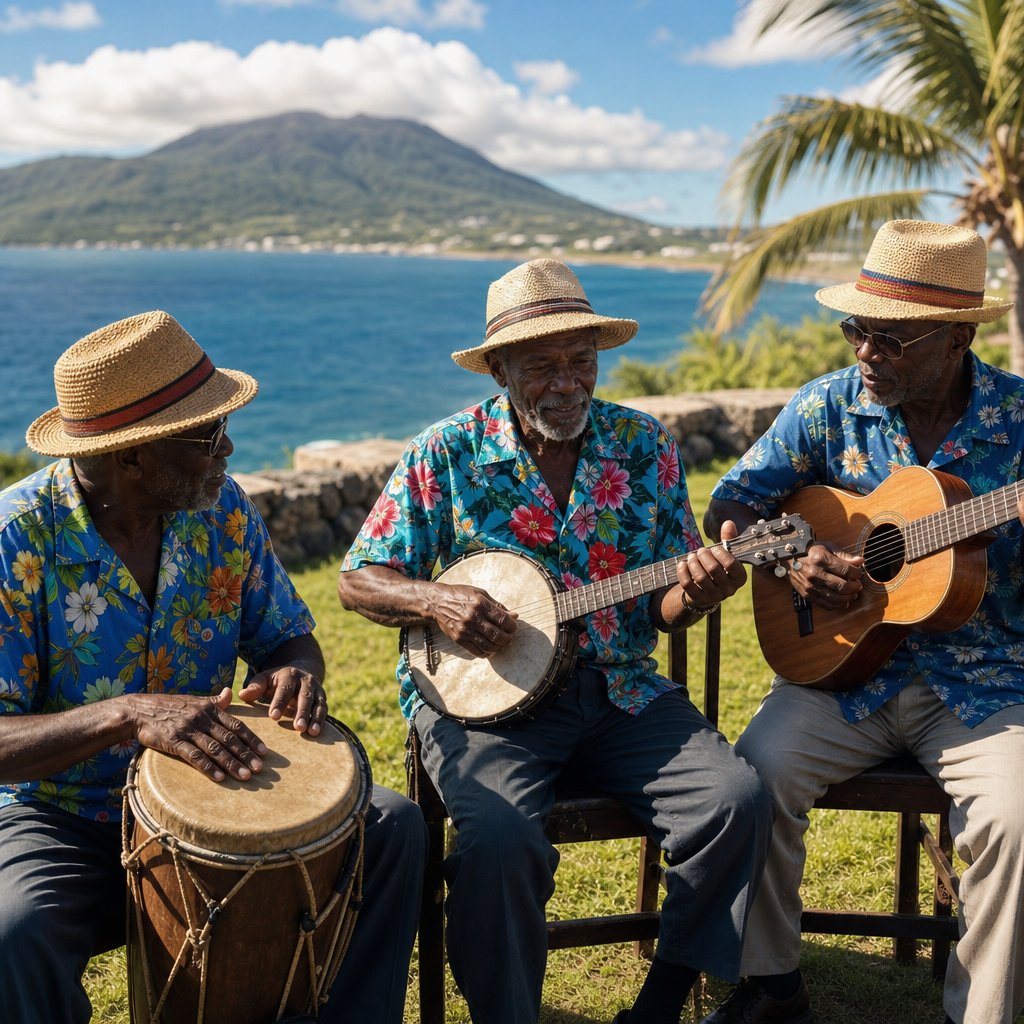
String band culture also deserves attention. In many Eastern Caribbean societies, string bands used guitar, cuatro or banjo-like instruments, fiddle, and improvised percussion to accompany dances, serenades, and social events. On Nevis, these ensembles linked domestic leisure to wider regional currents. They could play folk tunes, adapt calypsos, or accompany quadrille sets, making them musically flexible and socially useful. I have seen this same pattern across smaller islands: the most durable ensembles are not always the most famous, but the ones that can play for weddings, wakes, holiday events, and political gatherings.
Community performance on Nevis remains valuable because it keeps intergenerational transmission alive. A child who watches drummers in a parade or sings in a village concert learns timing, repertoire, and public confidence before ever entering a studio. That kind of informal apprenticeship is a core contribution to Caribbean music, since many regional stars first absorbed music in exactly these environments.
Carnival, Calypso, and the Art of Social Commentary
Nevis has also contributed to Caribbean music through carnival culture and the calypso tradition, both of which turn public performance into commentary on politics, morality, and everyday life. Calypso is not merely a catchy festival genre. It is a verbal art built on wit, narrative compression, topical reference, and audience recognition. In the smaller islands of the Eastern Caribbean, calypsonians often function as unofficial historians because their songs record election tensions, local scandals, economic anxieties, and moments of pride.
On Nevis, carnival performance developed in close conversation with Saint Kitts while maintaining a distinctly local voice. Competitions encouraged singers to write original lyrics, refine stagecraft, and build personas around humor, critique, or moral seriousness. This mattered because it created a structured pathway for talent development. A performer who entered local tents or competitions learned breath control, timing, crowd management, and lyrical precision. Those skills easily transferred into soca, gospel, radio presentation, and emceeing.
The island’s festival ecosystem also supported musicians beyond headline calypsonians. Arrangers, backing vocalists, drummers, keyboardists, horn players, costume designers, and sound engineers all developed through the demands of live seasonal production. In practical terms, carnival acts as a training ground. It forces musicians to work with rehearsal deadlines, amplification challenges, audience expectations, and competitive standards. Across the Caribbean, islands with strong carnival systems tend to produce resilient performers because they learn under pressure.
Another key contribution is thematic. Nevisian calypso often draws power from the scale of island life. Because communities are close-knit, songs can be intensely specific without losing broad appeal. A lyric about road repairs, water access, land development, or election rhetoric can resonate deeply because listeners know the people and places involved. That specificity gives songs documentary value and strengthens the island’s place within Caribbean musical discourse.
Church, School, and Institutional Music Training
Not all musical influence comes from festival culture. On Nevis, churches and schools have been among the most reliable engines of musical continuity. Hymn singing, choral festivals, youth concerts, and formal music classes create habits of listening and discipline that support the wider music scene. Anglican, Methodist, Moravian, Catholic, and other congregations across the Eastern Caribbean have historically maintained choirs, and Nevis fits that pattern strongly. Sacred repertories introduced singers to harmony, phrasing, and diction, while keyboard accompaniment exposed students to tonal structure and arrangement.
Schools expanded that base through choirs, recorder groups, steelpan units, and national celebrations. Even when budgets were limited, teachers often acted as cultural custodians, selecting folk songs for Independence programs and training students for speech and song competitions. This work is easy to underestimate because it looks routine, but it has lasting impact. Many Caribbean musicians first learned stage etiquette in school assemblies and church anniversaries rather than in professional venues.
Steelpan deserves mention here as part of the broader regional conversation. Although Trinidad and Tobago is the birthplace of the instrument, pan spread throughout the Caribbean and became a marker of cultural participation and modernity. On Nevis, school and community pan ensembles helped integrate the island into a regional musical language while still allowing local repertoire choices. A Nevisian pan group performing folk melodies, hymns, or contemporary soca demonstrates exactly how regional forms become locally meaningful.
| Institution or Setting | Musical Role on Nevis | Regional Importance |
|---|---|---|
| Church choirs | Teach harmony, breath control, repertoire, and leadership | Create singers who can move between sacred and secular genres |
| Schools | Introduce notation, performance discipline, and public presentation | Build the youth pipeline for bands, festivals, and national events |
| Carnival committees | Support competitions, rehearsals, and staging | Preserve calypso and soca as living traditions |
| Community groups | Maintain folk dances, drumming, and village celebrations | Protect oral tradition and intergenerational transmission |
Bands, Tourism, Media, and Diaspora Influence
Modern Nevisian music has also been shaped by hotel entertainment circuits, radio, recorded media, and migration. Tourism changed performance expectations by increasing demand for polished stage shows, mixed repertoires, and adaptable musicians who could play calypso one night, reggae the next, then jazz standards or soul covers for visitors. Some critics see tourism as diluting tradition, and the risk is real when local music is reduced to background ambiance. Yet the relationship is more complex. Tourism has also provided income, equipment access, and regular performance opportunities that help musicians remain active.
Radio and recorded music widened horizons further. Broadcasters in Saint Kitts and Nevis exposed audiences to Trinidadian calypso, Jamaican reggae and dancehall, North American R&B, and gospel from the United States. Nevisian musicians absorbed these influences selectively. A local band might retain calypso phrasing while adding reggae bass lines or use gospel vocal layering in a patriotic ballad. This synthesis is typical of Caribbean music-making, where genre boundaries are porous and musicians are expected to pivot quickly.
Diaspora movement has been equally important. Nevisians living abroad often sustain cultural ties through concerts, church conventions, reunions, and online sharing. Musicians who migrate gain access to studios, promoters, and wider audiences, then bring new production techniques back home. At the same time, diaspora nostalgia can strengthen older forms by creating demand for folk songs and festive repertoire that symbolize home. In my experience, diaspora audiences often value cultural continuity even more intensely than residents do, precisely because music becomes a portable homeland.
Looking across these forces, Nevis’ contribution becomes clear: the island has produced a musical culture that is locally grounded yet regionally fluent. Its artists, teachers, clergy, bands, and festival organizers have helped preserve core Caribbean practices while adapting them to changing audiences and technologies.
Nevis matters to Caribbean music because it shows how a small island can influence a region through continuity, adaptability, and community-centered performance. Its musical heritage is not defined by a single export genre or one internationally famous artist, although individual performers and bands remain important. Instead, its strength lies in a durable ecosystem: folk traditions that survived colonial disruption, masquerade and seasonal performance that keep memory visible, calypso that sharpens public debate, church and school training that build talent, and modern media and diaspora networks that carry local sound outward.
For anyone studying culture and history, this is the central lesson. Caribbean music is made not only in large capitals or recording hubs, but also in villages, schoolyards, sanctuaries, parade routes, and hotel stages where musicians learn to serve a community first. Nevis exemplifies that truth. The island’s contribution is both artistic and archival, because each performance stores values, stories, and social relationships that written records alone cannot preserve. When you listen carefully to Nevisian music, you hear the interaction of Africa and Europe, sacred and secular practice, local politics and regional exchange, memory and reinvention.
Use this hub as a starting point for deeper exploration of Nevisian folk forms, carnival history, notable performers, church music, and diaspora culture. The more closely you examine Nevis, the more clearly you see that Caribbean music has always depended on islands whose influence exceeds their size.
Frequently Asked Questions
How has Nevis influenced Caribbean music despite its small size?
Nevis has influenced Caribbean music by serving as a strong cultural bridge between local community traditions and wider regional musical developments. Although the island is small, its musical life has long been active in churches, village celebrations, seasonal festivals, school programs, string bands, brass bands, and carnival-related performance. These spaces helped preserve musical practices that are central to the Caribbean experience: call-and-response singing, communal dancing, drum-centered rhythms, processional performance, and the blending of African-derived forms with European hymnody, marching traditions, and popular song structures.
What makes Nevis important is not simply the number of musicians it has produced, but the way music has remained woven into everyday life. On Nevis, music has historically marked religious observances, family milestones, civic occasions, and festive gatherings, allowing traditions to be passed on across generations. This kind of continuity matters in Caribbean music history because many of the region’s most influential forms developed not only in recording studios or major cities, but also in local communities where performance was participatory, social, and tied to identity. Nevis contributed to that regional culture by sustaining traditions that reflect the shared musical language of the Eastern Caribbean while preserving its own local character.
What role have festivals and carnival traditions in Nevis played in Caribbean music?
Festivals and carnival traditions have been among Nevis’ most visible and important contributions to Caribbean music. In the Caribbean, carnival is more than entertainment; it is a space where rhythm, satire, dance, costume, procession, and public performance come together. On Nevis, festival culture has helped shape the kinds of music people perform, the instruments they value, and the social role music plays in the community. Carnival-related music encourages participation, competition, improvisation, and celebration, all of which are central features of broader Caribbean musical culture.
These traditions also connect Nevis to regional genres such as calypso, soca, road march music, drumming ensembles, and masquerade performance. Musicians and performers on the island have drawn on these wider currents while adapting them to local customs and community expectations. That process is a key part of Caribbean musical development: styles travel across islands, but they are reshaped in each place. Nevis’ festival settings have therefore acted as a living laboratory where regional influences are localized, making the island an active contributor to the evolution of Eastern Caribbean performance traditions rather than a passive receiver of outside trends.
Why is church music important to understanding Nevis’ contribution to Caribbean music?
Church music is essential to understanding Nevis’ contribution because sacred music has been one of the island’s most enduring musical foundations. For generations, churches provided regular opportunities for singing, instrumental accompaniment, choir leadership, and musical training. Hymns, anthems, gospel forms, and locally adapted sacred repertoires gave many Nevisians their earliest structured experience with melody, harmony, rhythm, and ensemble discipline. In small island communities, churches often functioned as cultural centers as well as places of worship, so their musical impact extended far beyond religious services.
Church music also reveals how Caribbean music developed through blending rather than separation. In Nevis, as elsewhere in the region, European hymn traditions interacted with African-descended vocal styles, rhythmic sensibilities, and expressive performance practices. The result was not a simple copy of imported church music, but a localized sacred sound shaped by Caribbean feeling, phrasing, and communal participation. This matters because the Caribbean’s musical history is deeply rooted in these kinds of adaptations. Nevis’ sacred music culture helped train singers, organists, band leaders, and community performers who later contributed to secular and festival music as well, making church music a central strand in the island’s wider musical influence.
How have community bands and local performance traditions shaped music on Nevis?
Community bands and local performance traditions have played a major role in shaping music on Nevis by creating spaces where musical knowledge is shared informally and continuously. Brass bands, string bands, school ensembles, village groups, and other local performance units have historically brought music into public life, whether for parades, ceremonies, dances, holiday events, or neighborhood celebrations. These groups helped make music accessible and participatory, ensuring that performance was not restricted to professionals but remained part of community identity.
This is especially significant in a Caribbean context, where many influential musical traditions grew through collective practice rather than through formal institutions alone. On Nevis, local bands preserved repertories, performance habits, and instrumental traditions that reflected both regional circulation and local taste. They also nurtured musicianship by teaching timing, ensemble coordination, improvisation, and audience engagement. In doing so, they strengthened the island’s cultural self-expression while contributing to the wider Eastern Caribbean soundscape. Their importance lies in the fact that they sustained music as a living social practice, one that connects memory, celebration, and local belonging.
How does Nevis fit into the wider history of Eastern Caribbean music?
Nevis fits into the wider history of Eastern Caribbean music as a culturally connected but distinctly local contributor. The island shares in the broader regional story shaped by African diasporic musical inheritance, European colonial influence, Christian worship traditions, labor histories, migration, and modern media exchange. Like other Eastern Caribbean societies, Nevis developed music through a combination of folk practices, sacred forms, festive performance, and later popular genres influenced by neighboring islands and international currents. Its importance lies in how it reflects these larger Caribbean processes in a concentrated and community-driven way.
Nevis also demonstrates an important truth about Caribbean music history: influence does not depend only on population size or commercial visibility. Smaller islands often preserve key traditions, maintain performance continuity, and contribute cultural forms that circulate regionally through migration, festivals, family ties, and shared institutions. As part of the Federation of Saint Kitts and Nevis, the island participates in a musical environment that is both national and trans-island, linking local heritage to the broader Eastern Caribbean. Understanding Nevis helps readers see Caribbean music not just as a collection of famous genres, but as a network of communities whose sacred, folk, and celebratory practices have all helped shape the region’s sound.