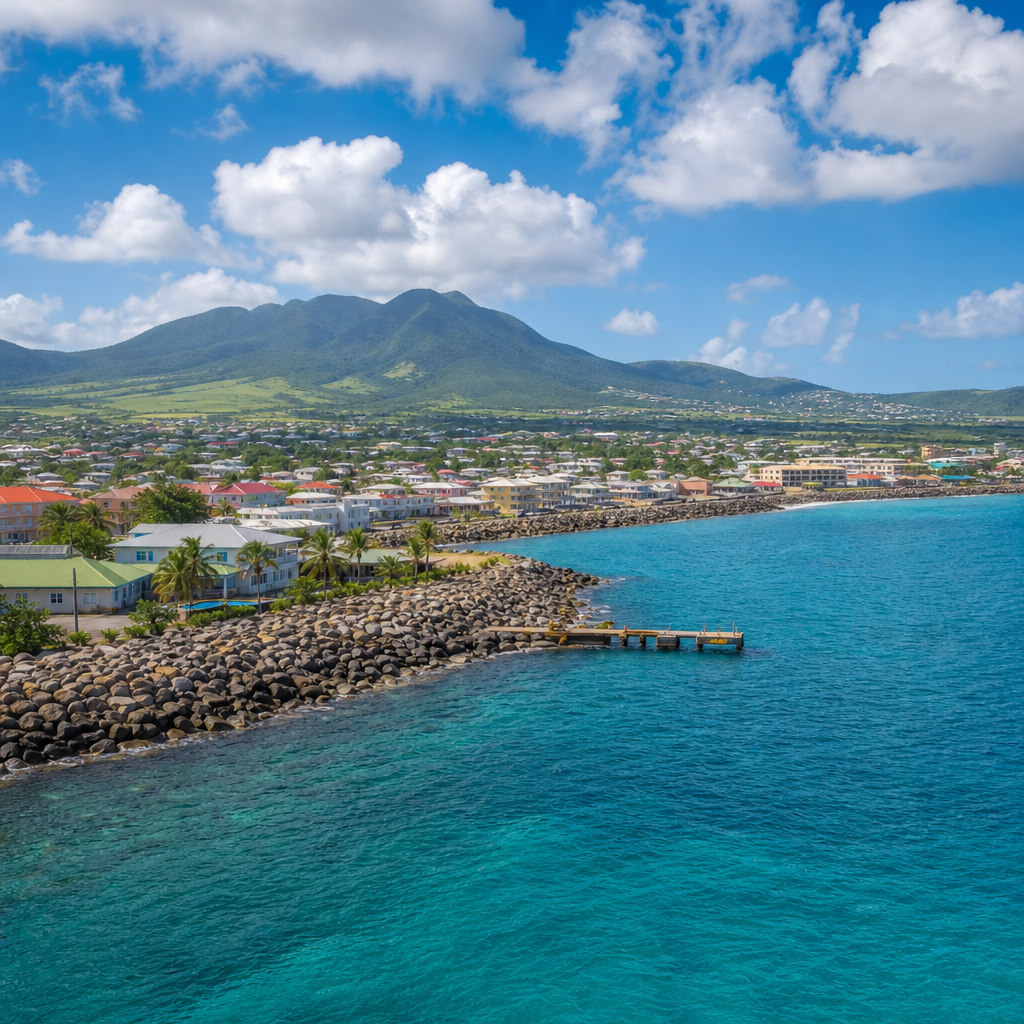
Real estate in Saint Kitts is entering 2025 with stronger fundamentals than many small-island markets, driven by tourism recovery, limited developable coastal land, and sustained interest from international buyers seeking second homes, rental income, and citizenship-linked investment routes. In practical terms, the market combines three segments that behave differently: local residential housing for residents and returning nationals, resort and villa property tied to tourism demand, and investment-grade developments marketed to foreign purchasers. Understanding those segments is essential because a broad headline about prices rising or sales slowing rarely explains what is actually happening on the ground.
Saint Kitts, the larger island within the Federation of Saint Kitts and Nevis, has a real estate profile shaped by geography, policy, and infrastructure. Prime property clusters around Frigate Bay, the Southeast Peninsula, Basseterre outskirts, and selected hillside communities with sea views. Supply is naturally constrained by topography, planning considerations, and the premium attached to oceanfront and resort-adjacent parcels. I have seen this pattern repeatedly in Caribbean markets: when a destination has limited prime coastline, improved air access, and a recognized legal process for foreign ownership, prices in the best locations hold firmer than broader averages suggest.
Why does this matter in 2025? Buyers want to know whether they should enter now or wait, sellers want realistic pricing, developers need to gauge absorption risk, and investors care about yields, holding costs, and exit demand. Governments also watch the sector closely because construction, tourism, professional services, and tax revenues all depend on healthy transaction volume. This hub article examines the major forces likely to shape real estate in Saint Kitts during 2025, including pricing trends, demand drivers, development pipelines, financing conditions, regulatory factors, and the practical opportunities and risks different buyers should weigh before making a decision.
Market Outlook for 2025: What Prices and Demand Are Likely to Do
The most probable 2025 scenario for real estate in Saint Kitts is selective growth rather than a market-wide boom. Prime villas, well-managed condominiums, and resort-linked units in established areas are likely to remain the strongest performers. These properties benefit from scarcity, rental appeal, and the confidence buyers place in locations with proven resale demand. By contrast, secondary stock with dated finishes, weak management, or less convenient access may face longer selling periods even if headline interest remains healthy. This is a common post-recovery pattern: quality attracts liquidity first.
Price appreciation will likely be moderate in most categories, with pockets of stronger movement where inventory is tight. Newer homes near Frigate Bay or the Southeast Peninsula can command a premium because buyers value turnkey condition, hurricane-resistant construction details, backup utilities, and proximity to beaches, marinas, and dining. Inland residential communities should remain more price-sensitive, reflecting local purchasing power and financing realities. A balanced prediction is that transaction values in top-tier segments could edge higher, while average asking prices across the island may overstate what buyers are willing to pay unless sellers align with current absorption rates.
Demand should continue to come from a mix of diaspora buyers, lifestyle purchasers from North America and Europe, and investors comparing Saint Kitts with alternatives such as Antigua, Barbados, and the Dominican Republic. Saint Kitts does not always win on volume, but it often competes well on exclusivity, legal familiarity, and the appeal of a smaller, quieter market. That positioning matters. In my experience reviewing Caribbean listings and development launches, buyers choosing Saint Kitts are often not looking for the cheapest property; they are looking for controlled supply, easier lifestyle management, and an asset that sits inside a recognizable international ownership framework.
Key Drivers Shaping Real Estate in Saint Kitts
Several forces will influence market predictions for 2025. First is tourism performance. Hotel occupancy, cruise traffic, airlift, and visitor spending affect villa rentals, resort confidence, and the willingness of developers to release new phases. If stayover tourism remains steady, short-term rental revenues should support buyer demand for furnished condos and villas. Second is infrastructure. Road improvements, utility reliability, marina activity, and airport connectivity all affect micro-market pricing. In island real estate, ten extra minutes of travel time or frequent utility interruption can materially change buyer sentiment.
Third is the policy environment. Foreign buyer confidence depends on transparent conveyancing, predictable due diligence, and confidence in title. Saint Kitts has long attracted overseas investors, and continuity in property registration, legal review, and investment policy remains critical. Fourth is build cost inflation. Developers across the Caribbean have dealt with higher prices for cement, steel, finishes, shipping, and skilled labor. Those costs put a floor under pricing for new product. Even if demand softens temporarily, replacing a quality villa or condominium in 2025 usually costs more than it did before the pandemic-era supply disruptions.
Finally, interest rates and currency stability matter. Many overseas buyers in Saint Kitts are cash buyers, but financing costs still influence the broader market because they shape investor alternatives and local affordability. The Eastern Caribbean dollar’s long-standing peg to the US dollar reduces one layer of exchange-rate uncertainty for international purchasers, which is a meaningful advantage when compared with more volatile jurisdictions. Buyers still face legal fees, due diligence costs, insurance, and maintenance obligations, but the currency framework makes return projections easier to model.
Where the Best Opportunities Are by Property Type
Not every asset class offers the same outlook in 2025. Luxury villas remain attractive for buyers focused on lifestyle first and yield second. The best examples combine unobstructed views, strong management, outdoor entertaining space, and resilient construction features such as shutters, cistern storage, and standby power. Condominiums appeal to a broader buyer base because they reduce maintenance complexity and often sit in locations that support both personal use and holiday rentals. Well-run strata environments with clear service charges usually outperform similar units in poorly administered developments.
Land also deserves attention, but only for buyers who understand timeline risk. Raw or lightly improved land can offer upside where infrastructure expansion or adjacent development changes the area’s profile. However, carrying land without a realistic build plan can tie up capital for years. I generally view serviced lots in credible communities as safer than speculative acreage marketed on future potential alone. Local residential homes occupy a different lane. They may not generate luxury-level margins, but they can benefit from steady domestic demand, especially if they are priced near the range accessible to professionals, business owners, and returning nationals.
| Property type | 2025 outlook | Main opportunity | Primary risk |
|---|---|---|---|
| Luxury villas | Stable to moderately rising | Scarcity and premium rental rates | Thin buyer pool at higher price points |
| Condominiums | Stable with selective growth | Lower maintenance and broad resale appeal | Service charge and management quality issues |
| Serviced land | Mixed, location dependent | Development upside in constrained areas | Slow appreciation without near-term building activity |
| Local residential homes | Steady demand | Practical end-user market | Affordability constraints and financing limits |
| Resort-linked units | Positive if tourism stays strong | Rental pool participation and branding | Operator dependence and fee drag |
Location Analysis: Frigate Bay, Southeast Peninsula, Basseterre, and Emerging Areas
Frigate Bay should remain one of the island’s most liquid submarkets in 2025. It offers beach access, restaurants, golf proximity, and a familiar environment for short-stay visitors and second-home owners. That mix supports resale demand and rental performance better than many less established locations. Properties here often trade on convenience as much as architecture. Buyers who expect frequent occupancy or straightforward property management usually start their search in this corridor for good reason.
The Southeast Peninsula carries a different value proposition: more exclusivity, lower density in some pockets, stronger luxury branding, and larger view-oriented homesites. This area can outperform on prestige, but the buyer pool is narrower and more discerning. Projects that pair privacy with dependable infrastructure and hospitality services have an advantage. Basseterre and its surrounding neighborhoods matter for a separate reason. They anchor the local residential market, government and business activity, and practical owner-occupier demand. Homes close to schools, services, and employment centers may not generate the same global attention as beachfront product, yet they provide a steadier base of domestic housing need.
Emerging areas should be judged carefully. In Saint Kitts, “up-and-coming” can mean very different things: an area near a planned tourism project, a hillside district with improving road access, or land benefiting from spillover demand as prime zones become expensive. The right question is not whether a place is emerging, but what specific catalyst will increase values. Is there committed infrastructure, a funded development, or demonstrated transaction activity? Without those signals, buyers should be cautious. The best gains usually come from buying just before a location matures, not from buying where the story exists only in brochures.
What International Buyers and Investors Need to Watch
Foreign interest will remain central to the 2025 outlook, but international buyers should avoid treating Saint Kitts as a generic Caribbean purchase. Due diligence is everything. A prudent transaction includes title verification, survey review, planning confirmation where relevant, strata document analysis for condominium purchases, and a realistic estimate of annual carrying costs. Those costs include insurance, routine maintenance, landscaping, utilities, and property management. In a tropical climate, deferred maintenance quickly becomes expensive, especially for waterfront assets exposed to salt air and heavy weather.
Investors comparing yields should also distinguish between gross and net returns. A villa that appears attractive on headline rental income may deliver a much slimmer net figure after platform commissions, housekeeping, management fees, maintenance reserves, and vacancy assumptions. Resort-managed units can simplify operations, but fees may materially reduce owner returns. The strongest investment case often comes from a property that works even if rental income underperforms for a season. In other words, buyers should value usability, resale appeal, and location strength as highly as projected occupancy figures.
Another point often overlooked is exit strategy. In smaller island markets, liquidity can thin quickly outside the best segments. A buyer who purchases an overly customized home in a remote location may enjoy it personally yet struggle to resell without discounting. By contrast, a well-laid-out two- or three-bedroom condo in a recognized area often attracts a wider mix of retirees, part-time residents, and investors. That broader audience matters in 2025, when global buyers remain selective and expect professional marketing, complete documentation, and transparent ownership costs before committing capital.
Risks, Constraints, and the Most Likely Surprises in 2025
No serious market prediction is complete without discussing downside factors. The first is external shock risk. Caribbean real estate remains exposed to global recession fears, travel disruptions, and weather events. A slowdown in North American discretionary spending can ripple into fewer second-home purchases and softer vacation rental demand. The second risk is construction delay. Projects can slip because of shipping bottlenecks, contractor capacity, or utility connection timing. Buyers considering pre-construction or newly launched inventory should insist on clear milestone schedules, escrow structure details, and realistic completion assumptions.
Insurance costs are another watchpoint. Across many island jurisdictions, premiums have risen because carriers are repricing catastrophe exposure. That affects affordability and net investment return. Regulatory change can also shift sentiment. Markets linked to international investment flows depend on credibility, so transparency, compliance, and consistency in policy implementation are essential. The likely positive surprise for 2025 is that constrained prime supply may keep values firmer than skeptics expect. In small markets, a limited number of quality listings can support pricing even when total transaction volume is not especially high.
A second potential surprise is stronger demand from buyers seeking mobility, lower-density living, and portfolio diversification outside major metropolitan markets. That trend has not disappeared. Buyers who can work remotely or spend part of the year abroad continue to value destinations with manageable scale, warm climate, and recognizable legal structures. Saint Kitts fits that profile well. Still, the winners in 2025 will not be random listings. They will be properties with clean paperwork, credible pricing, resilient construction, and locations that make everyday ownership simple.
The 2025 real estate outlook for Saint Kitts is best described as disciplined opportunity. This is not a market where every property will rise together, and it is not a market buyers should approach casually. It is a market where location, documentation, build quality, management standards, and realistic pricing will determine outcomes. Prime coastal and resort-adjacent assets should remain the strongest segment, condominiums with reliable administration will continue to attract practical investors, and local residential housing will hold importance because domestic demand provides a stabilizing base.
For investors and homebuyers alike, the central benefit of understanding these market predictions is better decision-making. You can focus on segments with durable demand, avoid overpaying for speculative stories, and structure your purchase around actual ownership costs rather than brochure promises. In my experience, the best results in Saint Kitts come from buying quality in proven areas, treating due diligence as non-negotiable, and planning the exit before the entry. That approach protects capital and improves long-term flexibility.
If you are researching business and investment opportunities in Saint Kitts, use this hub as your starting point and then drill into the subtopics that matter most: property types, legal process, rental strategy, development trends, and location analysis. A clear view of the market in 2025 will help you move with confidence, ask better questions, and choose real estate that matches your goals.
Frequently Asked Questions
1. What is the overall outlook for real estate in Saint Kitts in 2025?
The outlook for Saint Kitts real estate in 2025 is broadly positive, especially when compared with many other small-island markets that remain more volatile or overbuilt. Several factors are supporting this strength at the same time. Tourism has continued to recover, international travel patterns are normalizing, and demand from overseas buyers remains active, particularly among people looking for second homes, lifestyle properties, vacation rentals, and investment options connected to long-term residency or citizenship-linked programs. Just as important, Saint Kitts has a natural supply constraint: prime coastal land is limited, and that tends to support pricing over time.
That said, the market is not moving as one single category. It is more accurate to think of 2025 as a year of selective strength. Local residential housing is influenced by domestic income levels, financing access, construction costs, and the needs of residents and returning nationals. Resort and villa properties are more closely tied to visitor arrivals, short-term rental demand, and the performance of the luxury tourism sector. Investment-oriented properties, including those considered by international buyers, often respond to global wealth trends, currency conditions, and policy confidence. Because these segments behave differently, some areas may see faster appreciation and stronger transaction activity than others.
Overall, the most likely prediction for 2025 is not a dramatic price spike across the board, but a market characterized by resilience, moderate upward pressure on desirable properties, and stronger performance in well-located, quality assets. Buyers should expect competition for finished homes, villas with rental potential, and land in highly sought-after coastal or elevated view locations. Sellers, meanwhile, may benefit from firm demand, but pricing still needs to reflect the realities of each micro-market. In short, Saint Kitts appears positioned for steady growth rather than speculative overheating.
2. Which real estate segments in Saint Kitts are expected to perform best in 2025?
The strongest-performing segments in 2025 are likely to be resort-adjacent villas, high-quality second homes, and investment properties that can generate short-term or medium-term rental income. These segments benefit directly from continued tourism recovery and from buyer interest in flexible-use real estate that serves both lifestyle and income purposes. Properties near beaches, marinas, established resort communities, and areas with reliable infrastructure usually attract the most attention because they appeal to both owner-occupiers and investors. In a market like Saint Kitts, where location and accessibility matter greatly, well-positioned homes often command a meaningful premium.
Another segment with notable potential is residential housing aimed at returning nationals and local professionals, although this part of the market may grow at a steadier pace. Demand here is often driven by household formation, remittances, and the desire for stable long-term housing rather than tourism-related returns. The challenge in this segment is affordability, especially as imported building materials, labor, and land costs remain elevated. As a result, practical homes in accessible areas may see solid demand, even if appreciation is less dramatic than in the premium coastal market.
Land can also perform well in 2025, especially parcels with development potential, ocean views, or proximity to established tourism zones. However, land is more sensitive to planning rules, infrastructure readiness, holding periods, and the buyer’s development timeline. Investors often focus on built properties first because they can produce income sooner, but strategically located land remains attractive due to the island’s limited supply of prime sites. In general, the best-performing assets in 2025 are expected to be those that combine location, quality construction, rental appeal, and scarcity.
3. Are property prices in Saint Kitts expected to rise in 2025?
Yes, prices in Saint Kitts are widely expected to remain firm in 2025, with moderate increases most likely in the most desirable submarkets. The key reason is the balance between demand and supply. International buyers continue to view the island as attractive for lifestyle ownership and portfolio diversification, while limited developable coastal land helps prevent the kind of oversupply that can pressure prices downward. In premium areas, especially where there are ocean views, beach access, resort services, or established rental demand, values may continue to edge upward because buyers are competing for a relatively small number of quality listings.
However, price growth will not be uniform across every property type. Luxury villas and investment-grade homes may outperform the broader market, while properties requiring substantial renovation or those in less connected locations may move more slowly. Local residential housing may also be influenced by affordability constraints, mortgage availability, and construction costs, which can create a different pricing pattern from the tourism-linked market. This is why broad national averages can sometimes be misleading; micro-location, title clarity, build quality, and marketability matter a great deal in Saint Kitts.
For buyers, the practical takeaway is that waiting for major price declines may not be a strong strategy unless global conditions shift sharply. For sellers, the lesson is that demand is supportive, but realistic pricing still matters because today’s buyers are selective and increasingly informed. The most probable 2025 scenario is continued price stability with pockets of appreciation, particularly in turnkey homes, resort-area villas, and properties with proven rental performance.
4. How will tourism and international buyer demand affect the Saint Kitts property market in 2025?
Tourism and international buyer demand are expected to remain two of the most important drivers of the Saint Kitts property market in 2025. When tourism performs well, it strengthens several parts of the real estate ecosystem at once. It increases short-term rental demand, supports occupancy rates for villas and resort residences, encourages hospitality-linked investment, and raises the profile of the island among prospective buyers who first experience Saint Kitts as visitors. In many island markets, tourism acts as the front door to real estate demand, and Saint Kitts is no exception.
International buyers are especially influential in the higher-value segments of the market. Many are not only purchasing for personal use, but also considering income potential, long-term capital preservation, and strategic mobility benefits. Their interest tends to concentrate in properties that are easy to manage, attractive to vacation renters, and located in areas with good amenities, security, and transport access. This means that premium, well-maintained properties often see stronger demand than generic inventory. In practical terms, tourism recovery and foreign interest can lift transaction activity even when the local residential market is moving more gradually.
Still, this demand is not purely automatic. International buyers pay close attention to legal transparency, transaction efficiency, tax considerations, and confidence in the regulatory environment. Markets that maintain clear processes and a reputation for stability usually perform better. For 2025, the expectation is that sustained overseas interest will continue to support prices and liquidity in key segments, especially where properties offer a clear lifestyle advantage and a credible rental story. If tourism remains healthy, it should reinforce the market’s overall resilience and help keep investor sentiment constructive.
5. What should buyers and investors watch most closely before purchasing real estate in Saint Kitts in 2025?
Buyers and investors should pay the closest attention to location quality, legal due diligence, infrastructure, and realistic income projections. In Saint Kitts, a property’s value is often shaped less by size alone and more by factors such as coastal access, elevation, views, road connectivity, utilities, and proximity to tourism hubs or established residential communities. A home or parcel that looks attractive on paper can perform very differently depending on whether it has dependable access, clear title, strong resale appeal, and manageable maintenance demands. Because island real estate is highly location-sensitive, detailed due diligence is essential.
For investors focused on rental income, it is important to analyze occupancy assumptions carefully rather than relying on optimistic marketing estimates. Short-term rental performance depends on seasonality, property management quality, competition from comparable villas, traveler preferences, and operating costs such as insurance, upkeep, utilities, and staffing. Gross revenue can look appealing, but net returns are what matter. Investors should also examine whether the property has the features that actually drive bookings, such as views, pool access, privacy, modern finishes, and reliable internet and services.
Buyers should also monitor construction costs, insurance trends, and the broader global economic environment, because all three can influence decisions in 2025. Rising costs can affect both new development feasibility and renovation budgets. At the same time, premium assets with strong fundamentals may continue to hold value because supply is inherently constrained. The smartest approach is to focus on properties with lasting demand drivers: excellent location, sound construction, clear ownership documentation, and flexibility for personal use or rental income. In a market like Saint Kitts, disciplined buying tends to outperform speculative buying, especially when the goal is long-term value.