February is one of the most rewarding months to explore the fauna of Nevis because the island’s dry-season clarity, moderate heat, and active coastal waters make wildlife encounters easier to plan and easier to enjoy. Nevis, the smaller sister island to St. Kitts in the eastern Caribbean, combines volcanic highlands, dry scrub, agricultural edges, mangroves, beaches, reefs, and offshore waters in a compact landscape. That variety creates an unusually dense mix of species for such a small island. When travelers ask what they can actually see in February, the practical answer is this: sea turtles offshore, shorebirds on quiet beaches, hummingbirds and doves in gardens, monkeys in forest margins, bats at dusk, reef fish in clear water, and seasonal marine life including rays and, with luck, passing cetaceans.
Understanding the fauna of Nevis starts with a simple distinction between resident wildlife and seasonal visitors. Resident species live on or around the island year-round, though their visibility changes with weather, breeding cycles, food supply, and human activity. Seasonal visitors, especially migratory birds and some marine species, appear during part of the year as they move through the wider Caribbean. February matters because it sits in the heart of the dry season. Trails are usually firmer than in wetter months, sea visibility often improves for snorkelers, and migratory bird presence remains strong. In my experience planning wildlife days on Nevis, February consistently offers the best balance between comfort and biodiversity, especially for travelers who want broad sightings rather than a single target species.
For a hub article under Nature and Wildlife, “miscellaneous” should not mean random. It should mean the full working overview of how Nevis wildlife fits together: where habitats are found, which animals visitors are most likely to encounter, how timing changes success, and what responsible observation looks like on a small island with sensitive ecosystems. Nevis is not a safari destination with guaranteed megafauna, but that is exactly its appeal. Encounters feel intimate and habitat-led. A monkey crossing a hillside road at dawn, a brown pelican folding into the sea off Pinney’s Beach, or a hawksbill turtle feeding over a reef can be more memorable than a checklist because the island allows you to understand the ecology behind the sighting. That ecological context is what turns a holiday walk into real wildlife travel.
Habitats That Shape Wildlife Encounters in February
The first key to seeing wildlife on Nevis is understanding habitat zones. The central landmark, Nevis Peak, rises above 3,000 feet and creates a wetter, greener interior than the coast. Higher elevations support moist forest and dense vegetation where birds, insects, bats, and green vervet monkeys find cover and food. Lower slopes transition into farmland, village gardens, and roadside woodland. Around the coast, conditions become drier, with scrub, sandy beaches, rocky shorelines, and marine habitats including seagrass beds and coral reefs. Small wet areas and mangrove-fringed sections, though limited compared with larger Caribbean islands, are disproportionately important for birds and juvenile marine life.
February conditions sharpen these habitat differences. Upland areas can still be lush, but coastal vegetation often looks drier and more open, which improves visibility for birding and monkey watching. Offshore, calmer periods can produce better snorkeling conditions on the leeward side, especially in the mornings before winds rise. I generally advise visitors to treat Nevis as three wildlife zones in one day: early morning in gardens or foothills for birds and monkeys, midmorning to early afternoon on reefs or beaches for marine life, and dusk near open edges for bats and crepuscular activity. Because distances are short, you can move between habitats quickly without spending half the day in transit, which is a major advantage over larger islands.
Birdlife: The Most Reliable Wildlife Category for Visitors
For most travelers, birds deliver the highest number of sightings in February. Common and conspicuous species include brown pelicans, magnificent frigatebirds, laughing gulls, terns, and shorebirds along the coast. Inland and around hotels or private gardens, visitors often notice Caribbean elaenias, bananaquits, zenaida doves, hummingbirds, and occasionally herons near ponds or wet ground. During the northern winter, the wider Caribbean hosts migratory species from North America, so February is a productive month for birders scanning beaches, salt flats, and open coastal stretches for sandpipers, plovers, and other passage or wintering birds.
The practical reason February birding works so well is not just migration. Light, weather, and foliage density all help. Early dry-season mornings provide strong visibility, and birds often feed actively in the cooler hours. A simple roadside stop near flowering shrubs can yield close hummingbird views, while beaches at lower disturbance levels can produce useful shorebird observations. On Nevis, brown pelicans are especially rewarding because their feeding behavior is easy to watch. They patrol nearshore waters, then dive with precision, often in repeated loops. Frigatebirds are a different spectacle, soaring high and barely beating their wings, sometimes harassing other birds for food. Even casual observers quickly learn the difference in silhouette and flight style.
Travelers interested in a more structured bird day should combine a coastal sunrise walk with a late afternoon garden session. Flowering ornamental plants around inns and estates can be excellent for nectar-feeding species. Binoculars in the 8×32 or 8×42 range are ideal because habitat shifts are constant and distances are moderate. If you are building a deeper bird itinerary, this hub pairs naturally with dedicated pages on birdwatching sites, migratory species, and garden birds of Nevis.
Monkeys, Bats, and Other Land Animals
The land mammal encounter most visitors remember is the green vervet monkey, introduced centuries ago and now firmly associated with St. Kitts and Nevis. On Nevis, vervets are most often seen along forest edges, agricultural land, and quiet roads in the early morning or late afternoon. They are highly adaptable, intelligent, and socially complex, moving in groups that use trees, fences, roofs, and open ground. February’s drier conditions can make them easier to spot because vegetation screens less of their movement. That said, visibility depends on food sources and disturbance. Visitors should never feed monkeys. Provisioning changes behavior, increases boldness around people, and can intensify conflict with farmers and householders.
Bats are common but underappreciated components of Nevis fauna. Most are seen at dusk when they emerge to feed on insects, fruit, or nectar, depending on species. Their ecological role is substantial: insectivorous bats help regulate insect populations, while fruit and nectar feeders support seed dispersal and pollination. If you sit quietly near a garden edge or treeline just after sunset, you can often watch fast, zigzagging flight paths overhead. Reptiles are also part of the everyday wildlife picture. Small lizards are abundant in sunny areas, and geckos appear around buildings after dark. They may not be headline species, but they are among the most consistent animal encounters on the island and are useful indicators of healthy microhabitats.
Marine Life in February: Reefs, Turtles, and Offshore Possibilities
Marine wildlife is the category that surprises many first-time visitors most. Nevis has accessible snorkeling and boating opportunities, and February often brings respectable underwater visibility when winds and swell cooperate. Reef communities include parrotfish, surgeonfish, angelfish, trumpetfish, wrasses, sergeant majors, and juvenile fish sheltering around coral heads or rocky structure. Southern stingrays may be seen on sandy bottoms, and eagle rays are possible in deeper or more open water. Green and hawksbill turtles are among the most sought-after sightings. Hawksbills often associate with reef areas where they feed, while green turtles are more tied to seagrass habitats, though local movement patterns vary.
It is important to set expectations accurately. February is not peak nesting season for sea turtles on Nevis beaches; nesting usually aligns more with warmer months. However, in-water turtle encounters can still be excellent because feeding and transit activity continue year-round. Responsible operators maintain distance, avoid chasing, and brief guests not to touch wildlife or block surfacing routes. On calm mornings, the difference between a rushed snorkel and a productive one is often just site choice and entry timing. Leeward sites with limited sediment disturbance tend to perform best. For travelers expanding this hub into specialist reading, separate guides on snorkeling wildlife, turtle ethics, and reef identification make logical next steps.
| Wildlife group | Best February habitat | Most productive time | What visitors commonly see |
|---|---|---|---|
| Shorebirds and seabirds | Beaches, rocky coast, nearshore waters | Sunrise to midmorning | Pelicans, frigatebirds, gulls, terns, sandpipers |
| Garden and foothill birds | Flowering gardens, woodland edge, farms | Early morning, late afternoon | Hummingbirds, doves, bananaquits, flycatchers |
| Monkeys and small reptiles | Forest margins, roadsides, sunny walls | Morning and late day | Vervet groups, lizards, geckos |
| Reef and turtle life | Coral patches, seagrass, sandy channels | Calm mornings | Parrotfish, rays, green turtles, hawksbills |
Beaches, Wet Edges, and Overlooked Coastal Wildlife
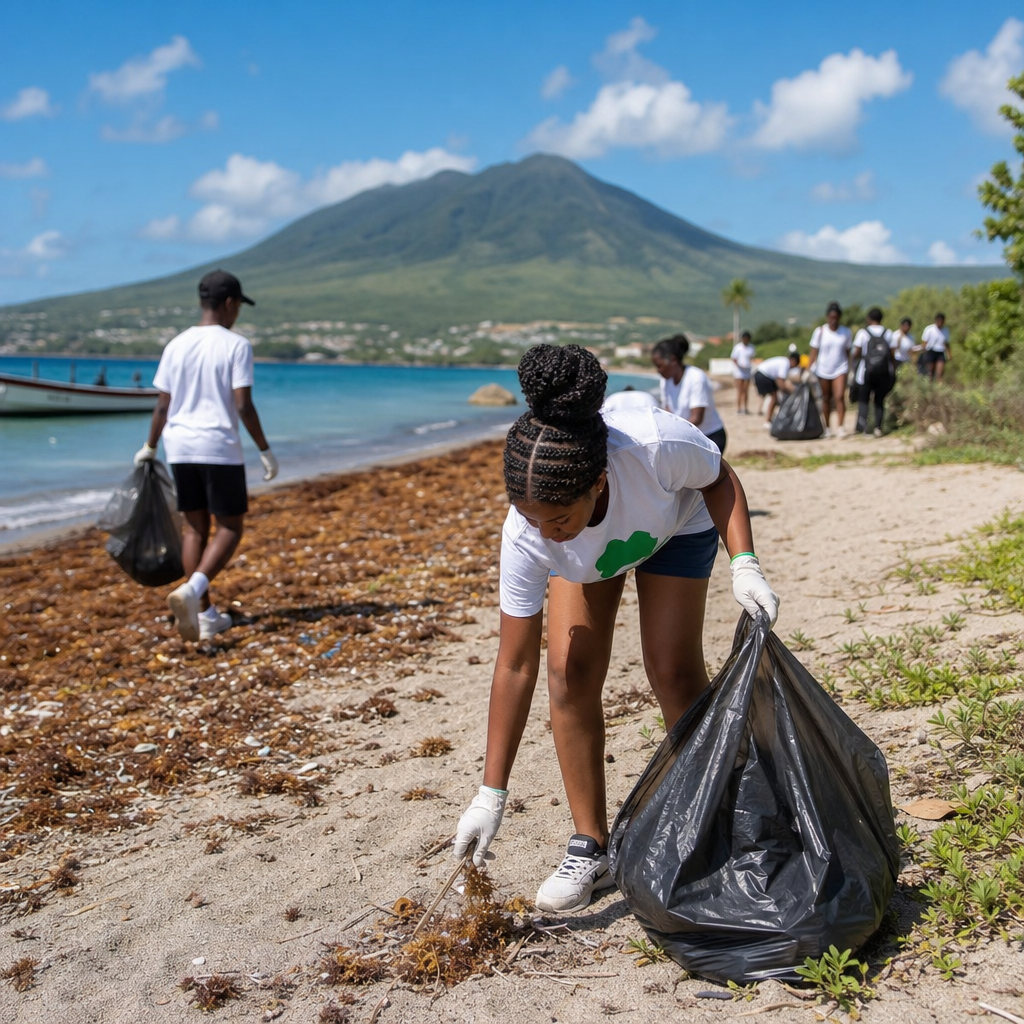
Many visitors treat Nevis beaches primarily as leisure spaces, but in wildlife terms they are transition zones where marine, avian, and human activity intersect. Pinney’s Beach and other accessible stretches can reveal feeding pelicans, roosting gulls, and passing terns, especially during quieter hours. Rocky edges and small coves may hold crabs, juvenile fish in clear shallows, and wading birds taking advantage of exposed prey. Where freshwater seepage, ponds, or wet depressions occur near the coast, they can attract herons and migratory species that would otherwise be missed by travelers who only look out to sea.
February is especially useful for these overlooked places because lower rainfall often means easier access and less visual clutter. I encourage visitors to slow down and scan in layers: surf line first, then damp sand, then wrack, then shoreline vegetation, then the sky. That method consistently increases sightings. Even common species become more interesting when behavior is observed closely. A sanderling running the tide edge demonstrates energy-efficient feeding. A pelican drifting offshore may suddenly coordinate with a fish school. A heron standing motionless in a drainage area is using patience as a hunting strategy, not inactivity. These details matter because they help travelers understand why a small island supports such diversity in limited space.
How to Plan Responsible Wildlife Encounters on Nevis
The best wildlife encounters on Nevis come from restraint, timing, and local knowledge rather than aggressive pursuit. Start with realistic goals: a broad half-day wildlife circuit will usually outperform a rigid hunt for a single rare species. Use licensed guides or experienced boat operators when entering marine habitats or upland trails, both for safety and for interpretation. Bring binoculars, reef-safe sun protection where possible, water shoes for rocky entries, and a dry bag for boat trips. For photography, a moderate telephoto lens is often more useful than extreme magnification because many encounters happen at medium distance in mixed light.
Responsible behavior is non-negotiable on a small island. Keep distance from turtles, nesting or roosting birds, and monkeys. Stay on established paths where practical to reduce erosion and avoid trampling fragile coastal vegetation. Do not collect shells if occupied, and avoid handling starfish or other marine animals for photos. If snorkeling, maintain buoyancy control to prevent contact with coral. Coral damage is often accidental, but accidental damage still harms habitat that grows slowly and supports fish recruitment. Local conservation outcomes depend heavily on visitor behavior because pressure accumulates quickly in compact destinations. If you are using this miscellaneous hub to plan further reading, the most useful follow-on topics are ethical wildlife viewing, best guided nature tours, reef etiquette, and seasonal wildlife calendars by month.
The fauna of Nevis in February is defined by accessibility, variety, and the pleasure of seeing wildlife within a compact island system that makes ecological connections easy to grasp. In one trip, you can move from hummingbirds in a flowering garden to vervet monkeys on a hillside, from pelicans patrolling the coast to turtles feeding offshore. That range is the central strength of Nevis as a nature destination. It rewards curiosity more than speed and observation more than volume. Visitors who understand habitat, weather, and timing usually come away with richer encounters than those who rely on chance alone.
The most important takeaway is simple: February offers some of the island’s best conditions for general wildlife watching because the dry season improves visibility on land and often underwater while migratory bird interest remains high. You do not need to be a specialist birder, diver, or field biologist to appreciate the fauna of Nevis, but you do need to look carefully and act responsibly. Small signs—a moving branch at the forest edge, a shadow over reef grass, a distant bird shape over the bay—often lead to the most memorable sightings. Use this hub as your starting point, then build outward into focused guides on birds, marine life, trails, and conservation-minded tours to make your February wildlife experience on Nevis more informed and more rewarding.
Frequently Asked Questions
What kinds of wildlife can visitors realistically expect to see in Nevis during February?
February is one of the best months to enjoy Nevis wildlife because the island’s dry-season conditions generally improve visibility, access, and comfort. Visitors can expect a broad mix of species across several habitats, even on a short stay. Along the coast and offshore, sea turtles, reef fish, rays, and seabirds are among the most exciting possibilities, especially in calm water and around healthy reef structure. Dolphins may also be seen in surrounding waters, while seasonal marine activity often makes boat-based wildlife watching especially rewarding in late winter.
On land, Nevis offers a surprisingly rich range of encounters for such a compact island. In drier lowland areas and agricultural edges, travelers often notice small birds, insects, lizards, and monkeys, especially the well-known African green vervets that have become part of the island’s modern ecological identity. In wetter upland and forested areas around Nevis Peak, birdlife becomes more noticeable, with species taking advantage of fruiting trees, shelter, and cooler conditions. Mangroves and pond margins can add wading birds and other water-associated species to the list. What makes February special is not necessarily that rare wildlife suddenly appears, but that the combination of moderate heat, lower rainfall, and clearer conditions makes wildlife easier to observe across beaches, trails, reefs, and roadside habitats in the same trip.
Why is February considered such a good month for wildlife encounters in Nevis?
February stands out because it aligns practical travel comfort with favorable viewing conditions. Nevis is in its drier season at this time, so trails are often easier to manage, coastal roads and viewpoints are more predictable, and heavy rain is less likely to interrupt a day of birding, hiking, snorkeling, or boating. The moderate heat also matters more than many visitors expect. Wildlife watching is simply more enjoyable when you can spend longer outdoors without the fatigue that can come with hotter, wetter months.
Another major advantage is clarity. Dry-season air and water conditions can make a noticeable difference, particularly for coastal observation and marine wildlife experiences. Snorkelers and divers often benefit from better underwater visibility, while people exploring beaches, rocky shores, and mangrove edges can more easily spot movement and behavior. Birds are also often easier to watch in brighter, more stable morning conditions. Because Nevis includes volcanic slopes, scrub, farms, wetlands, and marine environments within a relatively small area, February lets visitors move efficiently between habitats without losing much of the day to weather disruption. In practical terms, that means more chances to see more species with less effort.
Where are the best places in Nevis to look for wildlife in February?
The best locations depend on which animals you most want to see, but Nevis rewards visitors who explore several habitats instead of staying in only one area. Beaches and nearshore waters are ideal for spotting marine life, seabirds, and coastal species, especially in the morning when conditions are calmer and human activity is lower. Reef areas and clear bays are particularly valuable for snorkelers hoping to observe colorful fish, invertebrates, and occasionally turtles or rays. Offshore boat trips can open the possibility of larger marine encounters and broaden the range of seabirds you may see.
For land-based wildlife, agricultural edges, quiet roadsides, and dry scrub can be excellent for vervet monkeys, lizards, butterflies, and common island birds. Mangroves and saline ponds are especially worthwhile for birdwatchers because these habitats can attract herons, egrets, and other species associated with shallow water and shelter. If you want a different ecological zone, the slopes of Nevis Peak and surrounding greener uplands provide a more forested setting where bird activity can be stronger and the atmosphere feels entirely different from the coast. The island’s greatest advantage is its compact size: you can start the day with birds and monkeys inland, move to mangroves by late morning, and finish with snorkeling or a sunset seabird watch along the coast.
Are there any ethical or safety guidelines visitors should follow when watching wildlife in Nevis?
Yes, and following them makes the experience better for both visitors and animals. The most important rule is to observe without interfering. That means keeping a respectful distance, avoiding loud noises, never chasing animals for photographs, and resisting the urge to feed wildlife. This is particularly important with vervet monkeys, which may appear approachable but should not be encouraged to associate people with food. Feeding or crowding wild animals can alter natural behavior, increase aggression, and create long-term health and management problems.
Marine encounters require equal care. Snorkelers and swimmers should avoid touching coral, standing on reef structure, or pursuing sea turtles and rays. Boats should operate responsibly around wildlife, and any guided excursion should prioritize animal welfare over close contact. On land, visitors should stay on established paths where possible, especially in sensitive habitats such as mangroves, nesting areas, or upland trails. Practical safety matters too: wear sun protection, carry water, use suitable footwear for rocky or muddy terrain, and check local conditions before entering the sea. Ethical wildlife watching in Nevis is not restrictive; it is what allows these encounters to remain natural, memorable, and sustainable.
How can travelers maximize their chances of seeing more wildlife during a February trip to Nevis?
The best strategy is to treat wildlife watching as a series of well-timed habitat visits rather than a single excursion. Early morning is usually the most productive period for bird activity, monkey sightings, and comfortable walking in scrub, farmland, or foothill areas. Calm mornings can also be excellent for kayaking, shoreline observation, or snorkeling before winds and surface disturbance increase later in the day. Late afternoon is another strong window, especially for coastal watching and general animal activity as temperatures soften.
It also helps to diversify your approach. Rather than spending every day on the beach or every day in the hills, combine upland, lowland, wetland, and marine environments. Bring binoculars, a camera with some zoom, reef-safe sun protection, and a simple species checklist if you enjoy keeping track of sightings. Hiring a knowledgeable local guide can significantly improve results because guides understand seasonal patterns, access points, and animal behavior that casual visitors often miss. Finally, stay patient and observant. Nevis is not a theme park for wildlife; its rewards come from paying attention to movement in trees, birds at pond edges, fish over coral, and subtle changes in habitat. In February, those details are often easier to detect, which is exactly why the month is so rewarding for fauna-focused travel.