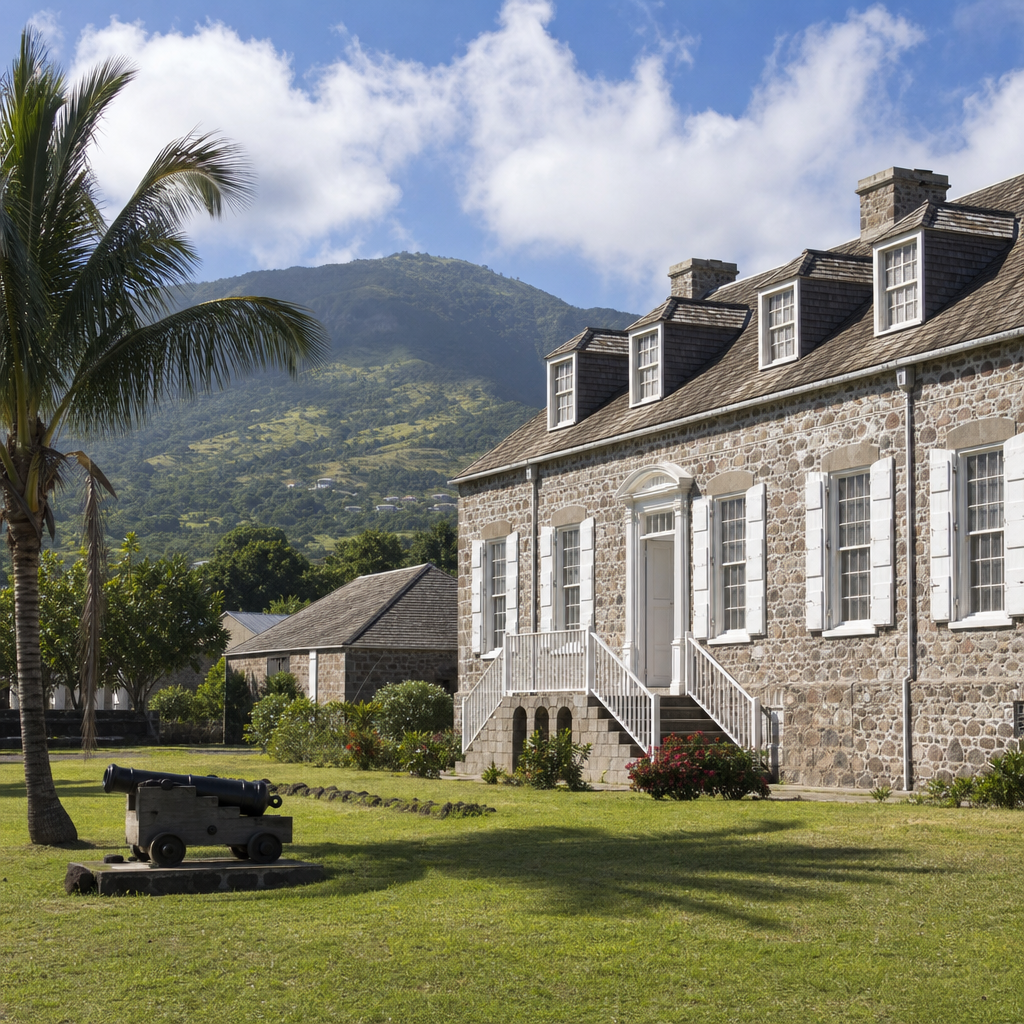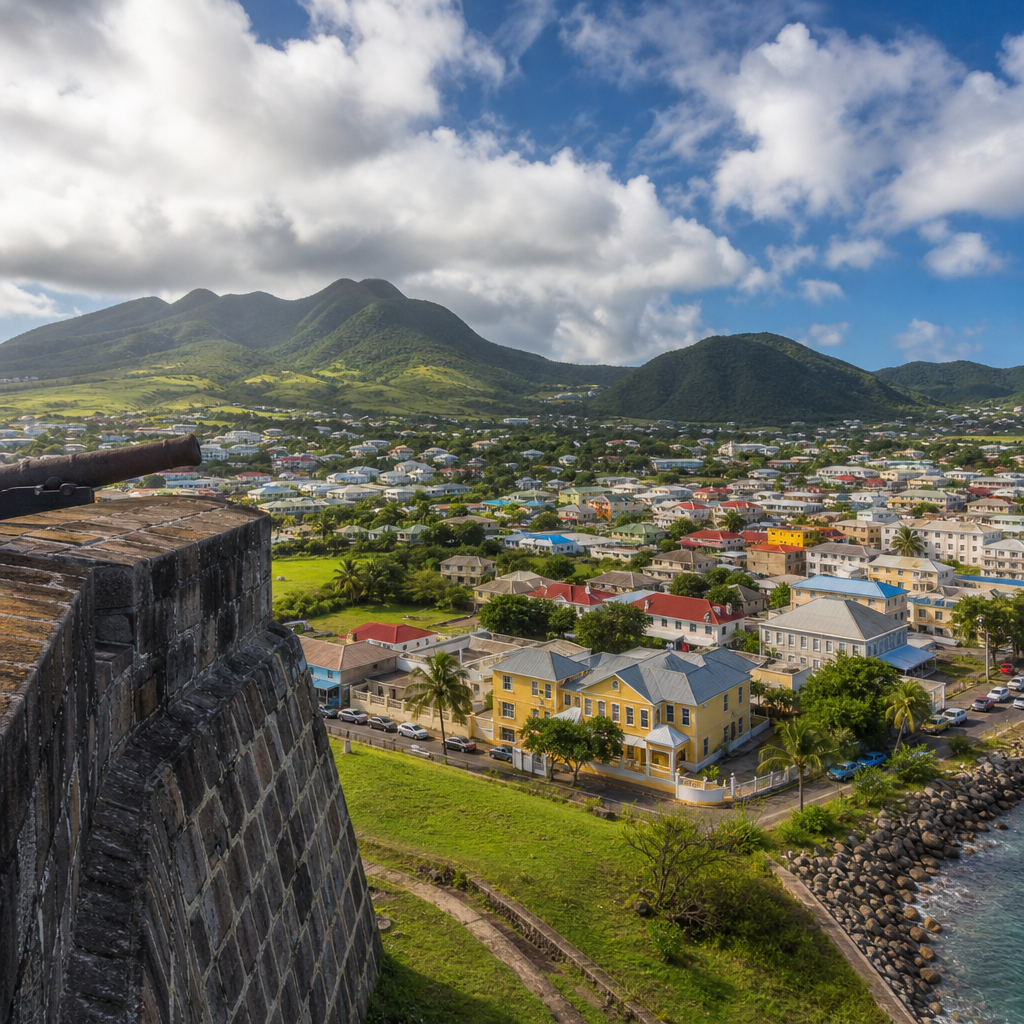
The influence of the British Empire on Saint Kitts is visible in the island’s language, laws, land use, architecture, education system, and political institutions, making imperial history essential to understanding modern Kittitian society. Saint Kitts, officially Saint Christopher, is one of the two islands that form Saint Kitts and Nevis in the eastern Caribbean. When historians discuss British imperial influence here, they mean more than military occupation or colonial governors. They mean a long process through which Britain reshaped labor, religion, trade, social hierarchy, and public administration, then left behind structures that continued after emancipation, federation, and independence.
This subject matters because Saint Kitts was not a marginal colony. It was one of Britain’s earliest and most profitable Caribbean possessions, deeply tied to the rise of the sugar plantation economy and the expansion of Atlantic slavery. Decisions made in London and by colonial elites on the island affected who owned land, who had political power, how wealth was distributed, and which cultural practices were privileged or suppressed. In my work reviewing Caribbean colonial records and heritage interpretation, Saint Kitts repeatedly stands out as a place where empire can be traced in unusually concrete ways: the boundaries of old estates, the Anglican churches at village centers, the court system, parliamentary procedure, and even the road network around former plantations.
Understanding the British Empire’s impact on Saint Kitts also helps explain present debates about inequality, heritage tourism, reparations, and national identity. The island’s story includes conquest, forced migration, resistance, adaptation, and institution building. It is therefore a hub topic within Culture and History, connecting to articles on slavery, sugar, emancipation, independence, architecture, religion, migration, and heritage sites. To grasp Saint Kitts today, it is necessary to see how imperial rule established patterns that endured for centuries, sometimes by design and sometimes through habit, convenience, or economic dependence.
Colonization, rivalry, and the making of a British colony
Saint Kitts became central to British imperial strategy in the early seventeenth century. English settlers arrived in 1623 under Thomas Warner, and the island soon became one of the first successful English colonies in the Caribbean. The French also settled there, creating an unusual period of shared occupation before repeated wars shifted control. Because of its location in the Leeward Islands and its fertile land, Saint Kitts served as a launch point for wider colonization across the region. From an imperial perspective, it was both a settlement colony and a military asset.
British control was never a simple administrative fact. It was established through conflict with Indigenous Kalinago communities, competition with France, and the importation of enslaved Africans for labor. By the eighteenth century, Britain had secured dominance, and Saint Kitts was integrated into the mercantilist system that tied colonial production to metropolitan profit. Colonial assemblies, governors, and plantation owners worked within a framework shaped by British law, but local elites exercised substantial influence. That blend of imperial oversight and planter power became a defining feature of governance on the island.
One reason Saint Kitts mattered so much is that it demonstrated how empire functioned commercially. The island exported sugar, molasses, and rum into Atlantic networks protected by British naval power. In return, it imported manufactured goods, credit, and administrative rules. The colony’s economic success helped legitimize further imperial expansion. At the same time, the wealth extracted from Saint Kitts depended on coercion and environmental transformation, making the island an early example of how Britain’s empire fused commerce, violence, and bureaucracy.
The plantation system and the economics of sugar
The strongest British influence on Saint Kitts was the creation of a sugar colony organized around plantations. Sugar cultivation expanded rapidly from the late seventeenth century and soon dominated land use, labor demand, and export earnings. Planters consolidated estates, mills, boiling houses, curing houses, and transport routes into a landscape designed for monocrop production. This was not simply agriculture. It was an industrial system powered by enslaved labor, international credit, shipping insurance, and imperial preference.
Across the Caribbean, sugar reshaped islands, but Saint Kitts is a particularly clear case because so much of its terrain was divided into estates. The countryside became a map of imperial priorities: fertile land concentrated in the hands of a relatively small planter class, with enslaved and later free laborers living near the properties they worked. Estate names survived in place names long after their owners changed. Even today, former plantation zones influence settlement patterns and property boundaries. Visitors who ride the scenic railway, which follows old sugar transport lines, are literally moving through an imperial economic geography.
British policy reinforced this system. Navigation laws, tariff arrangements, and credit structures favored colonial producers linked to British merchants. During the height of the plantation era, sugar from Saint Kitts was part of a larger imperial commodity chain that connected Caribbean fields to refineries, ports, and consumers in Britain. The profits were unevenly distributed. Planters, merchants, insurers, and absentee owners accumulated capital, while enslaved workers bore the human cost. That imbalance remained significant after slavery ended because land ownership stayed highly concentrated.
| Area | British imperial impact on Saint Kitts | Long-term result |
|---|---|---|
| Land use | Expansion of sugar estates and monocrop farming | Concentrated ownership and plantation landscapes |
| Labor | Reliance on enslaved Africans, later wage labor | Deep social inequality and class divisions |
| Trade | Integration into British Atlantic markets | Export dependence and vulnerability to price swings |
| Government | Colonial assemblies, governors, and British legal norms | Westminster-style institutions after independence |
| Culture | English language, Anglican influence, imperial schooling | Enduring British-derived public culture |
Slavery, emancipation, and social transformation
No assessment of the British Empire in Saint Kitts is credible without centering slavery. Enslaved Africans and their descendants made the sugar economy possible. They cleared land, planted cane, operated mills, worked in boiling houses, built roads, and sustained the colony under brutal conditions. British imperial rule provided the legal framework for racial slavery through slave codes, property law, and military enforcement. On Saint Kitts, as elsewhere, the plantation order depended on surveillance, punishment, and the denial of basic human rights.
Yet enslaved people were never passive. They resisted through work slowdowns, sabotage, escape, cultural retention, and rebellion. Caribbean historians have shown that resistance helped destabilize slavery across the region, especially after the Haitian Revolution transformed planter fears and imperial calculations. In Saint Kitts, emancipation in 1834, followed by apprenticeship and full freedom in 1838, ended legal bondage but did not produce equal citizenship. Formerly enslaved people entered freedom with little access to land, limited political rights, and strong pressure to remain tied to plantations as laborers.
This transition reveals a recurring pattern in British colonial governance: reform without fundamental redistribution. The empire abolished slavery, but compensation went to slave owners, not to the enslaved. That fact is vital when discussing Saint Kitts today because wealth gaps and estate-based land concentration did not emerge by accident. They were built into the end of slavery itself. Villages, family networks, churches, and mutual aid traditions grew partly as responses to these exclusions. Modern conversations about heritage and reparatory justice on the island are rooted in that historical reality.
Law, government, and political institutions
Another durable imperial legacy is institutional. Saint Kitts developed under British constitutional norms that emphasized gubernatorial authority, legislative procedure, common law traditions, and a civil service model tied to colonial administration. Although representation was historically restricted by race, class, and property, the basic machinery of government came from British practice. Court procedures, legal terminology, parliamentary debate, and administrative recordkeeping still bear that imprint.
As a former colony within the Leeward Islands federation framework and later the associated state system, Saint Kitts inherited a layered political culture. British governance trained local elites in constitutionalism while also limiting popular sovereignty. That tension shaped twentieth-century politics. Labor organization, anti-colonial activism, and electoral reform emerged partly in response to a system that claimed legality while protecting planter and imperial interests. The rise of the Saint Kitts-Nevis-Anguilla Labour movement illustrated how workers used the language of rights and representation against structures Britain had helped create.
After independence in 1983, Saint Kitts and Nevis retained a parliamentary democracy modeled on Westminster, remained within the Commonwealth, and kept the common law tradition. This continuity is not unusual in former British territories, but on Saint Kitts it is especially visible because many public institutions evolved rather than being replaced. The advantage is stability and procedural familiarity. The limitation is that inherited systems can preserve colonial assumptions about land, authority, and status unless they are deliberately reformed.
Language, religion, education, and everyday culture
British influence on Saint Kitts is also cultural, though it always interacted with African, Caribbean, and local traditions. English became the official language of administration, schooling, and law, while Kittitian Creole developed through contact among African languages, English, and plantation society. In practice, this means daily life on the island reflects both imperial standardization and creolized adaptation. Formal speeches, legal documents, and school instruction may follow British-derived norms, but local expression carries distinct rhythms and vocabulary shaped in the colonial period.
Religion offers another example. Anglicanism enjoyed prestige because it was linked to state authority and elite respectability, yet Methodism, Moravian missions, and other denominations also became important, especially among the Black population. Churches were more than spiritual spaces. They were sites of literacy, social discipline, mutual aid, and community leadership. British missionary education often aimed to produce order and moral conformity, but local communities used schools and churches to pursue advancement and collective identity on their own terms.
Education systems in Saint Kitts long reflected British curricula, examinations, and institutional values. Generations studied English literature, imperial history, and standardized syllabi influenced by Cambridge or regional adaptations of British models. School uniforms, prefect systems, speech days, and formal examinations all carried recognizably British features. At the same time, these institutions became pathways for social mobility. Many Caribbean leaders emerged from colonial schools that taught loyalty to empire yet inadvertently equipped students to criticize it. That paradox is central to Saint Kitts’s modern history.
Architecture, infrastructure, and the physical landscape
The built environment of Saint Kitts preserves the British Empire in stone, timber, and spatial design. Brimstone Hill Fortress National Park, now a UNESCO World Heritage Site, is the clearest example. Built by enslaved African labor for the British military, the fortress symbolized imperial defense in the eastern Caribbean and guarded against French attack. Its engineering reflects eighteenth-century military principles, but its labor history reveals the human cost of imperial ambition. Few sites in the Caribbean illustrate those two truths so starkly.
Plantation great houses, sugar works, churches, cemeteries, courthouses, and administrative buildings also show British influence. Their layouts often expressed hierarchy: elevated houses for owners, clustered work areas for production, and segregated village spaces for laborers. Roads and rail infrastructure were designed primarily to move cane and connect estates to export points, not to promote balanced internal development. Even Basseterre’s urban form carries traces of colonial planning shaped by commerce, defense, and administration.
These physical remnants matter because they are not merely heritage attractions. They structure tourism, land values, conservation priorities, and public memory. Restoring a fort or marketing a former estate as a destination can educate visitors, but it can also sanitize plantation history if slavery and inequality are not fully interpreted. The best heritage work on Saint Kitts presents the landscape honestly: beautiful, strategic, and economically important, yet built within a coercive colonial order.
Legacy, identity, and debates in the present
The British Empire’s influence on Saint Kitts did not end with independence. It survives in institutions, legal habits, ceremonial life, surnames, land disputes, and ideas about class and respectability. Cricket, parliamentary ritual, and the monarchy’s residual symbolism all reflect imperial inheritance, even when local meaning has changed. At the same time, national identity in Saint Kitts is not British in any simple sense. It is Kittitian, Caribbean, and diasporic, formed through the blending of African ancestry, colonial experience, labor politics, and postcolonial self-definition.
Current debates show how alive this history remains. Questions about land access, preservation of plantation sites, teaching slavery in schools, and the meaning of reparations all stem from imperial structures. The closure of the sugar industry in 2005 marked a major break with the economic system Britain helped entrench, yet the social geography of sugar still shapes the island. Communities continue to live with the legacy of concentrated estates, labor migration, and uneven development.
For readers exploring Saint Kitts under the wider Culture and History topic, this hub article offers the essential frame: British rule influenced nearly every major sphere of life, but that influence was always mediated by resistance, adaptation, and local creativity. To understand the island fully, follow the connected stories of sugar, slavery, emancipation, religion, heritage sites, and independence, and examine how the past continues to organize the present.
Frequently Asked Questions
How did British rule shape the language and everyday culture of Saint Kitts?
British rule left a lasting mark on both the formal and informal ways people communicate in Saint Kitts. English became the official language of government, education, law, commerce, and public life, and that legacy remains central to the island today. At the same time, local speech developed in conversation with African heritage, plantation society, and Caribbean experience, producing distinctive Kittitian expressions, rhythms, and forms of communication that reflect more than simple imitation of Britain. In other words, British influence established the framework, but the people of Saint Kitts transformed it into something local and recognizable as their own.
That same pattern appears in everyday culture. British imperial customs influenced dress codes, school traditions, church life, administrative etiquette, and public ceremonies, while local communities adapted those practices to Caribbean realities. Sports such as cricket, for example, became part of island identity through empire, yet they took on deep local meaning far beyond their British origins. The result is a society in which imperial influence is visible, but never untouched; it has been reshaped by generations of Kittitians into a culture that is both historically rooted and distinctly national.
What role did the British Empire play in shaping Saint Kitts’ laws and political institutions?
The British Empire played a foundational role in building the legal and political structure of Saint Kitts. British colonial administration introduced legal traditions based on English common law, along with courts, property rules, administrative offices, and systems of governance that still influence the country’s institutions. Many of the island’s procedures in legislation, public administration, and judicial practice can be traced to British imperial models. This helps explain why modern Saint Kitts and Nevis shares institutional features with other former British territories, including parliamentary traditions, legal terminology, and constitutional forms that emerged from the colonial era.
At the same time, these institutions were not originally designed for equal participation by the entire population. During the colonial period, political power was concentrated in the hands of imperial officials and planter elites, especially those tied to the sugar economy. Enslaved Africans and, later, many laboring people were excluded from meaningful authority. Understanding British influence therefore requires looking at both legacy and limitation: empire created the formal machinery of law and government, but it did so within a deeply unequal social order. Over time, however, Kittitians challenged and transformed those inherited institutions through labor activism, reform movements, electoral politics, and eventual independence, making the system more representative than its colonial origins.
How did British imperialism affect land use and the economy in Saint Kitts?
Few areas reveal British imperial influence more clearly than land use and the economy. Under British rule, Saint Kitts was organized heavily around plantation agriculture, especially sugar production, which became the backbone of the colonial economy. Large estates dominated the landscape, and land was used primarily to serve imperial trade networks rather than the needs of local communities. This meant fertile land was often devoted to export crops, while economic power remained concentrated among plantation owners and colonial interests. The island’s roads, labor systems, shipping connections, and settlement patterns were all shaped by this plantation-centered model.
The human cost of that system was enormous. The wealth of the sugar economy depended first on enslaved African labor and later on systems of low-wage labor that preserved economic inequality after emancipation. This legacy influenced class divisions, land access, and patterns of rural life long after the formal end of slavery. Even in the modern period, the imprint of the plantation economy can still be seen in where people live, how land has historically been distributed, and how economic opportunity developed unevenly across the island. To understand present-day Saint Kitts, it is essential to recognize that British imperial policy did not simply govern the island politically; it reorganized the landscape and economy in ways that endured for generations.
In what ways is British influence visible in Saint Kitts’ architecture and built environment?
British influence can be seen clearly in the island’s architecture, urban organization, and public buildings. Colonial rule introduced administrative buildings, churches, schools, military structures, estate houses, and town layouts that reflected British priorities and styles, even when adapted to Caribbean climate and local materials. In Basseterre and other historic areas, elements of colonial planning remain visible in street patterns, civic buildings, and institutional spaces. Anglican churches, former plantation great houses, and official government structures all tell part of the story of how empire expressed power physically on the landscape.
Yet the built environment of Saint Kitts is not purely British in character. African-descended communities, local builders, practical climate needs, and later historical changes all shaped how structures were designed, used, and modified. Verandas, ventilation choices, stone construction, and adaptive reuse of colonial spaces reveal a blending of imported forms and local realities. Historic sites linked to military conflict and plantation production also remind visitors that architecture under empire was not neutral; it was tied to defense, control, religion, labor, and hierarchy. That is why the island’s buildings are so important historically: they preserve visible evidence of both colonial authority and local adaptation.
Why is British imperial history still important for understanding modern Saint Kitts?
British imperial history remains essential because so many features of modern Saint Kitts were shaped within that colonial framework. The official language, school system, legal order, parliamentary model, land patterns, and many public institutions all carry traces of British influence. Even where Saint Kitts has redefined these systems on its own terms, the original structure often came from the imperial period. This does not mean modern Kittitian identity is simply colonial in character. Rather, it means the society developed through a long process of resistance, adaptation, reform, and self-definition in response to empire.
Studying this history also helps explain ongoing social and economic questions. Issues related to land ownership, inequality, class formation, labor history, and national memory cannot be fully understood without reference to the plantation era and colonial governance. British influence is therefore not just a matter of flags, governors, or old buildings; it is woven into the deeper development of institutions and everyday life. For readers trying to understand modern Saint Kitts, imperial history provides the context for how the island became what it is today: a sovereign Caribbean nation whose people inherited colonial systems but have continually reshaped them through their own political struggles, cultural creativity, and national aspirations.