Nevis may be small, but its nature reserves carry outsized importance for Caribbean biodiversity, watershed protection, cultural heritage, and sustainable tourism. When people picture the island, they usually think first of volcanic slopes, quiet beaches, and views across the Narrows to St. Kitts. Those landscapes are real, but the deeper story is ecological: cloud forest on Nevis Peak, dry coastal scrub, mangroves, offshore reefs, salt ponds, and nesting beaches all function as linked habitats that support birds, reptiles, marine life, and native plants. In practical terms, nature reserves of Nevis are protected or conservation-priority areas managed through law, planning policy, community stewardship, and site-specific restoration. Some are formally designated, while others are safeguarded through fisheries rules, coastal setbacks, watershed management, or heritage protections that directly affect habitat quality.
That broad definition matters because island conservation rarely depends on one fenced park. On Nevis, biodiversity protection is a networked effort. The upper elevations capture rain and stabilize soils. Ghauts funnel freshwater downslope. Wetlands buffer storm surge and provide nursery habitat for fish. Coral reefs reduce wave energy and support local livelihoods. Sea turtle nesting beaches connect the terrestrial and marine environment in a way visitors can see immediately. I have worked on island content and protected-area research long enough to know that the most useful overview is not a simple list of attractions. Readers need to understand what each reserve-like landscape does, what species depend on it, what threats it faces, and how individual site articles fit into a larger conservation picture.
For that reason, this hub article covers the full scope of Nevis conservation under the Nature and Wildlife umbrella, including forests, marine habitats, wetlands, bird areas, scenic coastlines, and community-led protection. It is designed to answer common questions directly: What are the main natural habitats on Nevis? Which species are most significant? Why do protected areas matter on a small island? How can travelers visit responsibly? The answers are straightforward. Nevis matters because islands concentrate endemism, migratory stopover habitat, and climate vulnerability in a limited land area. A damaged wetland or cleared hillside cannot be replaced easily. Protecting biodiversity on Nevis protects freshwater, fisheries, erosion control, landscape beauty, and the island’s long-term resilience.
Nevis Peak and the island’s forested watershed
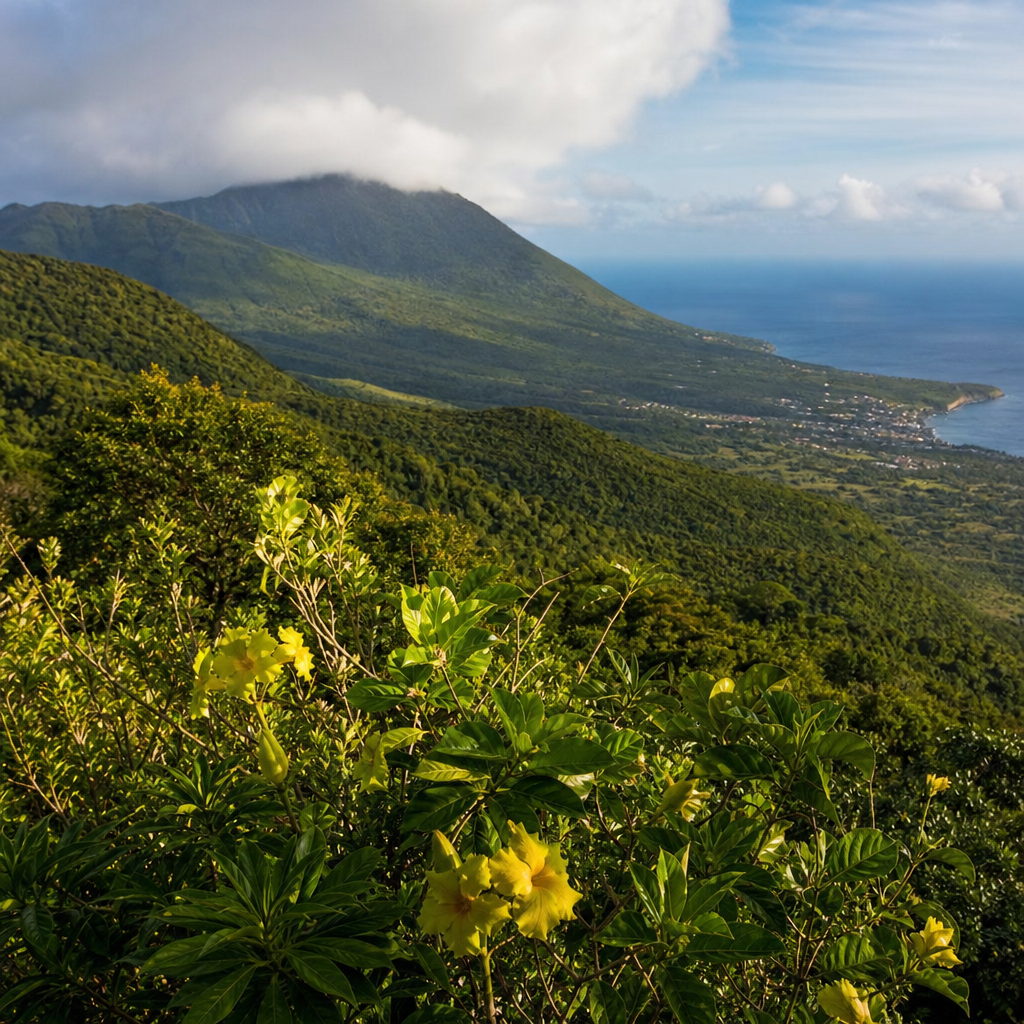
The ecological core of Nevis is Nevis Peak, a 985-meter volcanic mountain whose upper slopes hold moist forest, palm brake, tree fern communities, and cloud-influenced habitat. This high-elevation zone is not important only because it is scenic. It is the island’s principal watershed. Vegetation intercepts moisture, slows runoff, anchors fragile volcanic soils, and feeds the ghauts that carry water toward settlements and coastal ecosystems. In island conservation planning, upland protection is always a first-order priority because deforestation upstream quickly produces flooding, sedimentation, and reef decline downstream.
Forest on Nevis also supports native biodiversity that tourists often overlook. Birdlife includes species such as the purple-throated carib, green-throated carib, Lesser Antillean bullfinch, and pearly-eyed thrasher, alongside migratory warblers that use Caribbean islands seasonally. The mountain’s cooler, wetter microclimates allow plant assemblages that differ sharply from the coast. Hikers experience this as a rapid ecological transition: cultivated land gives way to secondary woodland, then denser montane vegetation with mosses, vines, and reduced visibility near the summit. A reserve approach here means limiting erosion, controlling invasive plants where feasible, and managing trail use so recreation does not degrade the same habitat people come to enjoy.
Coastal wetlands, ponds, and mangrove systems
If Nevis Peak is the island’s green engine, wetlands are its shock absorbers. Coastal ponds, seasonally flooded depressions, and mangrove-fringed areas trap sediment, filter runoff, hold floodwater during heavy rain, and provide feeding grounds for birds. These habitats can look unassuming in dry periods, which is exactly why they are often undervalued in development debates. Yet on small islands, a salt pond or mangrove edge can support herons, egrets, shorebirds, crabs, juvenile fish, and invertebrates that sustain wider food webs.
Wetlands on Nevis are especially significant during migration. The Lesser Antilles sit on important flyways, and even modest ponds can become temporary refueling sites for sandpipers, plovers, and other passage migrants. Local birders know that weather events, rainfall patterns, and seasonal water levels can transform a quiet basin into a productive birding location overnight. From a protection standpoint, that means setbacks, hydrological integrity, and pollution control matter as much as formal designation. Filling, dredging, or altering water flow can destroy ecological function long before a site appears visibly damaged.
Marine reserves, reefs, and seagrass beds
Marine biodiversity is inseparable from any serious guide to nature reserves of Nevis. The island’s nearshore environment includes coral reefs, patch reefs, rocky substrates, sandy bottoms, and seagrass beds that support fish, sea urchins, conch, lobster, rays, and turtles. Reefs also deliver a public-safety service that is easy to quantify: they dissipate wave energy, helping protect beaches and infrastructure during storms. When coral cover declines because of warming, disease, sediment, or anchor damage, the island loses both habitat complexity and coastal defense.
In practice, marine protection around Nevis relies on fisheries management, mooring use, boating rules, dive operator standards, and the growing recognition that land-based impacts are reef impacts. Sediment washed from disturbed slopes can smother corals. Nutrient runoff can favor algal growth. Poorly managed coastal construction can cloud water and stress seagrass. The most effective reserve model is therefore ridge-to-reef. Divers, snorkelers, and fishers all benefit when upland forests, ghauts, wetlands, and coastlines are treated as one connected system rather than separate policy boxes.
| Habitat | Primary ecological role | Representative wildlife | Main pressure |
|---|---|---|---|
| Montane forest | Water capture, soil stability, cooler microclimates | Caribbean birds, bats, native plants | Erosion, invasive species, trail damage |
| Wetlands and ponds | Flood buffering, filtration, migratory bird habitat | Herons, shorebirds, crabs, juvenile fish | Drainage, filling, pollution |
| Coral reefs and seagrass | Nursery habitat, fisheries support, wave attenuation | Reef fish, turtles, rays, invertebrates | Warming, sedimentation, anchor damage |
| Nesting beaches | Sea turtle reproduction, dune stability | Hawksbill, green, and leatherback turtles | Lighting, disturbance, erosion |
Sea turtle nesting beaches and shoreline conservation
Sea turtles are among the most visible conservation ambassadors on Nevis, and their nesting beaches illustrate how a “reserve” can include regulated use rather than complete exclusion. Hawksbill turtles are especially associated with the wider eastern Caribbean, while green and leatherback turtles may also occur in regional waters and on nesting shores. Successful nesting depends on dark beaches, intact dunes, limited nighttime disturbance, and clean sand above the high-tide line. Artificial lighting disorients both nesting females and hatchlings, drawing them inland instead of toward the sea.
On Nevis, beach conservation therefore intersects with hotel design, villa landscaping, coastal engineering, and visitor behavior. Shielded lighting, seasonal monitoring, marked nests, and public education all make a measurable difference. I have seen islands lose nesting activity on heavily lit shores within a few seasons, while quieter beaches with simple management rules remain productive. This is why local partnerships are so valuable. Government agencies, conservation groups, and tourism businesses can reduce disturbance without closing the coast entirely. For readers exploring related articles, turtle conservation, beach ecology, and responsible wildlife watching are core subtopics connected to this hub.
Bird habitats and Important Bird Area values
Bird conservation provides one of the clearest ways to understand Nevis biodiversity because birds use nearly every habitat on the island. Coastal ponds attract waders and migrants. Woodland edges support doves, hummingbirds, and passerines. Higher slopes hold species adapted to wetter forest. Offshore and nearshore zones may host seabirds hunting over productive water. In the Caribbean, even islands without huge species lists can be internationally meaningful because they provide breeding sites, endemic-range habitat, or stopover resources during migration.
Nevis rewards patient observation rather than checklist chasing. Early morning around wetlands or foothill gardens can reveal hummingbird activity, flycatchers, and seasonal migrants using fruiting trees. After rain, temporary pools may hold birds absent the week before. Conservation lessons follow directly from those patterns. Habitat diversity is what sustains avian diversity. If development simplifies the landscape into lawn, road, and seawall, birdlife declines quickly. If hedgerows, ghauts, mangroves, and mixed native vegetation remain, the island retains both ecological richness and strong birdwatching value.
Threats to biodiversity on Nevis
The major threats facing Nevis are familiar across small islands but play out with local specificity. Unplanned or poorly sited development fragments habitat and increases runoff. Invasive species can outcompete native plants, prey on eggs, or alter forest regeneration. Climate change intensifies drought, heavy rainfall, coral bleaching, stronger storm impacts, and sea-level pressure on low-lying shores. Waste management and wastewater treatment remain critical because nutrient and debris leakage degrade wetlands and coastal water quality. None of these pressures acts alone; cumulative impact is the real conservation challenge.
For example, one hillside cleared without adequate drainage may seem manageable. Multiply that by road cuts, roof runoff, and shoreline hardening, and the result is sediment-rich discharge into bays where reefs are already heat-stressed. Similarly, a few bright beachfront properties may not appear disastrous, but combined lighting across an entire coast can sharply reduce turtle nesting success. Good reserve management on Nevis therefore depends on planning discipline, enforcement capacity, and public buy-in, not just on drawing boundaries on a map.
How protection works: policy, community action, and tourism standards
Effective conservation on Nevis is a blend of top-down rules and bottom-up stewardship. Formal environmental law, fisheries regulations, physical planning controls, and building standards create the legal framework. Community organizations, schools, guides, fishers, and hotel operators translate that framework into daily practice. This mixed model is common on islands where government resources are limited but local knowledge is strong. It works best when decision-makers treat residents as partners rather than obstacles.
Tourism can either undermine or strengthen biodiversity protection. Poorly managed visitation increases trampling, litter, anchor damage, wildlife disturbance, and water demand. Well-managed tourism funds guides, habitat restoration, environmental education, and higher-value experiences built around intact nature. On Nevis, the opportunity is quality over volume. Visitors who hike responsibly, snorkel with trained operators, respect nesting beaches, and support businesses that reduce light spill and waste create real incentives for conservation. For a Nature and Wildlife hub, that is the practical message linking every destination-specific article: protection succeeds when ecological value is visible, understood, and economically relevant.
Using this hub to explore Nevis nature and wildlife
This hub should help readers navigate the full “Miscellaneous” range of Nevis biodiversity topics with context. Individual pages can go deeper on Nevis Peak trails, mangroves, birdwatching sites, snorkeling areas, turtle nesting seasons, native plants, or conservation history, but they all connect back to the same ecological framework. Forest safeguards freshwater. Wetlands protect coasts and birds. Reefs support fisheries and tourism. Beaches host turtles. Ghauts and slopes link everything between summit and sea. Once readers understand those relationships, every future article becomes more useful.
The most important takeaway is simple: nature reserves of Nevis are not isolated scenic spots but a living system that keeps the island healthy. Protecting biodiversity here means protecting water security, storm resilience, fisheries, recreation, and the character that makes Nevis distinct in the Caribbean. If you are planning content, research, or travel, use this hub as your starting point, then explore each habitat and species topic in detail. The better informed you are, the more effectively you can enjoy Nevis while helping preserve the island’s wild places for the next generation.
Frequently Asked Questions
Why are Nevis’s nature reserves so important for biodiversity if the island is relatively small?
Nevis’s size can be misleading. Although the island is compact, it contains an unusually rich range of habitats packed into a relatively small area, and that diversity gives its nature reserves exceptional ecological value. From the cloud forest around Nevis Peak to dry coastal scrub, mangroves, salt ponds, seagrass beds, offshore reefs, and nesting beaches, the island supports a network of connected ecosystems rather than isolated natural sites. Each habitat plays a different role: upland forests capture moisture and stabilize slopes, wetlands filter water and provide feeding grounds for birds, mangroves shelter juvenile fish, and coral reefs protect shorelines while supporting marine life.
This habitat connectivity is one of the main reasons Nevis matters so much for Caribbean biodiversity. Species often depend on more than one environment during their life cycles, especially birds, fish, crustaceans, and marine turtles. If one part of the system is degraded, the effects can ripple outward. Protecting reserves on Nevis therefore helps preserve ecological relationships, not just individual species or scenic landscapes. In addition, islands are often home to species populations that are especially vulnerable to development pressure, invasive species, storms, and climate change. That makes conservation on Nevis both locally meaningful and regionally important.
What kinds of ecosystems are protected within Nevis’s nature reserves?
Nevis’s protected and conservation-priority landscapes include a striking variety of ecosystems, each adapted to different elevations, rainfall patterns, soils, and coastal conditions. The most famous is the upper-elevation forest associated with Nevis Peak, where cooler temperatures and frequent mist create conditions that support lush vegetation, watershed functions, and habitat for native wildlife. These upland areas are essential because they help regulate water flow, reduce erosion, and maintain the ecological health of lower elevations.
Closer to the coast, the island’s dry forests and scrublands support species adapted to more exposed, sun-drenched conditions. These areas may appear less dramatic than the peak, but they are ecologically significant and often underappreciated. Wetlands, salt ponds, and mangrove zones are equally important. They serve as feeding and resting areas for migratory and resident birds, help buffer storms, trap sediment, and improve water quality. Offshore, seagrass beds and coral reefs extend the conservation story into the marine environment. These habitats provide nursery grounds for fish and invertebrates, support reef biodiversity, and contribute to fisheries and tourism. Together, these ecosystems form a complete ridge-to-reef system, which is one of the most important concepts in understanding why Nevis’s reserves deserve protection.
How do nature reserves on Nevis help protect water resources and the island’s environment overall?
Nature reserves on Nevis do much more than preserve wildlife. They are also critical for watershed protection, which affects freshwater availability, soil stability, and the long-term health of communities and coastal ecosystems. Forested slopes, especially in the higher elevations, capture rainfall and cloud moisture, slow runoff, and allow water to infiltrate the ground more effectively. This natural process helps recharge water supplies while reducing flash flooding and erosion during heavy rains.
When upland vegetation is damaged or removed, soil can wash downhill into ghauts, wetlands, and eventually the sea. That sediment can degrade mangroves, smother seagrass beds, and stress coral reefs, linking land management directly to marine health. Protected areas help interrupt that chain of damage by keeping slopes vegetated and ecologically functional. Wetlands and mangroves also contribute by filtering runoff, trapping sediment, and buffering coastlines from storm surge. In practical terms, conserving Nevis’s reserves helps maintain cleaner water, healthier fisheries, more stable shorelines, and more resilient landscapes. For a small island facing stronger storms and climate pressures, those services are not secondary benefits; they are central to environmental security.
What role do Nevis’s nature reserves play in cultural heritage and sustainable tourism?
On Nevis, nature and heritage are closely linked. The island’s forests, coastal landscapes, and traditional pathways are part of how residents and visitors understand its identity. Reserves protect not only biodiversity, but also places that carry historical memory, community meaning, and a sense of continuity between people and landscape. Views from the volcanic slopes, the character of the coastline, and the persistence of native habitats all contribute to the island’s cultural distinctiveness. In that sense, conservation helps preserve the setting in which local history and everyday life have unfolded.
These same protected landscapes also support a more sustainable model of tourism. Many travelers increasingly look for destinations that offer authentic environmental experiences, such as hiking, birdwatching, snorkeling, turtle awareness, and guided interpretation of local ecosystems. Well-managed reserves make those experiences possible without relying on overdevelopment or damaging the very resources visitors come to enjoy. Sustainable tourism works best when it channels economic value back into conservation and local communities, while keeping ecological disturbance low. For Nevis, that means protected areas can strengthen the visitor economy, enhance the island’s reputation, and encourage long-term stewardship rather than short-term exploitation.
What are the biggest threats to biodiversity on Nevis, and how can conservation efforts make a difference?
The biggest threats to biodiversity on Nevis are similar to those facing many small islands, but they can have especially strong impacts because the island’s ecosystems are so interconnected. Habitat loss from poorly planned development is one of the most significant risks, particularly in coastal zones where wetlands, beaches, and nearshore marine habitats can be altered quickly. Invasive species also pose serious challenges, as they can outcompete native plants, prey on wildlife, or disrupt delicate ecological balances. Pollution, sediment runoff, and unsustainable land use can further degrade rivers, ponds, mangroves, seagrass beds, and reefs.
Climate change adds another layer of pressure through rising temperatures, shifting rainfall patterns, stronger storms, sea-level rise, and coral bleaching. These impacts do not remain confined to one habitat. Damage to forests can affect water systems, coastal erosion can reduce nesting habitat, and marine ecosystem decline can weaken fisheries and reef protection. Effective conservation makes a difference by addressing these threats at multiple levels. That includes habitat protection, restoration of degraded areas, invasive species management, stronger environmental planning, scientific monitoring, and public education. Community involvement is especially important. When residents, land managers, businesses, and visitors understand the value of Nevis’s reserves, conservation becomes more durable and practical. Protecting biodiversity on Nevis is ultimately about safeguarding the natural systems that support the island’s economy, heritage, resilience, and quality of life.