Nevis’ coastal ecosystems reveal how a small Caribbean island can contain extraordinary ecological complexity, where tides, mangroves, reefs, beaches, and rocky shores interact to support life at every scale. On Nevis, the coast is not a thin border between land and sea; it is a living transition zone shaped by lunar cycles, trade winds, rainfall, currents, sediment movement, and human use. When scientists describe coastal ecosystems, they mean interconnected habitats influenced by saltwater, freshwater, wave energy, and periodic tidal flooding. In practical terms, that includes sandy nesting beaches, seagrass meadows, nearshore coral reefs, brackish ponds, estuaries, mangrove stands, and intertidal flats where organisms survive alternating immersion and exposure.
This matters because the health of Nevis’ coast underpins fisheries, shoreline protection, tourism, water quality, and biodiversity. I have worked on coastal content and habitat assessments long enough to know that islands like Nevis are often discussed through postcard imagery instead of ecological function. That misses the real story. A mangrove fringe can reduce erosion, trap sediment, shelter juvenile fish, and store carbon at the same time. A reef crest can dissipate wave energy before surf reaches hotels, roads, and homes. Even the daily tide, modest in range compared with some continental coasts, still drives feeding rhythms, nutrient exchange, larval transport, and the timing of shorebird activity. Understanding Nevis’ coastal ecosystems means understanding relationships: between tides and roots, plankton and fish, beach sand and offshore reef structure, local livelihoods and long-term resilience. As a hub for miscellaneous coastal life and processes, this article maps those links clearly and gives readers a grounded framework for exploring Nevis’ wider nature and wildlife story.
The Coastal Mosaic: Beaches, Reefs, Seagrass, and Mangroves
Nevis presents a compact but varied coastal mosaic. Sandy beaches on the western and northern shores support tourism, recreation, and, in suitable seasons, sea turtle nesting. Rocky sections and pocket coves create microhabitats for algae, mollusks, crabs, and small reef fish. Offshore, coral communities and hardbottom areas provide structure for invertebrates and finfish, while seagrass beds connect shallow bays to reefs by stabilizing sediment and serving as nursery habitat. Where sheltered conditions allow, mangroves and salt-tolerant wetland plants anchor the land-sea margin. These habitats are not isolated. Fish often spend juvenile stages in mangroves or seagrass and move to reefs as they mature. Sediment captured by vegetation can improve water clarity, which directly benefits corals and benthic plants that need sunlight.
On a volcanic island like Nevis, steep uplands influence the coast quickly. Heavy rain can send pulses of freshwater, soil, and organic matter downslope through ghauts and drainage channels. In moderate amounts, this input can supply nutrients and detritus used by coastal food webs. In excess, it can smother corals, reduce light penetration, and alter salinity in nearshore lagoons. I have seen this pattern across Caribbean islands: after intense rain, the sea near an outfall turns visibly turbid, and within days reef managers start watching for sediment stress or algal responses. Nevis is no exception. Coastal ecology here depends as much on what happens uphill as on what happens in the surf zone.
The island’s relatively narrow shelf in places also means that habitats can shift over short distances. A visitor may walk from dry beach vegetation to wave-washed sand, then swim over seagrass and reach reef habitat within minutes. That closeness increases ecological connectivity but also vulnerability. Disturbance in one place can spread fast through the system. Poor anchoring scars seagrass. Seagrass loss can free sediment. Sediment can cloud nearby reefs. Reef decline can weaken natural coastal defense. The lesson is simple: Nevis’ coast works as a chain, and chain strength depends on every link.
How Tides Shape Daily Life Along the Shore
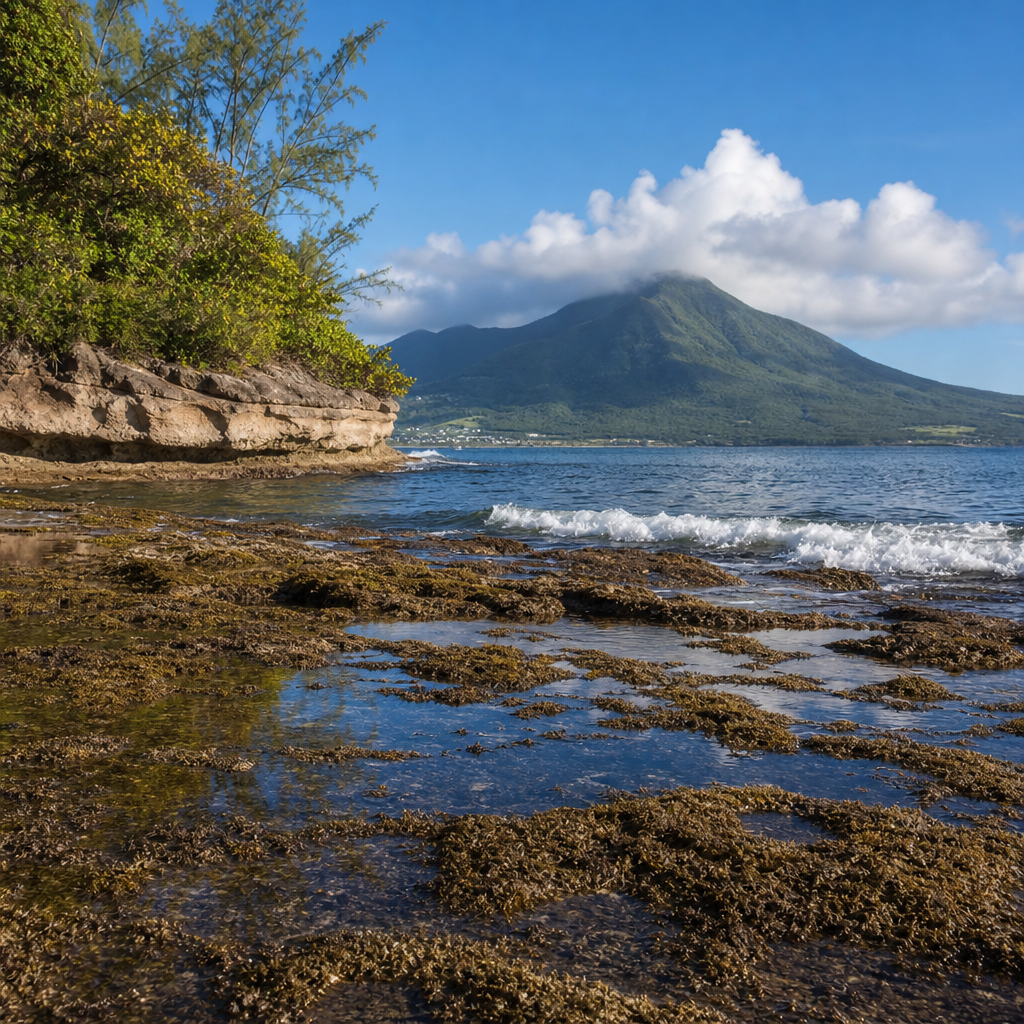
Tides around Nevis are generally mixed and modest in amplitude, but their ecological importance is far greater than the vertical change alone suggests. Tides regulate inundation of roots and flats, expose feeding areas for birds, refresh shallow pools, and help transport eggs, larvae, and dissolved nutrients. In sheltered embayments, a small tidal rise can increase access for juvenile fish to mangrove edges. On ebb tides, organisms adapted to filter feeding or scavenging exploit water movement that brings suspended food. Intertidal snails, crabs, and small crustaceans time movement to avoid desiccation and predation. Shorebirds often concentrate foraging during falling tides when prey becomes accessible in soft sediments.
Because Nevis does not experience the dramatic tidal ranges seen in places like the Bay of Fundy, some travelers assume tides are ecologically minor. That is incorrect. On tropical islands, even limited tidal exchange can define salinity gradients in ponds and wetlands, determine how long mangrove pneumatophores remain flooded, and influence oxygen conditions in shallow basins. Tide and wave setup together can also change beach width over a single day, affecting where turtles choose to nest and how close wrack lines sit to dune vegetation. During spring tides combined with strong onshore wind, low-lying sections of coast may experience more overwash and saline intrusion than casual observers expect.
For researchers and conservation planners, the practical takeaway is that timing matters. Biodiversity surveys, water sampling, turtle patrols, and shoreline photography produce different results depending on tidal stage. When I review field notes from coastal projects, one of the first checks is whether the team recorded tide, wind, and recent rainfall. Without that context, species counts and habitat observations can be misleading. On Nevis, tides are a quiet driver: subtle to the eye, decisive in ecological process.
Species and Food Webs in Nevis’ Nearshore Waters
Life along Nevis’ coast is organized through layered food webs. At the base are phytoplankton, microalgae, seagrasses, mangrove litter, and photosynthetic symbionts within corals. These primary producers capture solar energy and fuel higher trophic levels. Filter feeders such as bivalves and some sponges process suspended particles. Grazers, including sea urchins, parrotfish, and herbivorous snails, help control algal growth. Predators range from octopus and barracuda to herons and frigatebirds. Decomposers and detritivores recycle organic matter, particularly in mangrove and lagoon systems where leaf litter becomes food for crabs, worms, bacteria, and juvenile fish.
Sea turtles are among the most visible coastal species linked to these habitats. Green turtles commonly forage in seagrass meadows, while hawksbills are associated more strongly with reef environments where they feed on sponges and other invertebrates. Shoreline lighting, beach compaction, and disturbance can reduce nesting success, so beach management has direct wildlife consequences. Reef fish diversity also depends on habitat complexity. Branching or massive corals, rocky crevices, and seagrass edges all provide refuge from predators. Where structural complexity falls, fish biomass often declines because juveniles lose shelter and adults lose feeding territory.
| Habitat | Primary Ecological Role | Typical Species or Groups | Main Pressure |
|---|---|---|---|
| Sandy beach | Nesting, wrack-based food web, storm buffer | Sea turtles, ghost crabs, shorebirds | Erosion, lighting, trampling |
| Mangrove fringe | Nursery habitat, sediment trapping, carbon storage | Juvenile fish, crabs, mollusks, herons | Clearing, pollution, altered hydrology |
| Seagrass bed | Sediment stabilization, grazing ground, nursery area | Green turtles, conch, juvenile reef fish | Anchor damage, turbidity, runoff |
| Coral reef | Wave attenuation, biodiversity hotspot, fish habitat | Corals, sponges, parrotfish, snapper | Warming, disease, sedimentation |
The strongest coastal systems are diverse because diversity spreads risk. If one food source drops seasonally, another may support the community. If one habitat is disturbed, mobile species may shift temporarily to another. That resilience has limits, however. Repeated stress from warming seas, nutrient enrichment, or shoreline hardening can reduce redundancy in the food web. Once that happens, Nevis’ coast becomes less productive and less able to recover from storms.
Seasonality, Weather, and Water Quality
Nevis’ coastal life changes with wet and dry seasons, hurricane risk, water temperature, and episodic events such as Saharan dust influxes. In the wetter part of the year, terrestrial runoff can increase nutrient and sediment delivery to bays and inshore reefs. Nutrients are not automatically beneficial. In balanced conditions they support productivity, but in excess they can encourage algal blooms, reduce water clarity, and shift competition away from corals toward fast-growing algae. Sediment is especially damaging when fine particles remain suspended in calm water, blocking light needed by corals and seagrasses.
Storms are both destructive and regenerative. Strong wave energy can break coral, reshape beaches, uproot coastal vegetation, and flush lagoons. Yet storms also redistribute sand, open new channels, and reset ecological succession. The problem arises when natural disturbance meets human constraint. Seawalls, poorly placed infrastructure, and dredging can prevent beaches and wetlands from adjusting. After major weather events, coastlines need room to move. On an island with active tourism and limited land, that room is often restricted.
Water quality is therefore a central management issue. Standard monitoring usually tracks turbidity, temperature, salinity, dissolved oxygen, pH, chlorophyll, and bacterial indicators such as enterococci in bathing waters. These metrics tell a practical story. Rising turbidity means less light for submerged plants. Low dissolved oxygen stresses fish and benthic fauna. Elevated bacteria can signal sewage or runoff problems that affect both ecosystems and public health. For Nevis, consistent sampling near outfalls, marinas, and popular beaches would strengthen early detection of coastal stress before visible decline becomes severe.
Human Use, Conservation, and the Path Forward
People use Nevis’ coast for fishing, swimming, boating, diving, hotel development, transport, and cultural life. None of those uses are inherently incompatible with ecological protection, but they must be managed within environmental limits. Sustainable fisheries depend on nursery habitats remaining intact. Tourism depends on clear water, attractive beaches, and living reefs. Shoreline construction must account for erosion rates, storm surge, and turtle nesting corridors. In my experience, the most effective coastal plans are not abstract policy documents; they are practical systems that align zoning, wastewater control, mooring management, habitat restoration, and public education.
Several actions consistently deliver results across Caribbean islands and are directly relevant to Nevis. Installing mooring buoys reduces anchor damage on reefs and seagrass. Protecting mangroves preserves natural flood buffering and fish nurseries. Dark-sky beach lighting standards improve turtle nesting outcomes. Setbacks based on erosion and surge exposure reduce future loss of property and emergency spending. Reef-safe boating rules, sediment controls on construction sites, and targeted wastewater upgrades all improve nearshore water quality. Citizen science also matters. Snorkelers, fishers, and local residents often notice bleaching, fish kills, illegal dumping, or unusual turtle activity before formal surveys do.
Nevis’ coastal ecosystems are best understood as one connected living system driven by tides, weather, habitat diversity, and careful stewardship. Beaches, mangroves, seagrass beds, and reefs each perform distinct jobs, but their real power lies in how they work together. Tides move nutrients and organisms through the system. Wet-season runoff links upland land use to reef condition. Food webs tie microscopic producers to turtles, fish, birds, and people. When one habitat weakens, the entire coast becomes less stable, less productive, and less beautiful.
The main benefit of understanding this coastal mosaic is better decision-making. Residents, planners, educators, and visitors can protect what they value only if they recognize how ecological processes operate day to day. On Nevis, coastal conservation is not separate from economic resilience or community well-being; it supports both. Healthy reefs reduce wave force. Healthy seagrass supports fisheries and turtles. Healthy beaches sustain tourism and wildlife at once. If you are exploring Nevis under the broader Nature and Wildlife topic, use this hub as your starting point, then continue into related articles on marine species, shoreline habitats, and conservation practices to see how each piece of the island’s coast fits into the whole.
Frequently Asked Questions
What makes Nevis’ coastal ecosystems so ecologically complex?
Nevis’ coastal ecosystems are unusually rich because several habitats meet and influence one another in a relatively small area. Mangroves, seagrass beds, coral reefs, sandy beaches, tidal flats, rocky shorelines, and nearshore waters are all linked by the movement of tides, nutrients, sediment, larvae, and organic matter. Rather than functioning as isolated environments, these coastal zones operate as a connected system in which changes in one habitat can quickly affect another. A fish may shelter in mangrove roots as a juvenile, feed over seagrass beds as it grows, and later move to reef habitat offshore. Likewise, sediment washed from upland areas can alter water clarity, which influences seagrass and coral health, which then affects the animals that depend on them.
What also adds to the complexity is the number of physical forces shaping the coast at once. Tidal cycles, wind-driven waves, seasonal rainfall, currents, storm events, and shoreline erosion all help determine salinity, water depth, oxygen levels, and habitat structure. On a Caribbean island like Nevis, these factors can change over short distances and over short periods of time. A calm bay may support delicate nursery habitat, while a nearby exposed shoreline experiences stronger wave action and supports a very different community of organisms adapted to stress and disturbance. This diversity of conditions creates a mosaic of life and makes Nevis an excellent example of how small islands can support remarkably intricate ecological networks.
How do tides influence life along the coast of Nevis?
Tides are one of the most important organizing forces in coastal ecology because they regularly shift the boundary between land and sea. On Nevis, even modest tidal changes can affect which areas are flooded, which are exposed, and how organisms feed, reproduce, and avoid predators. In intertidal habitats such as rocky shores, tidal pools, and shallow flats, plants and animals must tolerate alternating periods of immersion and exposure. Crabs, snails, small fish, algae, and countless microscopic organisms are all influenced by the timing of water movement. When the tide comes in, it brings oxygen, suspended food particles, larvae, and access to feeding grounds. When it goes out, it can concentrate animals in pools, expose them to heat and drying, and reshape sediments along beaches and flats.
Tides also help regulate water exchange in mangroves, lagoons, and estuarine areas where salinity and nutrient levels can fluctuate. This periodic flushing is essential because it removes waste, redistributes organic material, and supports the productivity of the food web. For many species, tidal timing is directly linked to behavior. Some fish and invertebrates enter shallow coastal zones only at certain stages of the tide to feed safely. Shorebirds may forage most effectively on exposed mud or sand as the water recedes. In this way, tides do far more than raise and lower the sea; they create daily rhythms that structure the entire coastal community and influence where life can thrive.
Why are mangroves, seagrass beds, and coral reefs often described as connected habitats?
These habitats are described as connected because they support one another biologically and physically. Mangroves stabilize shorelines, trap sediment, and provide sheltered nursery areas for juvenile fish, crustaceans, and other species. Seagrass beds, often found in calmer waters nearby, further slow water movement, capture particles, recycle nutrients, and provide feeding habitat for fish, sea turtles, and invertebrates. Coral reefs offshore act as natural breakwaters, reducing wave energy and helping protect both seagrass meadows and mangrove fringes from heavy coastal erosion. Together, these ecosystems create a layered coastal defense system while also sustaining a broad range of marine life.
The ecological connections are just as important as the physical ones. Many species move between these habitats during different stages of life or even during different times of day. Juvenile reef fish may begin life among mangrove roots, shift to seagrass habitat as they mature, and later join reef communities offshore. Nutrients and organic matter also travel among these zones, linking food webs across the coastline. If one habitat is damaged, the effects can spread. For example, the loss of mangroves can increase sediment runoff into seagrass and reef areas, reducing water clarity and stressing sensitive organisms. Understanding Nevis’ coast means recognizing that these are not separate ecological units but parts of one interdependent coastal system.
What kinds of plants and animals are typically found in Nevis’ coastal ecosystems?
Nevis’ coastal ecosystems support a wide range of life, from microscopic plankton to birds, fish, reptiles, and marine invertebrates. In mangrove areas, you may find red mangroves with their characteristic prop roots, along with organisms that use those submerged root systems for shelter and feeding. Juvenile fish, crabs, shrimp, mollusks, and algae commonly occupy these spaces, taking advantage of the calmer water and abundant detritus. In seagrass habitats, the grasses themselves provide food and cover for invertebrates, small fish, and grazers, while also supporting a large hidden community of worms, crustaceans, and microorganisms living in and on the sediment.
Along sandy beaches and rocky shores, the community changes again. Ghost crabs, shorebirds, snails, limpets, barnacles, and tide-pool organisms are often adapted to intense sunlight, changing moisture levels, and wave action. Offshore and around reef-associated habitats, corals, sponges, reef fish, sea urchins, and countless invertebrates contribute to a highly diverse marine environment. Importantly, not all of the life is immediately visible. Coastal productivity depends heavily on bacteria, fungi, plankton, and decomposers that recycle nutrients and support the larger food web. This mix of highly visible species and microscopic ecological workers is what allows Nevis’ coastal environments to remain dynamic, productive, and resilient when conditions are healthy.
What are the biggest threats to Nevis’ coastal ecosystems, and how can they be protected?
Nevis’ coastal ecosystems face a combination of local and global pressures. Coastal development can alter natural drainage, remove vegetation, fragment habitat, and increase sediment and pollution entering nearshore waters. Poorly managed runoff from roads, construction, or land clearing can cloud the water and smother seagrass and coral systems that depend on sunlight. Overfishing and unsustainable harvesting can disrupt food webs, while damage from anchors, trampling, and irresponsible tourism can degrade sensitive habitats such as reefs and mangrove margins. Climate-related threats add another layer of stress, including sea-level rise, stronger storm impacts, coastal erosion, warming waters, and changing rainfall patterns that affect salinity and sediment transport.
Protection depends on treating the coastline as an interconnected living system rather than a collection of isolated sites. Effective strategies include conserving mangroves and wetlands, reducing land-based pollution, managing development setbacks, protecting reef and seagrass areas, enforcing sustainable fishing practices, and improving watershed management inland so less harmful runoff reaches the sea. Monitoring is also critical, because changes in water quality, species abundance, or shoreline stability can reveal problems before damage becomes severe. Community involvement matters just as much as policy. When residents, researchers, fishers, planners, and visitors understand how tides, habitats, and species are linked, it becomes easier to support practical conservation measures. In Nevis, protecting the coast means protecting biodiversity, fisheries, shoreline stability, and the island’s long-term environmental resilience all at once.