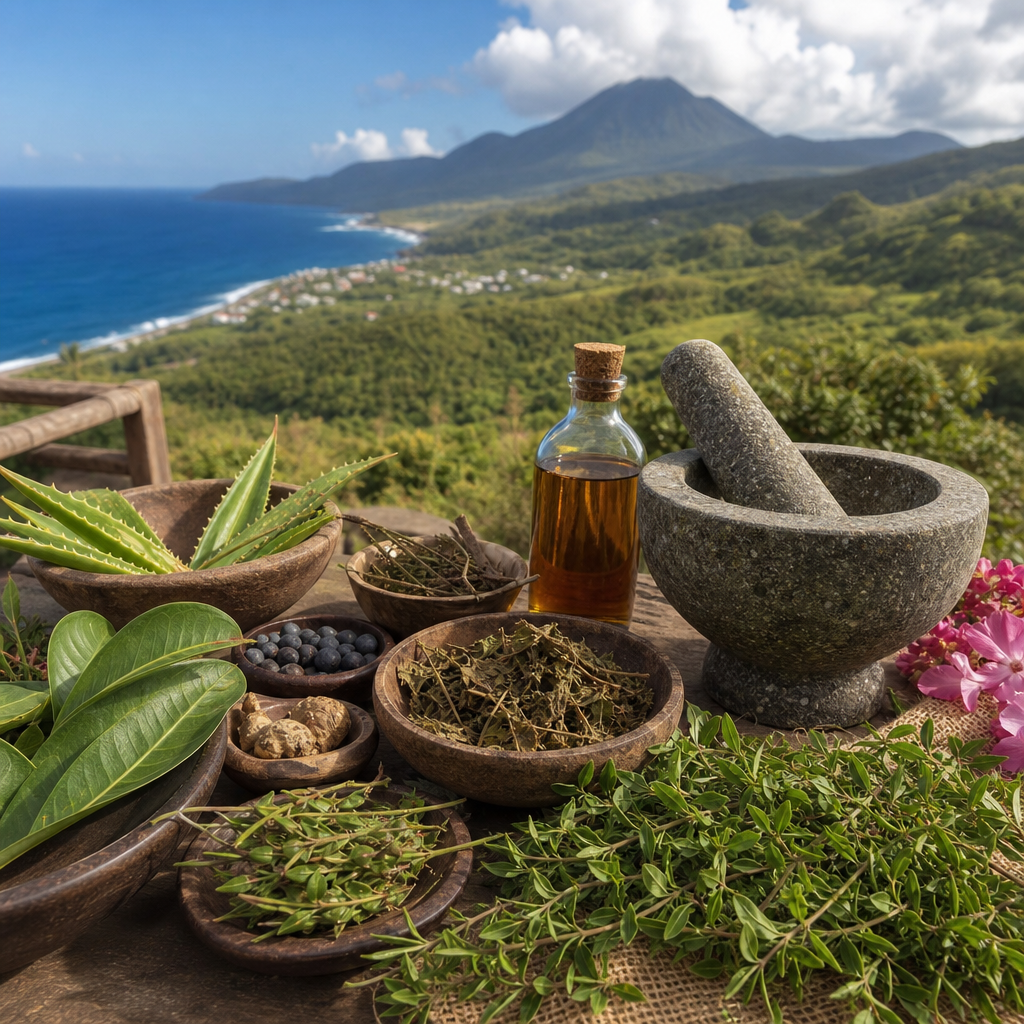
Nevis’ natural remedies reflect a living tradition shaped by African, European, and Indigenous Caribbean knowledge, local plants, and generations of practical care. On a small volcanic island where families long relied on home treatment before clinics and pharmacies were easily available, traditional healing practices developed as a community health system as much as a cultural inheritance. In Nevis, “natural remedies” usually means bush teas, poultices, baths, liniments, steam inhalations, and food-based treatments prepared from ingredients gathered in home gardens, hillsides, and market stalls. “Traditional healing practices” includes not only the remedies themselves, but also midwifery, massage, spiritual protection, diet rules, and the wisdom of elders who know when a simple tea is enough and when a fever, wound, or breathing problem requires a doctor.
This subject matters because it sits at the center of local life and experiences. Visitors often notice the island’s scenery first, yet everyday Nevisian culture is also preserved in kitchens, backyards, and conversations about what to drink for a cold, rub on a sore joint, or boil after a rainy week of mosquitoes and sniffles. I have seen how quickly a discussion about herbs becomes a discussion about family memory: which grandmother used soursop leaf for calming, who swore by ginger and lime for congestion, and which neighborhood elder knew the right plants for stomach upset. These practices remain relevant today because they offer affordable first-line care, reinforce self-reliance, and preserve biodiversity knowledge that can disappear within a generation if it is not documented and respected.
At the same time, Nevis’ natural remedies should be understood clearly and responsibly. Traditional medicine is not a substitute for emergency treatment, antibiotics when indicated, or evidence-based care for serious chronic disease. The real value lies in knowing what these remedies are, why people use them, and how they fit within modern health decisions. As a hub article under Local Life and Experiences, this guide covers the main plants, methods, cultural meanings, safety issues, and present-day uses that define the island’s miscellaneous healing traditions.
How traditional healing developed on Nevis
Traditional healing on Nevis emerged from necessity, environment, and cultural exchange. Before modern transport and widespread clinical access, island communities used what was available: cerasee vines over fences, aloe in yards, lemongrass near steps, and spice crops such as ginger, clove, and nutmeg brought through Caribbean trade networks. African herbal knowledge strongly influenced Caribbean bush medicine, especially in the use of bitter tonics, cleansing teas, and leaf baths. European influence appeared in castor oil use, poultices, and household liniments, while Indigenous plant knowledge shaped the broader regional understanding of roots, bark, and resins.
Because Nevis is volcanic and fertile, many medicinal plants grow easily in household spaces. A remedy culture developed around observation. If a tea eased gas, cooled a fever, promoted sweating, or improved sleep, that result was remembered and repeated. Over time, families created their own formulas. One household might add cinnamon bark to a cold remedy, another would insist on lime peel and honey. This flexibility is typical of oral medical traditions. The method is not standardized like a pharmacy label, but it is not random either. It depends on season, plant strength, age of the patient, and the experience of the person preparing it.
Traditional healers also learned limits. On Nevis, older people often distinguish between “something for the doctor” and “something to watch.” That practical triage is an underappreciated part of local healing knowledge. A mild stomachache might get bush tea. A deep cut, chest pain, severe dehydration, or prolonged high fever should not. Any serious account of Nevisian remedies has to include that realism.
Common medicinal plants and what they are used for
Several plants appear again and again in Nevisian remedy traditions because they are accessible, versatile, and familiar. Lemongrass is commonly brewed as a calming tea and used for mild colds, digestive discomfort, and relaxation. Ginger is one of the island’s most practical remedies, taken for nausea, “wind,” sore throat, poor circulation, and early cold symptoms. Aloe vera is widely applied to minor burns and skin irritation, and in some households taken carefully in small internal preparations, though that use requires caution because the latex can act as a strong laxative.
Cerasee, known across the Caribbean as a bitter vine tea, is often used as a cleansing tonic, for skin complaints, and for blood sugar concerns in folk practice. Soursop leaf tea is associated with calming and sleep, though claims beyond that should be treated carefully. Guava leaf preparations are used for diarrhea and mouth rinses, while peppermint or broadleaf thyme may be taken for coughs, congestion, and stomach discomfort. Turmeric, whether fresh or dried, appears in teas and topical pastes for inflammation and soreness. Castor oil remains a classic household item, used externally in rubs and packs and internally by some older generations as a purgative, though modern use is more restrained because dosing can be harsh.
| Remedy plant or ingredient | Traditional use on Nevis | Typical preparation | Important caution |
|---|---|---|---|
| Lemongrass | Relaxation, mild colds, digestion | Tea from fresh leaves | May interact with some medications if used heavily |
| Ginger | Nausea, congestion, sore throat | Tea, syrup, grated in food | Large amounts may irritate the stomach or affect blood thinning |
| Cerasee | Bitter tonic, skin and blood sugar folk use | Boiled tea | Not appropriate in pregnancy; avoid excessive intake |
| Aloe vera | Minor burns, skin soothing | Fresh gel applied topically | Internal use can be strongly laxative |
| Guava leaf | Diarrhea, mouth rinse | Tea or cooled rinse | Persistent symptoms need medical review |
| Soursop leaf | Calming, bedtime tea | Light infusion | Do not treat serious illness based on rumor |
These uses are consistent with wider Caribbean practice, and some align loosely with known plant properties. Ginger’s anti-nausea reputation is well supported internationally. Guava leaf has recognized astringent qualities. Aloe’s topical benefit for minor skin irritation is widely accepted. Still, traditional use and clinical proof are not the same thing. The strength of Nevisian practice is practical symptom relief for minor conditions, not miracle cures.
How remedies are prepared in everyday island households
Preparation matters as much as plant choice. In Nevis, remedies are often classified by method: tea, wash, steam, rub, tonic, or poultice. A tea may be an infusion, where hot water is poured over leaves, or a decoction, where tougher material such as bark, root, or vine is boiled longer. People who grew up with bush medicine often know that boiling delicate leaves too aggressively can make them unpleasantly bitter or weaker in aroma, while roots may need time to release their useful compounds.
For colds and congestion, a common household method is to combine ginger, lime, and honey in a hot drink, sometimes with cloves or cinnamon. Steam inhalation may be made with aromatic leaves in a basin of hot water, then inhaled carefully to loosen mucus. For skin problems, aloe gel is cut fresh from the plant and applied directly, while leaf baths are prepared for soothing, cooling, or ritual cleansing. Poultices use crushed leaves, grated root, or warmed castor oil cloths placed over sore areas. These methods are simple, but good practice includes cleanliness, correct plant identification, and conservative dosing.
One pattern I have repeatedly heard in Nevis is the phrase “drink it weak first.” That is sound traditional judgment. Bush teas are often introduced lightly, especially for children, older adults, or anyone recovering from illness. Another practical rule is timing. Some teas are taken at night for calming; bitter tonics are more often used in the morning; digestive remedies may be sipped after meals. These details show that local practice is not merely about ingredients. It is a system of observation, habit, and moderation.
The role of elders, midwives, and community knowledge
Traditional healing in Nevis has historically depended on people, not books. Knowledge was passed through mothers, grandmothers, gardeners, midwives, and respected elders who had treated common problems many times. In village life, these figures were part clinician, part counselor, and part historian. They knew which herb grew best in dry months, which teas were too strong during pregnancy, and which symptoms meant someone should be taken for formal care immediately.
Midwives were especially important in Caribbean communities, including Nevis, because childbirth once relied heavily on home-based support. Their knowledge extended beyond delivery to postpartum baths, abdominal care, nutrition, and infant soothing practices. Some remedies addressed practical concerns such as swelling, discomfort, digestion, and rest. Others were ceremonial, intended to protect mother and child during a vulnerable period. Even where hospital birth is now standard, the memory of this care still shapes how families talk about healing, recovery, and women’s health.
Community knowledge also works through storytelling. A remedy becomes credible because someone remembers it helping after a storm, during a flu season, or when money was short. This oral history is one reason traditional medicine remains resilient. It is tied to lived survival, not abstract nostalgia. Yet oral transmission can weaken when younger people migrate or rely exclusively on packaged products. That makes documentation, respectful interviews, and community archiving essential for preserving Nevis’ miscellaneous healing traditions.
Spiritual cleansing, baths, and the wider meaning of healing
On Nevis, healing has never been limited to the physical body. Many traditional practices connect wellness with emotional strain, spiritual imbalance, grief, envy, or the aftereffects of conflict. Herbal baths, floor washes, smoke, prayer, and protective rituals can all be part of what people describe as feeling “lighter” or “settled” again. Whether a visitor interprets these acts through religion, psychology, or cultural symbolism, their social function is clear: they restore calm, create a sense of agency, and mark a transition out of illness or distress.
Leaf baths are especially significant in Caribbean life. Plants chosen for fragrance or cooling qualities may be steeped and added to bath water for refreshment after fever, overwork, or emotional upset. In some families, children are bathed with particular herbs before school terms, after a fright, or during periods when they are restless and not sleeping well. These practices should not be dismissed as superstition. They combine aromatics, touch, routine, and belief in ways that can genuinely support comfort and emotional regulation.
The wider lesson is that Nevisian healing is holistic in the literal sense. Food, prayer, rest, social support, cleansing, and herbs work together. Modern medicine increasingly recognizes that stress, sleep, and community support affect recovery. Traditional Nevisian practice understood that long before wellness became a marketing term.
Safety, evidence, and how traditional remedies fit modern care
The safest way to approach Nevis’ natural remedies is to respect both heritage and medical limits. Accurate plant identification is essential because common names vary across islands and some plants can be irritating, toxic, or inappropriate in pregnancy. Dosage is another challenge. A tea made from a few leaves is very different from a concentrated boiled pot consumed several times daily. Children, pregnant women, older adults, and people with kidney disease, diabetes, high blood pressure, or anticoagulant use need special caution.
Evidence for traditional remedies exists on a spectrum. Some treatments are strongly supported, such as ginger for nausea and oral hydration for mild stomach illness. Others are plausible but less studied in Nevis-specific practice. Some claims circulating online, especially around cancer, infection, or “detox,” are exaggerated or false. In my experience, the most credible local practitioners do not promise cures. They recommend bush medicine for mild symptoms, comfort, appetite, sleep, and recovery support, then advise formal care when red flags appear.
Those red flags include difficulty breathing, severe allergic reaction, chest pain, confusion, high or persistent fever, dehydration, blood in stool, infected wounds, and symptoms that worsen instead of improve. Used this way, traditional remedies complement modern care rather than compete with it. That balanced approach protects both health and cultural integrity.
Why these practices remain vital to local life and experiences
Nevis’ natural remedies remain important because they connect health, identity, and place. They teach botanical literacy, preserve family memory, and keep everyday culture visible beyond festivals and tourist landmarks. They also support practical resilience. When a household grows lemongrass, aloe, thyme, and ginger, it keeps a small medicine chest in the yard. In an age of expensive imported goods, that knowledge still matters.
For readers exploring miscellaneous local life and experiences on Nevis, traditional healing practices are a true hub topic because they intersect with foodways, agriculture, elder knowledge, spirituality, women’s history, and environmental stewardship. The most useful way to engage with them is with curiosity and care: learn the plant names, ask elders how remedies are made, note the cautions, and understand when professional treatment is necessary. Nevisian bush medicine is not frozen in the past. It is a practical, adaptive tradition that continues to shape how people on the island care for themselves and each other. If you want to understand Nevis beyond the postcard image, start with the remedies growing in the yard and the stories told around them.
Frequently Asked Questions
What are “natural remedies” in Nevis, and why are they so important to local culture?
In Nevis, natural remedies refer to traditional forms of home-based healing that rely on local plants, everyday ingredients, and practical knowledge passed down through families and communities. These remedies commonly include bush teas, herbal baths, poultices, liniments, steam inhalations, and simple preparations used to ease common complaints such as colds, fever, stomach discomfort, aches, skin irritation, and fatigue. On a small volcanic island where earlier generations often lived far from formal medical care, these practices became an essential part of daily life. They were not simply “alternative” treatments in the modern sense; for many people, they were the first line of care and, at times, the only care immediately available.
The cultural importance of these remedies goes beyond their practical use. Nevisian healing traditions reflect a blending of African, European, and Indigenous Caribbean knowledge, adapted to the island’s climate, landscape, and available plants. Grandparents, parents, neighbors, and market vendors often served as trusted sources of advice, making healing a community activity as much as a private one. In that way, natural remedies helped preserve not just physical well-being but also memory, identity, and intergenerational connection. Even today, many people in Nevis view these practices with respect because they represent resilience, self-reliance, and a deep relationship with the land.
What kinds of traditional healing methods are commonly used in Nevis?
Traditional healing methods in Nevis are diverse, but they usually center on practical preparations designed to address familiar, everyday ailments. Bush teas are among the most recognized remedies. These are herbal infusions made from leaves, roots, bark, or other plant parts and are often used for colds, digestion, “cleansing,” calming the body, or supporting general wellness. Herbal baths are another long-standing practice, especially when someone feels run-down, sore, or in need of comfort and restoration. Steam inhalations may be prepared for congestion and respiratory discomfort, while poultices are applied externally to soothe swelling, skin issues, or localized pain.
Liniments and rubs also play an important role. These are typically used for muscle aches, stiffness, chest discomfort, or to warm the body. Some remedies involve combining herbs with oils, alcohol, or other household ingredients to create topical treatments. Others rely on timing, technique, and local understanding, such as how strong a tea should be, whether a remedy is best taken warm or cool, or how often it should be used. What makes these practices especially distinctive is that they are rooted in observation and experience. Generations of Nevisians learned which plants were thought to settle the stomach, break up congestion, calm the nerves, or help the body recover after illness. The result is a richly layered healing tradition shaped by the island’s environment and by the wisdom of everyday people.
How was traditional remedy knowledge passed down from one generation to the next in Nevis?
In Nevis, traditional remedy knowledge was usually transmitted through oral teaching, observation, and hands-on participation rather than written manuals. Children often learned by watching older relatives gather herbs, prepare teas, mix baths, or apply poultices at home. A grandparent might explain which leaf was used for a cold, when to pick a plant, how long to steep a tea, or why one remedy was suitable for adults but not for children. Over time, these lessons became part of ordinary household life. Healing knowledge was woven into gardening, cooking, caregiving, and seasonal routines, which made it both accessible and practical.
This knowledge was also reinforced through community relationships. Neighbors shared advice, elders were consulted for stubborn ailments, and certain individuals became known for their skill with herbs or home treatments. In many cases, learning was situational: someone fell ill, and the remedy became the lesson. That kind of transmission created a living tradition, one shaped by experience rather than abstraction. It also meant that local knowledge could adapt. Families refined recipes, substituted plants when necessary, and adjusted methods according to age, constitution, or circumstance. Today, this oral heritage remains one of the most meaningful aspects of Nevisian natural healing, because it reflects trust, memory, and a communal approach to care that extends far beyond the remedy itself.
Are Nevis’ traditional natural remedies still used today, even with modern healthcare available?
Yes, traditional natural remedies are still used in Nevis, although their role has evolved alongside modern healthcare. Many people continue to turn to bush teas, baths, steam treatments, and topical preparations for mild or routine concerns, especially those that families have addressed at home for generations. These remedies remain valued because they are familiar, affordable, culturally meaningful, and often associated with comfort and early intervention. For some households, preparing a tea or herbal bath is still a natural first response when someone begins to feel unwell.
At the same time, most people now understand these traditional practices within a broader health landscape that includes clinics, pharmacies, and professional medical care. Rather than replacing modern medicine entirely, natural remedies often exist alongside it. Someone might use a steam inhalation for congestion while also seeking medical advice if symptoms persist, worsen, or suggest a more serious condition. This combined approach reflects a practical mindset: respect for ancestral knowledge, paired with recognition of the benefits of contemporary diagnosis and treatment. In that sense, Nevis’ healing traditions remain relevant not because they are frozen in the past, but because they continue to adapt while preserving the island’s cultural heritage.
What should readers keep in mind when learning about or trying traditional remedies from Nevis?
Readers should approach Nevisian traditional remedies with both appreciation and caution. These practices carry deep cultural significance and are rooted in generations of lived experience, but that does not mean every remedy is suitable for every person or condition. Plants can vary in strength, preparation matters, and individual factors such as age, pregnancy, allergies, chronic illness, or medication use can affect safety. A bush tea that is mild for one person may not be appropriate for another, and an herbal remedy used traditionally for minor discomfort should not be treated as a substitute for professional care when symptoms are severe, unusual, or ongoing.
It is also important to respect the remedies as part of a larger knowledge system rather than reducing them to trendy “folk cures.” In Nevis, traditional healing is tied to family memory, environmental knowledge, and community values. Learning about these remedies should involve listening carefully to context: how they were used, who prepared them, when they were considered appropriate, and where their limits were understood. The best way to engage with this tradition is to be curious, respectful, and informed. Appreciating Nevis’ natural remedies means recognizing both their cultural richness and the importance of responsible health decisions, especially when expert medical guidance is needed.