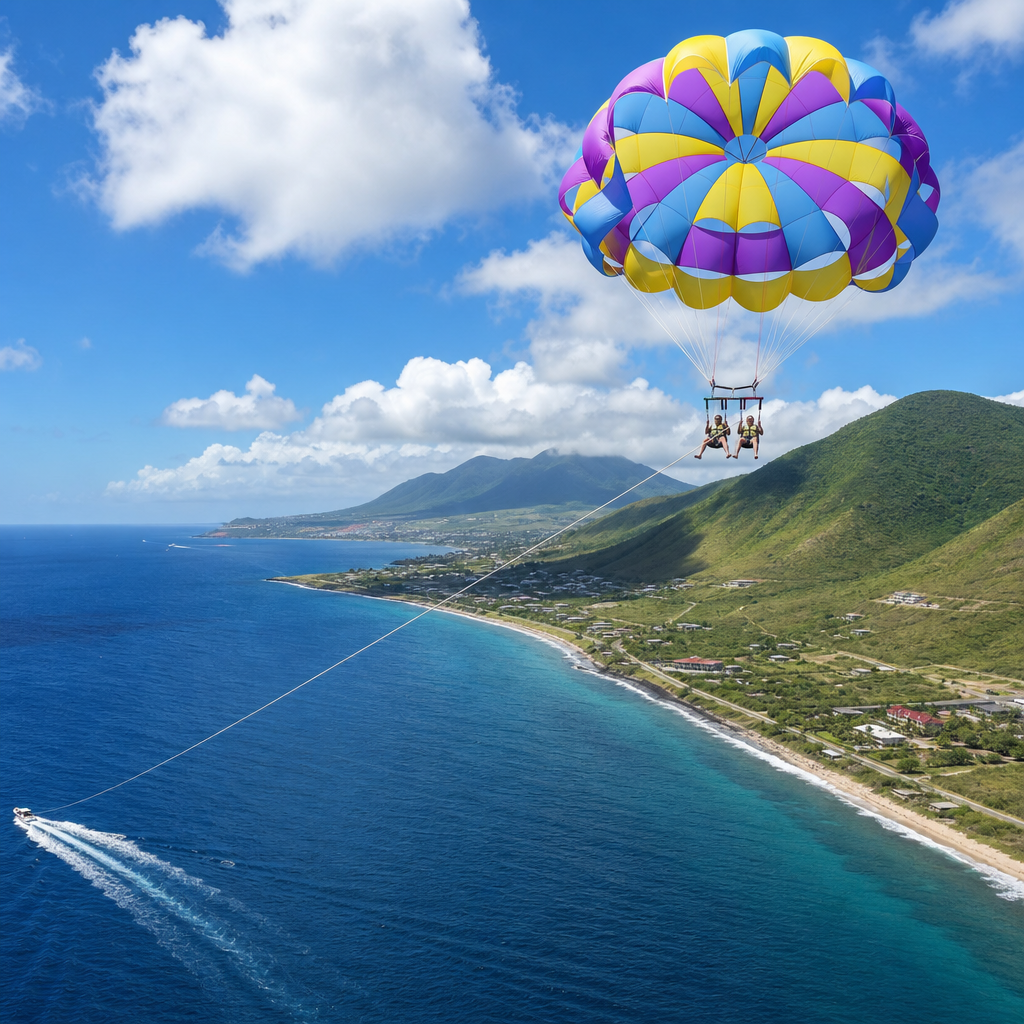
Parasailing in Saint Kitts gives travelers one of the clearest, most exhilarating ways to understand the island’s geography, mood, and coastal beauty in a single outing. Instead of seeing Saint Kitts only from a beach chair, a catamaran deck, or a tour van, parasailers rise above the Caribbean Sea and watch the island reveal its full shape: green volcanic slopes, bright hotel districts, fishing boats crossing the bay, and the long meeting line where turquoise shallows deepen into cobalt water. For visitors planning adventure activities, this aerial experience belongs near the top of the list because it combines excitement with accessibility. Most healthy adults can participate, no prior skill is needed, and reputable operators make the process surprisingly gentle from takeoff to landing.
In practical terms, parasailing involves being secured in a harness attached to a specially designed canopy, then lifted by wind and boat speed. The tow vessel creates forward pull, the parachute-shaped sail generates lift, and passengers ascend gradually from a launch platform at the rear of the boat. In Saint Kitts, flights usually take place off the calmer Caribbean side, where views can include Frigate Bay, the Southeast Peninsula, Basseterre’s waterfront, and on clear days neighboring Nevis. People often confuse parasailing with paragliding or skydiving. It is neither. Parasailing is a marine activity run from a boat, with controlled ascent and descent managed by trained crew using a hydraulic winch system. That distinction matters because it explains why the learning curve is low and why the activity fits such a broad range of travelers.
This hub article covers parasailing in Saint Kitts comprehensively within the wider adventure and activities landscape, especially the miscellaneous experiences that do not fit neatly into hiking, watersports, or sightseeing categories yet often become trip highlights. I have worked with Caribbean activity planners and reviewed marine excursion operations closely enough to know that the best experiences depend on details travelers rarely ask about soon enough: wind windows, operator insurance, harness fit, camera policies, weight balancing, and pickup logistics from cruise terminals or resort areas. Saint Kitts is especially well suited to parasailing because it offers compact geography, scenic coastline, and a tourism infrastructure that can support short, bookable excursions without consuming an entire day. For cruise visitors with limited shore time, honeymooners wanting a memorable shared activity, and families seeking a controlled thrill, parasailing provides an efficient, high-reward option that pairs naturally with beach time, snorkeling, or a catamaran cruise.
As a sub-pillar hub, this page also serves readers researching related miscellaneous adventures across Saint Kitts. While the focus here is the parasailing experience itself, the article also addresses who should try it, how to choose a reliable operator, what weather and safety standards matter, what the ride feels like, what it costs, and how it compares with other island excursions. If you want a straightforward answer, here it is: parasailing in Saint Kitts is worth doing when conditions are favorable and you book with an established marine operator that follows recognized safety procedures. The view is the headline attraction, but the real value is perspective. Seeing the island from above turns scattered landmarks into a coherent destination, and that often changes how travelers explore the rest of Saint Kitts after they land.
What Parasailing in Saint Kitts Is Really Like
The experience starts onshore or at a marina check-in point, where guests sign waivers, receive a short briefing, and confirm weight ranges for solo, tandem, or triple flights. Operators commonly group passengers by combined weight because canopy performance depends on balance and wind strength. After boarding, the boat heads to a designated flight zone away from dense swimming areas and moored vessels. Crew members fit life jackets and harnesses, explain hand signals, and clip riders to the bar beneath the canopy. On modern boats, takeoff usually happens directly from the stern platform. The boat accelerates, the line pays out smoothly, and within seconds passengers lift off with far less jolt than first-timers expect.
Once airborne, the ride becomes notably quiet. That is the part many guests remember most. The engine noise softens, the water traffic looks miniature, and the island’s contours become sharply legible. From several hundred feet up, Saint Kitts appears intensely green inland and brilliantly blue at its edges. You can often identify resort strips, curved bays, reef lines, and the rugged outline of the Southeast Peninsula extending toward The Narrows. On exceptional visibility days, Nevis looks close enough to touch. Depending on the operator and weather, flight time is often around eight to twelve minutes in the air, though the entire excursion can run longer when boat loading, safety sequencing, and shared turns are included.
Landings vary by operator setup. Some lower passengers gently back onto the rear platform, while others offer a controlled dip that skims feet through the sea before reeling riders in. Neither should feel abrupt when run properly. For nervous travelers, that controlled winch system is the key reassurance. Unlike free-flight sports, parasailing in Saint Kitts is highly managed from launch to recovery. The crew determines altitude, monitors wind shifts, and can shorten or end a flight quickly if conditions change. Good operators narrate enough to keep people calm without overwhelming them with technical language. In my experience reviewing excursion feedback, guests who feared the launch almost always say the anticipation was worse than the flight itself.
Why Saint Kitts Is an Ideal Parasailing Destination
Not every island suits parasailing equally well. Saint Kitts stands out because its topography and tourism layout create unusually rewarding views during a relatively short flight. The island is dominated by volcanic mountains, including the massif around Mount Liamuiga, with lower coastal development concentrated in recognizable clusters. That contrast reads beautifully from above. You are not simply looking at open water; you are seeing a compact island system with distinct landforms, bays, roads, and settlements that make visual sense at altitude. The coast near Frigate Bay is especially photogenic because beaches, resorts, and headlands sit close together.
Another advantage is convenience. Major visitor zones are near likely departure points, and cruise passengers arriving in Basseterre can often reach parasailing operations with a short transfer rather than a full island crossing. That matters on a port day when timing is tight. Saint Kitts also benefits from generally warm sea temperatures year-round, which makes an optional water dip comfortable for most travelers. The dry season often brings the most predictable excursion planning, but summer can also produce excellent windows in the morning before weather becomes less stable. The right operator will schedule around local marine conditions instead of forcing marginal departures.
Saint Kitts tourism has long balanced laid-back beach appeal with soft-adventure experiences, and parasailing fits that identity well. It is more exciting than a standard beach rental but less demanding than scuba certification, kitesurfing, or a strenuous summit hike. That middle ground broadens the audience significantly. Couples like it because tandem flights feel shared and cinematic. Families like it because teenagers often consider it adventurous while parents still view it as manageable. Cruise visitors like it because it delivers a strong memory quickly. In destination planning terms, that makes parasailing one of the island’s highest-efficiency thrill activities.
Safety Standards, Weather, and How to Choose an Operator
If you ask the most important question about parasailing in Saint Kitts, it is not “How high do you go?” It is “How seriously does the operator manage risk?” A good operation uses purpose-built parasail boats with hydraulic winches, commercial-grade harnesses, properly sized canopies, maintained tow lines, and trained crew who know local wind behavior. They provide life jackets, check fittings carefully, and refuse flights when squalls, gust fronts, electrical storms, or sea clutter make conditions questionable. Internationally, many reputable operators align procedures with guidance associated with the Watersports Industry Association and manufacturer recommendations for towable flight systems. Even when local regulation varies, serious operators follow these standards because the equipment leaves little room for improvisation.
Travelers should ask direct questions before booking. How long has the company operated in Saint Kitts? Is parasailing its primary business or a side offering? Are takeoffs and landings done from the boat platform? What are the age and weight limits? Are tandem and triple flights decided by actual conditions on the day? Does the company carry commercial liability coverage? Is transportation included from cruise port or hotel? Evasive answers are a warning sign. So are operators promising departures in obviously unstable weather. In marine tourism, cancellation is often evidence of professionalism, not inconvenience.
| What to Check | What Good Looks Like | Why It Matters |
|---|---|---|
| Boat setup | Dedicated parasail boat with stern platform and hydraulic winch | Supports controlled launch and retrieval |
| Crew briefing | Clear instructions on posture, signals, and landing | Reduces confusion and panic |
| Weather policy | Flights delayed or canceled for gusts, storms, or poor visibility | Weather is the biggest variable in safe operations |
| Equipment condition | Clean harnesses, intact tow lines, organized deck procedures | Visible maintenance reflects operating discipline |
| Insurance and reputation | Commercial coverage, strong recent reviews, established local presence | Signals accountability and consistent service |
Weather deserves special attention because Saint Kitts can change quickly. Trade winds often make conditions pleasant, but afternoon showers or passing systems can alter the sea state and visibility fast. Morning flights are often smoother, especially in wetter months. Guests prone to motion sickness should consider taking precautions because the boat ride between flights can be bumpier than the parasailing itself. The safest mindset is simple: if the captain hesitates, trust the hesitation.
Costs, Booking Strategy, and What to Expect on the Day
Parasailing prices in Saint Kitts vary with season, operator, transport inclusion, and whether you book direct, through a resort desk, or as a cruise shore excursion. In many Caribbean markets, expect a rough range from about $80 to $140 per person, with tandem or photo packages affecting the final price. Rates can be higher when transportation, beach club access, or bundled watersports are included. Travelers should verify whether the quoted amount covers taxes, port pickup, lockers, and digital photos. I have seen guests assume a package was all-inclusive only to learn the image add-on cost nearly as much as a meal for two.
Booking in advance is smart during peak cruise and winter sun periods, but flexibility matters. A reservation with a clear weather cancellation policy is better than a nonrefundable prepaid slot on a marginal day. For cruise passengers, buffer time is essential. Choose an operator that understands ship schedules and can return you with margin for traffic and boarding procedures. Independent bookings can offer better value than ship-sponsored tours, but only if the operator has a reliable punctuality record. Hotel guests usually have more freedom and can target the best weather window instead of the only available one.
Dress for function, not fashion. Swimwear, a secure rash guard or T-shirt, sunglasses with a retainer, and reef-safe sunscreen work well. Leave loose hats behind. Waterproof phone pouches are useful only if the operator permits devices during flight; many prefer guests to use provided photo systems for safety reasons. Remove valuables from pockets before harnessing in. If you wear prescription glasses, use a snug strap. Most people do not need athletic ability, but they should be comfortable stepping onto and off the boat platform and sitting briefly in the harness during takeoff and landing.
Who Should Try Parasailing and What Else to Pair With It
Parasailing in Saint Kitts suits more travelers than many assume. It is ideal for first-time adventure seekers, couples, older teens, active older adults, and cruise visitors who want one standout excursion without committing half a day. It is less suitable for people with certain back or neck issues, pregnant travelers, or anyone significantly uncomfortable on boats. Weight limits vary by equipment and conditions, and they change with wind, so a guest accepted one day elsewhere might not fly in Saint Kitts under different circumstances. That is normal, not arbitrary.
As a miscellaneous adventure hub topic, parasailing also connects well with other Saint Kitts experiences. A morning flight can pair with South Friars Bay beach time, a catamaran sail, snorkeling, a visit to the UNESCO-listed Brimstone Hill Fortress later in the day, or a relaxed lunch in Frigate Bay. Travelers building a broader activity itinerary often combine one aerial or marine thrill with one cultural stop to balance adrenaline and context. That is a smart way to experience the island. If parasailing gives you the overview, the rest of the day can fill in the details you spotted from above.
The main takeaway is straightforward: parasailing in Saint Kitts is one of the island’s most accessible and rewarding adventure activities when booked with a reputable operator and timed to favorable weather. It delivers exceptional scenery, a manageable learning curve, and a memorable sense of scale that beach-level sightseeing cannot match. For many visitors, the flight becomes the moment that makes the island click geographically and emotionally. If you are planning Saint Kitts under the adventure and activities umbrella, place parasailing high on your shortlist, compare operators carefully, and reserve a morning slot that leaves room to enjoy the coast after you land. Book smart, fly in good conditions, and let Saint Kitts introduce itself from the sky.
Frequently Asked Questions
What can you see while parasailing in Saint Kitts?
One of the biggest reasons travelers choose parasailing in Saint Kitts is the view. Once you lift off above the Caribbean Sea, the island’s geography becomes much easier to understand in a way that simply is not possible from the beach or from the road. From above, you can often see the contrast between the lush volcanic interior and the developed shoreline, with green hills rising behind resort areas, marinas, and wide sandy beaches. The water itself is also part of the experience, shifting from pale turquoise in the shallows to deeper cobalt blue farther out. On clear days, you may spot boats moving across the bay, reef lines, curving stretches of coast, and the dramatic meeting point between land, sea, and sky that makes Saint Kitts so visually memorable.
What makes the flight especially rewarding is that parasailing offers a calm, suspended perspective rather than a rushed one. You are not just catching a quick scenic glimpse; you are hovering high enough to take in the island’s shape, its coastline, and the texture of daily life along the water. Many visitors say the experience gives them a stronger sense of place because they can finally connect what they have seen on land with the broader layout of the island. It is part thrill ride, part sightseeing tour, and part photographic moment, all rolled into a single outing.
Is parasailing in Saint Kitts safe for first-time flyers?
Yes, parasailing in Saint Kitts is generally considered very approachable for first-time flyers, especially when you book with a reputable operator that uses modern equipment and follows clear safety procedures. Most visitors are surprised by how smooth and controlled the experience feels. Takeoff and landing usually happen from the back platform of the boat, and the crew handles the harnessing, line control, and launch process. Instead of a jolting sensation, the ascent is often gradual, with riders being lifted steadily into the air as the boat picks up speed. For many beginners, the biggest challenge is nervous anticipation before takeoff; once airborne, the ride often feels peaceful rather than intimidating.
Safety depends on a few practical factors: weather conditions, equipment quality, crew training, and weight guidelines. A professional parasailing company will explain the process before departure, check conditions carefully, and postpone trips if wind or sea state is not suitable. They will also provide life jackets and secure harnesses, and they should be willing to answer questions about flight height, tandem or group options, and any health-related concerns. If you are a first-timer, it helps to let the crew know so they can talk you through each step. With the right operator, parasailing is designed to be accessible, comfortable, and confidence-building even for travelers who have never done any aerial water sport before.
What should you wear and bring for a parasailing trip in Saint Kitts?
The best approach is to dress as though you are heading out for a boat excursion in warm Caribbean weather. Lightweight clothing, a swimsuit, and quick-drying materials are ideal because you may get lightly splashed during boarding or while on the boat. Many travelers wear swimwear with a cover-up or a T-shirt and shorts, then remove outer layers if needed. Secure sandals or bare feet are usually preferable to bulky shoes, since the crew may ask you to board and launch with minimal gear. Polarized sunglasses can be helpful for reducing glare, but they should have a strap if you plan to wear them in the air.
Bring only essentials, and think carefully about anything that could be dropped or damaged by saltwater. Sunscreen is important, especially because reflection off the water increases sun exposure even during short outings. A waterproof phone pouch or an action camera with a secure strap can be useful if the operator allows personal devices during flight, but you should always confirm their policy first. It is also smart to bring a towel, bottled water, and some form of dry storage for personal items. In general, the less you carry, the easier the experience will be. Parasailing is most enjoyable when you are comfortable, protected from the sun, and not worried about managing too many belongings.
How long does a parasailing experience in Saint Kitts usually last?
The total outing typically lasts longer than the actual time spent in the air, so it helps to understand what is included. The flight itself may only be several minutes, but the full experience often includes check-in, safety instructions, boat departure, waiting time if others are flying in your group, and the ride back to shore or dock. Depending on the operator and how many passengers are on board, the complete excursion may take anywhere from around 45 minutes to well over an hour. That makes parasailing an excellent option for travelers who want a high-impact adventure without committing half a day.
Even though the airborne portion is relatively short, most people find it satisfying because the visual payoff is immediate and dramatic. In a short span of time, you gain panoramic views of Saint Kitts, enjoy the sensation of floating high above the water, and come away with a completely different perspective on the island. If your schedule includes beaches, sightseeing, snorkeling, or a cruise stop, parasailing fits neatly into the day. It offers a concentrated burst of scenery and excitement without requiring extensive physical effort or long preparation.
Is parasailing worth it compared with other ways to see Saint Kitts?
For many visitors, absolutely. Saint Kitts is beautiful from ground level, whether you are relaxing on the sand, taking a scenic drive, or enjoying the coast by catamaran, but parasailing adds a perspective that those experiences cannot fully replicate. Seeing the island from above gives you a stronger appreciation for its contours, color contrasts, and coastal layout. You can observe the relationship between the beaches, bays, hills, and open sea in a single view, which makes the island feel more expansive and more interconnected. It is one of the few activities that combines sightseeing, adrenaline, and tranquility at the same time.
Whether it is “worth it” depends on the kind of traveler you are. If you value memorable views, unique photo opportunities, and experiences that feel distinct from a standard beach day, parasailing is often a standout choice. It is particularly appealing for couples, cruise passengers, first-time adventure seekers, and anyone who wants a vivid overview of Saint Kitts without hiking or taking a longer tour. Rather than replacing other excursions, parasailing complements them by giving context to everything else you see on the island. After viewing Saint Kitts from the air, many travelers say they notice the shoreline, hills, and water in a more meaningful way for the rest of their trip.