Saint Kitts’ marine mammals are among the most compelling reasons to look beyond the island’s beaches and into the deeper waters of the eastern Caribbean, where dolphins and whales move along ancient routes shaped by currents, food supply, and seasonal change. In practical terms, marine mammals are warm-blooded sea-dwelling animals that breathe air, nurse their young, and rely on complex behavior to survive in open water. Around Saint Kitts, that usually means cetaceans: dolphins, porpoises are absent here, and several whale species ranging from nimble pilot whales to giant sperm whales. This topic matters because these animals support biodiversity, strengthen nature tourism, reveal the health of offshore ecosystems, and connect the island to wider Caribbean conservation efforts. For visitors, residents, educators, and planners, understanding what lives offshore is the first step toward responsible wildlife watching and better marine stewardship. This hub article covers the main species, where and when they are seen, how tours work, why conservation is urgent, and which related wildlife themes deserve deeper reading across the broader Nature and Wildlife section.
What marine mammals are found around Saint Kitts?
Saint Kitts sits beside deep water, and that geography is the key reason whales and dolphins appear so close to shore. The narrow island shelf drops into submarine trenches and pelagic habitat used by cetaceans that hunt squid, schooling fish, and other prey. In my experience reviewing Caribbean sighting logs and speaking with operators in the Leeward Islands, the most regularly discussed species near Saint Kitts include bottlenose dolphins, Atlantic spotted dolphins, spinner dolphins, Fraser’s dolphins, short-finned pilot whales, sperm whales, humpback whales in migration season, and several beaked whale species that are harder to identify at sea. False killer whales and melon-headed whales are also recorded in the wider northeastern Caribbean, though sightings are less predictable.
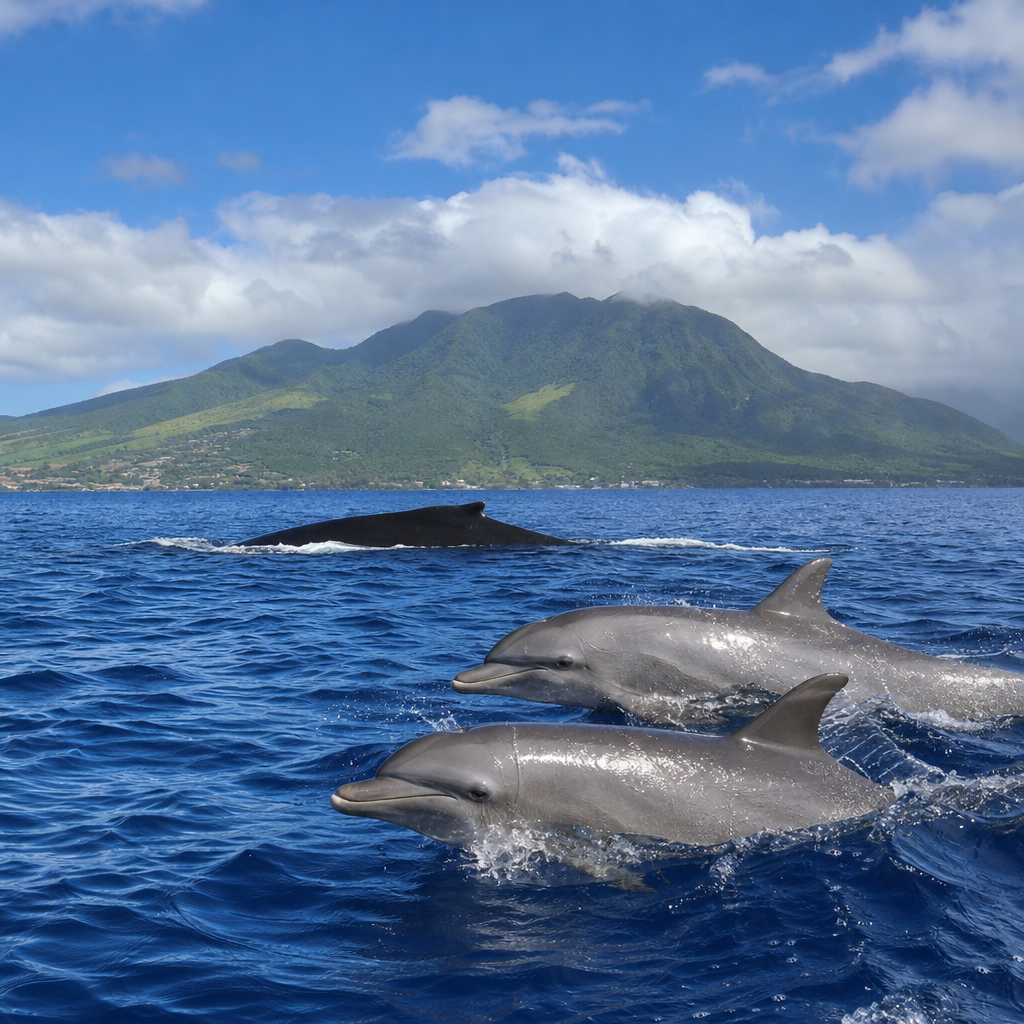
Bottlenose dolphins are the species most travelers recognize. They often move in social groups, surface repeatedly, and may approach boats, making them easier to observe. Atlantic spotted dolphins are especially notable in warm Atlantic waters; adults develop distinctive spotting patterns with age, a helpful field mark when sea conditions are calm. Spinner dolphins are famous for their acrobatic leaps and spins, although behavior varies by feeding and resting cycle. Pilot whales, despite the common name, are actually large dolphins. They travel in tight-knit pods and can remain in an area when prey is abundant. Sperm whales are the heavyweight deep-diving specialists of the region, capable of descending well over 1,000 meters to hunt squid. Humpback whales are seasonal visitors rather than year-round residents, but their migration through the Caribbean is one of the great wildlife spectacles of the wider Atlantic basin.
Why Saint Kitts is prime habitat for dolphins and whales
The island’s position in the Lesser Antilles gives it unusual ecological reach for such a small landmass. Offshore waters transition quickly from coastal habitat to oceanic depth, which allows both inshore and pelagic species to use the same general area. Cetaceans follow prey, and prey follows ocean conditions: currents, temperature gradients, seafloor structure, and nutrient pathways. Around Saint Kitts and neighboring islands such as Nevis and Statia, steep bathymetry can concentrate life in a way that improves sighting potential compared with broad shallow shelves.
Depth matters because many cetaceans are specialized feeders. Sperm whales target deep-water squid. Beaked whales also rely on deep diving and are usually linked to offshore canyons and steep slopes. Dolphins often exploit baitfish near current edges, especially where seabirds reveal feeding activity at the surface. On calm mornings, experienced captains watch for frigatebirds, terns, and sudden slick patches that indicate fish movement below. That same observational logic is used by researchers during line-transect surveys: birds, blows, splashes, and surfacing patterns all help narrow identification.
Another reason the area is important is connectivity. Marine mammals do not recognize political boundaries. Animals seen off Saint Kitts may range through waters used by Saint Eustatius, Saba, Antigua and Barbuda, Dominica, and Guadeloupe. Humpback whales migrate between high-latitude feeding grounds and low-latitude breeding areas, while resident and semi-resident dolphins may use overlapping home ranges across multiple islands. That makes local awareness valuable even when formal population estimates remain regional rather than island-specific.
Species profiles: dolphins and whales visitors most want to know
For a hub page, the most useful approach is to separate likely sightings from special sightings. Likely does not mean guaranteed, but it reflects what operators and regional databases report more often. Bottlenose dolphins are robust, curved-dorsal-fin animals that adapt well to varied habitats. They may bow-ride, but ethical operators do not chase them to force interaction. Atlantic spotted dolphins are smaller and often highly active; juveniles can be unspotted, so identification improves with experience. Spinner dolphins are sleek, long-beaked, and best known for aerial behavior, though many sightings are brief and fast-moving.
Among whales, short-finned pilot whales are one of the more realistic offshore targets. Their bulbous foreheads and low-profile surfacing style can confuse beginners at first, but a cohesive pod and repeated shallow blows often give them away. Sperm whales are unmistakable when seen well: large block-shaped head, angled blow, and the potential for a dramatic fluke-up dive. Humpback whales appear mainly during the broader Caribbean winter breeding and calving season. In those months, travelers may hear of surface-active groups, breaches, pectoral slaps, and song detected by hydrophone work elsewhere in the region.
| Species | Typical Habitat Near Saint Kitts | Best Clues for Identification | Sighting Pattern |
|---|---|---|---|
| Bottlenose dolphin | Coastal and offshore | Gray body, curved dorsal fin, social surfacing | Commonly reported |
| Atlantic spotted dolphin | Warm offshore waters | Spots on adults, energetic group behavior | Regularly reported |
| Spinner dolphin | Offshore pelagic zones | Slender form, spinning leaps | Occasional to regular |
| Short-finned pilot whale | Deep offshore water | Rounded head, tight pod structure | Regular offshore target |
| Sperm whale | Deep pelagic habitat | Large square head, fluking dive, angled blow | Unpredictable but significant |
| Humpback whale | Migratory passage and breeding region | Long pectoral fins, breaches, visible flukes | Seasonal |
When to see marine mammals in Saint Kitts
Dolphins can be seen in any month, but sea state often determines whether people find them, identify them correctly, and spend enough time observing natural behavior. The practical best window is usually the drier season, when trade winds and swell can be more manageable on selected coasts, though exact conditions change by week. Calm water makes small dorsal fins visible at greater distance and helps captains track a pod without abrupt course changes.
Whale timing is more seasonal. Humpback whales generally move through the Caribbean in winter and early spring, aligned with breeding and calving patterns documented across the region. January through April is the period most travelers associate with humpbacks in the eastern Caribbean, though local variability matters. Sperm whales and pilot whales depend more on prey distribution than tourist calendars, so sightings can occur outside a simple season label. Morning departures are often best because glare, wind chop, and afternoon weather can reduce visibility. Anyone planning a dedicated trip should ask operators not just whether whales are “in season,” but which species were seen recently, how far offshore trips go, and what sea conditions typically look like.
Responsible whale and dolphin watching
Good wildlife watching is based on distance, patience, and interpretation rather than pursuit. The Caribbean has improved standards over time, but trip quality still depends heavily on the operator. A responsible captain approaches from the side or rear quarter, avoids cutting across an animal’s path, keeps speed low near the pod, and limits viewing time when calves are present. Sudden acceleration, repeated repositioning, or crowding by multiple boats can interrupt resting, nursing, socializing, and feeding.
Travelers should look for operators who brief guests before departure, explain that sightings are never guaranteed, and prioritize behavior over selfies. If a dolphin pod changes direction sharply, increases speed, bunches tightly, tail-slaps repeatedly, or makes longer dives, those can be signs of disturbance. Noise is another issue. Cetaceans depend on sound for navigation, social contact, and foraging. Engine noise and erratic vessel handling can mask communication, especially for species using clicks and whistles in complex acoustic environments. The best tours often feel less dramatic than aggressive ones because the captain lets the encounter unfold naturally. That restraint is exactly what protects wildlife and usually leads to better observations.
Threats facing Saint Kitts’ marine mammals
The biggest threats are not always visible from shore. Entanglement in fishing gear, vessel strikes, chronic noise, plastic pollution, and climate-driven ecosystem change all affect cetaceans across the Caribbean. Deep-diving species are especially vulnerable to acoustic disturbance because sonar and other loud underwater sound sources can alter diving behavior. Beaked whales, in particular, have been linked globally to sensitivity around intense naval sonar events, a concern recognized in marine mammal science for decades.
Plastic and marine debris create both direct and indirect harm. Large whales can ingest floating material, while smaller prey species are affected by degraded habitat and food-web contamination. Chemical pollutants may accumulate in long-lived predators. There is also the subtler issue of unmanaged tourism. One reckless boat may not seem decisive, but repeated harassment in a small island corridor can displace animals from preferred resting or transit routes. Climate change adds a broader stress layer by shifting prey availability, storm patterns, and ocean temperature. No single island can solve these pressures alone, but local policy on speed, approach distance, reporting, and public education still makes a measurable difference.
Research, conservation, and how this hub connects to wider wildlife topics
Marine mammal knowledge around Saint Kitts comes from a mix of scientific surveys, regional databases, opportunistic sightings, and the observations of fishers, dive professionals, and boat crews who spend long hours offshore. Tools used in modern cetacean work include photo-identification, passive acoustic monitoring, line-transect distance sampling, biopsy sampling under permit, and citizen science reporting platforms. Photo-ID is especially valuable for humpback whales and some dolphin populations because tail flukes, dorsal fins, scars, and pigmentation patterns can identify individuals over time.
This hub sits within the broader Nature and Wildlife coverage because marine mammals connect with many related subjects. Seabirds often help observers locate feeding dolphins. Sea turtles share some offshore pressures, especially vessel interaction and plastic exposure. Coral reefs and coastal water quality influence nursery fish populations that support larger food webs. Mangroves and seagrass beds matter too, even if whales never enter them directly, because healthy nearshore ecosystems strengthen the marine productivity chain. Readers exploring this subtopic should also look for related pages on birdlife, sea turtle nesting, offshore ecology, protected areas, island geology, and responsible ecotourism in Saint Kitts and Nevis. Taken together, those topics explain why a whale sighting is never an isolated event; it is a visible sign of an entire living system working well enough to support apex marine life.
Saint Kitts’ dolphins and whales deserve attention not just because they are exciting to watch, but because they reveal the character of the island’s surrounding sea. The combination of deep offshore water, migratory pathways, and productive Caribbean habitat brings an impressive variety of marine mammals within reach of local boats and visiting naturalists. Bottlenose dolphins, Atlantic spotted dolphins, spinner dolphins, pilot whales, sperm whales, and seasonal humpbacks form the core species picture, while rarer cetaceans remind us how much remains to be studied. The most important lesson is simple: better sightings come from better stewardship. Choose operators who follow respectful viewing practices, travel in the right season with realistic expectations, and treat every encounter as wildlife observation rather than entertainment on demand.
For anyone using this page as a hub, the next step is to explore the linked wildlife themes that make marine mammal encounters possible, from seabirds and sea turtles to offshore ecology and conservation policy. Understanding those connections turns a boat trip into something more valuable: an informed view of how Saint Kitts’ natural systems fit together. Use this guide to plan responsibly, ask sharper questions on the water, and support the protection of the island’s remarkable dolphins and whales for years to come.
Frequently Asked Questions
What kinds of marine mammals can be seen around Saint Kitts?
Saint Kitts is best known for cetaceans, the group of marine mammals that includes dolphins, whales, and porpoises. In the waters surrounding the island, dolphins are the animals people are most likely to encounter, especially in deeper offshore areas where schools may travel, feed, or ride swells created by currents and wind. Depending on season, sea conditions, and luck, visitors may also spot larger whale species moving through the eastern Caribbean along long-established migration and feeding routes. These animals are not random visitors; they use habitats shaped by underwater drop-offs, changes in water temperature, prey availability, and the broader circulation patterns that influence life throughout the region.
What makes Saint Kitts especially interesting is its position within the Caribbean basin, where deep water can occur relatively close to shore. That creates opportunities for marine mammal activity within reach of boat-based excursions, though sightings are never guaranteed. Some species are resident or semi-regular, while others are transient and may only appear at certain times of year. The exact mix can vary, but the headline remains the same: the island’s marine mammals represent a living part of a much larger ocean ecosystem, and seeing them offers insight into how the eastern Caribbean functions beyond its beaches and reefs.
Why are dolphins and whales considered marine mammals?
Dolphins and whales are classified as marine mammals because, despite spending their lives in the ocean, they share the defining biological traits of mammals. They are warm-blooded, which means they regulate their own body temperature. They breathe air through lungs rather than extracting oxygen from water like fish do, so they must surface regularly. Females give birth to live young and nurse them with milk, and mothers often invest significant time and energy in caring for calves. These traits are central to understanding both their biology and their behavior in the waters around Saint Kitts.
They are also highly social and intelligent animals, and that matters just as much as their physical characteristics. Many dolphins live in pods with coordinated group behavior, communication, and cooperative movement. Whales, depending on the species, may travel alone, in small groups, or in larger social structures, often relying on sound to navigate, communicate, and locate prey across wide stretches of ocean. In practical terms, calling them marine mammals is not just a scientific label; it highlights that they are air-breathing, behaviorally complex animals with life histories very different from reef fish or other sea life commonly associated with Caribbean waters.
When is the best time to see dolphins and whales near Saint Kitts?
Dolphins can potentially be seen at many times of year around Saint Kitts, particularly when sea conditions are calm and boats can safely access deeper offshore waters. Because some dolphin species are relatively regular in the region, sightings are often more dependent on weather, visibility, and the skill of guides than on a single narrow season. Early morning trips may improve conditions for spotting fins, surface activity, or movement in the water before winds build later in the day. That said, the ocean is unpredictable, and even experienced operators cannot promise a sighting on every outing.
Whale sightings are often more seasonal, since many larger species pass through the Caribbean during migration. Timing varies by species, but cooler months are commonly associated with increased whale activity in parts of the region. Ocean currents, food supply, breeding cycles, and changing seasonal conditions all influence where animals are and how long they remain. For the best chance of success, travelers should ask local operators which months historically produce the strongest sightings and whether recent conditions have been favorable. The best time, in short, is when marine mammal activity overlaps with calm seas, knowledgeable guides, and responsible boat access to the right habitat.
Where do these animals spend most of their time around Saint Kitts?
Marine mammals around Saint Kitts are usually associated with deeper offshore waters rather than the shallow coastal zones where many visitors swim or snorkel. That is because dolphins and whales often follow prey and oceanographic conditions that are more common along shelf edges, underwater slopes, and deeper channels. These areas can concentrate fish, squid, and other food sources, making them productive habitat for cetaceans. The eastern Caribbean’s currents help shape these feeding opportunities, and the animals move in response to those shifting conditions rather than staying fixed in one place.
This is one reason why seeing dolphins or whales is often tied to boat excursions designed to reach open water efficiently and safely. While occasional sightings from shore are possible under ideal circumstances, most meaningful encounters happen farther out, where visibility is broad and guides can watch for surfacing patterns, birds, bait activity, and other signs of life. Their use of these waters also reflects a larger truth: Saint Kitts is part of an interconnected marine corridor, not an isolated destination. The animals seen there may be moving between islands, across deep basins, or along migration paths that have existed for generations.
How can visitors watch marine mammals around Saint Kitts responsibly?
Responsible viewing starts with choosing operators who treat dolphins and whales as wild animals rather than entertainment props. Good guides maintain respectful distances, avoid chasing or cutting across the animals’ path, and reduce speed when cetaceans are nearby. They watch behavior carefully and understand when animals are resting, feeding, traveling, or caring for young. If a pod changes direction repeatedly, dives longer than usual, bunches tightly together, or appears to avoid the vessel, a responsible operator will back off. The goal should always be observation without disruption.
Visitors can help by keeping expectations realistic and behavior calm. Loud noise, sudden movement, attempts to touch animals, or pressure on guides to get closer all increase stress on wildlife. It is also wise to avoid any excursion that promotes guaranteed interaction or unsafe proximity, because ethical wildlife watching depends on the animal having space and control. Beyond the boat itself, responsible tourism includes supporting businesses that value conservation, follow local regulations, and educate guests about the biology and vulnerability of marine mammals in the Caribbean. A respectful encounter not only protects dolphins and whales today, but also helps preserve Saint Kitts’ offshore wildlife experience for the future.