Churches in Nevis have never been only places of worship; they have been schools, relief centers, political meeting points, record keepers, and enduring landmarks that reveal how the island’s society developed across centuries. To understand the role of churches in Nevis’ social history, it helps to define social history broadly: not simply major events and famous leaders, but the everyday structures that shaped family life, education, labor, class relations, health, mutual aid, and community identity. On a small Caribbean island where plantation slavery, emancipation, migration, hurricanes, and tourism all left deep marks, churches became institutions through which people organized meaning and survival. Their influence appears in parish boundaries, cemetery inscriptions, baptism registers, marriage customs, feast days, choirs, charitable societies, and village calendars.
Nevis, one of the two islands forming the Federation of Saint Kitts and Nevis, was colonized by the English in the early seventeenth century and soon became a profitable sugar colony. That history matters because church life did not develop in isolation. Anglican establishments were tied to colonial governance, while Methodist, Moravian, and later other denominations often expanded where ordinary workers, free people of color, and rural communities needed pastoral care, literacy, and fellowship. In my experience reviewing Caribbean local histories and parish records, church documents are often the most continuous archive available for tracing changes in population and social values. In Nevis, that pattern is especially clear.
This article serves as a broad hub for the miscellaneous dimensions of church influence in Nevisian history. It looks beyond architecture and doctrine to explain how churches helped structure neighborhoods, preserve memory, shape moral expectations, respond to crisis, and adapt to modern life. It also highlights the tensions: churches could reinforce hierarchy even as they offered solidarity; they could preserve colonial norms while nurturing local leadership. Taken together, these institutions provide one of the clearest windows into Nevis’ cultural and historical development.
Colonial Foundations and the Early Parish Order
The earliest churches in Nevis developed alongside the island’s colonial parish system, and that relationship is central to understanding their social role. In the British Caribbean, the established church was more than a spiritual authority. It was woven into administration, landholding patterns, and public legitimacy. Parish churches served as hubs for formal rites of passage and as symbols of ordered society in plantation colonies. In Nevis, Anglican churches in places such as Charlestown and Gingerland reflected both settlement geography and the concentration of power among planters and officials.
These early churches helped define the rhythms of public life. Baptisms, marriages, and burials were not private family moments alone; they were legal and social acts recorded by church authorities. Before modern civil registration systems, parish registers documented births, kinship connections, mortality crises, and mobility between estates and villages. Historians rely on these records because they reveal demographic change that official political narratives often ignore. For descendants researching Nevisian ancestry today, church archives remain among the most valuable sources available.
At the same time, the colonial church reflected inequality. Seating arrangements, burial locations, memorial tablets, and patterns of access often mirrored racial and class divisions. Elite families funded buildings, pews, and monuments, and in many plantation societies the established church moved cautiously on issues concerning slavery. That does not make churches irrelevant to the enslaved majority; rather, it shows that religion existed inside a contested social order. The church building itself could symbolize authority, but the congregation around it often contained competing experiences of power, duty, and hope.
Churches, Enslavery, and Emancipation
Any serious account of churches in Nevis’ social history must address slavery and emancipation directly. Nevis was deeply tied to the sugar economy, and enslaved Africans and their descendants formed the labor force that sustained colonial wealth. Churches occupied an uneasy place in that system. Some clergy and missionaries defended gradual reform, some accommodated plantation realities, and some actively encouraged Christian instruction among enslaved people without challenging the full structure of bondage. Across the Caribbean, this mixed legacy is well documented, and Nevis fits that wider regional pattern.
Yet churches also became spaces where enslaved and later freed people forged community under oppressive conditions. Religious gatherings allowed for mutual recognition, music, moral language, and shared narratives of suffering and deliverance. After emancipation in 1834, followed by apprenticeship and full freedom, churches gained even greater importance because newly free communities sought institutions that could support marriage, education, sobriety movements, savings habits, and organized village life. In practical terms, a church could help transform a laboring population into a self-conscious community with leaders, committees, and a calendar of collective events.
One reason Methodist and Moravian influence grew in many Caribbean islands was their relative success in reaching non-elite populations through itinerant preaching, class meetings, and practical moral instruction. Even where Anglicanism remained prominent in Nevis, the broader denominational landscape mattered socially because it widened access to organized religion. The move from plantation chapel culture toward village congregational life marked a larger shift in authority. Freed people were not merely recipients of ministry; they increasingly became lay preachers, teachers, choir leaders, trustees, and moral voices within their own communities.
Education, Literacy, and Social Mobility
Long before the state built comprehensive social services, churches provided some of the most durable educational infrastructure in Nevis. Sunday schools introduced children to reading through scripture, hymns, and catechisms, but their effect often extended far beyond religious instruction. In small communities, the ability to read a Bible passage, sign a marriage register, or keep simple accounts could improve a person’s status and opportunities. Church-supported schools, whether formal or informal, trained generations in literacy, discipline, punctuality, and public speaking.
From a social history perspective, this educational role was transformative because it linked religion with mobility. Parents sent children to church schools not only for doctrine but for the practical advantages that came with literacy. Teachers, catechists, and ministers often became among the most respected figures in village life because they connected local families to a wider world of texts, examinations, and aspirations. In several Caribbean contexts, church schools served as stepping stones into clerical work, teaching, nursing, and migration pathways. Nevisian communities experienced similar patterns.
Churches also shaped cultural literacy. Harvest festivals, recitations, choir performances, and anniversary services gave children and adults experience in formal presentation. That mattered in a society where confidence, speech, and respectability could influence employment and leadership opportunities. Even today, many older Caribbean people remember church as the place where they first learned to read aloud, sing in harmony, memorize passages, or address an audience. In Nevis, these ordinary practices helped produce social capital long before the term existed.
Mutual Aid, Charity, and Crisis Response
Churches became indispensable in Nevis because island communities repeatedly faced economic shocks, storms, illness, and household hardship. In places with limited public welfare, the local congregation often functioned as the first safety net. Clergy and lay members organized food collections, sick visits, funeral assistance, and emergency support for widows, elderly residents, and families whose income disappeared after crop failure or storm damage. That pattern remains historically significant because it shows religion operating as community infrastructure, not only belief.
I have seen this across Caribbean parish histories: the most trusted institutions during crisis are often the ones already embedded in daily relationships. In Nevis, churches held that trust because people knew who kept the keys, who visited the vulnerable, who could rally volunteers, and which hall could shelter neighbors. Following hurricanes, congregations often served as distribution points for clothing, meals, and rebuilding help. During periods of migration, they also supported the children and older relatives left behind, maintaining social continuity when families were stretched across islands or overseas.
| Social function | How churches contributed in Nevis | Why it mattered |
|---|---|---|
| Relief after disasters | Opened halls, gathered supplies, coordinated volunteers | Provided fast local response before formal aid arrived |
| Funeral support | Organized services, collections, and burial assistance | Reduced hardship and preserved dignity for poor families |
| Youth formation | Ran Sunday schools, choirs, and supervised activities | Created structure, mentorship, and public discipline |
| Elder care and visitation | Checked on the sick and housebound through lay networks | Strengthened social bonds and reduced isolation |
This charitable role should not be romanticized. Churches could not eliminate poverty, and assistance could reflect moral judgments about deserving behavior. Still, their practical contribution was substantial. For many Nevisians, church-based aid was the difference between facing crisis alone and facing it within a network of obligation and care.
Identity, Ritual, and Community Memory
Churches helped Nevisians interpret life events through ritual, and that influence shaped identity across generations. Baptism welcomed infants into both spiritual and social belonging. Confirmation, marriage, harvest thanksgiving, and funeral rites marked transitions with language, music, clothing, procession, and public witness. These ceremonies did more than express faith; they told communities who belonged, who had kin, who had standing, and how memory should be preserved.
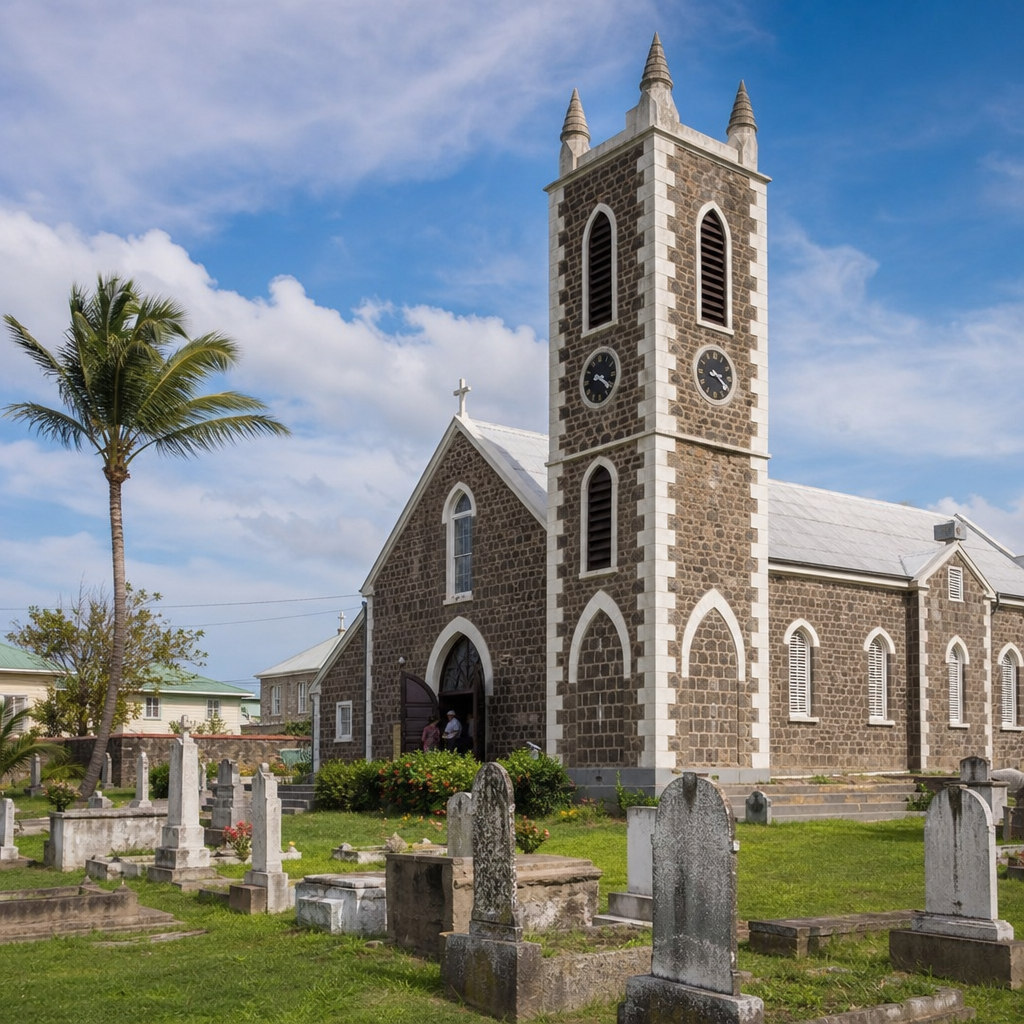
Cemeteries and memorial plaques make this role visible. Churchyards in Nevis preserve names, dates, family lines, military service, occupational titles, and devotional language that historians can read as social evidence. A headstone may reveal migration to Panama, service in a British regiment, or ties between village families that oral history alone might miss. In this way, churches became keepers of collective memory. They stored registers, commemorated benefactors, and maintained anniversaries that linked present communities to ancestors and local events.
Music is another crucial part of this story. Hymnody, choral singing, Christmas services, and special feast observances created emotional continuity in island life. Choirs often brought together multiple generations and gave talented singers social recognition. In many villages, the church calendar still helps organize the year through watch-night services, Lenten observance, Easter celebrations, harvest festivals, and memorial events. These practices sustain identity because they bind people to place, to family, and to recurring communal forms that outlast politics and economic change.
Leadership, Public Morality, and Political Influence
Church leaders in Nevis have long influenced public morality, though not always in uniform ways. Ministers and lay officers often spoke on family responsibility, alcohol use, education, sexuality, and civic conduct. In small societies, such guidance carried weight because church figures were visible beyond the sanctuary. They officiated at funerals, visited schools, knew local households, and were often asked to open public ceremonies with prayer. Their authority was therefore social as much as theological.
Churches also nurtured organizational leadership. Vestries, women’s groups, youth fellowships, men’s associations, and fundraising committees trained people in minute-taking, budgeting, event planning, conflict mediation, and public accountability. Those skills translated into village councils, cooperatives, unions, school boards, and national civic life. When historians ask how leadership cultures form on small islands, churches are part of the answer because they provide repeated practice in collective governance.
Political influence, however, has always involved tension. Churches can stabilize communities, but they can also resist social change or align too closely with prevailing elites. In post-emancipation and modern periods, some clergy advocated justice, education, and dignity for ordinary people, while others emphasized order over reform. The important point is not to force a simple verdict. The role of churches in Nevis’ social history is significant precisely because these institutions mediated debates about respectability, authority, and change. They were arenas where moral values entered public conversation.
Change, Heritage, and the Contemporary Role of Churches
Today, churches in Nevis operate in a different environment shaped by tourism, global media, migration, and a more religiously diverse public sphere. Their social role has not disappeared, but it has evolved. Attendance patterns may fluctuate, younger generations may engage faith differently, and state institutions now handle functions once left largely to congregations. Even so, churches remain important as heritage sites, community anchors, and repositories of local memory.
Historic church buildings in Charlestown and rural parishes contribute to cultural tourism and heritage interpretation. Visitors may arrive for architecture or genealogy, then leave with a deeper understanding of slavery, emancipation, village life, and island resilience. For residents, these sites still carry layered meaning. They are places where grandparents married, where storm victims gathered, where school prizes were awarded, and where funerals continue to knit families together across class and diaspora lines.
Contemporary churches in Nevis also support practical needs through counseling, youth mentoring, elder visitation, music ministry, and holiday outreach. Some partner with schools or civic groups; others use digital communication to stay connected with migrants in the United Kingdom, the United States, Canada, and elsewhere. That diaspora link matters because Nevisian identity is no longer confined to the island. Churches help maintain continuity between home communities and overseas families through memorial services, donations, livestreamed worship, and return visits tied to major religious seasons.
The history of churches in Nevis is therefore not a side note to the island’s past. It is one of the main threads through which Nevisians organized social life, preserved memory, and responded to change. From the colonial parish system to emancipation, from literacy training to funeral care, churches shaped institutions and habits that reached far beyond Sunday worship. They reflected the inequalities of their time, yet they also offered spaces for solidarity, leadership, and cultural continuity. That dual legacy is what makes them so important to historians and to anyone seeking a fuller understanding of Nevis.
For readers exploring Nevis under the wider Culture and History topic, churches provide a useful hub into many related subjects: plantation society, family history, village identity, music, education, migration, architecture, and heritage preservation. If you want to understand how an island community remembers itself, start with the churches, their records, their rituals, and the people who kept them alive. Use this page as a starting point, then continue into related articles on Nevisian heritage, historic sites, local customs, and community life.
Frequently Asked Questions
Why are churches so important to understanding Nevis’ social history?
Churches are central to Nevis’ social history because they influenced far more than religious life. For centuries, they helped organize the everyday structure of society by shaping education, family routines, social expectations, charity, and community leadership. In a small island setting like Nevis, institutions often served multiple purposes, and churches became some of the most visible and durable centers of local life. They marked births, marriages, and deaths, preserved records, offered moral guidance, and provided places where people gathered regularly across generations.
Looking at churches also helps historians move beyond a narrow focus on political milestones or elite figures. Social history asks how ordinary people lived, worked, learned, formed relationships, and survived hardship. Churches reveal those patterns clearly. They connected plantation society, village life, post-emancipation communities, and modern civic identity. Whether through sermons, schools, relief efforts, or public meetings, churches reflected changing ideas about class, race, labor, responsibility, and belonging. In that sense, the history of churches in Nevis is also the history of how communities were built, maintained, and remembered.
How did churches contribute to education in Nevis?
Churches played a major role in education in Nevis, especially in periods when formal public systems were limited, unevenly funded, or inaccessible to many people. Religious institutions often supported elementary instruction, literacy training, and moral education, making them among the earliest organized providers of learning on the island. In many communities, church-linked schools introduced children to reading, writing, arithmetic, and religious teaching, while also reinforcing discipline, social values, and communal expectations.
This educational role mattered deeply in social terms. Literacy opened the door to participation in religion, commerce, legal matters, and later civic life. For formerly marginalized groups, especially in the post-emancipation era, access to church-sponsored education could become a pathway to mobility, leadership, and self-organization. Churches were not neutral institutions; their teaching often reflected the assumptions of their denominations, colonial power structures, and social hierarchies. Even so, they helped create habits of learning and provided spaces where generations of Nevisians encountered formal instruction. When historians study church schools, attendance patterns, and religious education, they gain insight into how knowledge, discipline, opportunity, and social aspiration developed across the island.
In what ways did churches serve as community support and relief centers?
Churches in Nevis frequently acted as practical support networks in times of need, making them important institutions of mutual aid as well as worship. During illness, economic hardship, storms, crop failures, and other crises, churches could organize collections, distribute food or clothing, assist vulnerable families, and mobilize volunteers. Clergy and church leaders were often among the first people community members turned to when seeking help, advice, or intervention. This gave churches a lasting place in the island’s social safety structure, especially before the expansion of modern state welfare systems.
Just as important, churches helped create the social bonds that made relief possible. Regular attendance, shared rituals, and close local networks encouraged people to see hardship as a collective concern rather than only a private struggle. Church women’s groups, charitable societies, youth organizations, and lay committees often extended this work beyond the sanctuary. These activities supported widows, children, the elderly, and families facing sudden loss. Studying this role shows how Nevisian communities practiced care, responsibility, and resilience. It also highlights how churches became trusted institutions not only because of doctrine, but because they were embedded in the daily realities of people’s lives.
Did churches influence politics and public leadership in Nevis?
Yes, churches influenced politics and public leadership in Nevis, though not always in a formal or partisan way. Because churches were respected gathering places and clergy were often among the most educated and publicly visible figures in a community, religious spaces naturally became connected to civic discussion and social authority. Church leaders could shape public opinion through preaching, advocacy, moral instruction, and involvement in local disputes. In many societies, including Nevis, the boundary between religious influence and social leadership has historically been quite porous.
Churches also mattered politically because they brought people together and gave structure to public life. Meetings, announcements, and community deliberation often happened around religious institutions. At different times, churches could reinforce established power, but they could also provide language and organization for reform, dignity, and collective action. Their influence can be seen in debates about education, labor, welfare, morality, and community standards. Even when churches were not directly making policy, they helped shape the values and networks through which public leadership emerged. For historians, this makes churches useful lenses for understanding how authority operated in Nevis at both the local and island-wide levels.
What do church buildings and records reveal about the development of Nevisian society?
Church buildings and church records are among the richest sources for tracing the development of Nevisian society over time. The buildings themselves act as physical landmarks of continuity, change, and community memory. Their locations, styles, reconstruction histories, and patterns of use can reveal where populations were concentrated, how communities expanded, and which institutions remained important across generations. A church that survives earthquakes, hurricanes, economic downturns, or demographic change becomes more than architecture; it becomes evidence of endurance and collective identity.
Church records are equally valuable. Registers of baptisms, marriages, burials, memberships, and related activities can help historians reconstruct family ties, migration patterns, naming practices, mortality trends, and social relationships. In places where other records may be incomplete or scattered, church documents often preserve vital clues about ordinary lives. They can also illuminate class distinctions, racial divisions, denominational competition, and changing patterns of inclusion and exclusion. When read carefully, these materials show how religion intersected with labor, household formation, health, and local belonging. In short, church buildings and records help transform broad historical themes into a more intimate and detailed picture of how Nevisian society actually functioned.