Saint Kitts’ naval history is a story of geography turned into strategy, where a small eastern Caribbean island became a contested maritime prize during the age of sail and cannon. In practical terms, that era ran from the early European settlement period in the seventeenth century through the great imperial wars of the eighteenth and early nineteenth centuries, when wooden warships, merchant convoys, privateers, shore batteries, and harbor defenses determined who controlled trade routes and colonial wealth. For Saint Kitts, also known as Saint Christopher, naval history cannot be separated from sugar, slavery, fortification, and rivalry between England and France. The island sat in the Leeward Islands chain, close enough to major passages to matter, yet compact enough that possession of a few anchorages and heights could reshape its fate.
When historians speak about naval power in the Caribbean, they usually mean more than fleets fighting at sea. They mean an integrated system: deep-water anchorages, batteries overlooking roadsteads, warehouses, customs houses, convoy assembly points, and the merchant shipping that carried sugar, molasses, rum, and manufactured goods across the Atlantic. On Saint Kitts, Basseterre and Sandy Point mattered because they linked local plantation production to imperial commerce. Brimstone Hill mattered because guns on land could deny or protect movement at sea. In my experience researching Caribbean maritime sites, this is the point many readers miss: the most decisive naval actions around islands were often shaped before a broadside was ever fired, by charts, winds, supply lines, and elevation.
That is why Saint Kitts’ naval history deserves to be treated as a hub topic within culture and history rather than a narrow military sidebar. It connects to colonization, the rise of plantation society, enslaved labor, diplomacy, cartography, shipbuilding logistics, and the transfer of power after treaty settlements. It also explains why the island developed the way it did. The same coastline that welcomed merchant shipping also invited attack. The same harbors that exported sugar attracted privateers. The same forts built to deter enemy squadrons became symbols of imperial authority. Understanding the era of sail and cannon on Saint Kitts helps readers make sense of the island’s broader historical landscape, from surviving fortifications to place names, heritage tourism, and regional memory.
Why Saint Kitts Became a Naval Prize
Saint Kitts became a naval prize because it combined location, resources, and early colonial importance. It was one of the first successful English and French settlement points in the Lesser Antilles, beginning in the 1620s, and that early foothold gave it strategic weight beyond its size. The island offered arable land suited to tobacco first and later sugar, plus anchorages that could support inter-island traffic and Atlantic shipping. In the seventeenth-century Caribbean, islands were not isolated dots; they were nodes in a maritime network stretching from Europe to North America and South America. Control of Saint Kitts meant influence over nearby sea lanes and a base from which to raid, resupply, or escort commerce.
The island’s mixed colonial history intensified its importance. English and French settlers shared Saint Kitts uneasily in the early period, and that arrangement almost guaranteed recurring conflict whenever European wars spread into the Caribbean. Once war began, local coexistence collapsed into campaigns for exclusive control. Naval power was central because reinforcements, munitions, and provisions had to come by sea. A colony that could not be relieved by friendly shipping was vulnerable, however strong its militia might appear on paper. This pattern repeated across the region, but Saint Kitts was a particularly clear example because rival imperial claims were embedded in the island from the start.
Economics made the stakes even higher. As sugar replaced earlier crops, Caribbean islands became enormously valuable to European empires. Sugar plantations required labor, capital, and secure export channels. The wealth concentrated in a place like Saint Kitts could finance merchants, insurers, and state revenues far beyond the island itself. That wealth also paid for forts, batteries, and naval patrols. In other words, commerce funded defense, and defense protected commerce. The island’s naval history is therefore inseparable from the brutal plantation economy that underpinned it.
Settlement, Early Conflict, and the Rise of Maritime Defense
The early seventeenth century established the pattern that would define Saint Kitts for generations. English settlers under Thomas Warner and French settlers under Pierre Belain d’Esnambuc created one of the earliest enduring colonial footholds in the Eastern Caribbean. Their presence displaced Indigenous Kalinago communities through violence, culminating in deadly confrontations that reshaped the island permanently. After settlement, Saint Kitts became both a springboard for colonizing neighboring islands and a target for European enemies. Because local production depended on maritime connections, defense planning quickly moved toward coastlines, landing sites, and anchorage control.
At first, defenses were relatively simple: militia musters, small artillery positions, watch points, and improvised barriers against raids. But the escalation of imperial warfare drove more formal military engineering. The Caribbean was vulnerable to amphibious attack because ships could land troops where terrain and surf allowed, then support them with naval guns. The answer was not merely to build walls at the water’s edge. Commanders needed overlapping fields of fire, elevated positions, magazines protected from explosion, and enough logistical depth to withstand siege. On Saint Kitts, these requirements eventually culminated in one of the most formidable hilltop fortresses in the British Caribbean.
Privateering added another layer. Governments issued letters of marque allowing privately owned vessels to attack enemy commerce legally during wartime. Around Saint Kitts, privateers disrupted shipping, captured prizes, and forced merchants to think constantly about convoy protection. This blurred line between naval war and commercial predation was typical of the era. A sugar island could be attacked by a royal squadron, a privateer captain, or a combined expedition involving soldiers and sailors. The island’s defenses had to prepare for all three.
Forts, Harbors, and the Logic of Sea Power
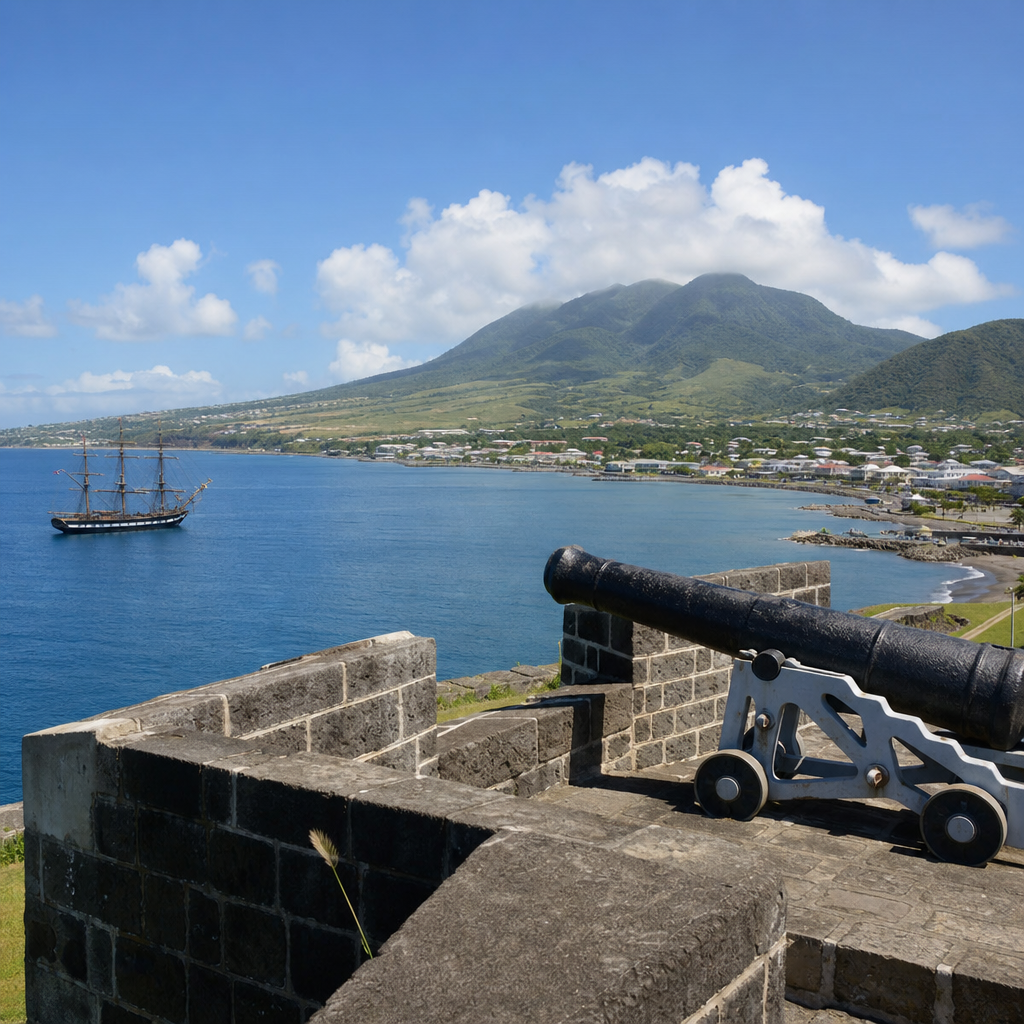
Saint Kitts’ most famous military monument, Brimstone Hill Fortress, explains the logic of Caribbean sea power better than any abstract theory. Rising inland but commanding approaches to the coast near Sandy Point, the fortress was developed mainly in the late seventeenth and eighteenth centuries by the British with the labor of enslaved Africans. Its design reflected established principles of fortification associated with European military engineering: strong stone works, bastions, protected gun positions, controlled access points, and the use of elevation to dominate surrounding terrain and coastal waters. A ship captain approaching the island had to consider not just reefs and winds, but whether shore guns from a height could rake an anchorage or cover a landing.
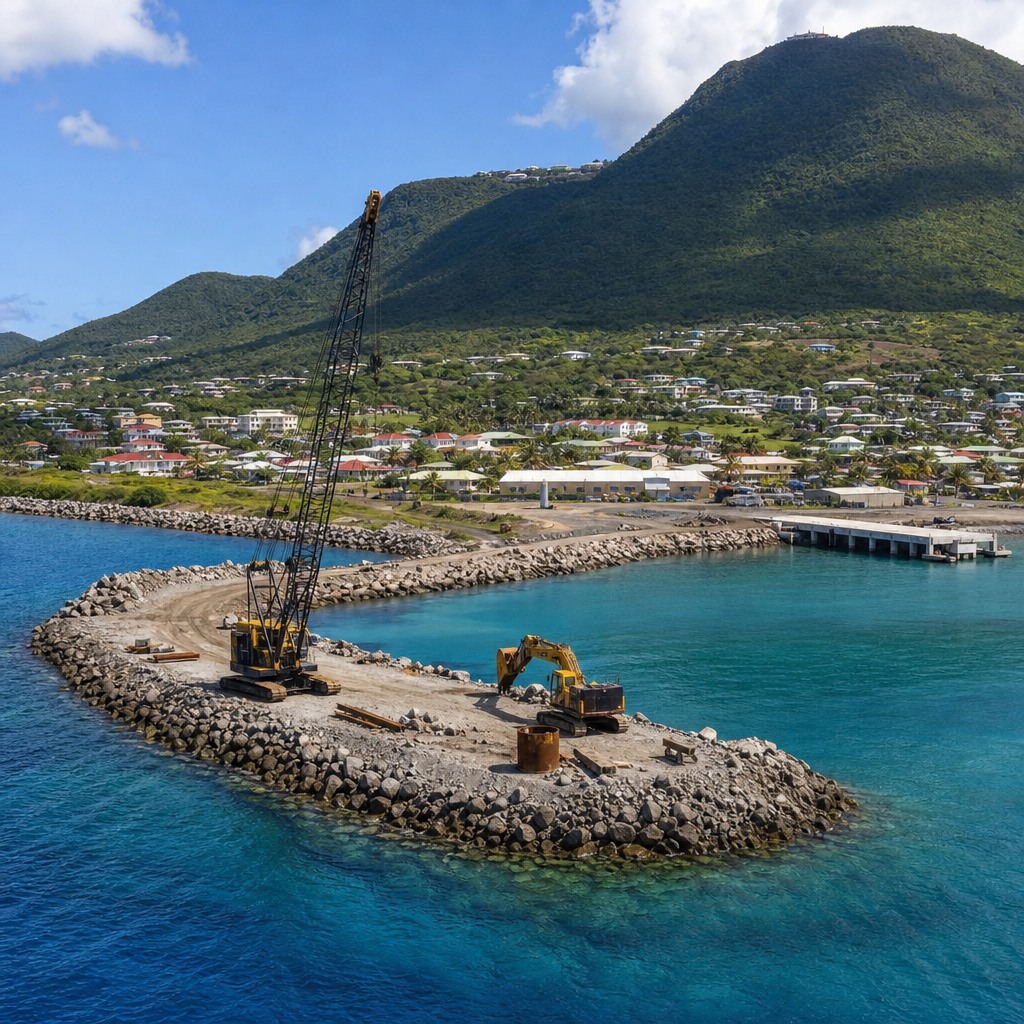
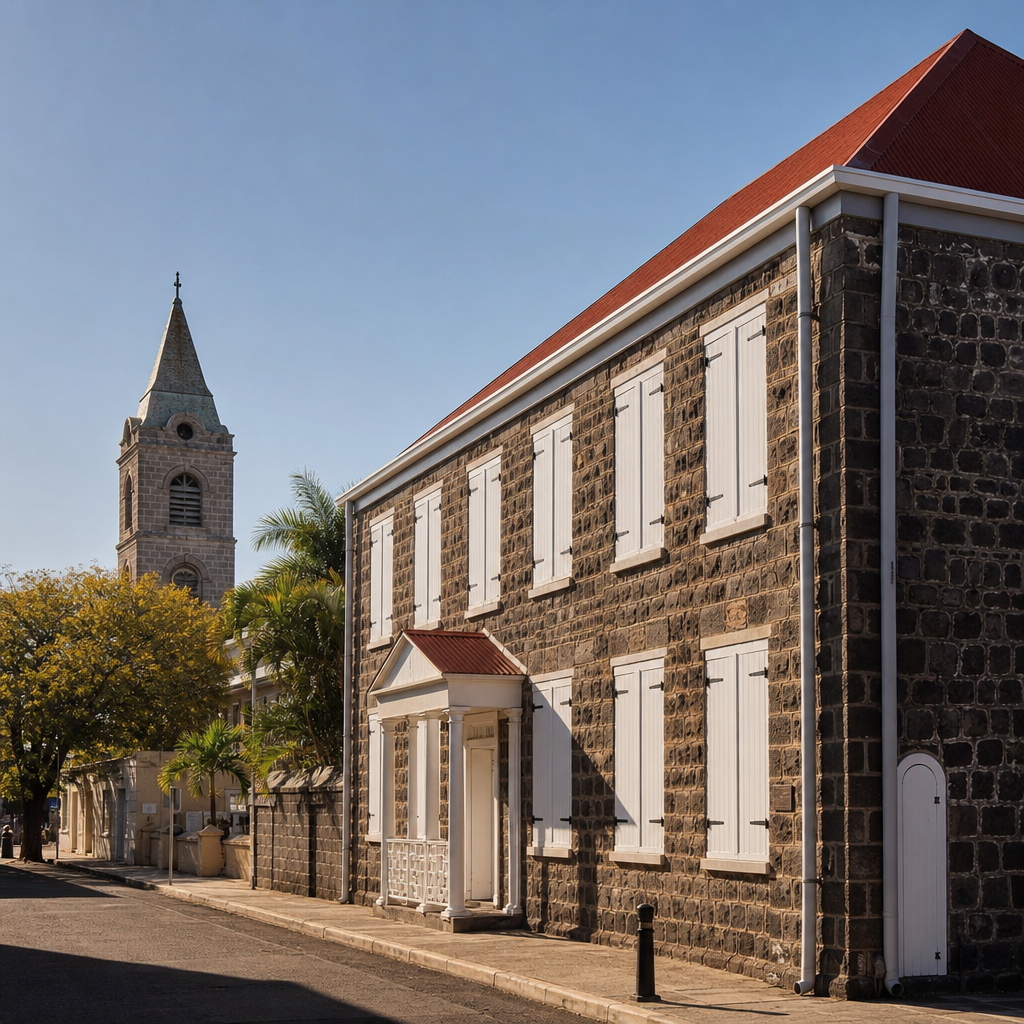
Basseterre, the principal town and port, served a different but equally important role. As an administrative and commercial center, it functioned as a maritime gateway. Customs activity, loading facilities, warehousing, and anchorage made it vital to both trade and war. Ports like Basseterre were not passive backdrops; they were operational spaces where convoys formed, news arrived, prisoners were exchanged, and naval officers coordinated with governors and plantation elites. In wartime, the pressure on such ports increased dramatically. Food supplies, powder stocks, and repair capacity could decide whether a colony remained defensible.
| Site | Naval Role | Why It Mattered |
|---|---|---|
| Brimstone Hill Fortress | Shore defense and siege stronghold | Commanded approaches near Sandy Point and anchored island defense |
| Basseterre | Commercial port and administrative harbor | Linked sugar exports, customs control, and military coordination |
| Sandy Point | Anchorage and western coastal access | Provided maritime approach near major defensive works |
| Roadsteads and bays | Temporary anchoring and convoy staging | Allowed merchant and naval vessels to load, resupply, or maneuver |
Harbors in the age of sail were judged by holding ground, depth, shelter from prevailing winds, and ease of defense. Saint Kitts did not need the single largest harbor in the Caribbean to matter; it needed usable anchorages integrated with plantation roads, magazines, and batteries. That integration is what turned the island into a durable imperial asset.
Wars Between Britain and France in the Leewards
Saint Kitts’ naval history reached its sharpest intensity during the repeated wars between Britain and France. The Anglo-French struggle in the Caribbean was never isolated from European conflicts such as the Nine Years’ War, the War of the Spanish Succession, the War of the Austrian Succession, the Seven Years’ War, the American War of Independence, and the French Revolutionary and Napoleonic Wars. Each conflict transformed the Leeward Islands into a theater where fleets protected trade, attacked colonies, and sought bargaining chips for treaty negotiations. Saint Kitts changed hands and endured invasions because it was valuable enough to fight over and small enough to be taken if sea control shifted.
One of the best known episodes came in 1782, during the American War of Independence, when French forces under the Marquis de Bouillé captured Saint Kitts despite the presence of British defenses. The campaign highlighted a central truth of the age: even powerful fortifications were vulnerable if the enemy could combine naval pressure, troop landings, and operational surprise. British Admiral Samuel Hood fought skillfully in the waters off the island and briefly secured an anchorage at Frigate Bay, a maneuver often praised in naval history for its audacity. Yet tactical brilliance at sea did not automatically reverse the strategic outcome on land. Brimstone Hill eventually capitulated after siege conditions worsened.
The island’s fate also shows that Caribbean war was often a contest of endurance rather than a single decisive battle. Heat, disease, water supply, provisioning, and the hurricane season all constrained commanders. Naval squadrons could not remain indefinitely without fresh stores, and transport delays could alter campaigns dramatically. In archival records across the region, one repeatedly sees the same concerns: powder running low, ships needing careening, troops weakened by fever, and merchants pleading for convoy protection. Saint Kitts was part of that wider operational reality.
Trade, Convoys, Privateers, and Everyday Maritime Life
For most people connected to Saint Kitts, naval history was experienced less as fleet action and more as the daily management of risk. Planters worried about whether sugar would reach market. Merchants tracked insurance rates and wartime capture reports. Dockworkers, sailors, pilots, coopers, and warehouse clerks sustained the practical business of moving goods from plantation to ship. Enslaved people performed much of the labor that made maritime commerce possible, from producing export crops to transporting supplies and helping construct military works. The prosperity that attracted naval protection rested on coercion at every level.
Convoy systems were crucial. Merchantmen sailing alone were vulnerable to enemy cruisers and privateers, so imperial authorities grouped ships under escort whenever possible. This reduced losses but introduced delays. A vessel ready to depart Basseterre might wait days or weeks for assembled protection, especially in wartime. Those delays affected prices, credit, and storage. Sugar was durable compared with some goods, yet shipping timetables still mattered. In the eighteenth-century Atlantic economy, time truly was money, and naval scheduling shaped commercial outcomes.
Privateering made the sea around Saint Kitts intensely competitive. A fast schooner or brig with legal authorization could prey on enemy traders, bringing captured cargoes into port for adjudication in vice-admiralty courts. Prize law, not just cannon fire, was part of the maritime system. Captured ships were valued, crews interrogated, and cargoes redistributed through legal process. This is one reason naval history belongs within broader cultural history: it affected law, finance, urban life, and social hierarchy as much as battle narratives.
Ship Types, Weapons, and the Limits of Sail-Era Warfare
The phrase era of sail and cannon can sound romantic, but the reality around Saint Kitts was technical, violent, and constrained by material limits. Warships ranged from ships of the line and frigates to sloops and smaller armed vessels used for dispatch, escort, and patrol. Merchantmen varied in rig and tonnage according to route and cargo. Smaller craft linked Saint Kitts with neighboring islands, carrying provisions, messages, and people through a constantly shifting maritime frontier. No commander chose vessels by prestige alone. Hull design, draft, crew size, and endurance had to match local conditions.
Cannon were decisive but imperfect. Smoothbore naval guns were powerful at close range yet inaccurate by modern standards. Shore batteries gained an advantage from stable platforms and pre-measured firing arcs, while ships had mobility and concentration of force. The balance depended on sea state, wind direction, water depth, and whether a squadron could anchor safely within range. Amphibious operations were equally complex. Troops, guns, ammunition, water casks, and entrenching tools had to move from transports to shore boats, then across hostile terrain under fire. Many campaigns failed not because courage was lacking, but because logistics broke down.
Weather imposed the final limit. Hurricanes could scatter fleets, destroy stores, and erase months of preparation. Seasonal planning in the Caribbean was therefore essential. Experienced officers respected climate, reef hazards, and the wear tropical conditions imposed on rigging, hulls, and crews. Saint Kitts’ naval story is most accurate when told with these constraints in mind, not as a sequence of heroic duels detached from environment.
Legacy, Memory, and Why This History Still Matters
The legacy of Saint Kitts’ naval history survives in stone fortifications, port landscapes, archives, museum interpretation, and the island’s wider historical identity. Brimstone Hill Fortress National Park, now recognized as a major heritage site, is the clearest physical reminder that maritime power in the Caribbean depended on land-based engineering and enslaved labor. Visitors often arrive expecting a simple fort tour and leave understanding that the entire island was shaped by competition over sea control, trade, and empire. That is the enduring value of this subject as a hub within culture and history: it links military events to architecture, labor history, diplomacy, and memory.
It also invites a balanced reading of the past. Naval defenses protected colonial economies, but those economies were built on dispossession and slavery. Merchant success in Basseterre meant suffering on plantations. Imperial rivalry produced impressive forts, yet also repeated invasion and insecurity. Recognizing these tradeoffs makes the history stronger, not weaker. It moves the discussion beyond nostalgia for tall ships toward an honest account of how power worked in the Caribbean. If you want to understand Saint Kitts fully, start with the coast, the guns, the harbors, and the people whose labor sustained them, then follow the connections outward across the Atlantic world.
The key takeaway is simple: Saint Kitts mattered in the age of sail because maritime geography, military engineering, and commercial wealth converged there. From early settlement and Anglo-French rivalry to convoy protection, privateering, and fortress building, the island was both a battlefield and a working port within a larger imperial system. Use this hub as your starting point for deeper reading on forts, Basseterre, Brimstone Hill, colonial warfare, plantation trade, and heritage sites across Saint Kitts and Nevis, and the island’s past will come into much sharper focus.
Frequently Asked Questions
Why was Saint Kitts so strategically important during the age of sail and cannon?
Saint Kitts was strategically important because its geography made it far more than just a small Caribbean island. Positioned in the eastern Caribbean, it sat within a maritime zone that connected Atlantic crossings from Europe to the plantation economies of the West Indies and onward to North American and inter-island trade. In the age of sail, control of sea lanes was everything. Islands with good anchorages, access to fresh water, and defensible coastlines could function as supply points, convoy stops, military outposts, and launching grounds for raids or invasions. Saint Kitts offered several of those advantages at once.
Its value also came from economics. The island became an important sugar-producing colony, and sugar was one of the most profitable commodities in the Atlantic world. Any island producing significant export wealth immediately became a target in imperial rivalry. European powers did not view Saint Kitts simply as land; they saw it as a source of customs revenue, plantation income, naval leverage, and regional influence. Holding the island meant protecting merchant shipping, sustaining colonial administration, and denying those same advantages to an enemy.
Just as importantly, Saint Kitts existed within a crowded imperial landscape. British and French interests overlapped constantly in the Lesser Antilles, and nearby islands could support fleets, privateers, and troop movements. That made Saint Kitts vulnerable but also useful. It could serve as a forward operating point in wartime, a place where naval power and shore defenses combined to secure harbors and commerce. In short, Saint Kitts mattered because it linked geography, trade, and war in a way that perfectly matched the strategic realities of the sailing era.
Which European powers fought over Saint Kitts, and why did control of the island change so often?
The main European powers that fought over Saint Kitts were Britain and France, though the broader context included the larger imperial competition that shaped the Caribbean as a whole. From the seventeenth century onward, the island was deeply affected by the recurring wars of European dynasties and empires. Conflicts that began in Europe rarely stayed there. Once war was declared between crowns, colonial possessions like Saint Kitts became immediate targets because they were valuable, vulnerable, and often easier to seize than heavily defended positions on the European mainland.
Control changed frequently because the Caribbean was a theater of opportunism. Naval squadrons, expeditionary forces, local militias, and privateers all played roles in shifting the balance. An island could be attacked by sea, isolated through blockade, pressured through the destruction of shipping, or compelled to surrender if its fortifications were insufficient or its defenders unsupported. In many cases, the side that controlled nearby waters had the advantage, because armies on islands depended on supplies, reinforcements, and communication delivered by ship. Without naval support, even strong local defenses could become difficult to maintain.
Diplomacy also contributed to these changes. Caribbean islands were often exchanged, restored, or reassigned through treaties ending larger wars. That means Saint Kitts could be won in battle, lost in a campaign, and then officially transferred again at the peace table. This pattern was common in the colonial era: military events on the island were tied to negotiations taking place far away in Europe. So when control shifted, it was usually the result of both battlefield realities and the broader logic of imperial settlement. Saint Kitts changed hands so often because it sat at the intersection of strategic geography, plantation wealth, and the global struggle between rival maritime empires.
What role did warships, privateers, and merchant convoys play in Saint Kitts’ naval history?
Warships, privateers, and merchant convoys were central to Saint Kitts’ story because naval history in the Caribbean was never limited to fleet battles alone. Royal warships projected state power. They escorted convoys, hunted enemy raiders, blockaded hostile ports, supported troop landings, and defended colonial harbors. Even a small number of armed vessels could influence the fate of an island by controlling approaches to anchorages and disrupting enemy logistics. Around Saint Kitts, ships of the line might appear in major wartime operations, but smaller frigates, sloops, and other versatile craft were often just as important in daily enforcement and defense.
Privateers added another layer. These were privately owned vessels authorized by governments to attack enemy commerce. In the Caribbean, where trade was constant and distances between islands were relatively short, privateering could be highly effective. A privateer did not have to defeat a navy outright to have strategic impact. By capturing merchant ships, raising insurance costs, spreading fear, and interrupting the flow of goods, privateers could weaken colonial economies and force governments to divert naval resources to protection. For an island like Saint Kitts, which depended on maritime links for exports, supplies, and communication, commerce raiding was a serious threat.
Merchant convoys were the defensive answer to that threat. Rather than allow valuable ships to sail independently, colonial powers grouped them together under naval escort. This system helped protect sugar fleets and other cargoes bound for Europe or neighboring colonies. Convoys were crucial because the loss of merchant shipping could undermine both local prosperity and imperial war finance. Saint Kitts’ place within convoy networks shows how closely commerce and military power were intertwined. The island’s naval history was not just about cannons firing from ships or forts; it was about the entire system of escort, attack, interception, supply, and trade that sustained empire in the Caribbean.
How did forts, shore batteries, and harbor defenses shape the island’s security?
Forts, shore batteries, and harbor defenses were essential because islands in the age of sail could not rely on fleets alone for protection. Ships were mobile and powerful, but they could not be everywhere at once. Permanent defenses gave Saint Kitts a fixed military framework: they guarded anchorages, covered key landing points, protected towns and storehouses, and provided a last line of resistance if enemy vessels entered local waters. In an era when naval guns and amphibious operations determined so much of colonial warfare, a well-placed battery could make a harbor difficult and costly to attack.
These defenses worked best when integrated into a broader system. A fort overlooking a bay could deter enemy ships from anchoring too close. Batteries along the shoreline could create overlapping fields of fire. Elevated positions were especially valuable because they gave defenders visibility over sea approaches and increased the range and effectiveness of artillery. Garrisons, signal stations, and militia support all contributed to this network. If an enemy fleet appeared offshore, defenders needed to detect it early, communicate quickly, and coordinate guns, troops, and any available naval support.
That said, fortifications were not invincible. Their effectiveness depended on maintenance, manpower, ammunition, and command. A strong fort with inadequate supplies or too few trained gunners could become more symbolic than practical. Likewise, if an enemy achieved naval superiority, landed troops elsewhere, or cut off relief by sea, shore defenses might be bypassed or reduced over time. In Saint Kitts’ case, forts and batteries mattered because they raised the cost of attack and helped secure colonial authority, but their true value came from how they fit into the larger contest between sea power and land defense. They were critical instruments of security, though never sufficient on their own.
How did the era of sail and cannon shape Saint Kitts’ long-term historical identity?
The era of sail and cannon shaped Saint Kitts’ identity by embedding the island in the wider history of Atlantic empire, warfare, and commerce. This was the period when Saint Kitts emerged not simply as a settlement, but as a strategically defined colonial space whose importance was measured in harbors, plantations, shipping lanes, and military resilience. Repeated conflict left its mark on the political development of the island, on the building of defensive works, and on the patterns of governance tied to imperial priorities. The island’s history cannot be separated from the maritime world that surrounded it.
Economically, the age helped anchor Saint Kitts within the plantation system, especially through sugar production and export. That prosperity drew naval protection, but it also attracted attack. As a result, commerce and insecurity developed side by side. The island’s fortunes rose and fell with convoy systems, wartime disruption, labor structures, and the policies of distant imperial capitals. Its local history was therefore shaped by forces that were both intensely immediate and unmistakably global.
Culturally and historically, the legacy of that era survives in the memory of contested sovereignty, fortified landscapes, and the island’s role in Caribbean imperial rivalry. Saint Kitts became a place where local experience reflected larger historical patterns: colonial competition, strategic defense, maritime dependence, and the use of naval power to project authority across oceans. When historians describe the island’s naval past, they are really describing a world in which geography dictated political importance. That is the lasting significance of Saint Kitts in the age of sail and cannon: it shows how a relatively small island could become a major piece on the imperial chessboard of the Atlantic world.