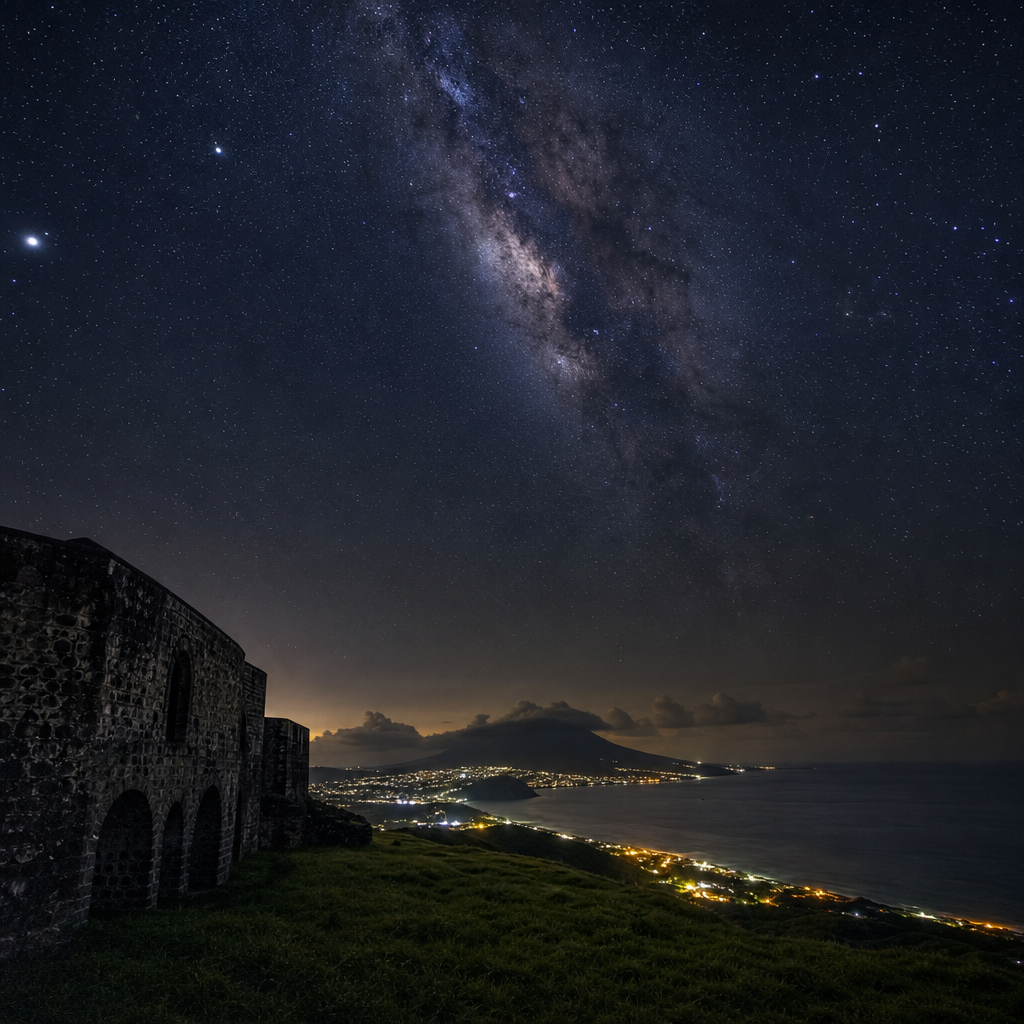
Saint Kitts offers some of the most accessible tropical stargazing in the Caribbean, combining dark coastal viewpoints, volcanic highlands, warm evening temperatures, and a compact island layout that lets amateur astronomers experience multiple observing conditions in a single night. For travelers and residents interested in Saint Kitts night skies, the appeal is practical as well as poetic: you can watch the Milky Way rise over the Atlantic, track planets above Brimstone Hill, or set up a small telescope near a quiet beach without driving for hours. Amateur astronomy, in simple terms, is the observation of celestial objects without the infrastructure of a professional observatory. That includes naked-eye skywatching, binocular sessions, smartphone astrophotography, and more advanced telescope work. On Saint Kitts, those activities benefit from relatively low light pollution outside Basseterre, broad sea horizons, and a latitude near 17 degrees north that reveals constellations many northern observers rarely see well. This hub article covers the miscellaneous essentials: where to go, what to expect by season, which targets are easiest, how weather and moonlight affect visibility, and how to observe responsibly in a sensitive natural environment.
I have planned observing sessions on islands like Saint Kitts, and the pattern is consistent: success comes less from expensive gear than from understanding local conditions. Marine haze, passing trade-wind clouds, and moon phase matter more than aperture on many nights. The reward for learning those patterns is significant. From Saint Kitts, Sagittarius and Scorpius climb high enough to make the galactic center region impressive, while southern objects skim into view that many observers in Europe or the northern United States miss. At the same time, the island’s tourism infrastructure makes astronomy approachable for beginners. You do not need a remote expedition or specialist transport. You need timing, a dark site, modest equipment, and realistic expectations. Because this page serves as a miscellaneous hub within Nature and Wildlife, it also points toward the broader experience: night insects, coastal sounds, changing weather, sea-turtle nesting sensitivities, and the etiquette required when astronomy shares space with habitats and communities. Think of Saint Kitts not as a single stargazing spot, but as a small network of micro-environments, each with strengths for visual observing, astrophotography, casual sky appreciation, and family-friendly night outings.
Why Saint Kitts Works for Amateur Astronomy
Saint Kitts is well suited to amateur astronomy because it combines low-to-moderate development density with geographic variety. Basseterre and the southeastern peninsula produce the most noticeable skyglow, especially low on the horizon, but much of the island remains dark enough for meaningful deep-sky observing. On clear nights, the Milky Way is visible from many coastal pull-offs and elevated inland areas, particularly when the moon is absent. The island’s tropical latitude is another major advantage. Observers farther north often struggle to see southern constellations at useful altitudes. From Saint Kitts, parts of Centaurus, Crux on the lowest southern horizon in favorable conditions, and rich Milky Way star fields appear better placed. Even when a target stays low, the novelty is substantial for visiting observers.
Conditions are not perfect every night. Transparency can suffer from humidity, salt haze, and airborne dust during Saharan dust events, usually more common from late spring into summer. That said, seeing, the steadiness of the atmosphere, can sometimes be surprisingly good over the sea after sunset when ground heat dissipates. For planetary viewing, this matters. Jupiter’s cloud belts or Saturn’s ring separation may look sharper from a stable shoreline site than from a breezy hillside with better darkness but more thermal turbulence. In practice, the best Saint Kitts astronomy sessions match the target to the site. Use darker inland or less developed coastal areas for nebulae and star clouds; use stable open horizons for planets, the Moon, and bright conjunctions. That distinction helps beginners avoid frustration and gets better results from simple equipment.
Best Stargazing Locations on the Island
The best stargazing locations in Saint Kitts balance darkness, safety, access, and horizon quality. The southeastern peninsula is popular because it offers open views and relatively limited development once you move away from resort lighting. Turtle Beach area viewpoints can be productive, though observers should stay clear of sensitive nesting zones and avoid bright white lights during nesting periods. Elevated roads near the central highlands can be darker, but cloud buildup is more likely there, and roadside setup requires caution. Brimstone Hill vicinity offers historic atmosphere and often excellent sky context, though local access rules and operating hours matter if you are not attending an organized evening event. Frigate Bay is convenient but usually too bright for faint deep-sky work; it is better for the Moon, bright planets, and introductory sessions.
When I evaluate island observing spots, I use four criteria: horizon openness, stray-light control, cloud tendency, and exit simplicity. On Saint Kitts, beach-adjacent lay-bys often win because they cool quickly after sunset and provide a clean horizon over water. The tradeoff is moisture. Optics can dew or salt over, so lens cloths, dew heaters, or sealed storage become important. Inland agricultural edges can be darker, but they may have more insects, uneven footing, and occasional passing vehicles. For families or first-time observers, choose a place within twenty to thirty minutes of accommodation, with a legal parking area and a straightforward route back. Astronomy goes better when people are comfortable, not when they are tired, lost, or worrying about terrain. That practical reality matters more than chasing the absolute darkest square kilometer on the island.
| Location Type | Main Advantage | Main Limitation | Best For |
|---|---|---|---|
| Southeast coastal viewpoints | Wide horizons, relatively dark skies | Wind and moisture from the sea | Milky Way, meteor showers, wide-field photography |
| Central elevated roads | Darker surroundings, reduced resort light | More clouds, trickier setup | Deep-sky observing with binoculars or small telescopes |
| Historic hill areas | Scenic setting and balanced horizons | Access restrictions, variable local lighting | Planets, constellation tours, outreach sessions |
| Frigate Bay and developed coasts | Convenience and easy parking | Significant light pollution | Moon viewing, bright planets, beginner sessions |
What You Can See From Saint Kitts
For most amateur astronomers, the biggest question is simple: what is actually visible from Saint Kitts? The answer depends on season, moon phase, and equipment, but the island supports rewarding naked-eye and telescope observing all year. In winter and early spring, Orion dominates the evening sky, bringing the Orion Nebula, the Pleiades, Sirius, and bright winter stars. Spring improves galaxy viewing for experienced observers, though faint galaxies are always challenged more by transparency than by darkness in humid marine climates. Summer is often the signature season because Scorpius and Sagittarius rise prominently, showcasing dense Milky Way fields, the Lagoon Nebula, Trifid Nebula, and numerous open clusters. Autumn transitions toward Pegasus, Andromeda, and later the return of winter targets.
From a beginner’s perspective, Saint Kitts is especially strong for bright showcase objects. The Moon is spectacular in any season and remains the best first target with binoculars or a telescope. Jupiter and Saturn are regular highlights when in evening visibility, while Venus can dominate twilight. The Southern Cross is not guaranteed high in the sky, but under good southern horizon conditions, low southern star patterns can be a memorable bonus for visitors from higher latitudes. Meteor showers such as the Perseids, Geminids, and Quadrantids can also be excellent from dark beaches, with the caveat that moonlight often matters more than shower peak date. If you want dependable success, plan around bright planets, the Moon near first quarter, and the Milky Way during the dark phase of late spring through early autumn.
Seasonality, Weather, and Moon Planning
Successful stargazing in Saint Kitts starts with planning around the moon and the weather rather than simply choosing travel dates. The single biggest factor for dark-sky viewing is moon phase. A full or gibbous moon will wash out the Milky Way and most faint nebulae, even at otherwise dark sites. For deep-sky observing, aim for the week centered on new moon. If your trip falls during a bright moon phase, shift your goals toward lunar observing, bright planets, double stars, and twilight sky scenes. This mindset prevents disappointment. I have seen many travelers assume tropical skies automatically equal perfect darkness; they do not when the moon is high and humidity is scattering light through the atmosphere.
Saint Kitts has a tropical maritime climate, so cloud timing matters almost as much as season. Short-lived evening clouds are common, and conditions can improve dramatically by 9 or 10 p.m. after sunset heating fades. The drier months, often considered roughly December through April, can offer clearer skies, but astronomy is possible year-round. Hurricane season, from June through November, increases weather uncertainty, and summer can bring more haze from Saharan dust, reducing contrast. Use forecast tools such as Meteoblue astronomy seeing charts, Clear Outside, standard satellite loops, and local weather apps rather than relying on a generic forecast. Also check wind direction. A breezy night may feel less comfortable, but it often reduces mosquitoes and can improve transparency by mixing humid surface air. Flexibility is the amateur astronomer’s most valuable planning tool on a small island.
Gear, Techniques, and Responsible Night Observation
You do not need complex equipment to enjoy Saint Kitts night skies. In fact, I usually recommend starting with the naked eye, then adding 8×42 or 10×50 binoculars before transporting a telescope. Binoculars excel on islands because they are portable, tolerate brief cloud gaps well, and frame large star fields beautifully. A small refractor or a 5- to 8-inch Dobsonian telescope can work very well if you have a vehicle and a stable setup location. Bring a red flashlight, a simple star app with offline mode, extra batteries, lens cleaning supplies, insect repellent, and a lightweight chair. For astrophotography, a tripod, wide-angle lens, and interval timer are often more useful than a heavy tracking rig for casual travelers. Smartphone night modes can capture surprising results when used from a stable support.
Responsible observation matters because Saint Kitts’ nighttime environment includes wildlife, local residents, and fragile coastal spaces. Avoid bright white flashlights, car headlights aimed at beaches, and loud group behavior. If you are near sea-turtle nesting areas, use only low-intensity red light and follow any local conservation guidance. Stay on established paths to avoid trampling vegetation or disturbing shoreline habitats. Respect private property and resort boundaries; a darker spot is not worth trespassing. Dew and salt exposure also require care. Cap optics when not in use, wipe equipment only with proper materials, and let gear dry before storage. Finally, tell someone where you are going if observing in a remote place. Good astronomy practice is equal parts sky knowledge and field discipline, and on Saint Kitts that discipline ensures both better observations and a lighter footprint on the island.
How This Hub Supports Further Exploration
As a miscellaneous hub within Nature and Wildlife, this guide is designed to anchor related Saint Kitts content rather than replace it. A serious reader naturally branches into narrower questions: which beaches are darkest, when turtle nesting overlaps with astronomy etiquette, how volcanic terrain affects cloud formation, or what night insects and bats you may encounter while setting up. Those deserve their own detailed pages, and this hub should connect to them clearly. It also complements articles on hiking, coastal ecology, birdlife, and seasonal travel planning, because astronomy on Saint Kitts is never isolated from the wider natural setting. The island’s night experience is ecological as much as astronomical.
The main takeaway is straightforward. Saint Kitts is not merely a pleasant place to glance at stars after dinner; it is a genuinely rewarding destination for amateur astronomers who plan well. Choose darker coastal or elevated sites, match your targets to moon phase and sky conditions, bring compact gear, and observe with respect for wildlife and communities. If you build your trip around those principles, you can see far more than casual visitors expect, from brilliant planetary views to rich Milky Way structure over the Caribbean. Use this page as your starting point, then map out specific locations, seasonal targets, and conservation-aware practices before your next clear night on Saint Kitts.
Frequently Asked Questions
When is the best time of year to go stargazing in Saint Kitts?
The best time to enjoy Saint Kitts night skies is usually during the drier months, when humidity, cloud cover, and sudden showers are less likely to interrupt an observing session. In practical terms, many amateur astronomers find late winter through spring especially rewarding because the skies can be clearer and the air a bit steadier. That said, Saint Kitts offers year-round stargazing opportunities, which is one of the island’s biggest advantages. Even outside the driest period, you can often get excellent views by planning around local weather patterns, checking cloud forecasts, and heading out after evening showers have passed.
Moon phase matters just as much as season. If your goal is to see the Milky Way, faint constellations, star clusters, or meteor showers, schedule your session near a new moon or during the period before moonrise. If you are more interested in the Moon itself, bright planets, or casual naked-eye viewing, almost any clear night can work well. Because Saint Kitts has warm evening temperatures and relatively short travel distances between coast and highland areas, you can remain flexible, monitor conditions, and still make the most of a night even if one observing location turns out to be cloudy.
Where are the best places on Saint Kitts for amateur astronomers to observe the night sky?
Some of the best stargazing spots in Saint Kitts are areas with low artificial light, open horizons, and safe, practical access after dark. Coastal viewpoints can be excellent for wide-sky observing, especially if you want an unobstructed look at the Milky Way rising over the Atlantic or a clear view of low planets and constellations near the horizon. These seaside locations are often ideal for binocular astronomy, tripod-mounted cameras, and simple naked-eye sessions because they give you broad visibility without requiring a strenuous hike.
The volcanic highlands and elevated interior areas can offer a different but equally rewarding experience. Higher ground may provide darker conditions, less glare from developed zones, and a stronger sense of immersion under the stars. Around landmarks such as Brimstone Hill and other more open upland viewpoints, observers may enjoy a dramatic combination of historic scenery and dark sky contrast. The main advantage of Saint Kitts is its compact layout: in a single evening, you can test a coastal site, compare it with a higher inland spot, and choose the one with the clearest conditions. As always, prioritize legal access, personal safety, stable ground for equipment, and awareness of changing weather, especially in less populated areas.
What celestial sights can you realistically expect to see from Saint Kitts?
Saint Kitts offers a surprisingly rich observing experience for beginners and experienced amateurs alike. Under dark conditions, you can expect to see the Milky Way as a noticeable band across the sky during the right seasons, along with many bright constellations, major asterisms, and occasional meteor activity. The island’s tropical latitude is a major benefit because it allows observers to view portions of the sky that are especially appealing from lower latitudes, including southern targets that can be more difficult or impossible to see from farther north. This makes Saint Kitts particularly attractive for travelers who want to expand their observing list beyond what they see at home.
Planets are often a highlight. Venus, Jupiter, and Saturn can be striking even with the naked eye, and a small telescope will reveal far more detail, such as Jupiter’s moons or Saturn’s rings. The Moon is consistently rewarding and can become a centerpiece of the evening when conditions are less ideal for deep-sky observing. Binocular observers may also enjoy open clusters, bright nebulae, and larger star fields, especially from darker coastal or upland sites. What you see on any given night depends on season, moonlight, weather, and timing, but Saint Kitts makes it realistic to enjoy both casual skywatching and more intentional amateur astronomy without needing a highly remote expedition setup.
What equipment should beginners bring for stargazing in Saint Kitts?
For most beginners, the best setup is simple: your eyes, a red-light flashlight, a sky app or printed star chart, and a pair of binoculars. Binoculars are often the smartest first tool because they are lightweight, easy to travel with, and excellent for scanning star fields, moon details, and brighter deep-sky objects. A small telescope can be a great addition if you want more magnification for planetary viewing, but it is not essential for enjoying Saint Kitts night skies. In fact, the island’s dark viewpoints and broad horizons often make naked-eye observing especially satisfying.
If you are bringing gear outdoors in a tropical environment, think beyond optics. A sturdy tripod, lens cloth, portable power bank, insect protection, and a light jacket or extra layer can all improve comfort over the course of a long session. Humidity can affect lenses and eyepieces, so keeping caps on equipment when not in use is wise. If you plan to move between different observing locations in one night, travel-friendly gear is best. Saint Kitts is ideal for compact astronomy: a small telescope, binoculars, or even a DSLR or mirrorless camera with a tripod can deliver an excellent experience without requiring a large amount of equipment.
How can you plan a safe and successful stargazing night on Saint Kitts?
A successful night begins with planning for both sky conditions and logistics. Check the weather forecast, cloud cover maps, moon phase, and the times for moonrise and moonset before you go. Pick one primary site and one backup site in case haze, local lights, or passing clouds interfere. Because Saint Kitts is relatively compact, it is often possible to change locations without losing much observing time, which is a real advantage for amateur astronomers. Try to arrive before full darkness so you can get oriented, set up safely, and identify any obstacles or uneven ground while there is still some light.
Safety is just as important as sky quality. Let someone know where you are going, bring a fully charged phone, and avoid isolated areas you are unfamiliar with unless you are with others. Use only red light around your equipment to preserve night vision, and be mindful of coastal edges, changing wind, and damp ground. If you are observing near roads or scenic overlooks, choose a place where you are visible to others without exposing yourself to headlights. Finally, give your eyes time to adapt to darkness. Within 20 to 30 minutes, Saint Kitts’ starscape becomes much richer, and that is often when the island’s mix of dark water horizons, volcanic silhouettes, and warm Caribbean air feels most memorable.