Sustainable architecture in Nevis is more than an aesthetic trend; it is a practical response to climate, energy costs, water scarcity, and the island’s tourism-driven economy. In simple terms, sustainable architecture means designing, building, and operating structures to reduce environmental impact while improving comfort, durability, and long-term value. On Nevis, that usually involves passive cooling, storm-resilient construction, efficient water systems, local or low-impact materials, and site planning that respects fragile coastal and hillside ecosystems. Green buildings are therefore not just “eco-friendly” properties. They are homes, hotels, restaurants, villas, and public spaces intentionally shaped for island conditions.
I have worked on travel and built-environment projects across Caribbean destinations, and the same lesson appears repeatedly: buildings that ignore local climate become expensive to run and harder to maintain. On Nevis, where imported fuel raises electricity costs and weather events can be severe, sustainable design is directly tied to operational resilience. A shaded veranda can cut heat gain. A cistern can reduce dependence on municipal supply. Cross-ventilation can lower air-conditioning demand. These are design choices, but they are also business decisions for hospitality operators and quality-of-life decisions for residents.
This matters especially within sustainable tourism. Visitors increasingly expect accommodation and attractions to align with environmental values, but they also notice whether a place feels naturally cool, well lit, quiet, and connected to the landscape. Sustainable architecture helps deliver that experience. It protects the very assets that draw people to Nevis: clean beaches, healthy reefs, green hillsides, cultural character, and a sense of place distinct from generic resort development. As a hub topic, Nevis’ green buildings connect to energy efficiency, water stewardship, waste reduction, heritage preservation, regenerative landscaping, and climate adaptation. Understanding these connections is essential for anyone planning a trip, investing in property, managing a hospitality brand, or simply trying to see how tourism can grow without degrading the island it depends on.
Nevis provides a useful case because it combines small-island constraints with high expectations from international travelers. Land is limited, ecosystems are sensitive, and construction materials often arrive by sea, increasing embodied cost and environmental burden. At the same time, visitors compare villas and resorts against global standards for comfort, wellness, and sustainability. That tension forces better decisions. The strongest projects on the island do not treat sustainability as a marketing label added at the end. They integrate it at the earliest stage, from site selection and building orientation to roofing details and landscape drainage. That integrated approach is what makes green buildings in Nevis worth exploring.
What sustainable architecture means on Nevis
On Nevis, sustainable architecture starts with climate-responsive design rather than expensive technology. The island’s warm temperatures, strong sun, salt air, periodic heavy rain, and hurricane exposure create a clear design brief. Buildings need deep overhangs, shaded outdoor circulation, durable exterior finishes, and layouts that capture prevailing breezes. When I review strong Caribbean projects, the basics almost always outperform gadget-heavy solutions. A well-oriented building with operable windows, ceiling fans, insulated roofing, and shaded glazing can reduce cooling loads substantially before any mechanical system is specified.
Local context also shapes sustainability goals. A hillside villa has different constraints from a beachfront boutique hotel or a restored heritage property in Charlestown. On steeper sites, erosion control and sensitive grading matter as much as energy performance. Near the coast, corrosion resistance, dune protection, and setback planning become central. In town, preservation and adaptive reuse can be the most sustainable move because extending the life of an existing structure often avoids the material footprint of new construction. The core principle remains constant: design should fit the place instead of forcing the place to fit the design.
Sustainable architecture on Nevis also includes human outcomes. Indoor environmental quality matters in a tropical tourism market. Guests remember stale rooms, glare, mold, and noisy air-conditioning units. Residents feel the cost of poor design even more acutely. Green buildings aim to improve daylight, thermal comfort, acoustics, and air movement. They are also safer when designed for stormwater management, backup utilities, and robust envelopes. In practice, a successful green building on Nevis is one that performs well in daily use, survives stress better, and ages gracefully under island conditions.
Core features found in Nevis’ green buildings
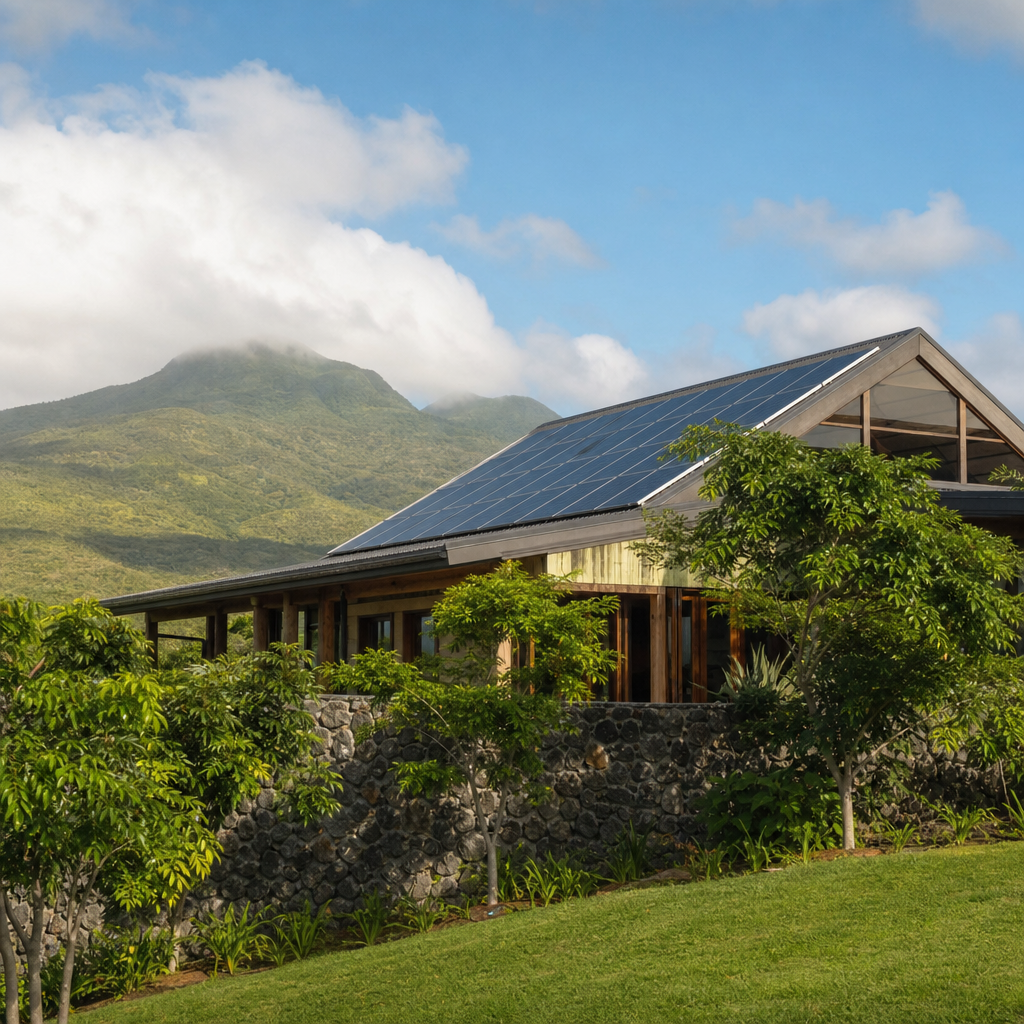
The most effective green buildings on Nevis typically combine passive design, efficient systems, and careful landscape planning. Passive measures come first: orientation to minimize direct solar gain, narrow floor plates for cross-ventilation, covered terraces, high ceilings, reflective roofing, and strategic shading through louvers or native trees. Mechanical systems then support, rather than replace, good design. High-efficiency mini-split air-conditioning, occupancy controls, LED lighting, Energy Star appliances, and solar water heating are common high-value upgrades for villas and hospitality properties.
Water systems are equally important. Because freshwater security is a constant concern on many Caribbean islands, green buildings often use rainwater harvesting cisterns, low-flow fixtures, drip irrigation, and drought-tolerant planting. On resort properties, submetering can identify leaks early, which is often one of the fastest ways to reduce operating costs. Wastewater management also deserves attention. Depending on site conditions and regulations, advanced septic solutions or treatment systems can reduce groundwater risk compared with poorly maintained conventional setups.
| Feature | Why it matters on Nevis | Typical application |
|---|---|---|
| Deep roof overhangs | Reduces heat gain and protects walls from rain | Villas, inns, restaurants |
| Cross-ventilation | Lowers cooling demand and improves comfort | Guest rooms, living spaces, lobbies |
| Solar water heating | Cuts electricity use in sunny conditions | Hotels, homes, spas |
| Rainwater harvesting | Improves water resilience and irrigation supply | Private residences, landscape systems |
| Native landscaping | Supports biodiversity and needs less irrigation | Resorts, public grounds, hillside sites |
| Impact-resistant envelope | Improves storm resilience and long-term durability | Island-wide new construction |
Material selection is another core feature, though it is often misunderstood. There is no single perfect green material. The right choice depends on durability, maintenance, shipping distance, salt exposure, and replacement cycle. In Nevis, long-lasting materials that resist corrosion, mold, and moisture damage can be more sustainable than fragile materials with a lower initial footprint but a shorter service life. Concrete, responsibly sourced timber, recycled-content finishes, and low-VOC coatings each have a role when matched correctly to the building type and microclimate.
Green buildings and sustainable tourism on the island
For Nevis, sustainable architecture supports sustainable tourism in direct, measurable ways. Hotels and villas consume large amounts of electricity for cooling, hot water, laundry, and lighting. They also influence land use patterns, shoreline health, and the visitor’s perception of the destination. A property that is designed for natural ventilation, efficient systems, and shaded outdoor living can lower utility costs while creating a more authentic island experience. Guests often prefer breezy open-air lounges, garden showers, and naturally lit spaces over sealed, over-conditioned environments that could be anywhere.
Green buildings also strengthen brand credibility. Travelers researching eco-conscious Caribbean stays increasingly look for visible proof: refillable water stations, renewable energy, reduced single-use plastics, edible gardens, composting programs, and architecture that visibly responds to place. The building becomes part of the sustainability story. A resort that restores wetlands, uses native planting to reduce irrigation, and integrates stormwater control into the landscape can communicate environmental care more convincingly than one relying only on towel-reuse signs.
There is an economic angle as well. Lower operating expenses can improve margins in a market exposed to imported energy prices. Better thermal performance can reduce wear on HVAC equipment. Thoughtful site planning can reduce flood damage and maintenance calls. These savings are not always immediate, and some strategies require higher upfront investment, but lifecycle value is usually the more accurate measure. Owners who calculate only first cost often miss the long-term benefit of resilient, efficient design.
Challenges and tradeoffs in Nevisian green design
Sustainable architecture on Nevis is not effortless, and honest discussion of tradeoffs is important. One challenge is supply chain complexity. Many specialized products must be imported, which can increase cost, delay schedules, and complicate maintenance if replacement parts are scarce. A system that looks impressive in a specification sheet may be the wrong choice if local technicians cannot service it reliably. I have seen projects perform best when they prioritize robust, understandable systems over overly complex installations.
Another challenge is balancing development pressure with ecological sensitivity. Coastal sites are valuable, but shoreline construction can affect dunes, runoff, habitat, and visual character if handled poorly. Hillside development can increase erosion and sediment movement, which then impacts nearshore marine environments. Sustainable architecture therefore has to work hand in hand with environmental planning, geotechnical assessment, drainage engineering, and landscape restoration. The building itself is only one piece of the sustainability equation.
Cost perception remains a barrier. Some owners still assume green building is automatically more expensive. In reality, the premium varies widely by strategy. Orientation, shading, window placement, ceiling height, and ventilation planning often add little when integrated early. Late-stage add-ons are what usually drive cost. There are also tradeoffs between openness and storm protection, between expansive glazing and solar heat gain, and between luxury expectations and resource use. Good design does not eliminate these tensions; it resolves them intelligently.
Practical pathways for developers, homeowners, and travelers
If you are developing or renovating on Nevis, the best starting point is a climate-first design brief. Ask how the building will stay cool, manage rain, resist salt, and remain usable during utility disruptions. Bring the architect, engineer, contractor, and landscape designer together early. Model sun paths, prevailing winds, and drainage. Evaluate solar hot water before defaulting to electric systems. Right-size air-conditioning after passive strategies are set, not before. For hospitality projects, operational teams should be included during design so sustainability features are practical to maintain.
Homeowners can make meaningful improvements without a full rebuild. Roof insulation, reflective finishes, shaded windows, efficient fans, leak detection, low-flow fixtures, and native planting are often high-return measures. Replacing old lighting with LEDs and upgrading to inverter air-conditioning can reduce energy use quickly. If budgets allow, adding cistern capacity or solar water heating can improve resilience and lower utility dependence. The key is sequencing improvements based on climate impact and payback, rather than chasing fashionable products.
Travelers also play a role in reinforcing better building practices. When choosing where to stay, look beyond vague eco-labels. Check whether a property describes concrete measures such as renewable energy, water conservation, local materials, habitat protection, and reduced chemical use in landscaping. Notice whether the design uses shade, breezeways, and natural light effectively. Support businesses whose architecture respects the island instead of overpowering it. Demand shapes supply, especially in a small destination where reputation matters.
Sustainable architecture in Nevis shows how green buildings can do more than reduce resource consumption. They can lower operating costs, improve comfort, strengthen climate resilience, protect sensitive landscapes, and deepen the visitor experience. The most successful projects are not defined by one technology or one style. They succeed because they respond carefully to sun, wind, water, materials, and local culture. In an island setting, that responsiveness is not optional. It is the foundation of durable, responsible development.
As a hub within sustainable tourism, this topic connects to energy systems, water management, biodiversity, heritage conservation, wellness design, and responsible hospitality operations. Each related subject deserves deeper exploration, but the central lesson is clear: better buildings support a better destination. When homes, villas, inns, and public spaces are designed for Nevis rather than imposed upon it, the island gains environmental protection, economic efficiency, and a stronger sense of place. That is the real value of sustainable architecture.
If you are planning travel, property investment, or a building project on Nevis, use green performance as a core decision criterion, not a secondary feature. Ask better questions, compare real design strategies, and prioritize projects that prove their environmental claims through architecture and operations. That is how sustainable tourism moves from slogan to standard, and how Nevis can keep building a future that remains both welcoming and resilient.
Frequently Asked Questions
What does sustainable architecture mean in the context of Nevis?
Sustainable architecture in Nevis refers to designing and building homes, villas, hotels, and commercial spaces in ways that respond intelligently to the island’s climate, natural resources, and environmental pressures. Rather than focusing only on style, it prioritizes lower energy use, reduced water waste, better indoor comfort, long-term durability, and less strain on the local ecosystem. In practical terms, that often means orienting buildings to catch prevailing breezes, using shading devices to limit solar heat gain, selecting materials that hold up well in a coastal climate, and incorporating systems that reduce dependence on imported energy and water-intensive operations.
On an island like Nevis, sustainable design is especially important because buildings must perform well under heat, humidity, salt air, and storm conditions. A structure that is poorly ventilated or overexposed to the sun can become expensive to cool and uncomfortable to occupy. By contrast, a thoughtfully designed green building can stay cooler naturally, require less mechanical air conditioning, and remain more resilient over time. Sustainable architecture in Nevis is therefore not just an environmental ideal; it is a practical, climate-aware approach that supports lower operating costs, better guest and resident experiences, and stronger long-term property value.
How do green buildings in Nevis reduce energy use and improve comfort?
Green buildings in Nevis reduce energy use first by working with the climate instead of fighting it. One of the most effective strategies is passive cooling, which includes cross-ventilation, higher ceilings, operable windows, shaded verandas, roof overhangs, and building orientation that captures trade winds while minimizing direct heat from the sun. These design choices can significantly reduce indoor temperatures and make spaces feel more comfortable without relying constantly on air conditioning. When cooling loads drop, energy bills often fall as well, which is especially valuable in places where electricity costs can be high.
Energy efficiency also improves through the use of high-performance building envelopes and equipment. This may include insulated roofing, reflective roof finishes, energy-efficient lighting, ceiling fans, efficient appliances, and well-chosen glazing that limits heat gain while still allowing daylight into the interior. Some buildings also integrate solar power, solar water heating, or battery-supported systems to reduce dependence on conventional energy sources. The result is not just lower consumption, but a more stable and pleasant interior environment. Occupants benefit from cooler rooms, better airflow, less glare, and a stronger connection to the outdoors, all of which enhance comfort in ways that purely mechanical systems often cannot match on their own.
Why are water systems such an important part of sustainable architecture on Nevis?
Water management is a major part of sustainable architecture in Nevis because island environments must treat freshwater as a valuable and limited resource. Green building design often includes rainwater harvesting, water-efficient fixtures, low-flow toilets and faucets, drought-tolerant landscaping, and drainage systems that reduce runoff and erosion. By collecting and reusing water where appropriate, properties can reduce demand on centralized supplies and become better prepared for dry periods or service disruptions. This is especially useful for larger residences, hospitality properties, and developments with significant outdoor maintenance needs.
Good water design also helps protect the surrounding environment. Poor site drainage can contribute to soil loss, flooding, and damage to nearby coastal or natural areas. Sustainable architecture addresses this by planning grading carefully, using permeable surfaces when possible, and directing water in ways that support the site rather than overwhelm it. In addition, efficient irrigation and native planting choices reduce unnecessary consumption while keeping landscapes healthy. In short, water-smart design in Nevis is both an economic and environmental strategy: it lowers utility pressure, supports resilience, and helps preserve the island’s natural resources for residents, businesses, and visitors alike.
What building materials and construction methods are considered sustainable in Nevis?
Sustainable materials in Nevis are generally those that are durable, appropriate for the tropical marine environment, and sourced or manufactured in ways that reduce environmental impact. The best choice is not always the most visibly “green” material, but the one that performs reliably over time with minimal maintenance and replacement. In coastal settings, this often means selecting materials that resist moisture, salt exposure, corrosion, mold, pests, and storm-related wear. Locally available or regionally sourced materials can also help reduce transportation impacts, while responsibly harvested timber, recycled-content products, low-VOC finishes, and long-lasting exterior materials may all play a role depending on the project.
Construction methods matter just as much as material selection. Sustainable buildings in Nevis are typically detailed for resilience, with attention to strong connections, roof security, drainage, ventilation cavities, and weather protection. Storm-resilient construction is a key part of sustainability because a building that survives extreme weather with less damage avoids the environmental and financial costs of major repairs or reconstruction. Careful craftsmanship, proper sealing, good insulation in the right areas, and moisture-aware design all contribute to a structure that lasts longer and performs better. Ultimately, sustainable construction on Nevis is about building for the real conditions of the island so that the property remains safe, efficient, and valuable over the long term.
How does sustainable architecture benefit homeowners, developers, and the tourism sector in Nevis?
Sustainable architecture offers meaningful advantages across the board. For homeowners, it can lower utility bills, improve day-to-day comfort, reduce maintenance needs, and create healthier indoor spaces through better airflow, natural light, and more thoughtful material choices. For developers, green design can make a project more attractive in the market by aligning with growing demand for efficient, resilient, and environmentally responsible properties. Durable construction and lower operating costs also support stronger lifecycle value, which is particularly important for investment properties and second homes where long-term performance matters as much as initial appearance.
For the tourism sector, the benefits are especially significant. Nevis depends heavily on its reputation as a beautiful, high-quality destination, and sustainable architecture helps protect the natural setting that draws visitors in the first place. Eco-conscious travelers increasingly pay attention to how resorts, villas, and hospitality spaces manage energy, water, waste, and environmental impact. Properties that deliver comfort while demonstrating responsible design often stand out in a competitive market. Features such as shaded outdoor living areas, naturally cooled interiors, water-saving systems, and well-integrated landscaping can enhance the guest experience while lowering operational costs. In that sense, sustainable architecture supports both environmental stewardship and business performance, making it a smart strategy for the island’s future.