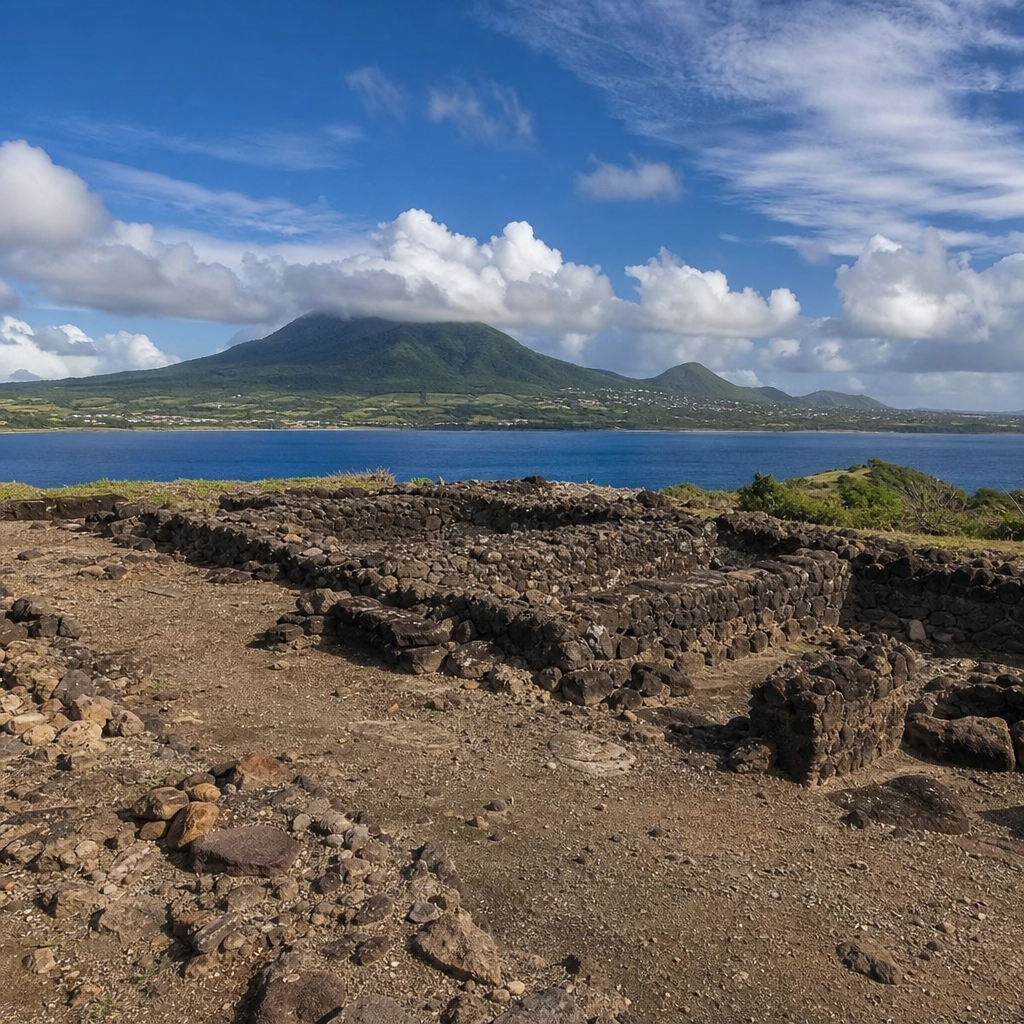
Saint Kitts holds one of the most layered archaeological records in the eastern Caribbean, where Indigenous settlement, European colonization, plantation expansion, warfare, religion, and everyday survival are preserved in landscapes that still shape the island today. Archaeology in Saint Kitts is the study of those material traces: ceramics buried under house floors, stone tools near ancient villages, sugar works on wind-swept hills, fortification walls above Basseterre, burial grounds hidden beneath modern roads, and shipwreck evidence resting offshore. These finds matter because they reveal a fuller history than official colonial documents alone. Written records in the Caribbean often privilege governors, planters, and military officers. Excavation adds missing voices by showing how Kalinago and earlier Indigenous communities lived, how enslaved Africans adapted and resisted, how poor Europeans and free people of color occupied space, and how trade linked this small island to wider Atlantic systems.
From my work reviewing Caribbean heritage reports and site surveys, one pattern appears again and again: the most important archaeological evidence in Saint Kitts is not confined to a single famous ruin. It is dispersed across villages, estates, churches, cemeteries, forts, coastal margins, and agricultural land. A roadside cut may expose Amerindian pottery. A hotel project may uncover a plantation yard. Erosion can reveal human burials on a beach. Because the island is small, development pressure and heritage preservation are always in tension, making careful documentation essential. For travelers, students, and researchers, this means Saint Kitts is best understood as an island-wide archive rather than a museum of isolated monuments.
The phrase archaeological secrets is not a promise of treasure hunting. It refers to hidden patterns that specialists reconstruct from artifacts, soil layers, architecture, faunal remains, pollen, and spatial analysis. In Saint Kitts, those patterns answer practical questions. Who first settled the island, and when? How did communities use marine and inland resources? What happened when French and English colonists divided and contested the island in the seventeenth century? How did sugar production reorder land, labor, and ecology? What survives from enslaved households beyond plantation account books? Why do fortifications stand where they do? This hub article addresses those questions comprehensively and points readers toward the major themes that define the island’s material past.
Understanding Saint Kitts archaeology also matters for cultural identity and sustainable tourism. Heritage interpretation at Brimstone Hill Fortress National Park, former estates, and historic churches can be much richer when grounded in excavation and survey rather than legend alone. Archaeological findings support conservation planning, school curricula, museum exhibits, and community memory. They also help explain why the modern island looks the way it does, from road alignments and settlement clusters to stone retaining walls and former cane landscapes. For anyone exploring the Culture and History section, this page serves as the central guide to the island’s miscellaneous archaeological story, connecting Indigenous heritage, colonial conflict, plantation life, sacred spaces, maritime remains, and the urgent challenge of protecting vulnerable sites before they disappear.
Indigenous settlement before colonization
The earliest archaeological story of Saint Kitts begins long before European arrival. Like other islands in the Lesser Antilles, Saint Kitts was settled by Indigenous peoples moving through maritime networks that connected the Orinoco region, neighboring islands, and coastal South America. Archaeologists usually identify these communities through ceramic styles, lithic tools, shell artifacts, food remains, and village layouts. On Saint Kitts, precolonial sites often appear on coastal terraces and near access to freshwater, fishing grounds, and cultivable land. Excavated material from the island and nearby islands shows a mixed economy based on horticulture, fishing, shellfish collection, and inter-island exchange.
Key evidence includes pottery fragments that can be linked to broader Saladoid and later ceramic traditions in the Caribbean. These ceramic sequences matter because they help date occupation and track cultural change over time. A decorated rim or griddle fragment can say a great deal about cooking practices, trade, and household activity. Stone celts, shell tools, and modified coral pieces provide further evidence of domestic production. Zooarchaeological analysis of fish bone, shell, and animal remains helps reconstruct diet and seasonality. In practical terms, archaeology shows that Indigenous communities on Saint Kitts were not isolated or primitive. They were highly skilled seafarers and land managers operating within a regional world.
Colonial contact, conflict, and early settlement landscapes
Saint Kitts became one of the earliest and most consequential English and French colonial footholds in the Caribbean during the seventeenth century. That makes its archaeological landscape especially valuable. The island was not simply occupied; it was partitioned, fortified, cultivated, raided, and repeatedly reshaped by imperial rivalry. Material evidence of this period includes fort remains, defensive earthworks, early road traces, domestic foundations, imported ceramics, gunflints, bottle glass, clay tobacco pipes, and religious structures. Together these remains document how precarious early colonization actually was.
One of the central historical episodes is the violent displacement and killing of Indigenous people in the early colonial period, often associated with narratives surrounding Bloody Point and Bloody River. Archaeology cannot resolve every detail of later legend, but it can test claims against landscape evidence, settlement distribution, and comparative records. This is one reason archaeological method matters so much: it separates memory, myth, and propaganda from verifiable material patterns. On Saint Kitts, early colonial sites often reveal close entanglements among military needs, agricultural experimentation, and transatlantic supply shortages. Imported wares from England, France, the Netherlands, and Iberian networks appear alongside locally adapted building techniques, showing that settlers depended on global trade while improvising with island resources.
Churchyards and early burial grounds are another vital source. Human remains, when studied under strict ethical protocols, can reveal disease burden, nutrition, trauma, and migration through isotopic analysis. In Caribbean contexts, these studies often show how war, labor, and food insecurity affected different social groups unequally. Saint Kitts is no exception. Even where excavation is limited, burial sites contribute evidence that written archives rarely provide.
Plantation archaeology and the material record of sugar
No archaeological overview of Saint Kitts is complete without sugar. From the seventeenth century onward, sugar plantations transformed the island’s economy, ecology, and demography. Archaeologically, plantations are not just great houses and scenic stone windmills. They are integrated industrial landscapes composed of cane fields, boiling houses, curing houses, mills, water systems, slave villages, boundaries, paths, provision grounds, trash deposits, and burial areas. When I evaluate Caribbean plantation sites, the biggest misconception I encounter is the idea that ruins tell only a story of elite architecture. In reality, the most important evidence usually comes from work yards and domestic refuse, where daily life is preserved in broken ceramics, food waste, nails, buttons, beads, pipes, and locally repaired objects.
On Saint Kitts, surviving estate ruins across the countryside help archaeologists map how sugar production expanded into nearly every suitable district. Wind-powered mills on ridges, stone aqueduct traces, and factory remains show how planters adapted technology to topography. The shift from smaller early estates to more capital-intensive plantation systems can often be read in masonry quality, equipment scale, and imported industrial components. Artifacts such as creamware, pearlware, transfer-printed ceramics, olive jar fragments, and bottle seals help date occupation phases and indicate changing consumer access.
| Site type | Typical finds | What archaeologists learn |
|---|---|---|
| Indigenous village | Pottery, shell tools, fish bone, hearths | Diet, trade links, settlement timing, household life |
| Fortification | Gunflints, shot, masonry, ceramics | Military strategy, supply networks, conflict phases |
| Plantation works | Mill parts, boiling house remains, drains | Sugar technology, labor organization, industrial change |
| Enslaved village | Coarse earthenware, beads, pipes, faunal remains | Daily life, foodways, cultural retention, resistance |
| Churchyard or cemetery | Graves, coffin hardware, markers | Health, mortality, kinship, social inequality |
| Maritime site | Anchors, ballast, hull fragments, cargo remains | Trade, warfare, storms, coastal use |
Plantation archaeology also exposes the lived experience of enslaved Africans and their descendants, whose labor made the island’s wealth possible. House platforms, postholes, yard surfaces, cooking wares, and faunal assemblages reveal how communities built homes, prepared food, raised small stock, and maintained social ties under coercive conditions. Across the Caribbean, archaeologists have documented evidence of Afro-Caribbean foodways, medicinal practices, spiritual expression, and informal exchange through patterned deposits and curated objects. Saint Kitts sites fit within that broader scholarship and are essential for understanding the island beyond planter narratives. This material record does not romanticize plantation life; it documents adaptation, deprivation, creativity, and resistance with unusual precision.
Brimstone Hill, military archaeology, and strategic geography
Brimstone Hill Fortress National Park is the best-known historic site on Saint Kitts, and its significance is archaeological as well as architectural. Built and expanded mainly in the eighteenth century, the fortress embodies the strategic logic of Caribbean warfare. Its elevated position offered commanding views of sea approaches and inland movement, while its design reflected contemporary British military engineering adapted to rugged volcanic terrain. Masonry analysis, construction sequencing, artifact scatters, drainage systems, and associated encampment areas all contribute to understanding how the fortress functioned as a working military complex rather than a static monument.
Military archaeology at Brimstone Hill and related sites asks practical questions. Where were troops quartered? How were cannon supplied? Which walls were rebuilt after attack or storm damage? What can ammunition types and uniform fragments reveal about occupation phases? Comparative study with forts in Antigua, Barbados, and Jamaica shows that Saint Kitts occupied a crucial place in imperial defense planning, especially during periods of Anglo-French rivalry. The fortress is also tied to the labor history of the island, since enslaved and forced labor contributed substantially to construction and maintenance. Reading the site solely as a masterpiece of engineering misses that human cost.
Beyond Brimstone Hill, batteries, lookout points, and smaller defensive works around the coast reflect layered responses to privateering, invasion threats, and inter-island warfare. These lesser-known sites are often vulnerable because they are overgrown, undocumented, or caught in development zones. Yet they are exactly the kinds of places that can change historical interpretation when surveyed systematically.
Sacred spaces, towns, and underwater heritage
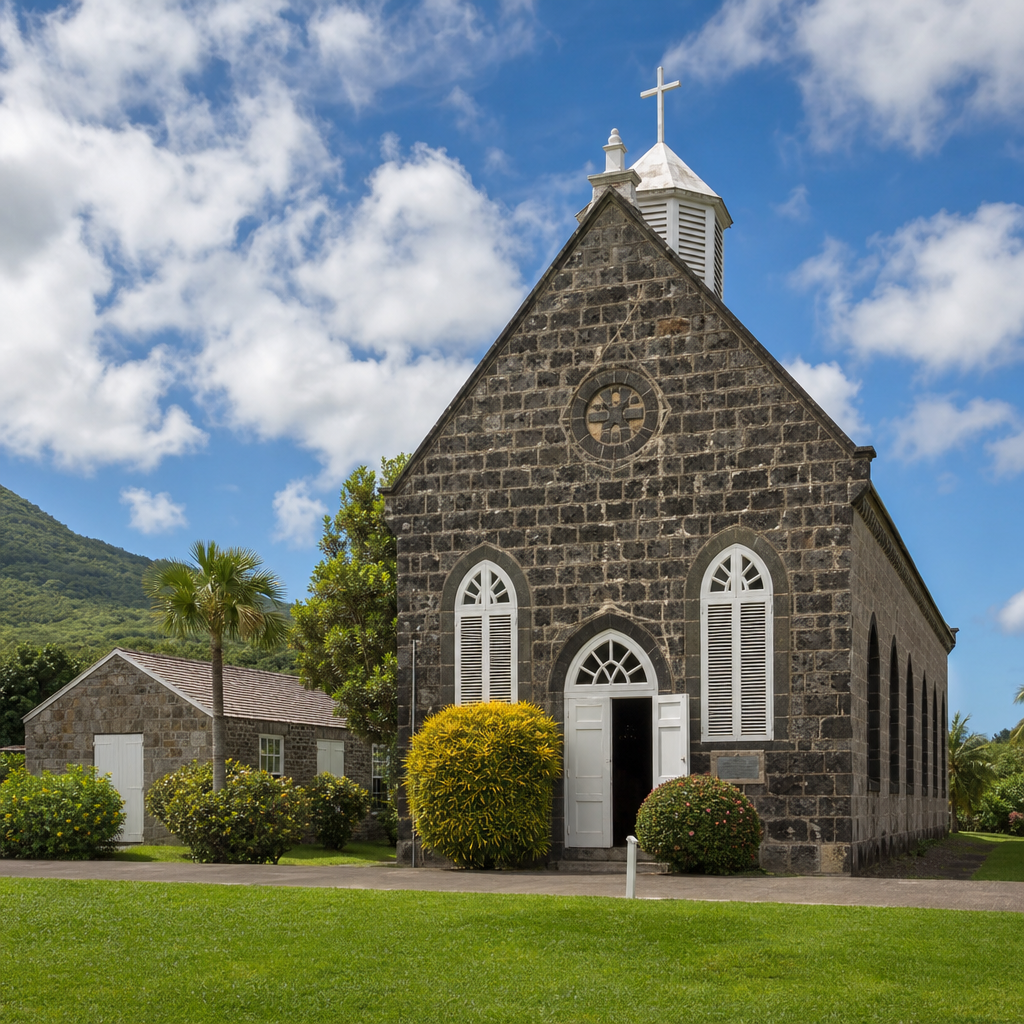
Archaeological secrets in Saint Kitts are not limited to rural ruins. Basseterre and other settled areas contain deeply stratified urban and religious landscapes. Historic churches, mission sites, cemeteries, market zones, drainage systems, and domestic lots can preserve evidence of rebuilding after fires, hurricanes, earthquakes, and military attacks. Urban archaeology often reveals continuity beneath visible change. A modern street grid may overlie earlier property boundaries; a standing church may incorporate reused masonry from an older structure. These details matter because they show how communities rebuilt after catastrophe and how public space reflected class, race, and authority.
Sacred spaces deserve special attention. Churchyards and burial grounds are often among the most sensitive and informative archaeological contexts on Caribbean islands. Gravestones provide names and dates, but excavation and survey can add data about unmarked graves, burial density, coffin construction, disease episodes, and social segregation. In Saint Kitts, where colonial society was sharply hierarchical, cemetery layout can speak volumes about status and exclusion. Ethical practice is essential here. Modern archaeology prioritizes consultation, minimal disturbance, legal compliance, and respectful interpretation, especially when descendant communities are involved.
Underwater archaeology adds another layer. Saint Kitts sat on trade and military routes, so its coastal waters may hold anchors, ballast piles, wreck scatters, harbor debris, and storm-displaced cargo. Even when no spectacular shipwreck is visible to divers, submerged cultural material can document anchorage patterns, shoreline change, and harbor use. Marine surveys using sonar, magnetometers, and diver inspection have transformed Caribbean archaeology over the last two decades, and Saint Kitts stands to benefit from more systematic offshore work. Coastal erosion and stronger storms make that work increasingly urgent.
Preservation challenges and why this hub matters
The greatest threat to Saint Kitts archaeology is not lack of historical importance but loss through neglect, construction, looting, vegetation, and climate pressure. Heritage management on small islands is difficult. Tourism development can fund conservation, yet it can also destroy sites if impact assessments are weak or rushed. Agriculture, road building, utility trenches, and coastal erosion regularly expose artifacts without ensuring proper recording. Hurricanes and heavy rainfall accelerate slope failure and masonry collapse. Salt exposure damages coastal fortifications. Rising sea levels place shoreline sites at direct risk.
This is why a hub article on miscellaneous archaeology matters within a wider Culture and History resource. Readers rarely begin with a technical excavation report. They begin with broad questions: What are the most important archaeological sites in Saint Kitts? Are there Indigenous sites worth knowing about? How does plantation archaeology work? What does Brimstone Hill tell us beyond military history? Where can urban or underwater heritage still be found? A strong hub answers those questions clearly while directing deeper exploration into focused articles on Indigenous heritage, sugar estates, forts, churches, cemeteries, museums, and conservation policy. That internal structure helps readers build understanding step by step, and it mirrors how archaeologists actually interpret the island: as a connected system of landscapes rather than isolated ruins.
Saint Kitts rewards anyone willing to look beneath the postcard surface. Its archaeological record shows an island shaped by migration, exchange, violence, industry, belief, and resilience across many centuries. The key takeaway is simple: every category of site, from Indigenous village scatters to plantation yards and coastal batteries, adds evidence that written history alone cannot supply. If you want to understand Saint Kitts more deeply, use this hub as your starting point and continue into the related Culture and History articles that explore each site type, period, and preservation challenge in detail.
Frequently Asked Questions
1. What makes Saint Kitts so important archaeologically in the eastern Caribbean?
Saint Kitts is archaeologically important because it preserves an unusually layered record of Caribbean history in one relatively compact island landscape. Long before European arrival, Indigenous communities lived, traveled, traded, and adapted to the island’s coastal and inland environments, leaving behind ceramics, shell deposits, stone tools, food remains, and settlement traces that help researchers reconstruct daily life over long periods of time. Those early occupations are not isolated episodes; they form the foundation of a much longer human story that continues into the colonial era and beyond.
What makes the island especially compelling is how many major historical processes overlap in the same places. Archaeologists can study Indigenous village sites, then examine nearby landscapes transformed by European colonization, plantation agriculture, military conflict, missionary activity, and expanding settlements. Sugar estates, windmills, boiling houses, roads, churches, cemeteries, fortifications, and domestic spaces all contribute to a material record that reflects both power and resistance. In Saint Kitts, archaeology is not simply about finding old objects; it is about tracing how people shaped and were shaped by conquest, labor systems, religion, trade, and survival.
The island also played a significant role in early European competition in the Caribbean, particularly between the English and French. That rivalry left behind fortified landscapes and settlement patterns that can still be read in the terrain today. Because so much of Saint Kitts’ history involved conflict, migration, forced labor, and environmental transformation, the archaeological record captures not only official colonial ambitions but also the lived experiences of ordinary people, including enslaved Africans, free laborers, and local communities who often appear only faintly in written archives. That ability to compare material evidence with incomplete historical documents is one reason Saint Kitts remains such a rich and revealing archaeological setting.
2. What kinds of archaeological sites and artifacts have been found in Saint Kitts?
The range of archaeological sites in Saint Kitts is remarkably broad, which is one reason the island offers such a vivid window into the past. Indigenous sites may include village locations, activity areas, shell middens, pottery scatters, burials, and tool-making evidence. Archaeologists often recover ceramic fragments, stone tools, shell artifacts, food remains, and posthole patterns that indicate where structures once stood. Even small fragments can be highly informative, revealing what people ate, how they cooked, what materials they traded, and how communities organized their domestic spaces.
Colonial-era archaeology adds another major layer. Across the island, researchers investigate plantation landscapes that include sugar mills, boiling houses, curing houses, estate yards, drainage systems, retaining walls, worker settlements, and great house areas. These sites can yield bottle glass, metal tools, ceramics, clay tobacco pipes, architectural materials, animal bones, and personal items such as buttons, beads, buckles, and tablewares. Together, these finds help archaeologists reconstruct social hierarchies, consumption patterns, labor organization, and daily routines under plantation rule.
Military and religious sites are also central to Saint Kitts’ archaeological story. Fortification walls, batteries, and strategic hilltop defenses speak to the island’s role in imperial rivalry, while churches, mission grounds, and burial sites provide evidence for changing beliefs, identities, and community formation. In urban and semi-urban areas, archaeologists may also encounter house foundations, trash deposits, road surfaces, drains, and market-related materials that reveal how ordinary residents lived and moved through colonial and postcolonial environments. The key point is that archaeology in Saint Kitts is not limited to spectacular ruins. A broken ceramic sherd beneath a floor, a buried wall line, or a cluster of food refuse can be just as important as a standing monument because each contributes to a fuller picture of island life over time.
3. How does archaeology help us understand everyday life in Saint Kitts, not just major historical events?
One of archaeology’s greatest strengths is its ability to illuminate the experiences of people who are underrepresented, misrepresented, or entirely absent from written records. In Saint Kitts, documents often emphasize governors, military officers, landowners, and official institutions, but archaeology allows researchers to investigate the material realities of ordinary life. The placement of houses, the kinds of cooking vessels people used, the food animals they consumed, the imported and locally made goods they accessed, and the way they organized work and domestic tasks all leave traces in the ground.
This is especially important for understanding enslaved and laboring populations on the island. Plantation records may note output, ownership, or punishment, but they rarely capture the full human complexity of everyday existence. Archaeological evidence from worker villages, yard spaces, kitchens, refuse deposits, and burial grounds can reveal patterns of resilience, adaptation, family life, health, belief, and cultural continuity. For example, ceramics and food remains may suggest how people combined imposed colonial systems with retained or adapted traditions in cooking and household organization. Personal artifacts may point to self-expression, exchange, and identity even in heavily controlled settings.
Archaeology also helps researchers understand the practical realities of survival. Water access, building materials, landscape modification, erosion control, and proximity to fields or roads all matter when reconstructing how people lived. In Saint Kitts, where climate, topography, and plantation expansion all shaped human choices, these details are crucial. Everyday archaeology makes the island’s past more human. It moves beyond dates and battles to show how communities created homes, managed hardship, built relationships, and navigated dramatic social change across centuries.
4. What challenges do archaeologists face when studying Saint Kitts today?
Archaeologists working in Saint Kitts face a combination of environmental, logistical, and historical challenges. One major issue is that many sites are fragile and have been altered over time by agriculture, road construction, urban growth, erosion, hurricanes, vegetation, and redevelopment. Plantation landscapes, for instance, may still be visible in part, but subsurface deposits can be disturbed or fragmented. Coastal Indigenous sites can be especially vulnerable to shoreline change, storm activity, and sea-level impacts, which means valuable evidence may be damaged or lost before it is fully documented.
Another challenge is that archaeology often requires careful interpretation of incomplete evidence. Not every site is well preserved, and not every artifact can be confidently tied to a single date or community without detailed analysis. In Saint Kitts, as elsewhere in the Caribbean, researchers must combine excavation data with oral history, maps, colonial documents, environmental studies, and regional comparisons to build reliable interpretations. That process takes time, technical expertise, and ongoing collaboration. It also requires sensitivity, particularly when investigating burial grounds, sacred spaces, or places connected to slavery and displacement.
There are also practical concerns involving funding, site management, heritage protection, and public awareness. Archaeological work depends on permits, trained specialists, conservation planning, and support from institutions and local stakeholders. Some important places may sit on private land or in active development zones, making access and preservation more complicated. Even when sites are identified, protecting them for future study is not always simple. That is why public education and heritage stewardship are so important. The more people recognize that Saint Kitts’ landscapes contain irreplaceable historical evidence, the better the chances of preserving that record before it disappears.
5. Why does the archaeology of Saint Kitts still matter today?
The archaeology of Saint Kitts matters today because it helps explain how the modern island was made. Its landscapes were shaped by Indigenous settlement, colonial competition, plantation economies, forced labor, religious change, and local adaptation, and those processes still influence land use, memory, identity, and heritage tourism in the present. Archaeology gives people a way to connect those visible and invisible layers, showing that the island’s hills, coasts, ruins, and towns are not just scenic settings but archives of human experience.
It also matters because archaeology can correct and deepen historical understanding. Written narratives of Caribbean history have often centered elite viewpoints or simplified the past into a few familiar themes. Material evidence from Saint Kitts complicates that picture. It reveals continuity as well as disruption, agency as well as oppression, and ordinary life alongside major events. By studying artifacts, buildings, and buried landscapes, archaeologists can recover stories that would otherwise remain hidden, including those of Indigenous communities, enslaved Africans, and working people whose contributions were essential to the island’s history.
Finally, archaeology matters because heritage has real cultural and educational value. For residents, it can strengthen connections to place and encourage informed preservation of important sites. For students and researchers, Saint Kitts offers a powerful case study in Caribbean history, colonialism, and resilience. For visitors, archaeology adds depth and meaning to landmarks that might otherwise be seen only as ruins or tourist attractions. In that sense, uncovering the archaeological secrets of Saint Kitts is not just about the past. It is about understanding how history lives on in the island’s landscape and why protecting that evidence remains important for future generations.