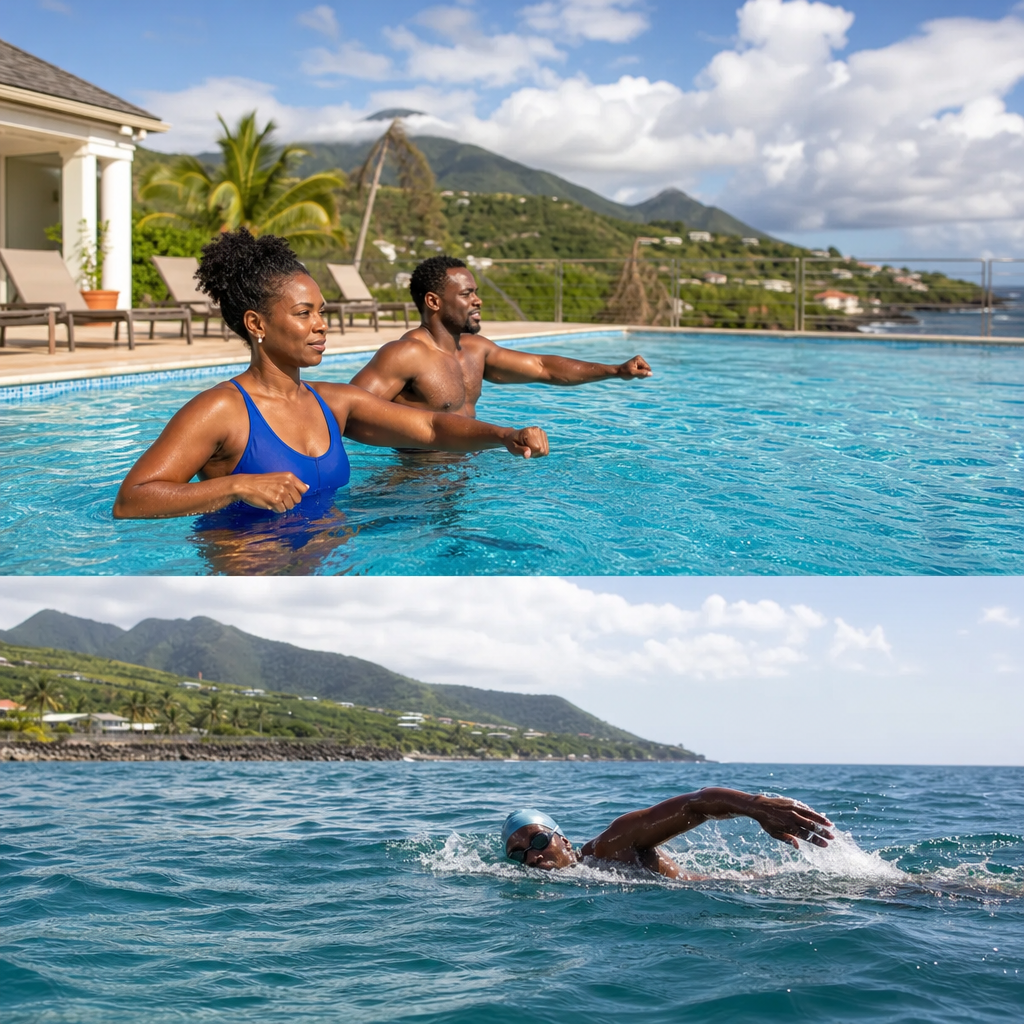
Aquatic fitness in Saint Kitts combines structured pool workouts, open-water ocean swimming, and a coastal lifestyle that makes exercise feel both practical and enjoyable. In simple terms, aquatic fitness means any training performed in water to improve cardiovascular endurance, muscular strength, mobility, balance, or recovery. In Saint Kitts, that can include lap swimming in a hotel or community pool, aqua aerobics, deep-water running, resistance drills with foam equipment, beach-entry interval sessions, and longer ocean swims along calmer bays. I have worked with swimmers, visitors, and wellness clients in Caribbean settings, and the pattern is consistent: people sustain water-based exercise longer because heat stress feels lower, joints tolerate movement better, and the environment itself increases motivation.
This matters because Saint Kitts offers conditions many places cannot match. Warm temperatures support year-round training. Coastal access gives residents and travelers more than one aquatic option. Water exercise also serves a broad population, from older adults managing knee pain to competitive triathletes building aerobic capacity without excessive impact. The buoyancy of water reduces ground reaction force, while hydrostatic pressure can assist venous return and influence perceived recovery. At the same time, the ocean adds variables pool users do not face, including currents, visibility, swell, marine life, and saltwater buoyancy. Understanding those differences is essential for building a safe, effective routine.
As a hub page for this area of health and wellness, this guide covers the miscellaneous but important questions people ask most often: what pool workouts work best, how ocean swimming differs, what equipment helps, how beginners should start, what safety standards matter, and how to choose the right training style for weight management, rehabilitation, endurance, or stress relief. The goal is straightforward: help you use Saint Kitts’s pools and coastline intelligently so aquatic exercise becomes a sustainable part of your fitness plan rather than a one-time vacation activity.
Why aquatic fitness works so well in Saint Kitts
Water changes how the body works during exercise. Because buoyancy supports body weight, movements such as jogging, kicking, squatting, and arm drives place less compressive load on the hips, knees, ankles, and lumbar spine than the same actions on land. That is why pool workouts are commonly used in rehabilitation and active recovery. The resistance of water also acts in every direction, so simple motions become strength and stability exercises without requiring heavy external load. In practice, even a basic knee lift or flutter kick can elevate heart rate and challenge the trunk when performed with good form.
Saint Kitts is especially suitable for aquatic training because environmental access lowers the friction that usually disrupts exercise habits. Instead of relying on a single indoor facility, people can rotate among resort pools, private pools, community settings, and protected coastal swim areas depending on their goal. A beginner may prefer chest-deep water and instructor-led classes. An experienced swimmer may use a pool for pacing and technique work, then shift to ocean swimming to build sighting skill and confidence in open water. That mix creates adherence, and adherence is the foundation of long-term results.
There is also a climate advantage. In tropical conditions, many land workouts are limited by heat buildup. Water helps dissipate heat more efficiently, which often lowers perceived exertion at a given workload. That does not mean aquatic exercise is easy; hard interval sets in water are physiologically demanding. It means many people can train consistently with less discomfort. For those dealing with arthritis, excess body weight, post-injury deconditioning, or reduced exercise tolerance, that consistency is often the difference between starting a program and quitting it.
Pool workouts: the most controlled way to build fitness
Pool workouts are the most controlled form of aquatic fitness in Saint Kitts because depth, distance, temperature, and entry points are predictable. That predictability matters for progression. In a pool, you can measure laps, repeat timed intervals, monitor rest periods, and focus on technique without worrying about currents or navigation. For beginners, this is usually the best place to build a foundation. For experienced exercisers, pools are ideal for speed work, form correction, and low-impact conditioning during high-volume training weeks.
A practical pool fitness program usually includes three categories of work. First is aerobic conditioning: continuous swimming, aqua jogging, or water walking for ten to forty minutes at a steady pace. Second is interval training: shorter efforts such as 25-meter or 50-meter repeats with controlled recovery, or one-minute high-effort water running bouts followed by easier movement. Third is resistance and mobility work: leg swings, tuck jumps, suspended bicycle movements, sculling drills, and upper-body pushes with paddles or foam dumbbells. Because water resistance increases with movement speed, intensity can be raised simply by moving faster with sound technique.
For general fitness, one session might begin with five minutes of easy water walking and shoulder mobility, followed by eight rounds of one minute hard and one minute easy in deep-water running, then two sets of ten squats, ten knee drives per side, and thirty seconds of plank stabilization against the pool wall. Someone focused on lap swimming could complete a warm-up, six 50-meter repeats at moderate effort, four technique drills emphasizing catch and body position, and a relaxed cooldown. The best pool workout is not the fanciest one. It is the one matched to skill level, repeated consistently, and adjusted when adaptation occurs.
Ocean swimming in Saint Kitts: benefits, demands, and local realities
Ocean swimming adds freedom and challenge that a pool cannot replicate. In Saint Kitts, calmer coastal areas can provide a beautiful training environment with natural cooling, variable scenery, and an immediate mental-health benefit many swimmers describe as meditative. Saltwater also increases buoyancy, which some swimmers find reassuring. For endurance development, ocean swimming teaches rhythm, breathing control, and sustained effort without the constant interruption of walls and turns. It can be excellent preparation for triathlons, charity swims, and general confidence in open water.
But ocean swimming is not just pool swimming without lane lines. The energy cost changes because swimmers must sight regularly, adapt to chop, and maintain direction despite waves or current. Even modest surface movement can disrupt stroke timing and breathing patterns. I have seen capable pool swimmers fatigue quickly in open water simply because they lifted their head too high to sight, lost body position, and spiked effort. Ocean training also requires attention to weather, seabed conditions, boat traffic, and entry-exit safety. A bay that looks calm from shore can still have lateral current or reduced visibility beyond the first few hundred meters.
In Saint Kitts, the best practice is to treat ocean sessions as planned workouts rather than spontaneous dips. Choose sheltered locations, swim with a partner or group, use a bright tow float for visibility, and tell someone your route and expected finish time. If you are new to open water, start with short parallel-to-shore swims where you remain close enough to exit easily. Build familiarity with saltwater breathing, sighting every six to ten strokes, and maintaining relaxed effort. Confidence in the ocean comes from repetition and judgment, not bravado.
Comparing pool workouts and ocean swimming
Both training environments are valuable, but they serve different purposes. Pools are better for measurable progression, precise intervals, beginner instruction, and rehabilitation. Ocean swimming is better for environmental variety, real-world endurance, and open-water competence. Most people in Saint Kitts do best with a hybrid approach: pool sessions for structure, ocean sessions for adaptation and enjoyment.
| Factor | Pool Workouts | Ocean Swimming |
|---|---|---|
| Safety control | High; fixed depth, clear boundaries, easier supervision | Lower; currents, swell, marine traffic, changing visibility |
| Best for beginners | Yes; easier skill building and pacing | Only with guidance and sheltered conditions |
| Technique practice | Excellent for drills and stroke correction | Useful for sighting, breathing under variable conditions |
| Fitness tracking | Precise lap counts and timed intervals | Less precise unless using GPS devices |
| Joint-friendly exercise | Excellent | Excellent, though entries and exits may add strain |
| Mental refreshment | Good | Outstanding for many swimmers due to scenery and immersion |
The table highlights a simple principle: choose the environment based on the outcome you want. If you need consistency and skill acquisition, start in the pool. If you already have water competence and want challenge, extend your training into the ocean. Neither option is universally better. The right choice depends on experience, goals, and conditions on the day.
Who benefits most from aquatic exercise
Aquatic exercise serves more populations than most people realize. Older adults often benefit because water reduces impact while allowing meaningful cardiovascular work and balance practice. People with osteoarthritis can move through a larger pain-free range in water than on land. Those carrying significant body weight frequently tolerate pool exercise better than walking or jogging, which can make aquatic training a gateway into broader lifestyle change. Pregnant women may find water exercise relieves swelling and improves comfort, although medical clearance is important for individualized guidance.
Athletes also use aquatic fitness strategically. Runners can maintain aerobic capacity with deep-water running during injury recovery. Team-sport athletes use pool circuits for conditioning without the cumulative pounding of sprints. Swimmers and triathletes naturally depend on water sessions, but even strength athletes can benefit from pool mobility and recovery work between heavy training days. In practice, I often recommend aquatic sessions to clients who have the motivation to train but not the orthopedic tolerance for more land-based volume.
Mental wellness is another important benefit. Repetitive lap swimming, rhythmic breathing, and the sensory environment of the sea can reduce stress and support emotional regulation. While aquatic fitness is not a substitute for mental-health treatment, it is a powerful supportive habit. In Saint Kitts, where natural coastal settings are part of daily life, ocean swimming and pool exercise can become realistic, repeatable routines rather than occasional luxury experiences.
Safety, equipment, and smart programming
Safe aquatic fitness starts with honest self-assessment. If you cannot tread water comfortably, control breathing under mild stress, or swim continuously for several minutes, begin with pool-based instruction before attempting ocean distances. Lifeguard presence, buddy systems, and weather awareness matter. For ocean sessions, check wind, swell, tide patterns, and marine traffic. Avoid swimming alone at dawn, dusk, or after alcohol use. If jellyfish activity, rough surf, or thunderstorms are possible, reschedule. Good judgment is part of training, not an optional extra.
Equipment should match the session. In pools, common tools include kickboards, pull buoys, fins, foam dumbbells, aqua belts, paddles, and pace clocks. For ocean swimming, the essentials are usually goggles suited to bright light, a visible swim cap, and a tow float. Some swimmers also use GPS watches for distance and route data, though battery life and signal accuracy can vary. Sunscreen matters in Saint Kitts, but apply a water-resistant product early enough to absorb before entering the water. Hydration is another frequent oversight; people underestimate sweat loss during water exercise because they feel cool.
Programming should be progressive. A beginner does not need a heroic workout. Two or three twenty-minute sessions per week can build tolerance quickly when intensity is controlled. A sensible framework is easy volume first, then moderate intervals, then sport-specific work. Increase only one variable at a time: duration, intensity, or complexity. If shoulders become persistently sore, technique and workload need review. If ocean sessions trigger anxiety, shorten the distance and improve environmental control. Progress in aquatic fitness is built through repeatable wins.
Building a weekly aquatic fitness routine in Saint Kitts
A balanced weekly plan in Saint Kitts often blends convenience with variety. For general health, three sessions are enough to produce meaningful results when performed consistently. One pool session can focus on aerobic conditioning, one on strength and mobility, and one ocean or pool session can emphasize endurance and enjoyment. People who also lift weights, walk, practice yoga, or play sports can use aquatic workouts as low-impact complements rather than replacements.
An effective beginner week might include Monday water walking and shallow-water intervals, Wednesday lap swimming with drill practice, and Saturday a short supervised ocean swim near shore. An intermediate exerciser could do Tuesday pool intervals, Thursday deep-water running plus resistance work, and Sunday a steady open-water swim. More advanced athletes may add technique doubles, longer endurance swims, or recovery sessions, but the principle remains the same: match session purpose to the environment and recover well enough to sustain the plan.
As the hub for this miscellaneous subtopic, this article connects the main pieces of aquatic fitness in Saint Kitts: pool workouts for control, ocean swimming for real-world challenge, safety practices for consistency, and programming that serves beginners through advanced exercisers. The key takeaway is simple. Water gives you a joint-friendly, climate-smart way to build endurance, strength, mobility, and resilience in one of the Caribbean’s most naturally supportive settings. If you live in Saint Kitts or plan to visit, start with one structured pool session or one short guided ocean swim this week, then build from there with intention.
Frequently Asked Questions
What does aquatic fitness in Saint Kitts usually include?
Aquatic fitness in Saint Kitts usually combines several types of water-based exercise rather than focusing on just one activity. At the most structured end, it can include lap swimming in a hotel, resort, or community pool, where swimmers work on endurance, breathing control, stroke technique, and pacing. It also often includes aqua aerobics, shallow-water conditioning, and deep-water running, all of which are excellent for raising the heart rate without the same level of joint stress that many land-based workouts create. Resistance drills using foam dumbbells, kickboards, pool noodles, drag equipment, or flotation belts are also common because water naturally adds multidirectional resistance.
What makes Saint Kitts especially appealing is the way pool training can be paired with open-water ocean swimming and beach-based intervals. Many people use pools for controlled workouts, then use calmer coastal areas for longer steady swims, acclimation to open water, or skill practice such as sighting and rhythm changes. This creates a practical mix of fitness and lifestyle. Someone might do technique-focused laps one day, a recovery aqua session the next, and an ocean swim along a beach entry route later in the week. In simple terms, aquatic fitness in Saint Kitts is not just swimming for leisure. It is a full training approach that can build cardiovascular endurance, muscular strength, mobility, balance, coordination, and active recovery while taking advantage of the island’s warm climate and coastal environment.
Is aquatic fitness a good option for beginners, older adults, or people recovering from injury?
Yes, aquatic fitness is often one of the best options for beginners, older adults, and many people returning to exercise after an injury, because water reduces impact while still providing meaningful resistance. The buoyancy of water supports body weight, which can decrease stress on the knees, hips, ankles, and lower back. At the same time, the water pushes back against every movement, so even simple exercises like walking, marching, leg lifts, arm sweeps, or gentle jogging in the pool can improve strength and cardiovascular fitness. That combination of support and resistance is one of the main reasons aquatic exercise is widely used for general fitness, mobility work, and rehabilitation-style conditioning.
In Saint Kitts, this can be particularly appealing because the environment encourages consistency. Warm weather and easy access to pools or calm beach areas make it easier for people to stay active without feeling intimidated by a traditional gym setting. Beginners can start in shallow water with controlled movements and gradually progress to longer sessions, faster intervals, or more complex drills. Older adults often benefit from balance work, core activation, and low-impact aerobic training in the pool. People recovering from injury may use aquatic exercise to rebuild confidence and movement quality before returning to full land-based activity. That said, anyone with a medical condition, recent surgery, or significant injury should still consult a qualified healthcare provider or physical therapist before starting. The safest plan is always a gradual progression based on comfort, stability, and proper technique.
What are the benefits of combining pool workouts with ocean swimming in Saint Kitts?
Combining pool workouts with ocean swimming gives you the advantages of both control and variety. Pool workouts are ideal for structure. You can measure distance accurately, hold specific intervals, repeat drills consistently, and focus on technique without the changing variables of waves, currents, or visibility. That makes the pool the best place for stroke correction, interval training, breathing drills, kick sets, deep-water conditioning, and recovery sessions. If your goal is to improve fitness systematically, pools provide the most predictable environment.
Ocean swimming adds a different layer of athletic development. It improves adaptability, confidence, and real-world swimming skills by exposing you to natural conditions such as swell, chop, changing depth, and visual navigation. Open-water swimmers learn how to sight landmarks, maintain direction without lane lines, manage pacing in less predictable water, and stay calm in a more dynamic setting. In Saint Kitts, this can be especially rewarding because ocean sessions often feel less like formal exercise and more like an enjoyable extension of daily coastal life. That lifestyle factor matters because people are more likely to stay consistent with training they genuinely enjoy.
From a fitness perspective, the combination is highly effective. Pool sessions build the engine and technique, while ocean sessions build resilience and practical skill. The change of environment can also reduce boredom and support long-term motivation. For many people, the ideal weekly routine includes one or two structured pool sessions, one skills or recovery session, and one open-water swim when conditions are appropriate. Together, these formats create a balanced approach to endurance, strength, mobility, confidence, and overall wellness.
How can someone train safely for ocean swimming and beach-entry workouts in Saint Kitts?
Safety starts with respecting the difference between a pool and open water. Before beginning ocean swimming or beach-entry interval training in Saint Kitts, it is important to assess conditions carefully. Look at wave size, water clarity, wind, current direction, tide behavior, and the presence of rocks, boats, reefs, or marine life. If you are unfamiliar with a beach or coastal route, ask a local guide, swim coach, hotel staff member, or experienced resident about the safest entry and exit points. It is always smarter to use a known, calm area than to experiment in a location you do not understand.
For training itself, avoid swimming alone whenever possible. Use the buddy system, choose daylight hours, and consider bright swim gear or a tow float for visibility. Beginners should start close to shore and practice short out-and-back efforts rather than committing to long unsupported distances. It also helps to develop a few basic open-water skills first, such as sighting every several strokes, floating calmly on your back, and adjusting your breathing when surface conditions become choppy. If beach-entry intervals are part of your routine, practice moving through shallow surf carefully rather than sprinting blindly into uneven footing. The transition zone where waves break can be slippery and unpredictable.
Hydration, sun exposure, and fatigue should not be overlooked. Even though you are in water, tropical conditions can still lead to dehydration and heat stress. Use sun protection, schedule longer sessions earlier or later in the day when possible, and do not ignore signs of overexertion. If you are new to open water, build up gradually and keep your first sessions modest. Confidence in the ocean comes from repetition under safe conditions, not from pushing too far too soon. With sensible planning, ocean swimming in Saint Kitts can be both energizing and safe.
What is a good weekly aquatic fitness routine for someone visiting or living in Saint Kitts?
A good weekly aquatic fitness routine depends on your experience, goals, and access to facilities, but a balanced schedule usually includes endurance work, strength-oriented water resistance, technique practice, and recovery. For a beginner or general fitness participant in Saint Kitts, a simple plan might include two pool sessions and one ocean or beach-based session per week. One pool workout could focus on steady aerobic work, such as easy laps, water walking, or low-impact aqua aerobics for 30 to 45 minutes. A second session could emphasize resistance and conditioning with exercises like deep-water running, flutter kicking with a board, arm pushes with foam dumbbells, or interval sets alternating fast and easy efforts. The third session, if sea conditions are calm, could be a short open-water swim or beach-entry interval workout that emphasizes comfort, breathing control, and enjoyment rather than speed.
For intermediate participants, the week can become more structured. A useful pattern might be one technique-focused pool session, one interval-based pool workout, one resistance or cross-training session in the water, and one open-water swim. Technique work could include drills for body position, kick efficiency, and bilateral breathing. Interval work might involve short, repeatable efforts with planned rest to improve stamina and pacing. Resistance sessions can target the upper body, lower body, and core through multidirectional movement that is hard to replicate on land without joint impact. Open-water sessions then apply those gains in a natural setting.
The key is progression and recovery. You do not need every session to be intense. In fact, one of the biggest advantages of aquatic fitness is that it allows productive low-impact training on days when the body needs a break from harder exercise. Many people in Saint Kitts do well with a weekly rhythm that alternates challenge and recovery, using the pool for precision and the ocean for variety. If you stay consistent, even three well-designed water sessions per week can produce noticeable improvements in endurance, strength, mobility, confidence, and overall energy levels.