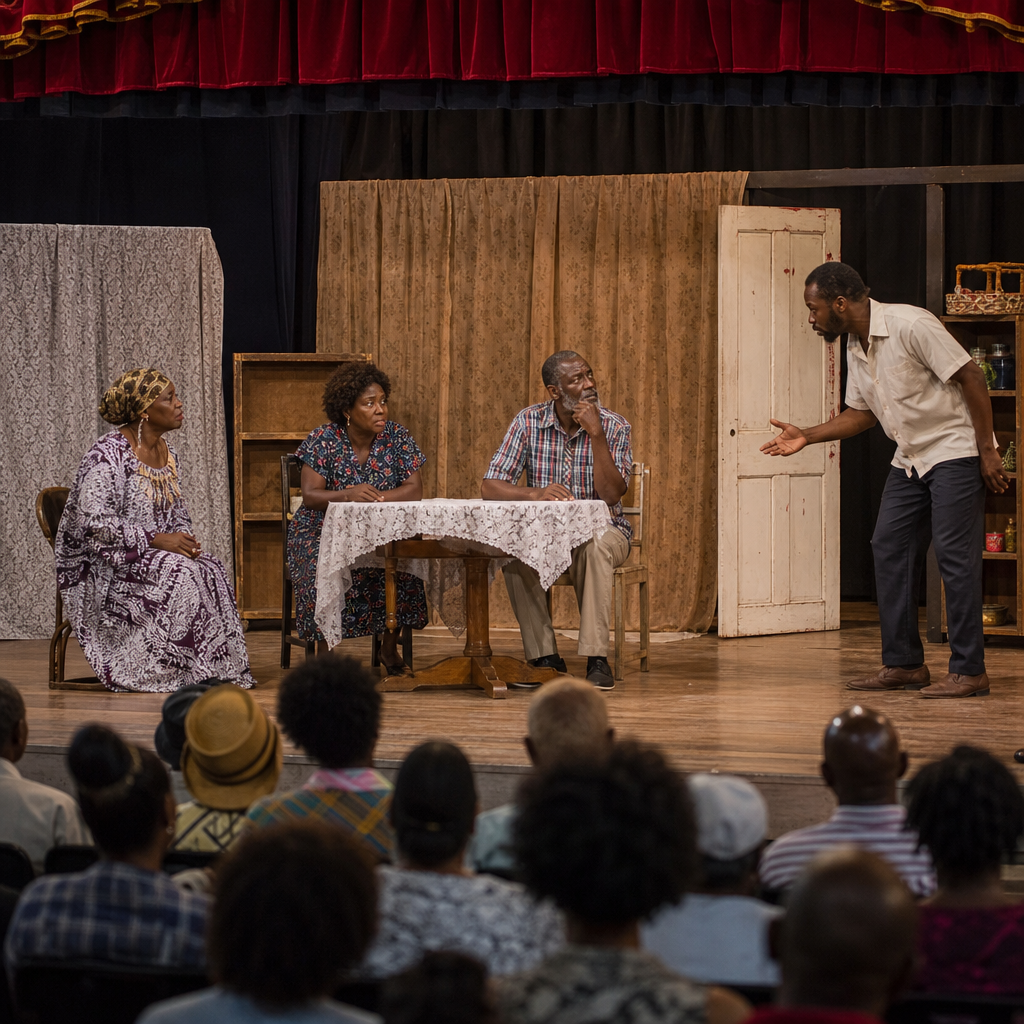
Nevis’ local theater has long served as more than entertainment; it is a civic stage where humor, music, memory, and dissent meet. In a small island society, performance carries unusual weight because audiences know the places, surnames, customs, and political tensions being referenced. That intimacy makes local theater in Nevis a powerful platform for social commentary. It can question leadership, expose inequality, preserve folklore, and invite difficult conversations without the distancing effect of formal policy debate. When a joke lands in Charlestown or a dramatic pause follows a line about migration, the audience often hears more than dialogue. It hears itself.
By local theater, I mean community-rooted performance created for Nevisian audiences or by Nevisian artists, whether staged in formal venues, school halls, churches, festival settings, or open-air cultural events. Social commentary refers to artistic work that interprets public life: politics, family pressure, tourism, youth opportunity, gender expectations, crime, land use, class difference, and the pull between tradition and modernization. In practice, Nevis’ local theater often blends spoken drama with calypso sensibility, carnival energy, folk storytelling, and the comic timing of Caribbean oral culture. That blend makes it especially effective at saying hard truths in familiar language.
This matters because small-island communities face concentrated versions of global pressures. Tourism brings revenue while reshaping labor, coastline use, and public identity. Migration creates remittance flows but can hollow out local talent pipelines and strain family structures. Digital media expands visibility yet competes with live cultural participation. Theater remains one of the few spaces where these forces can be interpreted collectively, in real time, by neighbors sitting together. I have worked around community arts programming in Caribbean settings, and the pattern is consistent: when local performance is strong, public conversation becomes sharper, more nuanced, and more inclusive. In Nevis, that civic function deserves serious attention.
Why theater works so well in Nevis
Theater is uniquely suited to social commentary in Nevis because it is immediate, low-barrier, and communal. A newspaper editorial can inform, but a scene between a returning migrant and a grandparent can make the same issue emotionally legible in minutes. Unlike film or television, local stage work can adapt quickly to current events, public controversies, and changing audience mood. Playwrights and directors can revise dialogue before opening night, performers can sharpen local references, and festival audiences can respond instantly with laughter, silence, or call-and-response. That feedback loop matters in a place where public issues are lived closely.
Nevisian performance also benefits from the Caribbean tradition of coded speech. Satire, double meaning, proverb, song, and exaggeration allow artists to challenge authority without sounding didactic. A character complaining about a pothole may really be speaking about governance. A comic exchange about imported food may point to dependency and agricultural decline. This layered communication lets theater address sensitive topics while remaining entertaining. It also protects the audience from the fatigue that often follows overt political messaging. People return to a production because it is enjoyable first, then realize the critique stays with them after the curtain call.
Another advantage is accessibility. Community theater does not require expensive technology to be effective. A strong script, recognizable setting, and capable cast can produce serious cultural impact. That matters for islands where arts funding is limited and venues may not always have advanced lighting, acoustics, or set budgets. Schools, cultural organizations, churches, and festival committees can all host meaningful work. In practical terms, this means social commentary in Nevis is not confined to elite arts spaces. It can emerge wherever people gather.
What local productions usually comment on
Nevis’ local theater most often comments on everyday systems that shape island life. Governance is a central theme, not always through explicit party politics, but through scenes about public services, favoritism, bureaucracy, infrastructure, and trust. Audiences immediately understand references to roads, water supply, planning disputes, or the frustration of getting simple matters resolved. Theater can reveal how administrative decisions feel at street level, which is often more persuasive than abstract criticism. A well-written character waiting months for a permit tells the story of governance in human terms.
Family and migration form another major subject. In many Caribbean communities, migration is both aspiration and loss. A parent leaves for work abroad; a child grows up with grandparents; money arrives, but closeness does not. Local theater can hold all sides of that truth at once. It can criticize the economic conditions that push migration, while also honoring the sacrifice involved. The best productions avoid caricature. They show the pride of mobility, the pain of absence, and the awkwardness of return when values have shifted.
Tourism and development also appear frequently because they cut across employment, land, and identity. A hotel project may promise jobs while raising worries about beach access, environmental strain, or cultural dilution. Theater can stage those tensions directly by putting a taxi driver, vendor, investor, civil servant, and fisher in the same scene. That compressed social encounter mirrors real island debate. In my experience, audiences engage strongly with these stories because they recognize that tourism is never just an industry. It changes speech, architecture, schedules, prices, and the way a place presents itself to outsiders.
Gender roles, youth frustration, and crime prevention are similarly common themes. Plays may explore expectations placed on young men, the unpaid labor of women, domestic conflict, or the pressure on students navigating limited opportunities. These stories matter because they connect public policy to private life. When theater shows how unemployment can feed despair, or how silence enables abuse, it pushes social commentary beyond complaint into collective reflection.
How performance style carries the message
Message alone does not make effective theater. In Nevis, style is part of the argument. Comedy is especially important because it lowers resistance. A satirical scene about election-season promises can provoke laughter first, then recognition. That sequencing is powerful. People are more willing to examine their own complicity, loyalties, and habits when they do not feel lectured. Caribbean comic traditions have always carried serious substance, and Nevisian theater follows that logic closely.
Music and rhythm also deepen commentary. Songs can summarize a conflict, repeat a slogan ironically, or shift a scene from realism to reflection. A chorus line about rising prices can carry economic critique more memorably than exposition. Likewise, dialect and code-switching signal social position, education, aspiration, and authenticity. When a character changes register between local speech and formal English, the audience hears a negotiation of power. That is not incidental; it is social analysis performed through language.
Stagecraft matters too, even with modest resources. A bench can become a bus stop, courthouse queue, or village lime, allowing the same set to represent several public spaces where island life unfolds. Minimalism often helps commentary by keeping attention on dialogue and relationship. Some of the most effective community productions I have seen used little more than strong blocking, precise timing, and a script rooted in local observation. Spectacle is helpful, but truthfulness is what makes the audience trust the critique.
| Theme | How theater presents it | Why audiences respond |
|---|---|---|
| Governance | Satire about public services, permits, promises, and accountability | People recognize daily frustrations immediately |
| Migration | Family scenes about departure, remittances, and return | Nearly every household knows the tradeoffs involved |
| Tourism | Conflicts over jobs, land access, and cultural identity | The benefits and costs are visible across the island |
| Youth opportunity | Stories about schooling, unemployment, and ambition | Parents and students see their own pressures reflected |
| Gender and family | Domestic dialogue, caregiving strain, and expectation gaps | Private issues gain a safe public language |
Community venues, schools, and festivals as civic spaces
One reason local theater functions so well as commentary in Nevis is that it is distributed across community life rather than isolated in a single institution. Schools are especially important. Student productions often test issues adults discuss cautiously, including peer pressure, violence, mental health, and digital influence. Because parents, teachers, and public officials attend, the performance becomes a shared civic event. Young actors also bring urgency to topics such as opportunity and belonging; they are not discussing the future in theory, but in lived expectation.
Festivals expand that reach. In Caribbean cultural calendars, festival performance is not ornamental. It is where collective identity gets rehearsed, challenged, and refreshed. Carnival-related satire, seasonal showcases, and heritage programming create occasions where audiences expect wit, exaggeration, and topical relevance. That expectation gives artists permission to push further. Material that might feel confrontational in a formal meeting can be accepted onstage because performance has its own social rules. The result is not avoidance of politics but a more culturally fluent way of doing politics.
Church halls, village spaces, and multiuse venues also matter because they reduce distance between artist and audience. Viewers are often relatives, classmates, former teachers, or workmates of the cast. That closeness raises the stakes. A line about parenting, corruption, or class aspiration cannot hide behind anonymity. It is spoken into a web of real relationships. For that reason, local theater in Nevis often achieves a level of accountability that mass media cannot. The audience knows who is speaking, and the performer knows who is listening.
Benefits, constraints, and what stronger support would change
The main benefit of Nevis’ local theater is that it turns public issues into shared understanding. It helps communities name what they are experiencing, whether that is the stress of rising costs, the ambivalence of development, or the emotional toll of migration. It preserves local speech patterns and memory while keeping cultural expression current. It also develops practical skills: writing, public speaking, teamwork, stage management, and critical listening. These are not side benefits. They are part of how culture strengthens civic capacity.
There are limits, and they should be stated clearly. Funding is often inconsistent. Rehearsal spaces can be scarce, technical equipment may be basic, and artists frequently balance creative work with full-time jobs. Small audiences can also create caution. In tight communities, direct criticism risks social fallout, sponsorship concerns, or political labeling. That can encourage self-censorship or overreliance on broad comedy. In addition, local productions may struggle with documentation. Strong work is staged, discussed, and then disappears without proper archiving, making it harder to build institutional memory or teach future practitioners.
Better support would produce measurable gains. Small grants for script development, lighting, and youth training would raise quality quickly. Partnerships with schools, tourism stakeholders, and cultural agencies could expand audiences without weakening independence if governance is transparent. Recording and archiving productions would help scholars, educators, and future directors understand how Nevis has narrated its own social changes over time. Even modest investments in front-of-house operations, ticketing, and marketing can improve sustainability. The point is not to professionalize every production into something slick. It is to give local theater the stability to keep doing what it already does best: tell the truth in a form people will actually hear.
Nevis’ local theater matters because it gives public life a human voice. It does not treat social issues as distant headlines or technical files. It stages them as conversations among neighbors, relatives, workers, students, and leaders who share the same roads, beaches, anxieties, and aspirations. That is why it remains one of the island’s most effective platforms for social commentary. Through satire, drama, music, dialect, and community participation, theater makes complicated issues understandable without flattening them. It invites laughter, discomfort, recognition, and debate in the same evening.
As a hub within Local Life and Experiences, this topic connects naturally to wider miscellaneous coverage: community events, oral traditions, youth culture, public celebrations, migration stories, neighborhood change, and the everyday spaces where island identity is negotiated. Local theater sits at the center of those threads because it gathers them, interprets them, and reflects them back to the community. When it is healthy, a society hears itself more clearly. When it is neglected, an important civic mirror dims.
If you want to understand Nevis beyond brochures and itineraries, pay attention to its stages. Attend a school production, support a community play, talk to performers, and listen for the social questions beneath the laughter. Local theater is not a side attraction. In Nevis, it is one of the clearest ways the island thinks out loud.
Frequently Asked Questions
Why is local theater in Nevis such an effective platform for social commentary?
Local theater in Nevis is especially effective because it speaks to audiences who immediately recognize the social world being portrayed on stage. References to neighborhoods, family names, public figures, traditions, and everyday island life are not abstract details; they are lived realities for the people watching. That closeness gives performances unusual force. When a playwright uses humor, satire, music, or dramatic conflict to address issues such as leadership, economic inequality, migration, generational tension, or cultural change, the audience does not have to decode the relevance. They already know the context, and that familiarity makes the message sharper and harder to dismiss.
In a small island society, theater can also say things that might feel too confrontational in a formal political setting. A well-crafted performance creates room for reflection by blending critique with storytelling, wit, and emotion. People may laugh at a scene that exaggerates corruption, gossip, social climbing, or neglect of community values, but that laughter often carries recognition. It allows difficult truths to surface in a form that feels communal rather than purely accusatory. This is one reason local theater can move public conversation forward: it invites audiences to see themselves, their leaders, and their institutions from a slightly altered angle.
Another important factor is trust. Community-based theater often feels more authentic than imported entertainment because it is rooted in local speech patterns, local rhythms, and local memory. That authenticity matters when artists tackle sensitive topics. Viewers are more likely to engage with criticism when it comes from voices that clearly understand the island’s culture and contradictions. In Nevis, theater is not just performance; it is a social mirror, and that makes it a powerful civic forum.
What kinds of social and political issues are commonly explored in Nevisian theater?
Nevisian theater can engage a broad range of issues, often drawing directly from the island’s social fabric and public life. Political accountability is one recurring theme. Plays may explore leadership styles, campaign promises, favoritism, bureaucracy, or the gap between official rhetoric and everyday reality. These subjects are particularly potent in a close-knit society where the effects of policy decisions are visible and personal. A story about a struggling family, a neglected village concern, or a public official’s choices can resonate strongly because audiences understand how governance affects daily life.
Economic inequality is another major topic. Theater can highlight differences in opportunity, access to land or employment, class mobility, and the pressures facing working families. It may also examine the impact of tourism, development, and migration, asking who benefits, who is left out, and what communities lose when economic change moves too quickly or unevenly. These are not just policy debates; they are human stories, and theater is well suited to showing how large forces shape private lives.
Cultural preservation also appears frequently in socially engaged performance. Playwrights and performers may use the stage to defend local language, music, customs, and folklore against erosion or commercialization. At the same time, theater can address intergenerational tensions around modernity, identity, education, and values. Questions about youth aspiration, diaspora influence, gender roles, and changing family structures often emerge in ways that feel immediate and recognizable. Because theater brings these issues into a shared public space, it helps communities think through not only what is changing in Nevis, but what should be protected, questioned, or reimagined.
How do humor, music, and folklore strengthen the social message in Nevis’ local theater?
Humor, music, and folklore are not decorative extras in Nevisian theater; they are core tools that make social commentary more memorable, accessible, and culturally grounded. Humor is particularly powerful because it lowers defenses. A sharp joke, an exaggerated character, or a satirical exchange can expose hypocrisy, vanity, or injustice without immediately alienating the audience. People may come for entertainment, but comedy often opens the door to serious reflection. In a society where everyone understands the references, even subtle humor can carry pointed criticism.
Music deepens that impact by connecting audiences emotionally and culturally. Songs, rhythms, and performance styles rooted in local experience can reinforce the themes of a production and make its message linger long after the curtain falls. Music can celebrate resilience, mourn loss, mock pretension, or unite a crowd around shared feeling. In many cases, it acts as a bridge between storytelling and collective memory, helping audiences not just understand an issue intellectually but feel its weight.
Folklore adds another layer of authority and resonance. By drawing on traditional stories, archetypes, proverbs, and communal wisdom, playwrights can frame modern problems within a deeper cultural narrative. A familiar folk figure or symbolic storyline can illuminate present-day concerns such as greed, betrayal, exploitation, or moral responsibility. This approach strengthens the message because it places contemporary debates within a continuity of shared values and historical experience. In Nevis, where cultural memory remains deeply meaningful, folklore helps theater speak to both present realities and inherited identity at once.
Does local theater in Nevis really influence public conversation and community awareness?
Yes, local theater can meaningfully influence public conversation, especially in a place where audiences and subject matter are closely connected. A performance that addresses recognizable social tensions often becomes a topic of discussion well beyond the venue itself. People talk about scenes, characters, and lines that felt especially true, and those conversations can continue in homes, workplaces, schools, community gatherings, and on local media platforms. Because theater packages complex issues into vivid human stories, it often gives people language and examples they can use to discuss topics that may otherwise remain awkward or divisive.
Its influence does not depend on changing policy overnight. Theater’s power often lies in shaping awareness, challenging complacency, and making certain realities harder to ignore. A play that portrays inequality, political neglect, cultural loss, or social stigma can validate experiences that members of the audience may have felt privately but not voiced publicly. It can also challenge others to reconsider assumptions they had accepted without scrutiny. In that sense, theater helps widen the space for honest dialogue, which is often the first step toward broader social response.
In a community like Nevis, where relationships are direct and reputation matters, the impact can be especially pronounced. The audience is not observing a distant society; it is watching a dramatized version of its own world. That immediacy gives performances real civic relevance. Even when theater does not produce immediate institutional change, it can shift tone, influence perception, and encourage a more engaged public culture. Over time, that kind of cultural work matters greatly.
What role does local theater play in preserving Nevisian identity while also questioning society?
Local theater plays a dual role that is essential to cultural life in Nevis: it preserves identity while also creating space for critique. On one hand, it keeps language, storytelling styles, humor, music, historical memory, and social customs alive in a public and participatory form. This is especially important in smaller societies navigating globalization, tourism pressure, migration, and changing generational habits. Theater allows communities to see themselves represented in their own voice rather than filtered through outside interpretations. That representation affirms belonging and helps protect distinctive cultural textures that might otherwise fade.
On the other hand, preservation does not mean idealization. Strong local theater does not simply celebrate heritage; it also examines the tensions within it. It can ask whether certain traditions still serve the community well, whether power is being used justly, whether economic progress is inclusive, and whether social norms silence some voices while privileging others. This balance is what makes theater so valuable. It resists the false choice between honoring culture and questioning society. Instead, it shows that thoughtful criticism can be a form of care for the community itself.
For Nevis, this role is particularly significant because identity is not just a matter of history; it is an active conversation about who the island is and who it wants to become. Local theater contributes to that conversation in a way few other art forms can. It gathers people together, reflects shared memory, challenges comfortable narratives, and makes culture something living rather than static. In doing so, it helps ensure that Nevisian identity remains both rooted and responsive.