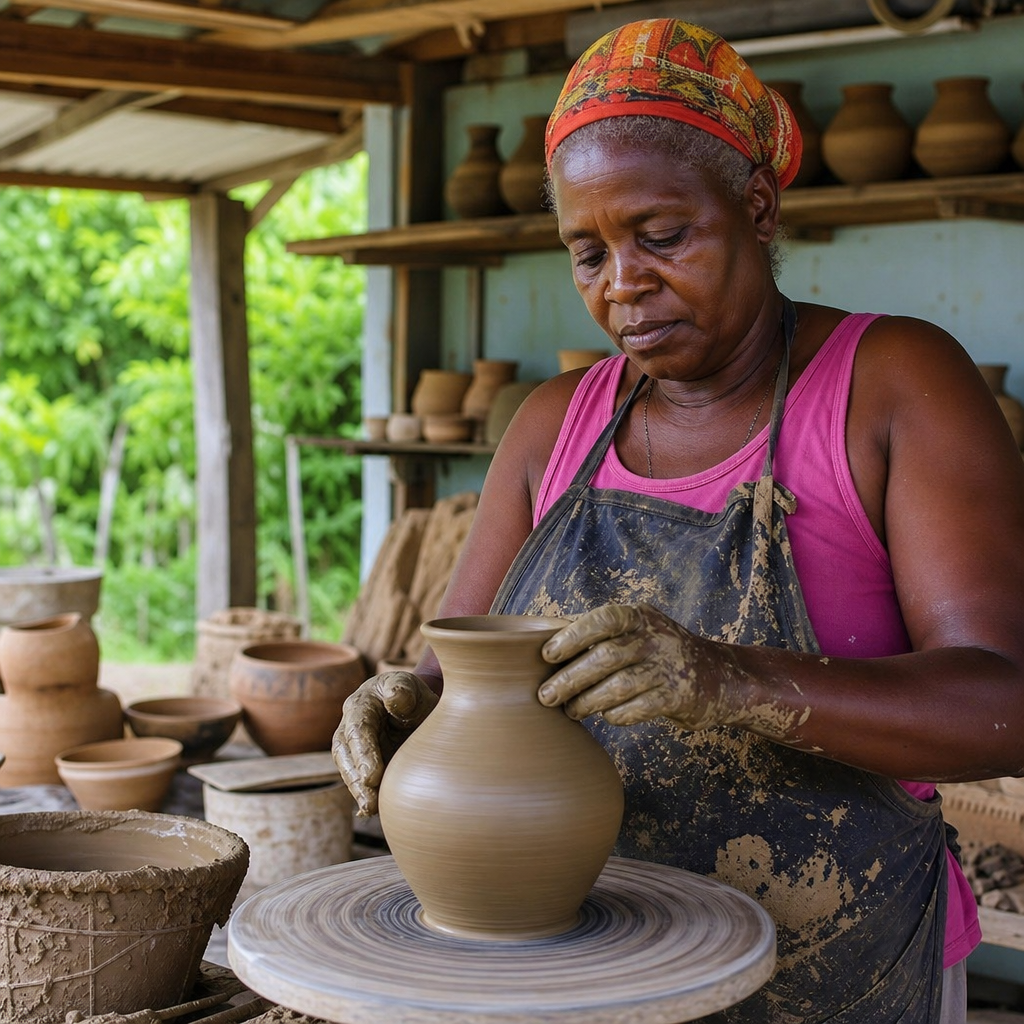
Nevis’ pottery tradition is more than a craft practice; it is a living record of how clay, art, and community have shaped everyday life on the island. In Nevis, pottery refers to the making of functional and decorative objects from local or imported clay through hand-building, wheel work, drying, glazing, and firing. Tradition, in this context, does not mean something frozen in the past. It means a body of skills, design habits, stories, and shared routines that continue to evolve from one maker, family, school, studio, market, and visitor experience to the next.
As someone who has spent time documenting Caribbean cultural businesses and speaking with makers about materials, pricing, kiln access, and customer demand, I have seen that pottery communities survive when craft is rooted in daily use as well as artistic identity. That is especially true on a small island such as Nevis, where local life depends on practical resourcefulness, strong community ties, and a steady balancing act between heritage and tourism. Pottery sits at the intersection of all three. A bowl can be tableware, a wedding gift, a souvenir, a teaching tool, and a statement of local pride at the same time.
This matters because craft traditions often disappear quietly. When imported goods become cheaper, when younger residents do not see a path to income, or when studio infrastructure such as kilns and glazing supplies is hard to maintain, pottery can shift from a household skill to a niche hobby. Yet islands that sustain visible craft traditions gain real benefits. They preserve cultural memory, create small-business opportunities, strengthen visitor experiences, and give residents meaningful ways to gather, teach, and celebrate place. For a Local Life and Experiences hub, pottery belongs in the center of the conversation because it connects food culture, festivals, architecture, education, retail, and the creative economy.
On Nevis, the story of pottery should be read broadly. It includes handcrafted wares sold at markets, studio pieces influenced by Caribbean colors and landscapes, school art projects that teach form and patience, and community workshops where beginners learn pinching, coiling, and slab building. It also includes the less visible side: sourcing clay bodies suited to the island’s climate, managing firing temperatures, preventing cracks during humid weather, and pricing handmade pieces against mass-produced imports. Understanding these practical realities makes the tradition easier to value accurately.
How pottery fits into Nevisian local life
Pottery fits into Nevisian local life because it transforms ordinary island experiences into tangible objects. Meals, gardens, hospitality spaces, church gatherings, and holiday tables all create demand for plates, serving bowls, planters, mugs, and decorative pieces. Even when many household ceramics are imported, locally made pottery carries a different meaning. It reflects the island’s textures, color palette, and slower human scale. A hand-thrown cup with subtle variations in thickness tells a customer immediately that a person, not a factory, made it.
In practice, local craft traditions on small Caribbean islands thrive where products meet real uses. Makers who offer durable tableware for villas, restaurants, guesthouses, and home kitchens often build more consistent business than those relying only on decorative souvenir sales. The hospitality sector is important here. Boutique inns and rental properties frequently look for place-based design touches, and handmade ceramics give dining rooms and patios a local signature that imported catalog goods cannot match. A ceramic platter used to serve island fish or fruit creates an experience that guests remember and photograph.
Pottery also supports community identity through events and learning. Markets, school exhibitions, studio open days, and cultural festivals all give craft a public role. When children see adults shaping clay, trimming leather-hard forms, loading kilns, and discussing glaze results, the process becomes legible rather than mysterious. That visibility matters. Heritage survives not only because elders remember it, but because younger people watch it being practiced in public and can imagine participating themselves.
Materials, methods, and the making process
The foundation of pottery is the clay body, and the choice of clay affects every later stage. Earthenware is often more accessible and fires at lower temperatures, usually around 1,000 to 1,150 degrees Celsius. Stoneware fires higher, commonly around 1,200 to 1,300 degrees Celsius, and produces stronger, more vitrified pieces. For island makers, availability and shipping cost can influence material choices as much as aesthetic preference. Imported clay, commercial glazes, kiln shelves, elements, pyrometric cones, and replacement parts all add expense, so efficient production planning is essential.
Most pottery on islands like Nevis is made using three main hand-building methods plus wheel throwing. Pinching forms small bowls and cups by pressing clay outward with fingers. Coiling builds larger vessels from rolled ropes of clay blended together. Slab building uses flat sheets for trays, boxes, wall pieces, and angular forms. Wheel throwing requires more equipment and training but allows fast repetition of cylinders, mugs, bowls, and plates. In workshops I have observed across the region, hand-building usually opens access for beginners because it needs fewer tools and gives students quick results.
Drying and firing are where many problems arise. High humidity can slow evaporation, while uneven drying leads to warping or cracking. Makers often control this by covering pieces loosely with plastic, drying handles separately before attachment, and compressing bases carefully. Bisque firing hardens unfired greenware into a porous ceramic body that can accept glaze. Glaze firing then melts the surface coating into a glasslike finish. Food-safe ware requires tested glaze chemistry and proper maturity in the kiln. That is not optional. Decorative pieces allow more freedom, but functional pottery must meet a higher standard of consistency and safety.
| Stage | Main task | Common challenge on a small island | Practical response |
|---|---|---|---|
| Clay preparation | Wedging and portioning clay | Material waste from drying out | Store tightly, recycle trimmings into reclaim |
| Forming | Hand-building or wheel throwing | Limited tools and studio space | Use modular bats, shared worktables, simple rib tools |
| Drying | Bring pieces to bone dry evenly | Humidity causes slow or uneven drying | Cover loosely, rotate pieces, dry in stages |
| Bisque firing | First kiln firing | High electricity or fuel costs | Batch firings efficiently and fill kiln loads well |
| Glazing | Apply tested surface finishes | Supply constraints for glaze materials | Standardize a small reliable glaze palette |
| Final firing | Mature clay and glaze | Kiln maintenance and replacement parts | Track firing schedules and service equipment proactively |
Artistic identity, design language, and island influence
Nevisian pottery gains power when it expresses island identity without reducing itself to cliché. The strongest ceramic design language usually comes from close observation: sea and sky blues, volcanic earth tones, gingerbread architectural details, breadfruit leaves, fishing culture, tropical flowers, and the geometry of shutters, stone walls, and old estate landscapes. These references can appear directly as carved motifs or indirectly through silhouette, proportion, texture, and glaze selection.
Good pottery design begins with use. A mug handle must fit the hand before it carries a decorative flourish. A serving bowl must pour cleanly before it earns praise as sculptural. This is one of the clearest lessons I have heard from experienced makers: decoration should support the object’s purpose, not conceal weak construction. In tourism markets, products that blend local imagery with reliable function tend to earn repeat customers. Visitors may buy a small vase once, but they recommend and reorder tableware that survives real use.
There is also room for fine art ceramics. Wall pieces, sculptural vessels, narrative tiles, and mixed-media works can speak to memory, migration, ecology, and ancestry. Caribbean artists have long used material culture to address colonial history, labor, trade, and landscape change. On Nevis, pottery can participate in those conversations while remaining grounded in local life. A community-oriented pottery scene does not have to choose between practical craft and gallery work. The healthiest ecosystems usually support both.
Pottery as education, enterprise, and community infrastructure
For a small island, pottery becomes sustainable when it is treated as infrastructure rather than an occasional attraction. That means classes for children and adults, visible retail channels, consistent workshop schedules, and shared access to expensive equipment. Schools are critical. Clay teaches hand strength, sequencing, patience, problem solving, and tolerance for failure because pieces crack, collapse, or glaze unexpectedly. Those lessons transfer beyond art. Students learn to revise, test, and finish.
From a business perspective, pottery often works best as a layered model. Revenue can come from product sales, commissions, classes, tourist workshops, wholesale accounts with hotels or shops, and seasonal event participation. A studio that depends on one stream is vulnerable. If visitor arrivals dip or shipping delays interrupt supply, income falls quickly. Diversification reduces that risk. I have seen Caribbean studios stabilize their cash flow by pairing a core line of repeatable products with premium custom work and beginner classes that convert visitors into buyers.
Community benefit extends further. Shared studios create social space. Public demonstrations turn making into cultural interpretation. Collaborations with chefs, florists, and interior designers connect pottery to other local businesses. Even kiln sharing can matter, because firing capacity is one of the biggest barriers to entry for emerging makers. On an island, a single reliable kiln can anchor an entire network of artists if scheduling, maintenance, and safety are handled well.
Where this hub connects to the wider Miscellaneous subtopic
As a hub article within Local Life and Experiences, Nevis’ pottery tradition links naturally to the broader Miscellaneous cluster because craft intersects with many island activities that do not fit neatly into one category. Readers exploring this topic usually want more than a narrow history of ceramics. They want to know where pottery appears in daily life, how to experience it, what to buy, how it supports local makers, and which related stories deepen their understanding of Nevis.
That makes this page a practical starting point for connected articles on artisan markets, creative workshops, homegrown gift ideas, cultural souvenirs worth buying, studio visits, heritage skills, seasonal festivals, and the economics of small island crafts. It can also connect to pieces about local food presentation, villa and restaurant design, school arts programs, wedding favors, garden décor, and community entrepreneurship. In other words, pottery is not an isolated niche. It is a doorway into how Nevis residents make, teach, exchange, and preserve culture through objects.
For travelers, the most useful approach is simple: choose one hands-on experience, one place to shop for locally made goods, and one cultural event where craft is visible in context. For residents and returning visitors, the better question is how to support continuity. Buying directly from makers, commissioning durable pieces, attending workshops, and sharing the story behind the object all help keep the tradition active rather than symbolic.
Nevis’ pottery tradition shows how a small island can hold culture in the palm of the hand. Clay becomes cup, bowl, planter, tile, sculpture, memory, and livelihood through practiced skill and community support. The tradition matters not only because it produces beautiful objects, but because it ties heritage to daily use, connects artists to schools and businesses, and gives residents and visitors a direct way to participate in local life.
The essential points are clear. Pottery on Nevis depends on more than talent. It requires materials knowledge, firing discipline, tested glazes, reliable equipment, and business models that fit island realities. It grows stronger when makers design for both function and identity, when hospitality and retail partners buy locally, and when workshops make the process visible to younger generations. It becomes resilient when it is embedded in education, tourism, and community events rather than treated as a one-time attraction.
If you are exploring Local Life and Experiences in Nevis, use pottery as a guide to everything else this Miscellaneous hub can reveal. Look for the makers behind the objects, ask how pieces are formed and fired, and choose purchases or experiences that keep skills circulating within the island. Start with one studio visit, one workshop, or one locally made piece for your home, and let that be your entry point into the wider creative life of Nevis.
Frequently Asked Questions
What makes Nevis’ pottery tradition unique?
Nevis’ pottery tradition stands out because it brings together practical skill, artistic expression, and community memory in a way that feels deeply rooted in everyday island life. Pottery on Nevis is not only about shaping clay into bowls, jars, vases, or decorative pieces. It also reflects how people have historically used local resources, adapted to changing materials, and passed knowledge from one generation to the next. That combination of usefulness and meaning gives the tradition its distinctive character.
Another important feature is its flexibility. In Nevis, tradition does not mean exact repetition of old forms without change. Instead, it refers to a living set of techniques, preferences, stories, and habits that continue to evolve. Makers may work with local or imported clay, use hand-building or the wheel, and explore both simple utility wares and more expressive art pieces. Even as tools, materials, and markets shift, the core practice remains connected to shared experience, local identity, and the social role of making things by hand.
This living quality is what makes the tradition especially meaningful. A pot can carry evidence of the landscape, the maker’s touch, and the values of a community at the same time. In that sense, Nevisian pottery is unique not just because of what is made, but because of what the process represents: continuity, adaptation, creativity, and connection.
How is pottery traditionally made in Nevis?
Pottery in Nevis typically begins with clay, whether sourced locally when available or brought in from elsewhere to meet the needs of specific makers and projects. From there, the clay must be prepared carefully. Preparation can include kneading or wedging to remove air pockets, improve consistency, and make the material workable. This stage is essential because the quality of the final piece depends heavily on how well the clay has been handled before shaping even begins.
Once prepared, the clay can be formed in several ways. Hand-building methods such as pinching, coiling, and slab construction are especially important in many pottery traditions because they allow a maker to build form gradually and with a high degree of control. Wheel work may also be used, particularly for more symmetrical vessels. After shaping, pieces are left to dry slowly so they do not crack or warp. This drying period is a critical part of the process and requires patience, environmental awareness, and experience.
When the clay has dried to the right stage, potters may refine the surface by trimming, smoothing, carving, or adding decorative details. Some pieces are glazed for color, texture, and durability, while others may be left with a more natural finish depending on the intended use and artistic choice. The final major step is firing, which transforms fragile dried clay into durable ceramic. Firing can vary in temperature and method, but it is always a decisive moment in pottery making. The complete process shows why pottery is both a technical discipline and an art form, requiring judgment at every stage.
Why is pottery important to community life in Nevis?
Pottery matters to community life in Nevis because it connects people through shared work, knowledge, and cultural expression. Historically, handcrafted objects played a role in ordinary domestic routines, and that practical function helped make pottery part of the rhythm of daily life. Even when a pot serves a simple purpose, it can still carry cultural meaning through shape, finish, and the familiar methods used to create it. In this way, pottery becomes more than an object; it becomes part of how a community remembers and recognizes itself.
The tradition also supports relationships between generations. Skills in clay work are often learned through observation, repetition, and direct instruction, which means pottery naturally creates opportunities for teaching and exchange. A more experienced maker may demonstrate how to center clay, build a stable wall, judge moisture levels, or control a surface treatment, while a newer maker learns not only technique but also values such as patience, discipline, and respect for materials. That transfer of knowledge strengthens cultural continuity.
In addition, pottery can bring people together in public and economic ways. Workshops, demonstrations, markets, and local cultural events give makers a chance to share their work and engage with residents and visitors. These spaces help keep craft visible and valued. They also allow pottery to contribute to local identity and small-scale creative enterprise. Because of all these roles, pottery remains significant in Nevis not simply as an art practice, but as a social and cultural thread linking making, memory, and belonging.
What kinds of objects are associated with Nevis’ pottery tradition?
Nevis’ pottery tradition includes both functional and decorative objects, and that range is part of what makes the craft so enduring. Functional pottery may include bowls, cups, plates, storage containers, cooking-related vessels, and other household wares designed for regular use. These items reflect the practical side of pottery, where form must respond to handling, storage, serving, or display. The maker has to think about balance, wall thickness, durability, and surface finish, so utility is never separate from craftsmanship.
Decorative pottery is equally important because it gives artists room to explore pattern, symbolism, texture, and sculptural form. Vases, ornamental vessels, tiles, figurative work, and display pieces may all fall within this category. Even when a piece is not intended for everyday use, it can still express aspects of local life, landscape, heritage, or personal interpretation. Some works may be minimal and elegant, while others may highlight bold glazing, carved details, or hand-built character.
It is also common for the line between functional and decorative pottery to blur. A serving bowl, for example, may be fully practical while also carrying strong artistic identity through its shape or finish. This overlap reveals an important truth about the tradition: in Nevis, pottery is not limited to one rigid category. It can serve the home, enrich visual culture, and communicate the maker’s individuality all at once.
How does Nevis’ pottery tradition continue to evolve today?
Nevis’ pottery tradition continues to evolve because living traditions adapt without losing their core identity. Contemporary makers may draw on inherited methods such as hand-building and careful surface finishing while also experimenting with new tools, kiln technologies, glazes, and design ideas. This does not weaken the tradition. On the contrary, it shows that the craft remains active, responsive, and meaningful in the present rather than preserved only as a historical curiosity.
Today’s potters may respond to a variety of influences, including tourism, regional exchange, global ceramic trends, and renewed local interest in handmade goods. Some may focus on preserving recognizable forms and techniques associated with earlier practice, while others develop more contemporary aesthetics that still honor the values of craftsmanship and material knowledge. The use of local or imported clay, the balance between function and art, and the relationship between maker and audience can all shift over time, yet the underlying commitment to skill and expression remains consistent.
Education and visibility also play a major role in this evolution. Community workshops, cultural programming, studio practice, and public interest in heritage crafts help sustain momentum. When younger makers encounter pottery not as something distant, but as something relevant and creative, the tradition gains new energy. That is why Nevis’ pottery tradition should be understood as ongoing cultural work: it is continuously shaped by the people who practice it, teach it, reinterpret it, and carry it forward.