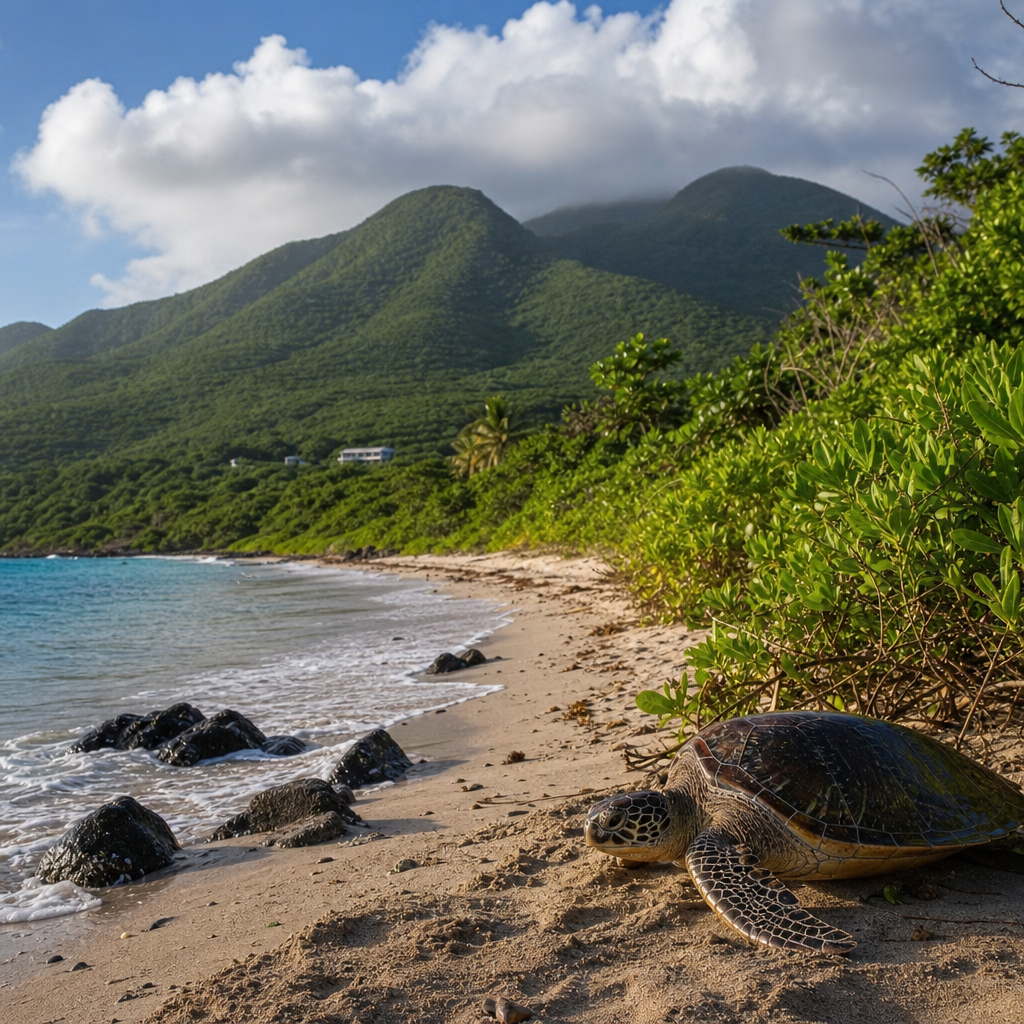
Nevis’ turtle watching offers one of the Caribbean’s most rewarding wildlife experiences, but the real privilege is not simply seeing a sea turtle; it is observing an ancient, threatened animal without disrupting the behaviors that keep its population alive. Turtle watching in Nevis generally refers to guided or self-directed observation of sea turtles nesting, emerging from the sea, covering nests, or occasionally hatchlings moving toward the water. Responsible observation means keeping distance, controlling light and noise, following local rules, and treating beaches as active habitat rather than entertainment venues. That distinction matters because sea turtles are highly sensitive during nesting and hatching, and even small disturbances can cause a female to abandon a nesting attempt, expose eggs to predation, or disorient hatchlings that should instinctively crawl toward the brightest natural horizon over the sea.
I have worked around coastal visitor management and wildlife interpretation long enough to see the same pattern everywhere: the places that deliver the best wildlife encounters are usually the places where clear boundaries are taken seriously. Nevis fits that rule. The island is known for quiet beaches, lower-density tourism, and a coastal character that still supports meaningful encounters with marine life. For travelers interested in nature and wildlife, turtle watching is not an isolated activity but a gateway into a wider set of coastal conservation topics, including nesting season awareness, beach etiquette, habitat protection, guided ecotourism, marine biodiversity, and community-based stewardship. As a hub within the broader Nature and Wildlife topic, this Miscellaneous page connects those strands and helps readers understand how turtle watching in Nevis fits into the island’s full ecological story.
Three sea turtle species are the most relevant to Nevis visitors: hawksbill, green, and leatherback turtles. Hawksbills are recognized by their narrow, pointed beak and overlapping shell scutes; they often use tropical reefs and may nest on Caribbean beaches. Green turtles are larger, with smoother shells and a diet that shifts heavily toward seagrass and algae as they mature, making them important grazers in marine ecosystems. Leatherbacks are the giants, built differently from hard-shelled turtles, with a leathery carapace and extraordinary long-distance migration capacity. All sea turtles found in the Caribbean face conservation pressure from habitat loss, coastal lighting, marine debris, fishing gear entanglement, historical overharvest, and climate-related changes that affect nesting beaches and sex ratios. Understanding those pressures is essential because responsible turtle watching is not just etiquette; it is a practical conservation tool.
Visitors often ask simple questions that deserve direct answers. When is the best time for turtle watching in Nevis? Generally, the broader nesting and hatching window spans the warmer months, with exact timing varying by species and year, so local guidance always matters more than a generic calendar. Can you approach a nesting turtle for photos? No, not closely, and never with flash. Should you touch turtles, eggs, or hatchlings? No, unless you are an authorized conservation professional acting under approved protocols. Is a guided experience better? In almost every case, yes, because trained guides know how to read the animal’s behavior, position groups safely, and explain what visitors are seeing without creating unnecessary stress. Those basics set the foundation for every other part of this guide.
Why Nevis matters for sea turtle conservation
Nevis matters because small islands can have outsized importance for migratory marine species. A nesting female may travel across national boundaries and depend on one relatively undisturbed beach for successful reproduction. In practical terms, that means the quality of beach management on Nevis can influence animals that spend much of their lives far beyond the island. Sea turtles contribute to healthy marine systems in ways that are easy to underestimate. Green turtles help maintain productive seagrass beds by grazing them, which supports fish habitat and improves nutrient cycling. Hawksbills feed on sponges on coral reefs, helping maintain ecological balance among reef organisms. Leatherbacks consume jellyfish and move enormous distances through Atlantic food webs. Protecting turtles therefore supports broader marine resilience, not just one charismatic species.
On islands with intensive nightlife and heavy beachfront construction, nesting success often falls because artificial light changes turtle behavior. Nevis still has areas where darker shorelines, lower development pressure, and community awareness can make a difference. However, those advantages are not permanent. One bright property, one unmanaged beach event, or repeated close approaches by curious visitors can degrade habitat quickly. I have seen beaches where turtle signs were obvious to trained observers, yet casual visitors missed the nesting evidence entirely and walked directly across vulnerable zones. That is why interpretation, signage, and local conservation involvement are so important. Good turtle watching starts long before a turtle appears; it begins with a beach culture that recognizes tracks, respects marked nests, and accepts that wildlife sometimes requires limits on human behavior.
What visitors can realistically expect to see
The most dramatic turtle watching moment is a female emerging from the sea at night to nest, but that is also the moment when disturbance risk is highest. Not every turtle that comes ashore will nest. Some perform a “false crawl,” meaning they emerge, assess the beach, and return to the water without laying eggs. Causes can include unsuitable sand, obstacles, human presence, noise, or lighting. If a turtle does commit to nesting, observers may see a sequence that includes ascent above the high-water line, body pit formation, egg chamber excavation using rear flippers, egg laying, covering, camouflage behavior, and return to the sea. Each stage has different sensitivity levels, and experienced guides usually time viewing around the least disruptive window.
Hatchling events are compelling but unpredictable. After incubation, hatchlings may emerge en masse, often at night or during cooler conditions, then orient toward the sea using natural cues. Artificial light from phones, villas, roads, and beachfront venues can pull them inland, where dehydration, predation, or vehicle strikes become lethal risks. Visitors may also notice tracks in the sand, shell fragments from hatched nests, ghost crabs, shorebirds, or signs of nest protection work by local volunteers. In daylight, snorkeling or coastal boat trips may occasionally reveal turtles foraging offshore, especially around seagrass or reef areas, but in-water wildlife observation follows a different set of rules from beach-based nesting observation. The key expectation is this: turtle watching rewards patience. Ethical wildlife tourism prioritizes animal welfare over guaranteed sightings.
Rules for observing sea turtles responsibly
The clearest way to protect turtles is to convert good intentions into specific actions. On Nevis, visitors should follow guidance from local conservation groups, tourism operators, and beach managers, but the core field rules are consistent across reputable turtle programs throughout the Caribbean.
| Situation | Responsible action | Why it matters |
|---|---|---|
| Approaching a nesting turtle | Stay behind the turtle, keep distance, and wait for guide instructions | Movement or silhouette in front of her can interrupt nesting and trigger a return to sea |
| Using lights | Avoid flashlights, camera flash, and bright phone screens; use only approved red-filter light if permitted | White light can disorient adults and hatchlings and alter natural behavior |
| Talking on the beach | Speak quietly and keep group size controlled | Noise increases stress and makes sensitive wildlife less likely to complete nesting |
| Touching animals or nests | Do not touch turtles, eggs, or hatchlings | Handling can cause harm, transfer contaminants, and violate conservation protocols |
| Walking on nesting beaches | Watch your footing, avoid tracks and marked nest areas, and stay with the group | Egg chambers can be difficult to detect, and repeated trampling degrades habitat |
| Photography | Use low-light settings only when explicitly allowed and never use flash | Images are not worth compromising a nesting event or hatchling orientation |
These rules are not symbolic. They address known behavioral responses documented by conservation practitioners for decades. A nesting turtle invests substantial energy in reproduction, and interruptions can reduce the odds of successful egg deposition. Hatchlings have almost no margin for error. If you remember only one principle, make it this: if your presence changes the turtle’s behavior, you are too close, too bright, or too loud.
Guided tours, local stewardship, and beach ethics
A guided turtle watching tour is usually the best option in Nevis because trained operators can balance visitor experience with species protection. Good guides do more than lead people to a beach. They assess tide and weather conditions, check recent nesting activity, understand species-specific behavior, screen participant expectations, and manage positioning once a turtle appears. They also know when not to proceed. In my experience, the most responsible wildlife guides are comfortable disappointing guests in the short term if that is what the animal’s welfare requires. That is a sign of quality, not poor service.
Visitors should look for operators who work with conservation partners, limit group sizes, provide a pre-visit briefing, and clearly prohibit flash photography and touching. It is also worth asking whether part of your fee supports monitoring, education, or beach protection. Community-based stewardship matters on islands like Nevis because enforcement alone cannot protect every nesting beach every night. Residents, hotel staff, fishers, drivers, and returning visitors all become part of the protection network when they know what to report and what to avoid. Beach ethics extend beyond a tour itself: fill holes, remove litter, avoid driving on beaches, keep dogs away from nesting zones unless explicitly managed, and choose accommodations that minimize beachfront lighting. Conservation succeeds when ordinary visitor choices reinforce formal protections.
Threats facing turtles in Nevis and across the Caribbean
Sea turtles in Nevis face the same core threats seen across the wider Caribbean, and responsible turtle watching should be understood in that context. Artificial lighting is one of the most immediate and controllable threats on nesting beaches. Bright coastal development can deter nesting females and fatally misdirect hatchlings. Beach erosion and hard coastal infrastructure reduce suitable nesting habitat, while beach furniture and retaining walls create physical barriers. Plastic pollution is another serious problem; turtles can ingest floating plastic or become entangled in marine debris. Lost fishing gear, boat strikes, and bycatch in commercial and small-scale fisheries also remain persistent risks.
Climate change introduces additional complexity. Sand temperature influences hatchling sex determination in sea turtles, so warming beaches can skew sex ratios over time. More intense storms can erode nesting areas or inundate nests. Rising sea levels can compress available beach habitat, especially where development prevents natural inland movement of the shoreline. Predation by dogs, mongoose, crabs, or other animals can affect nest survival, particularly where human activity indirectly increases predator presence. None of these pressures make turtle conservation hopeless, but they do mean that every successful nesting event matters. On a practical level, small improvements in beach lighting policy, waste reduction, monitoring, and visitor conduct can produce measurable conservation benefits at the local scale.
Planning your visit and connecting with the wider Nature and Wildlife hub
If you want to experience turtle watching in Nevis responsibly, start planning before you arrive. First, check the likely nesting season with current local sources rather than relying on outdated travel posts. Second, choose accommodations and tour providers that demonstrate low-impact coastal practices. Third, pack with wildlife observation in mind: dark clothing, insect protection, water, and a willingness to leave bright devices off. Fourth, build flexibility into your itinerary. Turtle activity is governed by nature, not show times, and weather or conservation priorities may change plans. That unpredictability is part of the value; it keeps the encounter authentic.
As the hub page for Miscellaneous content within the Nature and Wildlife sub-pillar, this article also points readers toward related themes that deepen the Nevis experience. Birdwatching, coastal walks, reef-safe snorkeling, mangrove awareness, volcanic landscape ecology, and marine conservation all intersect with turtle watching. A traveler who learns why beachfront lighting affects hatchlings will better understand why dark-sky beaches matter for nocturnal wildlife generally. A visitor who sees green turtles feeding offshore may become more interested in seagrass protection and watershed health. That is the larger benefit of this topic hub: it frames turtle watching not as a one-off excursion but as an entry point into the ecological relationships that make Nevis distinctive.
Nevis’ turtle watching is best when it is quiet, patient, and disciplined. The island offers a rare chance to witness ancient marine behavior in a setting that can still support meaningful conservation outcomes, but only if visitors act as careful observers rather than participants in the scene. The essential rules are straightforward: go with knowledgeable guides when possible, keep your distance, eliminate bright light, stay quiet, never touch turtles or nests, and respect beach habitat at every stage of your visit. Those actions protect nesting females, improve hatchling survival, and help local conservation efforts do their work.
The main takeaway is simple: responsible turtle watching creates a better experience and a better result. You will see more, understand more, and reduce the chance that your presence harms the very wildlife you came to appreciate. That makes this activity one of the clearest examples of good nature tourism on Nevis. Use this hub as your starting point for exploring the island’s broader Nature and Wildlife stories, then choose operators, accommodations, and beach habits that support the coast rather than burden it. If you are planning a trip, make turtle-friendly decisions now so Nevis’ beaches remain places where sea turtles can return, nest, and survive.
Frequently Asked Questions
What does responsible turtle watching in Nevis actually mean?
Responsible turtle watching in Nevis means observing sea turtles in a way that does not interfere with nesting, hatchling movement, orientation, or the animal’s overall sense of safety. In practical terms, that means keeping a respectful distance, staying quiet, avoiding sudden movement, and never touching turtles, hatchlings, nests, or eggs. It also means understanding that a successful turtle encounter is not measured by how close you get, but by whether the turtle is able to complete natural behaviors undisturbed. A nesting female that is frightened at the wrong moment may abandon the nesting attempt and return to the sea without laying eggs, which directly affects reproduction.
Good turtle watching etiquette also includes controlling light. Bright white lights from phones, flashlights, cameras, or vehicle headlights can disorient both adult turtles and hatchlings. Red-filtered lights are often preferred when permitted by guides or local conservation rules, but even red light should be used sparingly and only when necessary. Visitors should remain behind the turtle whenever possible, avoid blocking her path to or from the water, and follow the direction of trained guides at all times. Responsible observation protects a threatened species while still allowing people to experience one of Nevis’ most memorable natural events.
When is the best time to see sea turtles in Nevis, and what kinds of behavior might visitors observe?
The best time to see sea turtles in Nevis generally depends on the nesting season, local beach conditions, and the species using the shoreline. Many turtle-watching experiences happen after dark because that is when nesting females typically come ashore. During a responsible outing, visitors may observe a female emerging from the sea, selecting a nesting site, digging a body pit, laying eggs, covering the nest, disguising the area with sand, and then returning to the water. In some cases, people may also witness hatchlings emerging and making their way to the ocean, although these sightings are usually less predictable and should be approached with even greater care.
It is important to keep expectations realistic. Wildlife encounters are never guaranteed, and ethical turtle watching always places the animal’s welfare above the visitor experience. Guided tours can improve the chances of seeing turtles because local experts understand seasonal timing, beach activity, and legal observation practices. Even so, conditions such as weather, tides, moonlight, and recent disturbance on the beach can influence turtle activity. The most rewarding approach is to treat any sighting as a privilege rather than a scheduled attraction. That mindset helps visitors stay patient, follow rules more carefully, and appreciate the conservation value of the experience.
Why is light control so important when watching sea turtles?
Light control is one of the most important parts of responsible turtle watching because sea turtles rely heavily on natural darkness to orient themselves. Nesting females may become startled or disoriented by artificial light and may turn back before laying eggs. Hatchlings are especially vulnerable. Instead of moving toward the ocean horizon, which is normally brighter from reflected moonlight and starlight, they may crawl toward inland light sources such as buildings, flashlights, roads, or phones. This can lead to exhaustion, dehydration, predation, or death before they ever reach the sea.
For that reason, visitors should never use camera flash, phone flashlights, bright screens, or unfiltered torches around turtles. If a guide allows any lighting at all, it is usually limited, dim, and carefully managed. People should also avoid taking selfies, recording with bright devices, or standing where their light falls across the turtle’s face or the hatchlings’ path. On beaches near development, responsible travelers can support conservation simply by minimizing their own contribution to beachfront lighting. In turtle habitat, darkness is not an inconvenience; it is part of the species’ survival system.
Should visitors choose a guided turtle watching tour in Nevis, or is self-directed observation acceptable?
A guided turtle watching tour is usually the best option for most visitors because experienced guides know how to find turtles while minimizing stress on the animals. They understand nesting behavior, local regulations, beach access considerations, and the right moments to approach, pause, or back away. A good guide also helps visitors interpret what they are seeing, which makes the encounter more meaningful and reduces the temptation to break rules for a better photo or closer look. In many cases, guided observation is the most reliable way to enjoy turtle watching ethically and legally.
Self-directed observation may be acceptable in some areas, but only if visitors are well informed, extremely cautious, and committed to keeping the turtle’s needs first. Anyone going without a guide should research current local guidance before visiting the beach, including seasonal protections, restricted areas, lighting rules, and any instructions from conservation organizations. If there is any uncertainty about proper behavior, it is better not to approach at all. A turtle that changes direction, hesitates, stops nesting activity, or appears disturbed is a sign that observers are too close or too intrusive. In Nevis, the most responsible choice is the one that leaves the smallest possible impact.
What should you never do during a turtle watching experience in Nevis?
There are several things visitors should never do during turtle watching in Nevis. Never touch an adult turtle, hatchling, nest, or eggs. Never stand in front of a turtle or block her route to and from the sea. Never shine lights directly on the animal, use flash photography, make loud noise, crowd around the turtle, or attempt to move hatchlings unless trained conservation personnel specifically instruct otherwise. Feeding turtles, chasing them for photos, digging in nesting areas, or letting children run freely near an active nest are also unacceptable. Even actions that seem harmless can interrupt critical life-cycle behavior.
Visitors should also never assume that because a turtle appears calm, it is unaffected. Sea turtles can be highly sensitive to disturbance, especially during nesting. A female may abandon a nesting attempt long before an observer realizes something is wrong. Hatchlings may lose precious time and energy if distracted or misdirected. The safest rule is simple: observe quietly, stay back, keep the beach dark, and follow local conservation guidance without exception. When people respect these limits, turtle watching becomes what it should be: a rare, moving encounter that supports awareness and protection rather than adding pressure to an already threatened species.