Saint Kitts’ folkloric traditions preserve the island’s memory in motion, rhythm, and voice. They live in Christmas street performances, village gatherings, school stages, and family stories told after dinner. For anyone exploring Local Life and Experiences in Saint Kitts, folklore is not a side attraction; it is one of the clearest ways to understand how Kittitians have shaped identity from African heritage, European colonial history, Christian observance, and everyday community life. Dance, music, and storytelling work together here, not as separate arts but as a shared cultural system that teaches values, records hardship, celebrates wit, and strengthens belonging.
In Saint Kitts, folkloric traditions usually refer to inherited cultural expressions passed across generations outside formal institutions. That includes masquerade, string band music, fife-and-drum performance, work songs, proverbs, Anansi tales, seasonal customs, and comic characters who appear during Carnival and Christmas. Some traditions are highly visible to visitors, especially around the National Carnival, while others survive in less public settings such as church halls, elder circles, and school cultural programs. I have seen the difference firsthand: a staged hotel performance can introduce the form, but the meaning becomes clearer when you watch how local audiences react to a drum pattern, a joke, or a masquerade entrance they have known since childhood.
This subject matters because folklore in Saint Kitts is both cultural heritage and living practice. It supports tourism, education, and national identity, but it also raises practical questions about preservation. Older bearers of oral tradition are aging. Younger performers often balance heritage forms with soca, dancehall, gospel, and global media. Costumes and instrument-making require money and skill. At the same time, there is strong local pride, and institutions such as schools, community groups, the Department of Culture, Carnival committees, and regional festivals continue to keep these traditions visible. Understanding the island’s folkloric traditions means looking at where they came from, how they are performed, and why they still resonate now.
Historical roots of folklore in Saint Kitts
The foundation of Kittitian folklore lies in creolization: the process through which African, European, and Caribbean influences combined under plantation society. Enslaved Africans brought rhythmic structures, dance patterns, performance satire, trickster stories, and ritual memory. European colonizers contributed military parade styles, Christmas customs, quadrille influences, and instruments such as fiddle and banjo variants. Over time, these elements blended into forms specific to Saint Kitts. Folklore became one of the few spaces where enslaved and later freed people could encode resistance, mock authority, preserve ancestry, and build communal joy under difficult conditions.
Christmas has long been one of the most important folkloric seasons on the island. In many Eastern Caribbean territories, the period between Christmas and Carnival provided room for masqueraders, drummers, and costumed characters to take over public space. Saint Kitts follows that pattern. Folkloric performance was never only entertainment; it also marked social inversion. Characters could exaggerate class, gender, and power. Performers could parody officials, scare children, court applause, and collect gifts. That seasonal freedom explains why certain traditions remain tied to Carnival even when their origins are older than the festival format itself.
After emancipation in 1834 and full freedom in 1838, village celebrations became even more important as public expressions of identity. Through the late nineteenth and twentieth centuries, migration, church influence, formal education, and changing leisure patterns altered some customs, yet the island retained strong performance memory. Today, when schools teach folk items or troupes revive traditional costuming, they are not inventing culture from nothing. They are extending a long continuum that has adapted repeatedly without losing its basic purpose: to keep collective memory audible and visible.
Dance traditions and masquerade performance
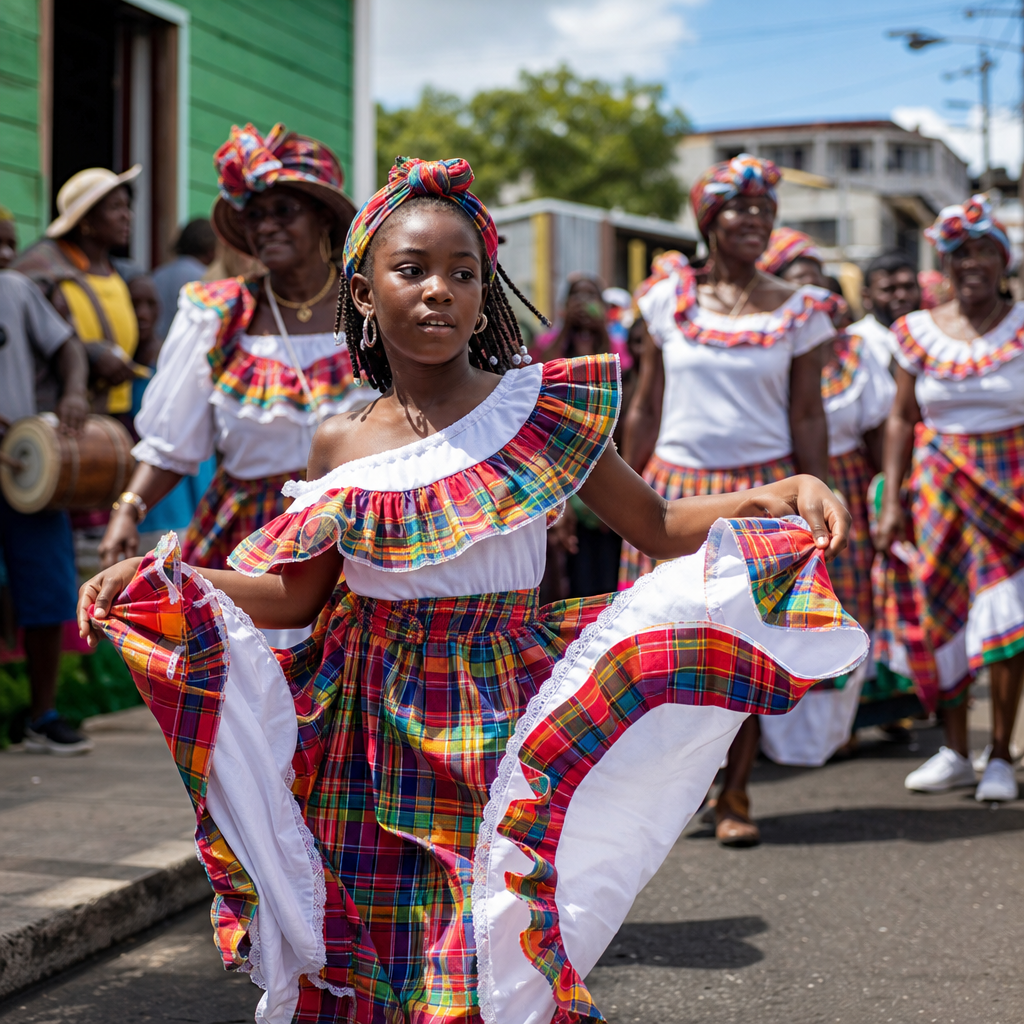
The best-known folkloric dance tradition in Saint Kitts is masquerade, often called Mas. Kittitian masquerade is a complex performance form combining dance, acrobatics, drum-led movement, costume display, and character acting. Traditional masqueraders wear brightly colored shirts and trousers decorated with ribbons, mirrors, bells, and sequins, often topped with elaborate headdresses. The visual effect matters because Mas is designed to command the road. Mirrors can symbolize deflection or brilliance, while bells turn every movement into sound. Costuming also reflects handcraft traditions that require sewing, ornamentation, and knowledge passed from older troupe members to younger ones.
The dance itself is athletic and disciplined. Performers execute high kicks, bends, spins, and coordinated formations, sometimes with whip-cracking and comic interaction depending on the troupe. In strong groups, the choreography alternates between precision and improvisation. I have watched rehearsals where leaders stop the line repeatedly to correct foot timing so the bells strike in unison with the drum pulse. That detail shows why masquerade should not be reduced to spectacle for tourists. It is technique-heavy folk performance, and good troupes train seriously.
Other traditional characters enrich the dance landscape. Clowns, Moko-Jumbies on stilts, Cowboys and Indians bands, and comic street performers have all appeared in Saint Kitts Carnival culture at different times. Not every character is equally prominent in every year, but together they create a folk pageantry rooted in movement. Moko-Jumbies, widely recognized across the Caribbean, likely draw on West African spiritual and protective traditions transformed in the New World. Their height, balance, and crowd interaction give them a ceremonial aura even in festive settings. Clowns and comic bands introduce satire and playful disorder, reminding audiences that folklore often thrives by bending social rules in public.
Music, rhythm, and traditional sound
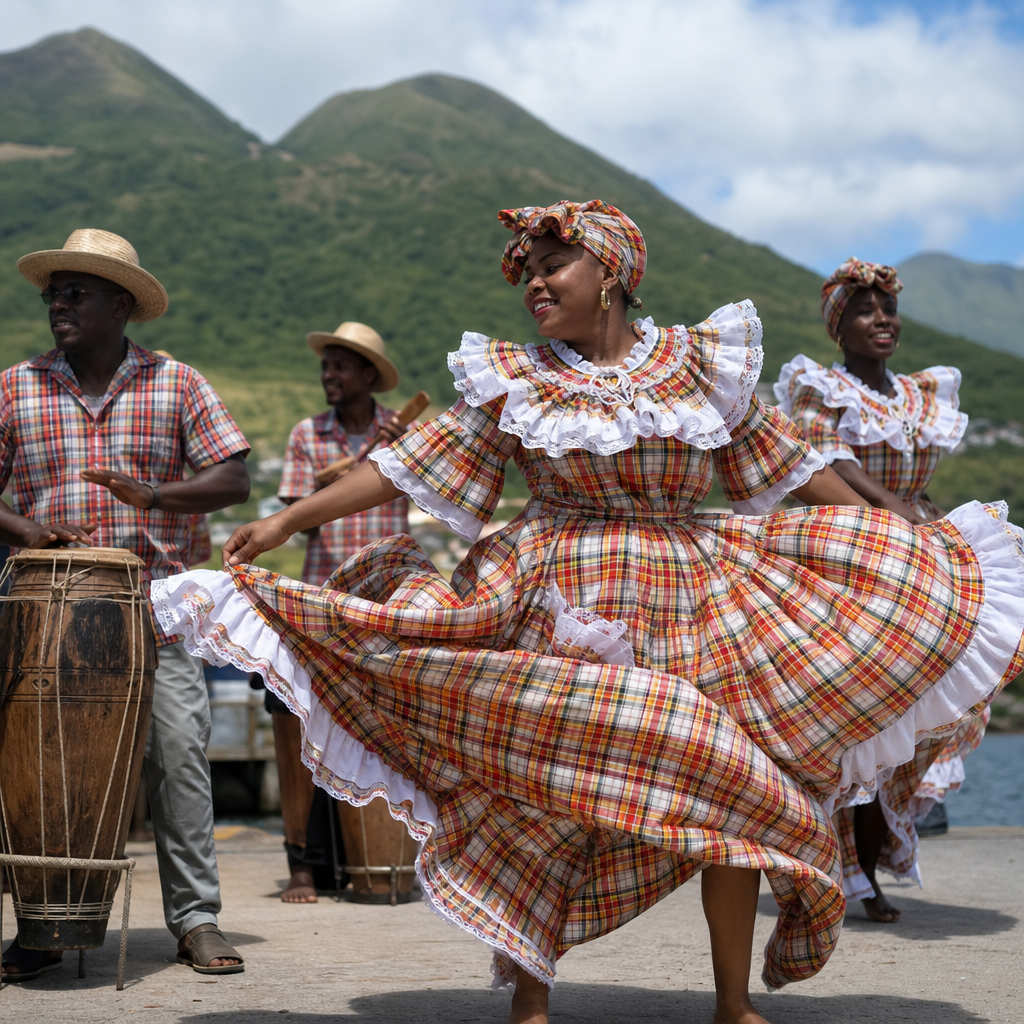
Music drives Saint Kitts’ folklore. Traditional performance depends on rhythm first, melody second. Drums set tempo for masquerade dancers, but the broader soundscape also includes fife, triangle, shack-shack, iron, banjo, guitar, and string band instrumentation. In older community settings, string bands were central to dances, tea meetings, and festive gatherings. Their repertoire could mix local songs, quadrille-related pieces, adapted popular tunes, and comic lyrics. The result was not polished conservatory music but functional community music designed to get people moving, laughing, and singing along.
Fife-and-drum traditions remain especially important because they connect movement, procession, and memory. The piercing fife cuts through outdoor space, while the drums organize collective response. This is music built for roads, yards, and open gatherings rather than quiet recital halls. It also reflects African diasporic rhythmic emphasis, where layered percussion and call-and-response structures carry social meaning. In practice, the lead player cues transitions, dancers answer physically, and the audience participates through clapping, shouting, or stepping into the circle.
Traditional songs often use repetition and direct language because they were meant to be remembered easily. Some are humorous, some moralizing, and some tied to labor or seasonal celebration. The same principle appears across Caribbean folk forms: memorable choruses make oral transmission possible. That matters in Saint Kitts because many items survived not through notation but through performance repetition.
| Tradition | Main features | Where people encounter it |
|---|---|---|
| Masquerade | Ribboned costume, bells, high-kick dance, drums | Carnival, cultural showcases, school events |
| String band | Fiddle or guitar-led ensemble, dance tunes, comic songs | Community celebrations, heritage programs |
| Fife and drum | Sharp lead melody, strong marching rhythm, outdoor projection | Street processions, folk reenactments |
| Anansi storytelling | Trickster plots, humor, moral ambiguity, audience response | Homes, classrooms, oral history sessions |
Storytelling, proverbs, and oral memory
Storytelling is the least visible folkloric form to visitors and one of the most important to cultural continuity. In Saint Kitts, oral tradition includes folktales, riddles, sayings, nicknames, cautionary tales, family anecdotes, and stories about village characters. The Caribbean trickster Anansi appears within the wider regional storytelling world, and Kittitian audiences understand the familiar lesson: the small, clever figure defeats the stronger opponent through wit, manipulation, or comic deceit. These tales entertain, but they also teach listeners how power works and how ordinary people survive it.
Proverbs condense community judgment into portable language. A proverb can settle an argument, warn a child, or frame a difficult situation without a long speech. In field-based cultural work, one of the clearest signs that oral tradition remains alive is hearing older residents reach for a proverb before offering direct advice. That habit links everyday speech to inherited wisdom. The same is true of riddling, where language becomes a social game testing quickness, memory, and shared reference points.
Oral storytelling also carries historical content that official documents often miss. Memories of sugar estate life, migration to Britain or the United States, hurricane survival, market trade, and village humor all circulate through spoken narrative. These stories may not always fit strict archival standards, yet they reveal how people understood events as they lived them. For anyone researching Saint Kitts beyond beaches and landmarks, oral tradition provides texture that written tourism materials cannot replicate.
Folklore in community life, education, and tourism
Folkloric traditions remain relevant because they are embedded in institutions as well as memory. Schools in Saint Kitts regularly include folk songs, dance displays, costume days, and cultural history in their programming, especially around Independence and Carnival periods. That educational role is essential. Children who learn a masquerade sequence or perform a folk skit are not only entertaining an audience; they are acquiring bodily knowledge that books alone cannot transmit.
Community groups and national cultural agencies also matter. Workshops on drumming, costume-making, storytelling, and heritage performance help bridge the gap between elder practitioners and younger participants. Regional events such as CARIFESTA have historically encouraged Caribbean territories to document and present traditional arts with greater seriousness. That pressure has been helpful. Once a tradition is recognized as heritage, it becomes easier to justify funding, rehearsal space, and school involvement.
Tourism offers both opportunity and risk. On the positive side, visitors who encounter authentic folkloric performance gain a richer understanding of Saint Kitts than resort entertainment alone can provide. Performers earn income, artisans sell costumes and crafts, and cultural visibility increases. The risk is simplification. A five-minute staged excerpt can flatten a form that normally depends on season, procession, local jokes, and community participation. The best heritage tourism on the island avoids that trap by adding context: explaining the character, naming the instruments, and showing how the tradition fits local history rather than presenting it as generic Caribbean color.
Preservation challenges and why the traditions endure
Like many small-island heritage systems, Saint Kitts’ folklore faces real pressure. Urbanization, migration, imported media, and the cost of sustaining troupes can weaken continuity. Younger audiences may know contemporary Carnival music better than folk repertoire. Some elders hold important knowledge that has never been recorded formally. Costumes require maintenance, instruments wear out, and rehearsal time competes with work and school demands. Preservation, therefore, is not sentimental work. It requires documentation, apprenticeship, public funding, and consistent performance opportunities.
Still, these traditions endure because they do something modern entertainment cannot fully replace. They make identity participatory. A masquerade troupe is built through collective labor. A folktale asks the listener to infer meaning. A drum rhythm organizes bodies in shared time. These are social experiences, not just content products. Saint Kitts continues to value them because they link generations and make history feel immediate.
For anyone using this hub to explore Miscellaneous topics within Local Life and Experiences, Saint Kitts’ folkloric traditions offer the essential starting point. They explain how the island remembers, celebrates, jokes, teaches, and resists forgetting. Follow the subtopic further by seeking local performances, museum resources, school showcases, and oral histories. The more closely you listen to the dance steps, drum patterns, and stories, the more clearly Saint Kitts speaks.
Frequently Asked Questions
What makes Saint Kitts’ folkloric traditions so important to the island’s cultural identity?
Saint Kitts’ folkloric traditions are important because they carry the island’s history in forms people can see, hear, perform, and remember together. Folklore in Saint Kitts is not limited to old customs preserved for special occasions; it remains a living expression of how Kittitians understand themselves, their ancestors, and their community values. Through dance, music, costume, spoken storytelling, seasonal celebrations, and village performance, people pass down memories shaped by African cultural inheritance, European colonial influence, Christian observance, labor history, and the everyday realities of island life.
What makes these traditions especially powerful is that they connect formal history with lived experience. Written records may explain slavery, emancipation, plantation society, migration, religion, and social change, but folklore shows how people emotionally processed those experiences and transformed them into creative expression. Rhythms, movement patterns, comic characters, ceremonial acts, and oral tales all reveal how communities preserved dignity, humor, resilience, and social commentary across generations.
For travelers interested in local life and experiences in Saint Kitts, folklore offers one of the clearest windows into the island’s identity. It shows how culture is not abstract or distant, but active in Christmas street performances, school presentations, family gatherings, village events, and national celebrations. In that sense, folkloric traditions help explain not only where Saint Kitts has been, but how Kittitians continue to define belonging, memory, and cultural pride today.
Which dances and performance traditions are most closely associated with Saint Kitts folklore?
Several performance traditions are strongly associated with Saint Kitts folklore, especially those seen during the Christmas season and at community cultural events. Among the best known are masquerade performances, which combine dance, music, costume, acrobatics, and theatrical movement into a highly recognizable folk expression. These performances are visually striking and deeply symbolic, often featuring decorated costumes, rhythmic footwork, and coordinated street presentation that links celebration with historical memory.
Another important tradition is the Moko-Jumbie, the stilt-walking figure that appears in parts of Caribbean folk culture, including Saint Kitts. The Moko-Jumbie carries spiritual and historical associations rooted in African traditions and has come to symbolize elevation, watchfulness, spectacle, and continuity with ancestral performance practices. In Saint Kitts, this figure often appears alongside other Christmas and carnival-related folk elements, reinforcing the connection between ritual, celebration, and communal identity.
Clown troupes and other festive street performers also play a role in the folk performance landscape. These traditions can include stylized movement, comic interruption, drumming, costume symbolism, and competitive display. Their significance goes beyond entertainment. They reflect how public space becomes a cultural stage where communities celebrate, teach, and remember. Even when performed for visitors or on formal stages, these dances still carry the energy of village roads, neighborhood preparation, and inherited custom. That is why they remain central to understanding Saint Kitts’ folkloric life.
How does music shape traditional folklore in Saint Kitts?
Music is at the heart of Saint Kitts’ folklore because it gives structure, emotion, and collective energy to performance and memory. In folkloric settings, music is rarely separate from dance or storytelling; it drives movement, marks transitions, heightens dramatic effect, and helps audiences participate. Drum-based rhythms are especially important, reflecting strong African diasporic influence in the island’s cultural foundation. Percussion creates the pulse that holds a performance together, whether in street processions, staged folk presentations, or festive seasonal gatherings.
Traditional music in Saint Kitts often works as a communal language. Repeated rhythmic patterns, call-and-response singing, and interactive performance styles invite listeners to become part of the event rather than remain passive observers. This is one reason folk music feels so immediate and grounded in community life. It is meant to be shared, responded to, and felt physically. In many settings, music also helps preserve memory, because melodies, refrains, and rhythms are easier to carry across generations than written texts alone.
Music in Saint Kitts folklore also reflects cultural blending. African-derived rhythmic sensibilities exist alongside European-influenced ceremonial structures and Christian musical elements that entered local tradition over centuries. The result is a layered sound world that mirrors the island’s history. Whether heard in Christmas traditions, community festivals, or school performances that teach national heritage, folk music in Saint Kitts continues to serve as both artistic expression and cultural archive.
What role does storytelling play in preserving Saint Kitts’ heritage?
Storytelling is one of the most important ways Saint Kitts preserves heritage because it keeps cultural knowledge personal, memorable, and adaptable. Folk stories told after dinner, during family gatherings, in classrooms, or at community events do more than entertain. They transmit values, warning lessons, humor, local beliefs, and historical perspective. In societies shaped by oral tradition, storytelling has long served as a practical tool for carrying knowledge forward, especially in contexts where not every experience was formally recorded in writing.
In Saint Kitts, storytelling helps preserve the emotional and moral dimensions of history. Through folktales, anecdotes, character stories, and remembered community incidents, people communicate ideas about cleverness, respect, spirituality, hardship, social behavior, and survival. These stories often reflect African retentive traditions, colonial-era realities, and the local creativity that allowed communities to interpret difficult circumstances with wit and resilience. Even when a tale changes slightly from one teller to another, its cultural purpose remains strong.
Storytelling also anchors identity at the household and village level. It allows elders to pass on a sense of place, family memory, and shared understanding in a form younger generations can absorb naturally. For visitors, listening to local stories can reveal nuances of Saint Kitts that landmarks alone cannot show. It is often through voice, phrasing, humor, and remembered detail that the deeper character of the island becomes most visible. In that way, storytelling remains one of the most intimate and enduring pillars of Kittitian folklore.
Where can visitors experience authentic folkloric traditions in Saint Kitts today?
Visitors can experience authentic folkloric traditions in Saint Kitts in several settings, especially during seasonal celebrations, community festivals, school cultural programs, and locally organized heritage events. Christmas time is particularly important, as many folk performance traditions become highly visible in public spaces through street appearances, village celebrations, and festive gatherings. This season often offers some of the strongest opportunities to witness masquerades, costumed performers, drumming, and other living expressions of Kittitian folklore.
Beyond holiday events, visitors should pay attention to cultural showcases hosted by schools, community groups, heritage organizations, and national festivals. These programs frequently present traditional dance, folk music, dramatic interpretation, and storytelling in ways that are accessible while still rooted in local meaning. Although stage presentations can be more structured than spontaneous village performances, they often play an essential role in preserving and teaching folklore to younger generations and wider audiences.
For the most meaningful experience, visitors should approach folklore as part of everyday community life rather than as a standalone attraction. Speaking with local guides, attending public cultural events, visiting during festival periods, and engaging respectfully with residents can lead to richer insight. Authenticity in Saint Kitts folklore is not only about seeing a performance; it is about understanding the community context behind it. When travelers appreciate the history, symbolism, and social function of what they are watching, they gain a far deeper connection to the island’s living culture.