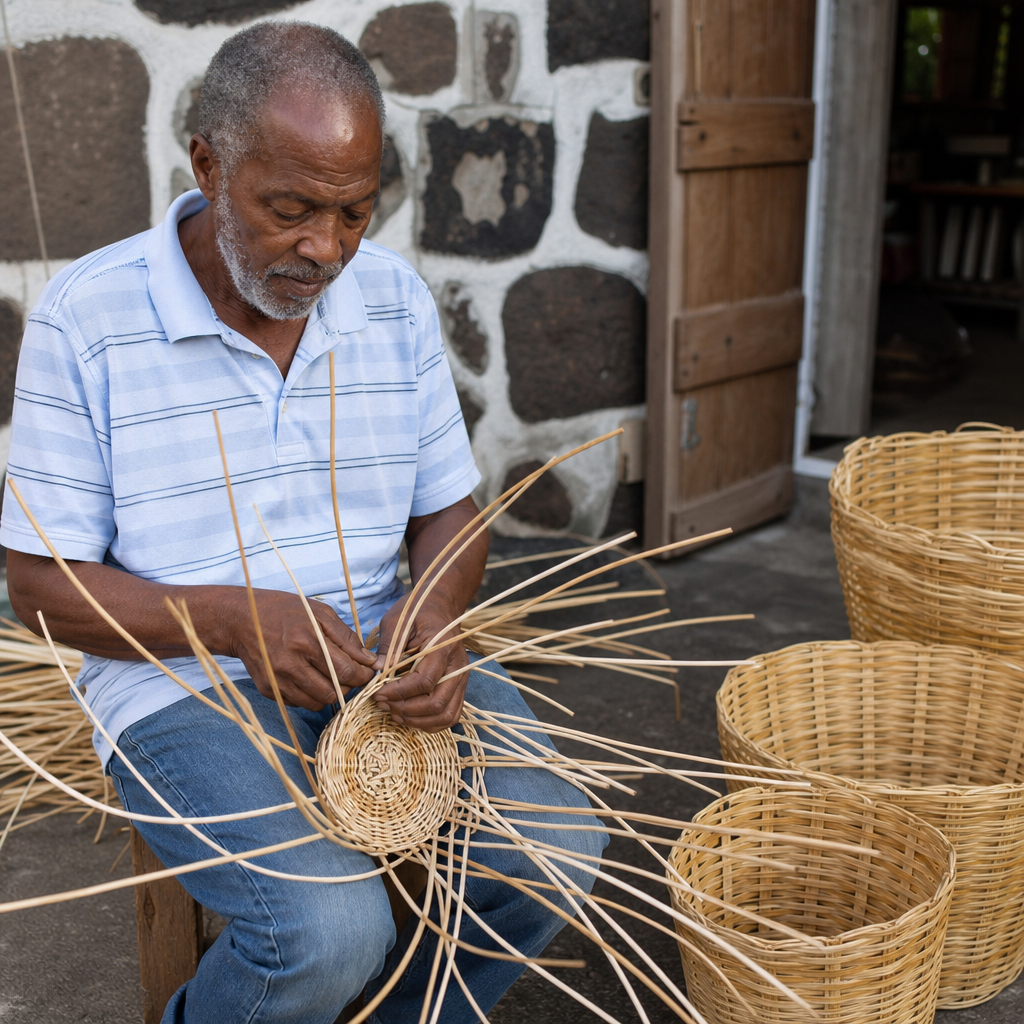
The art of basket weaving in Nevis is more than a craft; it is a living record of island resourcefulness, family knowledge, and the quiet beauty of making useful objects by hand. On an island better known to many travelers for beaches, heritage estates, and volcanic scenery, basket weaving sits within everyday local life, linking agriculture, fishing, market trade, homekeeping, and ceremony. When people speak about Nevisian craft traditions, they are often describing skills learned informally: watching an elder split a palm frond, soften a vine, tighten a rim, or judge whether a basket is strong enough for produce, laundry, or shellfish. That practical wisdom matters because handmade baskets reveal how communities adapt available natural materials into durable tools while expressing taste, identity, and memory.
In simple terms, basket weaving is the process of interlacing flexible plant fibers to create containers, mats, trays, and other functional forms. In Nevis, as in many Caribbean islands, the tradition reflects African carryovers, Indigenous plant knowledge, and later rural household practice shaped by plantation economies and village exchange. Materials may include palm, reed, grass, cane, bamboo, and other locally gathered fibers, though exact plant use can vary by season, locality, and what a maker can sustainably source. The resulting objects can be tightly woven for storage, more open for carrying provisions, or decorative for visitors and home display. What makes Nevis especially compelling is the way small-island life keeps function close to art. A basket is not merely admired; it is used, repaired, and judged by how well it serves.
This subject matters because traditional crafts often disappear quietly. Skills are lost when imported plastic goods become cheaper, when younger residents have fewer opportunities to learn, or when tourism rewards quick souvenirs over quality workmanship. I have seen this pattern in island communities repeatedly: once a craft leaves daily use, it survives only if local teachers, cultural groups, schools, and buyers decide it deserves time and fair payment. For Nevis, basket weaving supports cultural preservation, community storytelling, and small-scale economic activity. It also offers visitors a more accurate view of local life than generic resort experiences. As a hub within Local Life and Experiences, this guide explains how Nevisian basket weaving works, why it endures, what materials and methods define it, where it connects to other island traditions, and how to explore the broader miscellaneous craft landscape responsibly.
Origins, Influences, and Place in Nevisian Life
Basket weaving in Nevis developed through necessity before it was ever framed as heritage. Rural households needed containers for harvesting, storing, sorting, and transporting goods. Fishers needed practical carrying vessels. Market vendors needed ways to move and display produce. In that sense, weaving belonged to the same domestic and agricultural world as pottery, net mending, bread baking, and boat upkeep: skilled work woven into ordinary routines. Across the Caribbean, scholars of material culture note that handmade containers often preserve techniques with deep African roots, especially plaiting, coiling, and twining methods adapted to locally available plants. Nevis fits that regional pattern, while also reflecting island-specific landscapes and household habits.
The craft’s significance is easiest to understand through use. A well-made basket balances weight, flexibility, and ventilation. For produce, slight airflow reduces moisture buildup. For household storage, a tighter weave protects contents from dust while remaining lighter than wood or metal. For decorative pieces sold today, shape regularity and finishing matter more, but experienced makers still evaluate utility first. That practical standard is part of what gives the craft credibility. On Nevis, objects tied to real work carry more cultural weight than items produced only for display, and visitors who understand this tend to value handmade baskets more deeply.
Basket weaving also belongs to intergenerational learning. In many communities, instruction happens through demonstration rather than formal manuals. A learner may first prepare materials, then practice simple over-under plaiting, then move toward shaping walls and finishing rims. Mistakes are visible immediately: uneven tension warps the form; poorly dried material cracks; weak joins fail under load. Because the island is small, reputation travels quickly. A craftsperson known for durable baskets gains trust not through marketing language but through repeated use in homes and markets.
Materials, Preparation, and Core Weaving Techniques
The materials used in Nevisian basket weaving depend on availability, weather, and intended purpose. Palm is common across Caribbean weaving traditions because fronds can be split into workable strips and, when properly dried, provide a strong yet flexible structure. Cane, reeds, grasses, and bamboo may supplement or substitute depending on design. The first rule of good weaving is preparation. Freshly cut material often contains too much moisture, which can lead to shrinkage, distortion, or mildew. Overdried fibers become brittle. Skilled makers therefore cure, dry, soak, or shade materials in stages until they reach the right pliability.
Preparation usually includes cleaning off rough edges, sorting strips by width, and matching stronger lengths for stakes, frames, or rims. In my experience observing traditional fiber crafts, this stage determines quality more than most beginners expect. If widths are inconsistent, the weave will drift. If fibers are not rehydrated evenly before use, one section tightens while another loosens. Basket makers often rely on feel rather than instruments, but the principles align with standards familiar in conservation and craft education: moisture balance, fiber alignment, tension control, and structural reinforcement.
Three common construction approaches help explain most basket forms. Plaiting crosses flat strips in an over-under pattern, suitable for mats, trays, and square or oval bases. Twining uses flexible weavers twisted around upright stakes, creating strength and visual rhythm. Coiling builds a form by wrapping a stitching element around a bundled core, though this method is less universal and depends on the plant material available. Finishing is critical. Rim binding secures the top edge, handles distribute stress, and tucked ends prevent unraveling. Natural dyes may be used for patterning, but many makers prefer the understated elegance of undyed fibers that show the plant itself.
| Basket Type | Typical Use | Common Materials | Key Construction Need |
|---|---|---|---|
| Market basket | Carrying produce or dry goods | Palm, cane, reed | Strong base and reinforced handles |
| Storage basket | Household organization | Palm, grass, bamboo strips | Tighter weave for shape retention |
| Fishing or utility basket | Gear, shellfish, or general work | Cane, reed, tougher vine fibers | Ventilation and load-bearing strength |
| Decorative basket | Display or gifts | Selected fine fibers, dyed accents | Uniform pattern and neat finishing |
From Household Tool to Cultural Expression
Although utility remains central, basket weaving in Nevis also communicates aesthetics and belonging. Choices about pattern, proportion, and finish can indicate whether a basket is intended for market work, home presentation, or sale to visitors. Even simple forms may carry distinctive signatures: a tighter spiral at the base, a preferred handle shape, a specific border treatment. These details matter because craft traditions survive through recognizable standards. People often say all handmade baskets are unique, but in serious craft practice, uniqueness is less important than control. The strongest makers produce variation within discipline, not randomness.
That discipline turns everyday work into cultural expression. A basket made for breadfruit, mangoes, or herbs reflects local foodways. A shallow tray may suit kitchen sorting or community events. Decorative baskets sold in heritage shops often reinterpret these functional forms for modern interiors, but the best examples still preserve structural logic. When craft loses that logic, it becomes imitation rather than tradition. Nevisian weaving is most compelling when it remains connected to the island’s rhythms of farming, fishing, market exchange, and household care.
This is why basket weaving belongs in a wider miscellaneous hub under Local Life and Experiences. It intersects with village history, festival culture, artisan markets, oral storytelling, ecological knowledge, and heritage education. A visitor interested in baskets will often also want to explore traditional food preparation, local medicinal plants, music, domestic architecture, and seasonal celebrations. In practice, these subjects are not separate. The same elder who knows weaving techniques may also know garden cycles, church customs, roadside vending history, or how particular plants were once gathered after rainfall. Craft opens the door to a more complete understanding of island life.
Economic Value, Tourism, and Preservation Challenges
Handmade basketry contributes to Nevis in ways that go beyond souvenir sales. At a community level, it can support supplementary income, especially for older artisans, home-based makers, and small cultural enterprises. It can also diversify the visitor economy. Travelers increasingly seek workshops, demonstrations, and objects with traceable local origin rather than mass-produced imports. A basket purchased directly from a maker carries a story of material sourcing, labor time, and skill accumulation. That narrative has economic value because authenticity is not just sentimental; it differentiates local craft from generic retail goods.
However, preservation faces real obstacles. Imported containers are cheaper, faster, and often more uniform. Natural materials may be harder to access if land use changes or if fewer people know harvesting cycles. Younger residents may admire the craft but choose work with steadier income. Tourism can help, yet it can also distort production by rewarding low-cost, quickly finished items over durable pieces that require many hours. I have seen artisans across the region pressured to simplify techniques because buyers do not understand why a hand-finished rim or carefully matched weave width justifies a higher price. Once those shortcuts become normal, quality declines and knowledge thins.
The strongest preservation strategies combine cultural programming with market support. Demonstrations at museums, heritage sites, schools, and community festivals create visibility. Workshops give learners a starting point, even if mastery still requires practice. Fair-pricing initiatives and maker profiles help buyers understand labor. Documentation matters too. Recording plant names, local terminology, and step-by-step methods provides a safeguard when elder knowledge bearers are no longer able to teach. Institutions such as UNESCO have repeatedly emphasized that intangible cultural heritage survives best when communities continue practicing it, not when it is frozen behind glass. Nevis can apply that principle directly by keeping basket weaving active, useful, and respected.
How to Experience Basket Weaving in Nevis Responsibly
If you want to explore the art of basket weaving in Nevis, start by looking for places where craft appears in context rather than as isolated merchandise. Community events, heritage programs, artisan markets, and locally run cultural spaces usually offer the most meaningful encounters. Ask who made the basket, what material was used, how long preparation took, and whether the form was historically used for storage, harvest, or market carrying. Good makers answer these questions easily because their work is grounded in practice. Vague origin stories are a warning sign that an item may be imported or only loosely connected to Nevis.
Buy with standards in mind. Check whether the base sits evenly, whether the weave tension is consistent, whether the rim is firmly bound, and whether handles are secured at stress points. These are not niche details; they reveal whether a basket was made to last. If a seller explains that a piece is decorative rather than load-bearing, that honesty is a good sign. Responsible buying also means accepting that handmade work costs more than factory-made substitutes. Time spent harvesting, curing, sorting, weaving, and finishing deserves compensation.
For readers using this page as a hub for the broader miscellaneous side of Local Life and Experiences, basket weaving is an ideal starting point because it connects outward so naturally. From here, continue into articles on local markets, traditional foods, village festivals, herbal knowledge, island craftsmanship, and community history. Each topic helps explain the others. Basket weaving shows this better than almost any single practice: one object can contain ecology, labor, memory, design, and exchange all at once.
The lasting lesson is simple. The art of basket weaving in Nevis endures because it is useful, beautiful, and deeply tied to place. It teaches how island communities turn natural materials into dependable tools and how cultural identity is preserved through repeated acts of making. For residents, it remains part of inherited knowledge worth teaching. For visitors, it offers a direct route into authentic local life. For anyone building a fuller understanding of Nevis, this craft provides both detail and perspective. Seek out local artisans, ask careful questions, and support the makers keeping this tradition alive for the next generation.
Frequently Asked Questions
What makes basket weaving in Nevis culturally important?
Basket weaving in Nevis is culturally important because it preserves a way of thinking about daily life that is rooted in practicality, memory, and local knowledge. On the island, woven baskets have long served real purposes: carrying produce, storing household goods, supporting fishing and farming work, and helping families manage everyday tasks with materials gathered from the surrounding landscape. That usefulness is part of what gives the tradition its depth. Basket weaving is not simply decorative craft; it reflects how Nevisians have historically relied on skill, patience, and available natural resources to make durable objects by hand.
It also matters because the knowledge is often passed down informally through observation, repetition, and family teaching rather than through formal schools. A child might learn by watching an elder prepare fibers, start a base, or shape a rim, absorbing not only technique but values such as thrift, care, discipline, and respect for materials. In that sense, each woven basket can be seen as a record of intergenerational learning. The tradition helps connect the present to earlier island life, when handmade items were closely tied to work, trade, and household management. Even today, basket weaving remains a meaningful expression of Nevisian identity because it shows how creativity and necessity have long worked together in local culture.
What materials are traditionally used for basket weaving in Nevis?
Traditional basket weaving in Nevis is closely tied to the island’s natural environment, so materials are typically selected for their flexibility, strength, and availability. Weavers have historically relied on plant-based fibers gathered locally, choosing leaves, reeds, grasses, vines, or similar natural materials that can be split, stripped, softened, and shaped into strong woven forms. The exact material may vary depending on what is accessible in a given area and what type of basket is being made, but the guiding principle remains the same: use what the land provides and prepare it carefully so it performs well.
Material preparation is just as important as material selection. Fibers often need to be dried, soaked, trimmed, or sorted by thickness before weaving begins. This process affects the color, texture, and durability of the finished basket. Experienced weavers understand which materials are best for a sturdy base, which are better for finer detail, and how moisture levels influence flexibility during the weaving process. That practical knowledge is a major part of the craft. It is not enough to gather plants; one must know when to harvest them, how to treat them, and how they behave over time. This close relationship between maker and material is one of the defining features of Nevisian basket weaving and helps explain why the tradition is valued as both a skill and a form of environmental understanding.
How is basket weaving traditionally learned in Nevis?
In Nevis, basket weaving has traditionally been learned through hands-on experience rather than formal instruction. The skill is often passed from one generation to the next within families or local communities, where younger people observe experienced weavers at work and gradually begin helping with simple tasks. They may start by sorting fibers, preparing materials, or practicing basic over-under patterns before moving on to more complex shaping and finishing techniques. This kind of learning is slow, practical, and deeply personal. It allows technique to be taught alongside stories, habits, and local values.
Because the teaching often happens in everyday settings, basket weaving becomes part of ordinary life rather than a separate specialized activity. A learner may absorb lessons while sitting with relatives at home, assisting during market preparation, or watching items being made for household use. This informal structure helps preserve not only the mechanics of weaving but also the social meaning of the craft. The rhythm of instruction can include correction, imitation, repetition, and encouragement, with knowledge shared through demonstration more than written explanation. That is why basket weaving in Nevis is often described as a living tradition: it survives through practice, relationships, and continued use. The technique matters, but so does the setting in which it is learned, because that setting carries the cultural memory of the craft.
What kinds of baskets and woven items are associated with life in Nevis?
Baskets and woven items in Nevis have traditionally been associated with work, storage, transport, and domestic organization. Depending on the maker and the intended use, baskets may be designed to carry fruits and vegetables, hold goods for market, store dry items in the home, or support agricultural and fishing tasks. Their shapes, sizes, and weave density often reflect function. A basket intended for carrying produce may need strength and breathability, while one made for household storage may emphasize neat form and a tighter weave. This balance between beauty and usefulness is central to the tradition.
Beyond strictly practical items, woven objects may also appear in settings linked to gift-giving, local ceremony, display, or heritage presentation. Even when a basket is created for sale to visitors or for cultural exhibitions, it still often carries the visual language of everyday island life. The form, materials, and methods are shaped by the same tradition that once met essential household needs. That continuity matters. It reminds people that craft in Nevis is not separate from history or community life; it grows out of them. Woven items can therefore be appreciated on several levels at once: as tools, as artworks, and as examples of how island communities transformed natural materials into objects of lasting value.
Why does basket weaving still matter in Nevis today?
Basket weaving still matters in Nevis today because it offers continuity in a rapidly changing world. As tourism, imported goods, and modern manufacturing reshape everyday life, traditional weaving stands as a reminder of older systems of knowledge that emphasized local materials, hand skills, and self-reliance. It helps preserve a distinctly Nevisian way of making and understanding useful objects. For many people, that preservation is not only about nostalgia. It is about maintaining a cultural vocabulary that explains how communities adapted to island conditions with intelligence, creativity, and care.
The craft also remains relevant because it supports heritage education, local storytelling, and appreciation for sustainable practices. Basket weaving encourages people to think about where materials come from, how objects are made, and why handmade work carries a different value from mass-produced goods. When shared with younger generations, visitors, or cultural audiences, it becomes a way of teaching history through touch, process, and lived experience. In some cases, it can also contribute to local livelihoods through craft markets, demonstrations, and heritage-based tourism. Most importantly, basket weaving continues to matter because it represents more than a finished object. It reflects patience, memory, and the enduring human ability to create something useful and beautiful from the natural world close at hand.