Saint Kitts’ fruit farms show how a small Caribbean island can turn volcanic soil, trade winds, and careful cultivation into a year-round supply of tropical produce. In practical terms, fruit farming on Saint Kitts includes commercial orchards, mixed smallholdings, agroforestry plots, roadside family farms, and estate lands that combine crops for local markets, hotels, processors, and export niches. The island’s bounty is not limited to one signature fruit. Growers raise mango, banana, papaya, coconut, soursop, guava, tamarind, breadfruit, citrus, avocado, sugar apple, and many lesser-known varieties that thrive in warm temperatures and distinct wet and dry seasons. This matters because fruit farms connect directly to food security, rural livelihoods, biodiversity, tourism, and the wider identity of Saint Kitts. After years of sugar dominance, diversification into fruit has become more than an agricultural adjustment; it is part of how the island preserves land use, creates value from local harvests, and gives visitors a tangible experience of place through taste.
Having worked across Caribbean agricultural content and farm-based destination planning, I have seen that fruit farms often get treated as a colorful backdrop rather than a working system. On Saint Kitts, that misses the real story. Fruit farms here sit at the meeting point of ecology and economics. Rainfall patterns shape flowering and yield. Elevation affects disease pressure and flavor development. Access to labor influences pruning, harvest timing, and postharvest losses. Roads, packing methods, and buyer relationships determine whether fruit reaches a cruise kitchen in top condition or spoils in the field. For readers exploring the Nature and Wildlife theme, this miscellaneous hub matters because fruit farms support birds, pollinators, soil organisms, and mixed habitats while also feeding communities. Understanding Saint Kitts’ fruit farms means understanding the island’s landscape as a living, managed environment rather than scenery alone.
The agricultural landscape behind Saint Kitts’ tropical fruit production
Saint Kitts is defined by a central volcanic mountain mass, lower coastal plains, and a mosaic of abandoned cane lands, villages, ghauts, and secondary vegetation. That geography matters for fruit farming. Volcanic soils are generally fertile and, when managed well, support vigorous growth and strong nutrient cycling. The island’s tropical marine climate brings warmth throughout the year, but local conditions vary enough to influence what farmers plant and where they plant it. Areas with better drainage suit tree crops that dislike waterlogging, while sheltered zones can reduce wind damage to banana and papaya. In practice, successful fruit farms are built on site selection as much as on planting density or fertilizer rates.
Many Kittitian farms are mixed rather than monocropped. A grower might combine coconut on boundaries, banana in wetter pockets, mango and breadfruit on slopes, and short-cycle vegetables between young trees. This diversification spreads risk. If a dry spell suppresses one crop, another may still produce. If market prices fall for papaya, breadfruit or avocado may carry cash flow. Mixed planting also reflects Caribbean farming knowledge developed over generations, where shade, windbreaks, root depth, and household food needs all factor into the design of a holding. Visitors often notice abundance first, but the underlying system is careful stacking of species across terrain and season.
The legacy of sugar is still visible in land patterns and infrastructure. Large estates once prioritized cane; after the sugar industry’s closure in 2005, diversification became an urgent national issue. Fruit farming gained importance because tree crops can restore productivity on underused land, reduce erosion compared with bare fields, and supply both fresh and processed markets. Government extension services, regional agricultural networks, and private initiative have all supported movement toward broader crop portfolios. The result is not a single uniform fruit belt, but a patchwork of farms that illustrate transition from a plantation economy to a more varied agricultural base.
What fruits grow on Saint Kitts and when they matter most
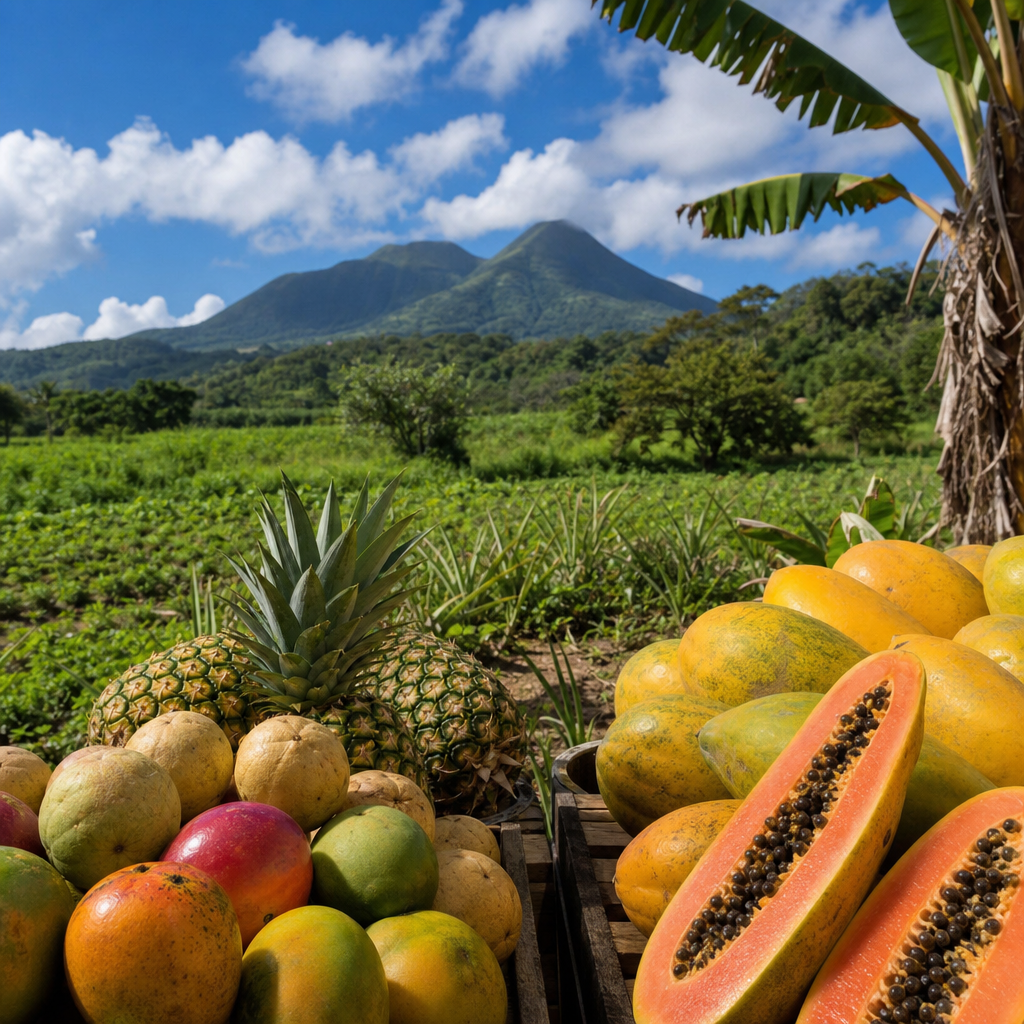
Saint Kitts supports an unusually broad fruit mix for its size. Mango is among the most recognized crops, with multiple varieties ripening at different times and supplying homes, roadside stalls, and juice makers. Banana remains important because it produces relatively quickly and suits local consumption. Papaya is valuable for consistent bearing and market flexibility, since it can be sold ripe for fresh eating or green for culinary use. Coconut is widespread and functions as both a commercial and cultural crop, supplying water, flesh, oil potential, and landscape value. Citrus, especially lime and orange, adds diversity and can feed beverage and condiment production.
Soursop, guava, tamarind, and sugar apple are especially relevant to the island’s identity because they bridge fresh sales and processing. Soursop becomes juice, ice cream, smoothies, and pulp. Guava can move into jam, jelly, and pastries. Tamarind is used in sauces, drinks, and confectionery. Breadfruit and avocado are not always grouped with sweet tropical fruits in popular writing, yet on Saint Kitts they are integral to farm output and local food culture. Breadfruit provides a starchy staple that fits household food security goals, while avocado delivers high-value fresh produce with strong appeal in hospitality channels.
| Fruit | Main farm value | Typical local use | Key production challenge |
|---|---|---|---|
| Mango | Seasonal high demand | Fresh eating, juice, chutney | Fruit fly and uneven ripening |
| Banana | Steady harvest cycle | Fresh market, cooking use | Wind damage and fungal pressure |
| Papaya | Fast-bearing cash crop | Fresh fruit, salads, smoothies | Virus risk and bruising after harvest |
| Coconut | Multiple product streams | Water, grated flesh, oil | Tall tree harvest logistics |
| Soursop | Strong processing potential | Juice, desserts, pulp | Delicate skin and short shelf life |
| Breadfruit | Food security staple | Roasted, boiled, chips | Seasonal glut management |
Seasonality matters because it shapes prices, labor needs, and visitor experience. During heavy mango periods, households may have more fruit than they can consume, which creates opportunity for drying, freezing, and preserves but also highlights postharvest weakness if no buyer is lined up. Banana can smooth income because bunches mature on a rolling schedule. Papaya often helps farms maintain market presence between larger seasonal peaks. For a hub page, the central point is simple: Saint Kitts is not dependent on one fruit calendar. The island’s strength is overlap, which supports resilience and keeps local produce visible across much of the year.
How fruit farms operate: cultivation, labor, and postharvest reality
From the outside, tropical fruit farming can look effortless. In reality, farm performance depends on continuous management. Tree spacing must account for canopy spread, airflow, and harvest access. Pruning is not cosmetic; it reduces disease pressure, controls height, and improves light penetration. Soil fertility programs typically combine organic matter, targeted mineral inputs, and weed control suited to slope and rainfall. Irrigation is less common than in arid systems, but water access becomes critical during prolonged dry periods, especially for young trees and papaya stands. Farmers who monitor flowering, fruit set, and pest load closely consistently outperform those who rely on rainfall and hope.
Labor is one of the least discussed constraints on Saint Kitts’ fruit farms. Harvesting mango or avocado at the right maturity stage takes judgment. Cutting bunches of banana safely requires skill and timing. Sorting fruit for hotel buyers is different from loading mixed grades for neighborhood sale. When farms cannot secure enough trained labor, losses rise quickly through missed harvest windows, poor handling, and inadequate field sanitation. I have seen this across Caribbean islands: the distance between excellent fruit on the tree and excellent fruit in the market is usually determined by labor discipline and postharvest care, not by sunshine alone.
Postharvest handling remains decisive. Fruits such as papaya, soursop, and guava bruise easily and lose value fast under heat. Shade at collection points, clean crates instead of sacks, rapid sorting, and short transport times can make the difference between premium sales and waste. Basic cold-chain capacity, even at modest scale, expands options for supplying restaurants and retailers. Packaging also matters for tourism-facing markets, where presentation influences purchase decisions. For many Saint Kitts growers, the biggest gains do not come from planting more acres but from reducing loss after harvest through better grading, timing, and buyer coordination.
Nature, wildlife, and the ecological role of fruit farms
Fruit farms are part of Saint Kitts’ nature story because they create semi-managed habitats that support wildlife beyond the farm gate. Flowering mango, citrus, and guava attract pollinators. Tall coconut and breadfruit trees add vertical structure used by birds. Mixed farms with hedgerows, leaf litter, and ground cover can shelter lizards, beneficial insects, and soil organisms that improve nutrient cycling. In landscapes fragmented by roads or former cane fields, orchards and mixed plots often function as biological connectors between forest edges, ghauts, and settlements. That does not make every farm automatically biodiverse, but well-managed fruit land can be far more ecologically valuable than repeatedly cleared ground.
The balance is nuanced. Fruit attracts wildlife that farmers may view as pests, including monkeys and birds that damage ripening crops. On Saint Kitts, the African green monkey is a well-known agricultural challenge, capable of causing significant losses in fruits and vegetables. Netting, fencing, harvest timing, and field vigilance help, but control is costly and imperfect. Insect pests such as fruit flies also complicate production and market access. The most effective farms respond with integrated methods: sanitation, trapping, monitoring, pruning, and selective intervention rather than uncontrolled spraying. That approach protects beneficial species while improving crop quality.
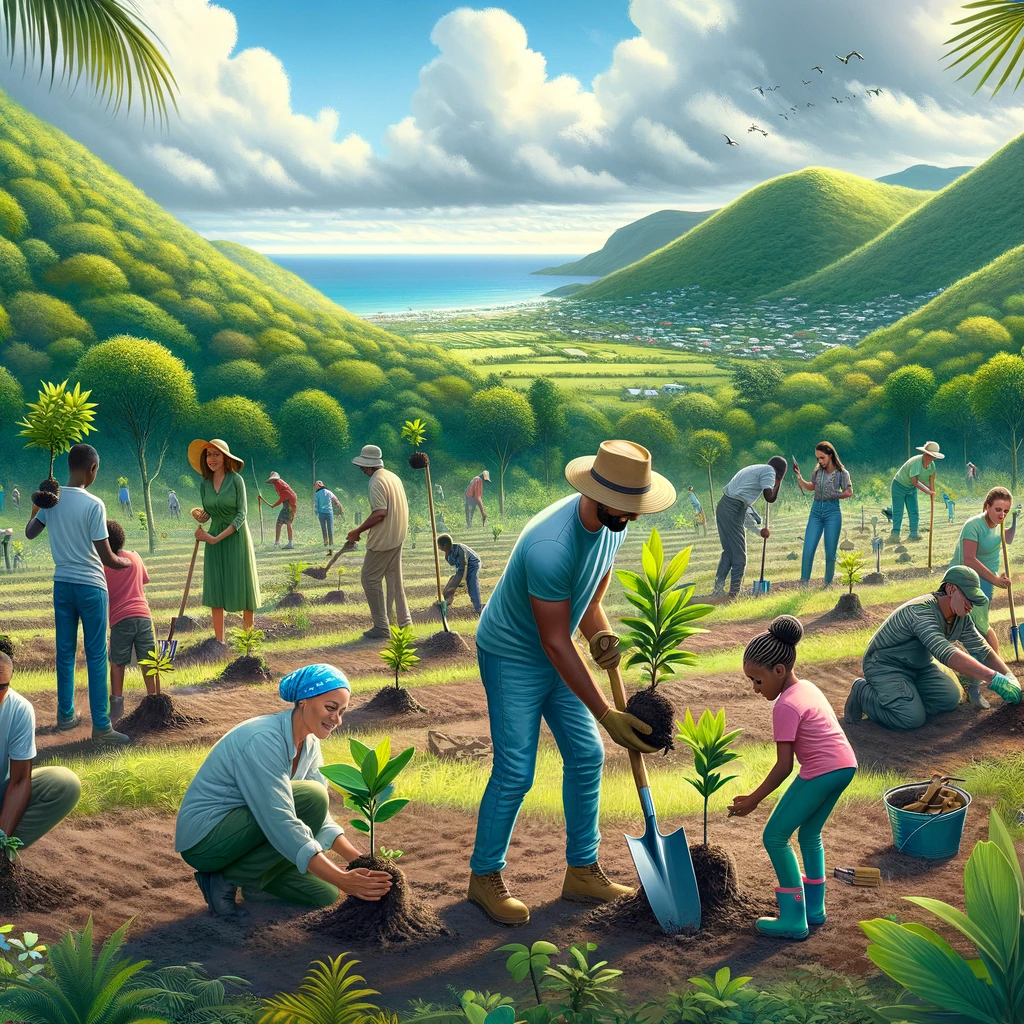
Agroforestry principles are increasingly relevant here. Combining fruit trees with timber species, root crops, herbs, or livestock can improve land efficiency and resilience. Mulching with pruned biomass conserves moisture and feeds soil life. Ground covers reduce erosion on slopes during heavy rain events, which are becoming more important as climate variability increases. For readers interested in related subtopics, fruit farms naturally connect with articles on island forests, pollinators, watershed health, invasive species, and sustainable rural tourism. They are not separate from nature and wildlife; they are one of the clearest examples of humans managing a tropical ecosystem without removing its ecological function entirely.
Markets, tourism, and why fruit farming matters to Saint Kitts’ economy
Fruit farming contributes value to Saint Kitts in several overlapping ways. First, it replaces imported food with local produce, which matters for an island economy exposed to shipping costs and supply shocks. Second, it supports farm income through direct sales, wholesalers, roadside trade, public markets, and hospitality supply. Third, it creates raw material for value-added products such as juices, jams, dried fruit, pepper sauces with fruit bases, frozen pulp, and baked goods. A single mango crop can generate revenue not only as fresh fruit but also through chutney, puree, pastry fillings, and tasting experiences for visitors.
Tourism is especially important because Saint Kitts sells place as much as product. Hotels, restaurants, beach bars, and tour operators all benefit from local fruit. A breakfast buffet with Kittitian papaya and pineapple has more destination value than imported alternatives. Cocktails made with tamarind, coconut, or soursop create an immediate sense of locality. Farm tours, orchard tastings, and culinary events give visitors a reason to engage with the island beyond the cruise port. In destinations across the Caribbean, the strongest farm-to-tourism programs succeed when chefs plan menus around seasonal supply and farmers commit to consistency, grading, and communication.
There are limits. Local production does not always meet the volume, cosmetic uniformity, or year-round standard that larger hotels want. Small farms may struggle with invoicing, transport, food safety documentation, or regular delivery schedules. Yet those barriers are operational, not structural. With cooperative aggregation, better packing, and stronger buyer relationships, fruit farms can capture more tourism spending. As a hub topic, miscellaneous coverage should include this point: the future of Saint Kitts’ fruit sector depends as much on market organization and product development as on what grows in the ground.
Challenges, future opportunities, and what to watch next
Saint Kitts’ fruit farms face clear risks: hurricanes, drought, crop theft, pest pressure, aging farmer populations, and uneven access to capital. Climate variability is the broadest threat because storms can strip trees, salt damage can hit coastal sites, and erratic rainfall disrupts flowering and fruit fill. Tree crops also demand patience. A mango orchard is not a quick fix, and even fast-bearing papaya carries disease and market risk. Farmers therefore need support systems that include extension advice, propagation quality, access to irrigation equipment, and realistic financing tied to crop cycles rather than generic lending models.
At the same time, opportunities are substantial. Improved propagation of grafted mango and avocado can raise uniformity and shorten time to productive harvest. Small-scale processing can absorb seasonal gluts and reduce waste. Digital marketing allows farms to sell boxes directly to residents and visitors. Geographic branding can differentiate Saint Kitts fruit by origin, freshness, and taste. Schools and hotels can source more local produce if procurement systems are simplified. For readers using this page as a gateway, the next articles to explore should include specific fruits, agro-processing, farm tours, conservation farming, and island food traditions linked to orchards and mixed holdings.
Saint Kitts’ fruit farms represent far more than colorful abundance. They show how land, climate, skill, and culture combine to create a productive tropical landscape that feeds people, supports wildlife, and strengthens the visitor experience. The key takeaway is that this bounty is managed, not accidental. Successful farms depend on good site selection, mixed cropping, trained labor, careful postharvest handling, and reliable markets. They also benefit the island beyond agriculture by preserving green space, connecting habitats, and giving local businesses authentic ingredients and stories to share. If you are building a deeper understanding of Saint Kitts under the Nature and Wildlife theme, start here, then follow the links into individual fruit crops, farming systems, and rural experiences to see how this living landscape works in practice.
Frequently Asked Questions
What makes Saint Kitts such a good place for fruit farming?
Saint Kitts has a rare combination of natural advantages that supports productive fruit farming across many parts of the island. Its volcanic soils are typically rich and well-draining, which helps fruit trees and tropical crops develop strong root systems while accessing essential minerals. The island’s warm temperatures, regular sunshine, and seasonal rainfall create favorable growing conditions for a wide range of produce throughout the year. Trade winds also play an important role by improving airflow through orchards and mixed farms, which can help reduce excess humidity around plants and support healthier growing conditions when farms are managed well.
Just as important, fruit farming in Saint Kitts is highly adaptable. Growers do not rely on one single model. Some operate commercial orchards with more structured planting, while others work on small family plots, mixed smallholdings, roadside farms, or agroforestry systems where fruit trees are grown alongside other crops. This flexibility allows farmers to match their production to local conditions, labor availability, and market demand. In practice, that means the island can maintain a diverse and resilient fruit sector that supplies households, hotels, restaurants, processors, and niche export buyers with a steady stream of tropical produce.
What kinds of fruit are commonly grown on Saint Kitts’ farms?
Saint Kitts’ fruit farms are known for their diversity, and that diversity is one of the sector’s biggest strengths. The island is widely associated with tropical staples such as mango, banana, and papaya, all of which are well-suited to the local climate. Growers also cultivate fruits like coconut, guava, pineapple, breadfruit, soursop, and citrus in many farming districts. On mixed farms, it is common to see several fruit varieties growing together rather than in large single-crop blocks, especially where farmers are supplying local markets and direct customers.
This range matters for both economic and practical reasons. Different fruits mature at different times, which helps spread production across the year and reduces dependence on a single harvest season. It also gives farmers multiple ways to serve the market. Fresh bananas and papayas may go to vendors and supermarkets, mangoes may supply households and hospitality businesses, and coconuts or guavas may be used for juices, preserves, sauces, desserts, or small-scale processing. By growing a variety of fruit, Saint Kitts’ farmers create a broader, more reliable tropical bounty that reflects the island’s landscape and culinary culture.
How do Saint Kitts’ fruit farms supply both local markets and tourism-related businesses?
Fruit farming in Saint Kitts supports a layered market system, and that is one reason it remains so important to the island’s economy and food culture. Local consumers buy fruit through public markets, roadside stands, village shops, supermarkets, and direct farm sales. At the same time, hotels, villas, restaurants, caterers, and juice makers need a regular supply of fresh, attractive produce for guests and food service operations. Because many farms grow multiple fruits and harvest over extended periods, they are well positioned to meet these different types of demand.
For tourism-related businesses, local fruit offers clear advantages. Fresh mango, papaya, banana, pineapple, and coconut can appear in breakfasts, beverages, desserts, and island-inspired dishes that visitors often expect when traveling in the Caribbean. Buying locally can also improve freshness and reduce the time between harvest and service. For farmers, hospitality sales may provide a higher-value outlet, especially when quality, consistency, and timing are managed carefully. In this way, Saint Kitts’ fruit farms do more than produce food; they help connect agriculture with the visitor economy, local identity, and everyday food supply.
Are fruit farms in Saint Kitts mostly large commercial operations or small family-run properties?
They are a mix of both, and that mix is central to understanding agriculture on Saint Kitts. While there are commercial orchards and estate lands with more organized production systems, a significant share of fruit growing also comes from small and medium-sized farms, family plots, roadside holdings, and diversified agricultural properties. Many growers combine fruit with vegetables, root crops, herbs, or livestock, which allows them to use land more efficiently and reduce risk. This creates a farming landscape that is varied rather than uniform.
Small family-run farms are especially important because they often preserve practical local knowledge about seasons, varieties, and cultivation methods suited to specific microclimates on the island. They may serve nearby communities directly and respond quickly to market shifts. Larger operations, on the other hand, may be better equipped to organize volume production, maintain scheduled supply, and pursue buyers in hospitality, processing, or export niches. Together, these different farm types form a complementary system. The result is a fruit sector that is not only productive, but also culturally rooted, economically flexible, and well adapted to the island’s scale.
What challenges do Saint Kitts’ fruit farmers face, and how do they maintain year-round production?
Like tropical growers everywhere, fruit farmers in Saint Kitts work within a changing environment that can present real challenges. Weather variability, including heavy rains, dry spells, and the broader threat of storms during the hurricane season, can affect flowering, fruit set, harvest timing, and crop quality. Farmers also need to manage pests, plant diseases, labor constraints, input costs, and transportation issues, especially when serving multiple markets with perishable produce. Because fruit is often sold fresh, timing and post-harvest handling are critical. Even a high-quality crop can lose value if harvesting, storage, or delivery is not handled properly.
To maintain production across the year, growers rely on diversity, timing, and careful field management. Planting multiple fruit types spreads harvest risk and ensures that when one crop is out of season or underperforming, another may still provide income and supply. Mixed farming systems and agroforestry plots can also improve land use and help create more stable growing conditions. Farmers pay close attention to pruning, spacing, soil health, moisture management, and harvest scheduling so orchards remain productive over time. In practical terms, year-round bounty in Saint Kitts is not accidental. It comes from combining favorable natural conditions with steady work, local experience, and a flexible farming approach that helps producers keep tropical fruit moving from farm to market through much of the calendar.