Music was not background entertainment in Saint Kitts’ long journey to freedom; it was a public language of resistance, memory, and national identity. In Saint Kitts, songs carried news across villages, encoded criticism that could pass beneath official scrutiny, and gave workers, church groups, political activists, and carnival bands a shared way to express grievance and hope. When discussing liberation and independence in the Kittitian context, liberation refers both to emancipation from slavery in the nineteenth century and to the wider political and cultural struggle against colonial hierarchy that continued into the twentieth century, culminating in independence for Saint Christopher and Nevis in 1983. Independence, in turn, was not only a constitutional event. It was also a cultural achievement shaped by speech, ritual, festival, and especially music.
This matters because national history can easily be reduced to dates, legislators, and official ceremonies. That account misses how ordinary people understood change while living through it. I have worked with Caribbean cultural history materials long enough to see that songs often preserve public feeling more accurately than formal reports do. In Saint Kitts, folk singing, work songs, string band traditions, church music, carnival performance, calypso, steelpan, drumming, and later popular recordings all helped people define who belonged, what injustice looked like, and what future they wanted. As a hub within Culture and History, this article explains how music functioned across emancipation, labor protest, nationalism, state formation, and diaspora memory, while pointing to the wider miscellaneous dimensions that make the subject richer than one genre or one political moment.
Music as memory after slavery and apprenticeship
Any serious account of music in Saint Kitts’ liberation must begin with the plantation system. Under British colonial rule, enslaved Africans and their descendants developed musical practices that preserved community under violent conditions. Drumming, call-and-response singing, ring games, religious song, and dance traditions did more than offer relief from labor. They retained African-derived ways of organizing rhythm, leadership, and collective participation. After emancipation in 1834 and the end of apprenticeship in 1838, these practices remained central to village life, wakes, seasonal festivals, and communal gatherings. That continuity mattered politically. A people who can maintain memory can eventually challenge the legitimacy of domination.
In Saint Kitts, as on other sugar islands, post-emancipation society did not suddenly become equal. Land remained concentrated, plantation labor remained coercive, and colonial respectability codes often treated Afro-Kittitian expressive culture as disorderly. Music therefore became one of the few spaces where working people could publicly affirm dignity on their own terms. Folk songs commented on hardship, migration, relationships with estate managers, and the moral failures of elites. Church music also played a significant role. Methodist, Anglican, Moravian, and other congregational singing traditions created disciplined communal performance, literacy through hymn texts, and a language of justice that later fed social activism. Liberation was thus cultural before it was constitutional.
Festival, street performance, and coded political speech
Street performance gave Kittitians an arena where critique could be heard by many at once. Carnival and Christmas sports, including masquerade traditions, clowns, mummers, drummers, and bands, were never politically neutral. Colonial administrators often saw these events as threats because they gathered large crowds, blurred class boundaries, and rewarded wit, satire, and verbal improvisation. In practice, performers could mock authority, dramatize social inversion, and celebrate black creativity in spaces from which formal power excluded them. Music made those performances memorable and repeatable. A slogan in a speech disappears quickly; a chorus in the street can move from one district to another in days.
Calypso later sharpened this function. Although Trinidad is the best-known center of calypso, the form became deeply important across the Eastern Caribbean, including Saint Kitts and Nevis. Calypsonians turned current events into singable commentary. They could praise labor leaders, criticize taxation, question colonial administrators, or expose hypocrisy with humor rather than direct confrontation. That indirectness was a political advantage. In small colonial societies where employment, policing, and reputation were tightly controlled, music allowed truth-telling with a measure of protection. I have repeatedly found that communities remember controversial episodes through song titles and refrains long after they forget official committee language.
Labor struggle, union culture, and the sound of organized resistance
The twentieth-century labor movement transformed music from diffuse cultural resistance into a clearer instrument of mass politics. Saint Kitts’ sugar economy relied heavily on low-paid black labor, and economic inequality intensified during global downturns. The labor disturbances of the 1930s were part of a wider British Caribbean crisis documented by the Moyne Commission, whose investigations exposed poverty, poor housing, weak wages, and limited political representation. In Saint Kitts, public meetings, marches, and worker organization depended on sound as much as on text. Songs unified crowds, set marching rhythm, repeated demands, and translated politics into language workers could own collectively.
The rise of the St. Kitts-Nevis Trades and Labour Union and the political movement associated with Robert Llewellyn Bradshaw created conditions in which music and politics openly intersected. Campaign meetings were not sterile affairs. Brass bands, string bands, choral groups, and community singers created atmosphere before speeches and carried messages afterward. Labor songs did not need formal publication to be effective. A simple chorus about wages, land, dignity, or solidarity could travel by memory through cane fields, villages, and town yards. Music reduced the distance between leadership and supporters. It turned abstract goals such as representation and self-government into felt, repeatable experiences.
| Historical phase | Musical forms heard most often | Political function | Typical setting |
|---|---|---|---|
| Post-emancipation era | Folk songs, drumming, hymn singing | Preserved memory, affirmed dignity, built community | Villages, churches, wakes, seasonal gatherings |
| Early twentieth century | String bands, brass bands, festival music | Spread commentary, shaped public opinion | Street parades, public celebrations, town events |
| Labor movement and constitutional reform | March songs, calypso, meeting music | Mobilized workers, reinforced party and union identity | Rallies, marches, union meetings |
| Independence period and after | Calypso, steelpan, patriotic songs, recordings | Narrated nationhood, debated federation, preserved memory | Carnival tents, radio, schools, state ceremonies |
Calypso, carnival, and the debate over nationhood
By the mid-twentieth century, calypso had become one of the clearest ways to hear political opinion in Saint Kitts and Nevis. It rewarded topicality, strong phrasing, memorable hooks, and public judgment. Audiences did not passively consume calypso; they evaluated whether a singer had told the truth, distorted facts, or captured the mood of the moment. That public testing gave the form unusual civic value. In election seasons and periods of constitutional change, calypso could condense complex debates into lines ordinary citizens repeated at work, in minibuses, at rum shops, and in market spaces. Few media channels in a small island society had equal reach.
Carnival amplified that reach. Tents and competitions gave singers an audience primed for commentary, while radio helped songs circulate beyond the event itself. Musical competition also encouraged sharper political writing. A strong calypso on federation, local governance, social inequality, or corruption could become part of the public archive. Independence in 1983 did not end debate; it intensified questions about what nationhood should mean in a federation of Saint Kitts and Nevis with distinct local identities. Music helped manage that tension by creating symbolic common ground, even when lyrics openly acknowledged disagreement. A durable nation requires forms through which disagreement can remain public without becoming destructive.
Steelpan, bands, and the performance of national pride
Steelpan deserves special attention because its regional symbolism reaches beyond entertainment. Originating in Trinidad and Tobago, the steelpan became a Caribbean emblem of creativity under pressure: discarded industrial material transformed into a disciplined, modern instrument. In Saint Kitts, pan ensembles and bands contributed to festival life, school culture, and national celebration, especially in the decades surrounding independence. Their importance was not only musical. Steelpan signaled that Caribbean modernity did not have to imitate Britain in order to be legitimate. It could sound local, black, innovative, and technically sophisticated at the same time.
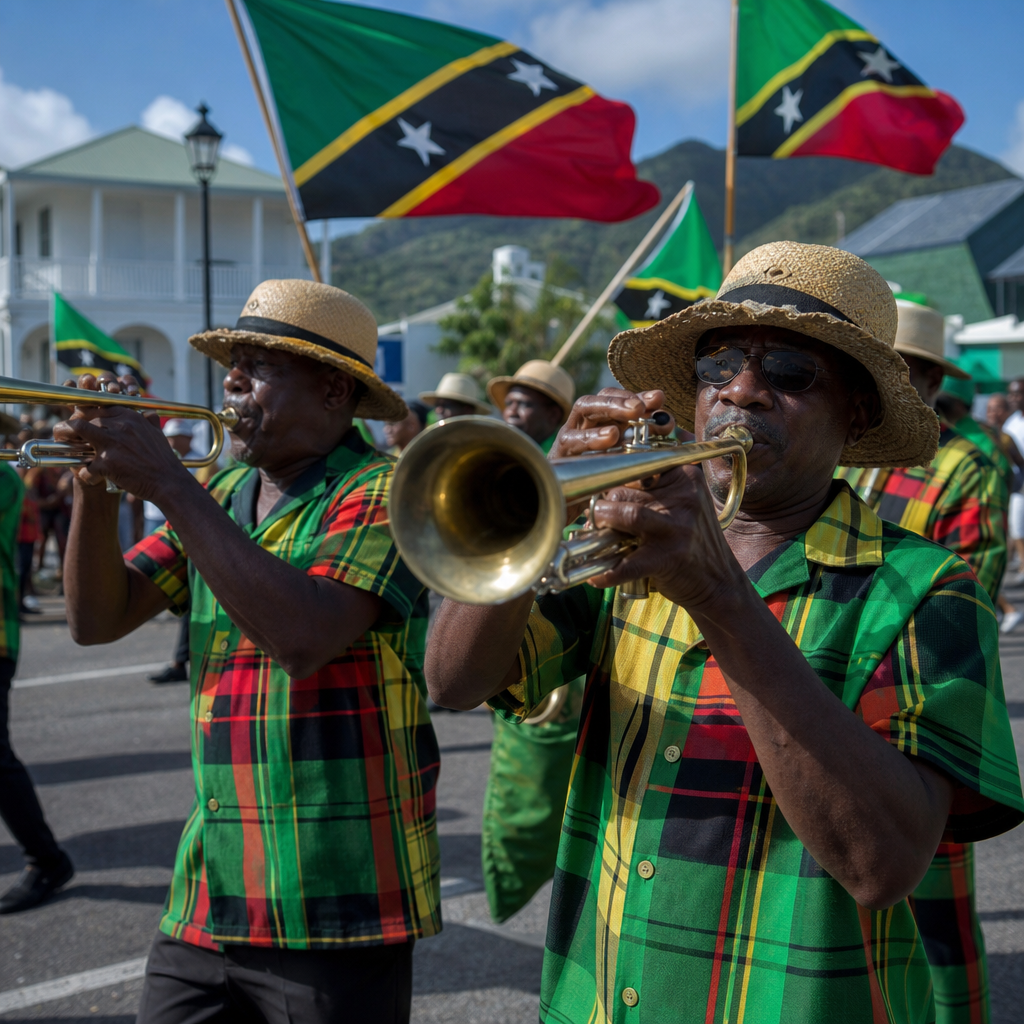
National ceremonies rely on this kind of symbolism. Marches, flag-raising events, school performances, and commemorations use arranged music to teach belonging. In Saint Kitts, patriotic repertoire, anthemic songs, and festival performances helped convert independence from a constitutional transfer into an emotional reality. I have seen this pattern across the region: people often feel the nation first through ceremony, repetition, and song before they can explain it through civics. Bands made that process visible and audible. They also created training grounds for youth discipline, notation, rehearsal culture, teamwork, and public representation. Those are civic skills as much as artistic ones.
Radio, recording, and the Kittitian voice at home and abroad
Music became even more politically significant once broadcasting and recording expanded. Radio in small island states has always been more than entertainment infrastructure; it is a nation-building medium. Songs aired repeatedly can normalize a shared vocabulary of belonging across class and district lines. For Saint Kitts, recorded calypso, gospel, string band music, and patriotic songs helped fix moments of struggle and celebration in public memory. A live performance reaches those present. A recording turns it into evidence, teaching material, and heritage object.
The diaspora added another layer. Kittitians living in the United Kingdom, the United States, the U.S. Virgin Islands, and elsewhere carried songs that preserved attachment to home while also reshaping identity abroad. Diaspora dances, association events, and cultural programs often used music to explain Saint Kitts to second-generation audiences. This matters for liberation history because migration was part of the social reality produced by colonial economics. Songs about home, hardship, return, and pride connected personal mobility to collective history. They also created feedback loops: musicians influenced by overseas scenes brought back new arrangements, instruments, and production styles, widening how independence could be imagined sonically.
Why this miscellaneous hub matters for culture and history
The role of music in Saint Kitts’ liberation and independence cannot be confined to one neat category, which is why a miscellaneous hub is useful. The story touches labor history, religion, carnival studies, oral tradition, colonial governance, education, migration, media, and memory. It includes formal composers and anonymous singers, state ceremonies and roadside satire, church choirs and calypsonians, local bands and diaspora performers. Each contributed differently. Some songs preserved inherited memory; others organized workers; others celebrated constitutional milestones; still others questioned whether official independence had delivered full social justice.
For readers exploring Culture and History more broadly, music offers an efficient entry point into the entire Kittitian experience. It reveals how power was challenged when newspapers were limited, how public opinion formed before mass television, how black identity was asserted despite colonial standards, and how a small island society negotiated modern nationhood. It also reminds us to read beyond archives created by administrators. To understand Saint Kitts fully, listen to what people sang, where they sang it, and why certain refrains survived. Explore related articles on carnival traditions, labor history, church culture, broadcasting, and diaspora life, because together they show that music did not merely accompany liberation and independence in Saint Kitts; it helped make both imaginable, popular, and enduring.
Frequently Asked Questions
How did music function as a tool of resistance in Saint Kitts before independence?
In Saint Kitts, music was far more than entertainment; it was a practical and symbolic tool of resistance. Long before formal independence, songs helped ordinary people speak about injustice in ways that were memorable, communal, and often difficult for authorities to control. In plantation society and in the generations that followed emancipation, music allowed people to express anger, endurance, and political awareness without always relying on official platforms. Lyrics could be direct, but they could also be coded, using metaphor, satire, and local references to criticize power while avoiding immediate punishment. That made music especially valuable in a society where open dissent could carry real consequences.
Songs also moved information. In communities where not everyone had equal access to newspapers, formal political meetings, or positions of influence, music carried ideas across villages and social groups. A chorus repeated at a gathering, church event, labor meeting, roadside lime, or carnival performance could spread news, shape opinion, and reinforce shared grievances. Workers, activists, and performers used these musical spaces to connect personal hardship to broader political conditions, including exploitation, inequality, and the unfinished legacy of slavery and colonial rule.
Just as importantly, music turned resistance into something collective. A speech may be heard once, but a song can be sung again and again. That repetition helped communities remember events, name their struggles, and imagine change together. In the Kittitian experience, liberation was not only about legal or constitutional milestones; it was also about building a public voice. Music gave people that voice, and in doing so, it became one of the most powerful cultural instruments in the island’s long journey toward freedom and self-definition.
What kinds of music were most important in shaping liberation and independence consciousness in Saint Kitts?
The music most important to liberation and independence consciousness in Saint Kitts was not limited to one single genre. Instead, it emerged from a range of traditions that reflected everyday life on the island. Folk songs, work songs, church music, carnival performance, string band traditions, and later popular Caribbean forms all played meaningful roles. Each of these musical expressions reached different audiences, but together they helped create a shared language of memory, protest, identity, and aspiration.
Folk and work-related songs were especially important because they were rooted in the lived experiences of laboring people. These forms often preserved stories of hardship, survival, and social inequality that formal records either minimized or ignored. They carried the emotional truth of plantation life, post-emancipation struggle, and the continued demand for dignity. Church music also mattered deeply. Religious spaces were among the few institutions where Black communities could gather with a degree of continuity and organization, and hymns, choirs, and sacred performance helped shape moral arguments about justice, deliverance, and human worth. Even when not overtly political, this music helped sustain a worldview in which oppression was neither natural nor permanent.
Carnival and street-based performance traditions were equally significant because they opened public space for commentary, humor, inversion, and social critique. Through performance, costume, rhythm, and lyric, musicians and masqueraders could challenge social hierarchies, mock elites, and express community frustration in ways that felt both celebratory and politically charged. As political consciousness developed through labor movements and anticolonial activism, these musical traditions became even more potent. They offered recognizable local forms through which larger ideas about self-rule, pride, and national belonging could be voiced. In that sense, the music that shaped independence consciousness in Saint Kitts was important not because it fit a narrow category, but because it grew out of the island’s own social life and spoke directly to the people whose freedom was at stake.
Why was music so effective at expressing political ideas in Saint Kitts?
Music was effective in Saint Kitts because it combined accessibility, emotional power, and collective participation. Political ideas can sometimes seem distant when they appear only in speeches, party documents, or official debates. Music changes that. It puts ideas into language people can remember, repeat, and feel. A melody helps a message travel. A chorus invites participation. A performance turns listeners into a public. In a small island society where community networks were strong and oral culture remained important, that made music one of the most efficient ways to communicate serious social and political meaning.
Another reason music worked so well is that it could carry multiple levels of meaning at once. A song might sound festive on the surface while containing sharp criticism underneath. It could speak to labor conditions, class inequality, colonial arrogance, racial injustice, or the desire for self-determination without always naming those subjects in overtly confrontational terms. That flexibility mattered in periods when direct criticism of authority was risky or unwelcome. Through wit, repetition, storytelling, and symbolism, musicians could articulate grievances in ways that resonated widely while still leaving room for interpretation.
Music also helped bridge social divisions. It could reach workers and churchgoers, activists and market vendors, young people and elders. It moved across formal and informal settings, from village gatherings to public celebrations. Because it was participatory, it encouraged not just private agreement but shared feeling. People did not merely hear political ideas in music; they embodied them by singing, dancing, clapping, marching, and remembering together. That communal experience helped transform political awareness into cultural confidence. In Saint Kitts, that was crucial, because the path to independence required not only constitutional change but also a strong sense that the people had a history, a voice, and a right to define themselves.
How did music help preserve historical memory during Saint Kitts’ journey to liberation and independence?
Music preserved historical memory in Saint Kitts by keeping lived experience alive in forms that communities could pass from one generation to the next. Not every struggle was fully documented in official archives, and even when records existed, they often reflected the viewpoint of colonial administrators rather than the people most affected by exploitation and inequality. Songs helped fill that gap. They stored fragments of community history: labor struggles, social hardship, resistance to injustice, religious hope, village pride, and the emotional afterlife of slavery and colonial control. In this way, music became a people’s archive.
This role was especially important because liberation in the Kittitian context was layered. It referred not only to emancipation from slavery, but also to later efforts to overcome the enduring structures of colonialism, economic dependence, and limited political power. Music linked these eras together. A song might carry memories of suffering inherited from earlier generations while also speaking to present demands for rights, representation, and national dignity. That continuity helped people understand independence not as an isolated political event, but as part of a longer historical struggle.
Music also preserved memory by attaching history to feeling. Facts matter, but songs help people remember why those facts mattered. Melodies, refrains, and performances create emotional associations that endure. A community may forget the exact wording of a speech, yet still remember a chorus that captured fear, defiance, or hope. In Saint Kitts, this made music central to national consciousness. It did not simply recount the past; it interpreted it, honored it, and made it usable in the present. That is one reason music remains so important when discussing liberation and independence: it kept the island’s struggles audible, personal, and impossible to reduce to dates alone.
What is the lasting legacy of music in Saint Kitts’ independence story today?
The lasting legacy of music in Saint Kitts’ independence story is that it continues to shape how the nation understands itself. Music helped people endure domination, articulate grievance, and celebrate the possibility of freedom. Because of that, it remains tied to ideas of identity, resilience, and belonging. Modern Kittitian culture still draws strength from the traditions that sustained earlier generations, and national celebrations, heritage events, and public commemorations often rely on music to reconnect the present with the island’s historical journey.
That legacy also survives in the way music validates local voice. Independence is not only about sovereignty on paper; it is also about cultural confidence. When Kittitians perform, preserve, and reinterpret their own musical traditions, they affirm that their history and perspective matter. This is especially significant in postcolonial societies, where imported cultural standards have often overshadowed local expression. Music pushes back against that by insisting that the sounds, stories, rhythms, and language of the island are worthy of respect. It reinforces the idea that nationhood is lived through culture as much as through government institutions.
Perhaps most importantly, the legacy of music in Saint Kitts is educational. It reminds younger generations that freedom was not automatic and identity was not handed down fully formed. Both were built through struggle, community, and expression. Songs and performance traditions continue to offer an accessible way to teach that history, not as something distant and ceremonial, but as something deeply human. In that sense, the role of music in Saint Kitts’ liberation and independence is not confined to the past. It remains an active force in how the nation remembers, explains, and renews itself.