Traditional crafts of Saint Kitts preserve the island’s memory in forms people can touch, use, and pass on. In a tourism economy where beaches and resort imagery often dominate attention, handmade objects tell a deeper story about survival, adaptation, faith, family, and local pride. When people talk about traditional crafts of Saint Kitts, they usually mean skills rooted in everyday island life: straw weaving, wood carving, pottery, embroidery, batik-inspired textile work, leatherwork, basket making, calabash craft, and practical household arts once essential in villages across the island. These crafts matter because they connect present-day Kittitians and visitors to the island’s agricultural past, Afro-Caribbean heritage, colonial history, and creative independence. They also support cultural tourism, small business growth, and intergenerational learning.
I have worked on Caribbean cultural content and spoken with artisans and heritage organizers across the region, and one pattern appears everywhere: a craft survives when it remains useful, teachable, and visible. Saint Kitts is no exception. The island’s craft traditions did not emerge in museums. They developed in homes, sugar estates, church communities, market spaces, and fishing villages where people used local materials because imported goods were scarce or expensive. Palm leaves became hats and baskets. Timber became furniture, utensils, and decorative carvings. Clay became cooking vessels. Fabric scraps became practical coverings, gifts, and ceremonial items. Even where exact techniques have evolved, the logic behind them remains the same: make durable things from available resources, and make them beautifully.
This hub article explains the main traditional crafts associated with Saint Kitts, how they developed, why some declined, and what is helping keep them alive today. It also serves as a broad guide to the miscellaneous side of local life and experiences, bringing together the many smaller stories that do not fit neatly into one category but shape how the island feels. If you want to understand Saint Kitts beyond attractions, studying its craft traditions is one of the most direct and rewarding ways to begin.
What Counts as a Traditional Craft in Saint Kitts
A traditional craft is a handmade practice passed through generations and tied to local materials, customs, or daily needs. In Saint Kitts, that definition includes both older survival-based skills and newer heritage crafts that have become culturally symbolic. Not every handcrafted souvenir qualifies. A machine-printed magnet imported in bulk may be sold on the island, but it does not express Kittitian craft heritage. A handwoven basket made from local fibers, a carved wooden piece by a village artisan, or a textile dyed using island-inspired motifs does.
Saint Kitts shares regional similarities with other Eastern Caribbean islands, yet its craft identity is shaped by its own landscape and economy. The sugar industry influenced labor patterns, trade access, and domestic production for centuries. Rural households often relied on repair, reuse, and hand fabrication. That practical culture helped sustain skills such as weaving, stitching, carving, and making containers from natural materials. Today, some of those crafts survive in their original form, while others continue as adapted products for local events, home décor, heritage festivals, and visitor markets.
It is also important to understand that traditional craft is not frozen in one historical moment. A craft can remain traditional even when artisans use improved tools or produce for modern customers. The continuity lies in technique, material knowledge, design vocabulary, and cultural meaning. That is why a contemporary Kittitian artisan selling hand-finished straw accessories or carved pieces at a community market can still be part of a living tradition rather than a staged reenactment.
Weaving, Basketry, and Fiber Arts
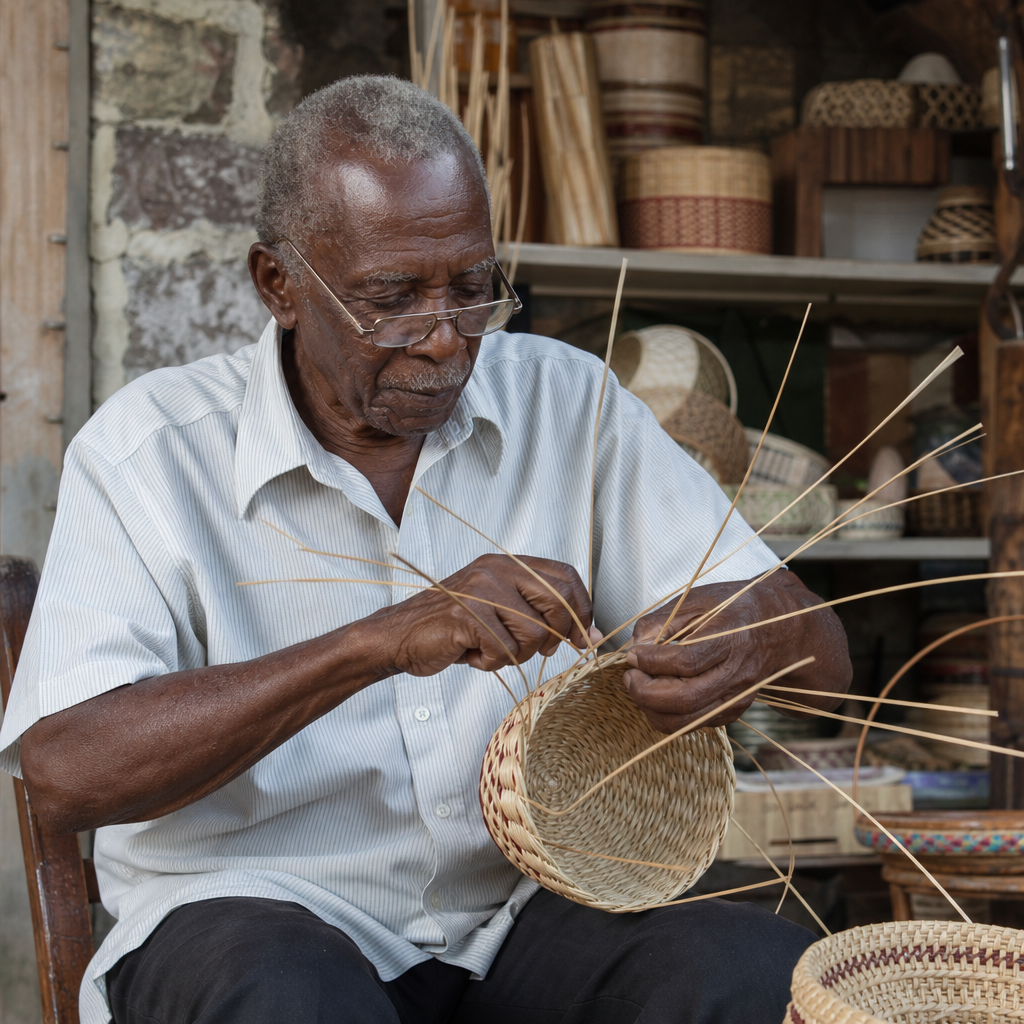
Weaving is among the most widely recognized traditional craft forms in the Caribbean, and Saint Kitts has long participated in that wider regional practice. Basketry and plaiting historically relied on plant materials such as palm, cane, and other flexible fibers available on the island. In practical terms, people made market baskets, storage containers, mats, hats, and carriers for produce or household goods. The craft required detailed material knowledge: which leaves cut cleanly, which needed drying, how long fibers should cure before use, and how tightly each strand could be pulled without breaking.
In many island communities, weaving skills were learned informally. Children watched elders split leaves, sort strips by width, and build patterns from the base upward. That process was about more than making an object. It taught patience, hand strength, counting, symmetry, and thrift. A well-made basket had to hold weight, resist wear, and maintain shape in a humid climate. Decorative appeal mattered, but function came first.
Today, woven craft in Saint Kitts often appears in souvenir items, home accents, and festival displays. The challenge is that fewer young people depend on these objects for daily life. Plastic and imported goods replaced many handmade containers decades ago. As a result, survival now depends on repositioning weaving as heritage design rather than necessity. Workshops, school demonstrations, and cultural fairs are effective because they let people see the process live. Once someone watches a skilled artisan turn dried fibers into a strong, even basket, the craft gains value beyond price alone.
Wood Carving, Utility Objects, and Decorative Work
Wood craft in Saint Kitts sits at the intersection of necessity and artistry. Historically, carpenters and carvers made stools, benches, paddles, kitchen utensils, walking sticks, storage pieces, and simple furniture using available timber. Over time, decorative carving expanded that tradition into masks, animal figures, island scenes, and symbolic motifs sold in local markets. The best work still reflects knowledge of grain direction, moisture content, finish selection, and appropriate tool use rather than simply rough shaping.
One reason woodcraft remains culturally significant is that it visibly records the maker’s hand. Tool marks, burnishing, and finishing choices cannot be replicated by mass production with the same authenticity. In my experience evaluating handmade tourism products, buyers respond strongly when artisans explain the wood species used, the intended function, and the reason for a certain pattern or figure. That story transforms a carved bowl or figurine from generic décor into cultural evidence.
Wood artisans on small islands face real constraints. Sustainable sourcing matters. Hardwoods may be limited, expensive, or protected, and green wood can warp if rushed into production. Skilled artisans therefore balance tradition with environmental responsibility, sometimes using reclaimed wood or smaller pieces for detailed work. When craft programs teach both carving technique and material stewardship, they protect heritage without encouraging wasteful extraction.
Textiles, Needlework, and Batik Influence
Textile traditions in Saint Kitts include sewing, embroidery, crochet, and decorative household stitching that once formed a quiet but important part of domestic life. These crafts were often associated with church communities, family preparation, and women’s skilled labor, though men also worked in tailoring and fabric trades. Handmade table linens, cushion covers, baby items, and ceremonial garments carried social value because they marked care, respectability, and occasion.
Any discussion of fabric arts in Saint Kitts should also note the wider influence of batik through the island’s cultural economy, especially as visitors connect colorful Caribbean textiles with local identity. While batik is most famously associated on Saint Kitts and Nevis with the nearby heritage setting of Romney Manor on St. Kitts, its broader significance is educational: it shows how historical textile methods can be revived, demonstrated, and sold in ways that keep craftsmanship visible. Wax-resist dyeing demands planning, design discipline, and controlled layering of color, making it a strong example of traditional process adapted for a modern market.
Needlework survives more easily than some other crafts because it requires less space and can be taught with modest equipment. Still, it competes with cheap imported fabric goods. The strongest path forward is specialization. Handmade embroidery for weddings, custom heritage gifts, school uniforms with fine finishing, and locally designed textile accessories give artisans a market where quality matters more than mass-produced price.
Pottery, Clay, and Calabash Traditions
Clay work and vessel making have deep roots across the Caribbean, though surviving production varies sharply by island. In Saint Kitts, pottery has not remained as commercially dominant as in places with stronger continuous clay industries, yet clay craft still matters historically as part of domestic food preparation and storage culture. Earthen vessels were valued for practical reasons: they could store water, hold dry goods, and tolerate cooking heat depending on the clay body and firing method used. Traditional pottery required site-specific knowledge of local clay quality, tempering material, drying time, and kiln or open-fire management.
Calabash craft belongs in the same conversation because it reflects the island habit of turning natural materials into durable household items. Dried calabash gourds could be cleaned, cut, polished, and decorated into bowls, ladles, containers, or musical elements. The appeal of calabash lies in efficiency: the shape is given by nature, but finishing it into a useful object requires judgment and care.
| Craft type | Traditional material | Common historical use | Modern revival path |
|---|---|---|---|
| Basketry | Palm, cane, fibers | Carrying produce, storage | Workshops, décor, gift markets |
| Wood carving | Local or reclaimed timber | Utensils, furniture, tools | Artisan branding, custom commissions |
| Needlework | Cotton, thread, fabric scraps | Linens, garments, ceremonial items | Specialty textiles, event pieces |
| Clay and calabash | Earthen clay, gourds | Cooking, serving, storage | Heritage demonstrations, studio craft |
Because these forms are less visible in everyday commerce, they benefit greatly from interpretation. Museums, heritage houses, and cultural festivals should not only display finished pieces but explain how firing, curing, polishing, and sealing work. Process education is often the difference between a craft being admired and being understood.
How Crafts Survived Social and Economic Change
The biggest threat to traditional crafts of Saint Kitts was not lack of talent. It was structural change. Imported manufactured goods became cheaper, faster to obtain, and socially associated with modern living. Urbanization and migration reduced the number of households where children regularly observed elders making practical items by hand. Tourism created a market for crafts, but it also created pressure to produce quickly, cheaply, and in standardized forms that can weaken authenticity.
Even so, many traditions endured because they adapted. Artisans shifted from pure utility to heritage presentation. A market basket became a decorative planter. A hand-stitched cloth became a wedding keepsake. A carved tool handle became a polished souvenir with a story attached. This kind of adaptation is not cultural loss by default. It is often the only viable route to continuity, provided the original techniques and meanings are still taught accurately.
Institutions matter here. Community groups, schools, tourism boards, national heritage departments, and event organizers all influence whether traditional crafts remain visible. Independence celebrations, agricultural fairs, and cultural showcases create demand for demonstration and sales. The more often artisans are treated as knowledge holders rather than vendors alone, the stronger the craft ecosystem becomes.
Why Traditional Crafts Still Matter to Local Life and Experiences
Traditional crafts of Saint Kitts matter because they make culture tangible. Music can be heard and food can be tasted, but craft can be held, repaired, used, and inherited. For residents, that means continuity with parents and grandparents who made beauty out of limited means. For visitors, it offers a more accurate experience of the island than generic imported souvenirs ever can. Buying directly from an artisan also keeps more value in the local economy.
Craft traditions strengthen identity in practical ways. They give schools material for heritage education. They create small-scale entrepreneurship opportunities, especially for women, retired workers, and rural makers. They support festivals, hotel gift shops, museum programming, and cultural tours. They also encourage sustainable thinking by showing how local natural materials can be used carefully and creatively.
If you are exploring the miscellaneous side of local life and experiences in Saint Kitts, crafts are an ideal hub topic because they connect to almost everything else: agriculture, architecture, religion, music, family ceremony, tourism, and memory. Keeping the past alive does not mean rejecting the present. It means recognizing which skills carry the island’s character and giving them room to remain useful. Seek out local markets, heritage sites, artisan demonstrations, and community events. Ask how something was made, who taught the maker, and what the object was originally for. That simple curiosity helps keep traditional crafts of Saint Kitts alive for the next generation.
Frequently Asked Questions
What are the most important traditional crafts of Saint Kitts?
The traditional crafts of Saint Kitts are closely tied to the island’s daily history, natural materials, and community life. Some of the most recognized forms include straw weaving, basket making, wood carving, pottery, embroidery, leatherwork, and textile arts influenced by batik-style techniques. These were not originally viewed only as decorative arts. In many cases, they began as practical skills used to meet household needs, support local trade, mark religious or family occasions, and make use of materials readily available on the island.
Straw weaving and basket making, for example, reflect a long tradition of creating useful objects from plant fibers for storage, transport, and domestic use. Wood carving often drew on both utility and artistry, producing items such as stools, utensils, or decorative pieces shaped by local experience and inherited skill. Pottery connects to traditions of making vessels and containers by hand, while embroidery and textile work express patience, identity, and personal craftsmanship through clothing, linens, and ornamental household items. Leatherwork also played a role in producing durable goods that were useful in work and everyday life.
What makes these crafts especially important is that they preserve memory in physical form. They show how Kittitians adapted to island conditions, transformed simple materials into lasting objects, and passed knowledge through generations. Even when modern manufactured goods became widely available, these crafts continued to matter because they carry stories of resilience, resourcefulness, and pride. Today, they remain important not just as heritage items, but as living expressions of Saint Kitts’ cultural identity.
Why do traditional crafts matter in Saint Kitts today?
Traditional crafts matter in Saint Kitts because they help protect parts of the island’s identity that can easily be overshadowed by more commercial images of tourism. Visitors often arrive thinking first of beaches, sunshine, and resorts, but handmade crafts reveal a deeper and more intimate story. They speak to how people lived, worked, celebrated, worshipped, and supported one another over time. A woven basket, carved wooden object, embroidered cloth, or hand-finished leather piece can communicate local history in a way that feels direct and human.
These crafts also matter because they connect generations. Many traditional techniques are learned by watching, practicing, and listening to older family or community members. That means every skill passed on carries more than technique alone. It carries values such as patience, discipline, care for materials, and respect for inherited knowledge. In that sense, craft traditions are a form of education and cultural continuity, not just artistic production.
There is also an economic and social dimension. In a modern island economy, traditional crafts can create opportunities for artisans, small businesses, cultural vendors, and heritage-focused tourism. When local people make and sell authentic handmade work, they keep more cultural value rooted in the community. At the same time, buyers gain objects with meaning rather than generic souvenirs. Most importantly, traditional crafts matter because they keep the past visible and usable in the present. They remind Saint Kitts that its history is not only found in archives or monuments, but also in the skills of human hands.
How have Saint Kitts’ traditional crafts been passed down through generations?
In Saint Kitts, traditional crafts have most often been passed down through informal teaching within families and communities. Rather than being preserved only in textbooks or formal institutions, many skills survived because elders demonstrated them in everyday settings. A child might watch a parent, grandparent, neighbor, or church member weave, sew, carve, or shape materials by hand, and then slowly begin to imitate the process. This kind of learning is deeply personal. It depends on repetition, observation, correction, and trust between generations.
Craft knowledge has also been transmitted through community events, church life, village networks, and local markets where artisans could display their work and younger people could see what was possible. In some cases, practical necessity helped keep traditions alive. Before imported goods became common or affordable, handmade items were often needed for household use, storage, clothing repair, farming support, or ceremonial occasions. Because of that, craft skills were not treated as hobbies alone; they were part of functioning island life.
Today, transmission often happens in a more deliberate way through cultural programs, artisan workshops, school projects, heritage demonstrations, and tourism-related events. These efforts are important because modern life does not always naturally create the same opportunities for patient apprenticeship. Younger generations have many competing demands and influences, so craft preservation now requires intentional support. Even so, the most successful passing on of these traditions still tends to happen when the skill is taught as part of a relationship and a story, not simply as a product-making exercise. That human connection is a major reason traditional crafts remain meaningful in Saint Kitts.
What challenges do traditional artisans in Saint Kitts face?
Traditional artisans in Saint Kitts face several serious challenges, many of which are common in small island economies. One of the biggest is competition from imported, mass-produced goods. Factory-made items are often cheaper, faster to produce, and more widely available, which can make handmade craftwork seem expensive to buyers who do not understand the time, skill, and cultural value behind it. This creates pressure on artisans to lower prices or alter their work in ways that may weaken tradition.
Another challenge is the gradual loss of intergenerational knowledge. As lifestyles change and younger people pursue different career paths, fewer may have the time or motivation to learn labor-intensive traditional methods. If an older craftsperson retires or passes away without teaching others, unique techniques can disappear quickly. Access to natural materials can also become more difficult due to land use changes, environmental pressures, or shifts in local supply chains. A craft tradition is hard to sustain if the raw materials are no longer easy to find, prepare, or afford.
Marketing and visibility are additional concerns. Many artisans produce deeply authentic work but may lack access to strong promotional channels, steady retail spaces, or online platforms that connect them with broader audiences. In tourism settings, there is sometimes pressure to produce simplified versions of cultural goods for quick sale, which can blur the line between genuine craftsmanship and generic souvenir production. Despite these obstacles, many artisans continue because they see themselves as caretakers of heritage. Supporting them through education, fair pricing, cultural programming, and local appreciation is one of the best ways Saint Kitts can keep its traditional crafts alive.
How can visitors and locals support the traditional crafts of Saint Kitts?
Visitors and locals can support the traditional crafts of Saint Kitts in practical and meaningful ways, starting with how they choose to buy. Purchasing directly from artisans, craft markets, heritage fairs, or reputable local cultural outlets helps ensure that money goes to the people actually making the work. It also encourages the continuation of authentic skills rather than the spread of imported imitation goods. When buying, it helps to ask questions about materials, process, and meaning. That conversation shows respect and often deepens appreciation for the object itself.
Support also means recognizing that handmade work deserves fair value. A woven basket, carved item, embroidered piece, or hand-dyed textile may take hours or days to complete. Paying a fair price is not simply a transaction; it is an investment in cultural survival. For locals, support can include attending exhibitions, recommending artisans, encouraging schools and community groups to include heritage crafts in their programs, and helping younger people see these traditions as valuable and relevant rather than old-fashioned.
Visitors can go further by seeking out cultural experiences that feature live demonstrations, workshops, or storytelling around craft traditions. These experiences often create a more respectful connection to Saint Kitts than buying anonymous souvenirs. Sharing artisan work responsibly on social media, with proper credit and context, can also increase visibility. Ultimately, the strongest support comes from treating traditional crafts not as curiosities, but as important expressions of Saint Kitts’ history, creativity, and endurance. When communities and visitors value the maker as much as the object, they help keep the island’s past alive in a lasting and honorable way.