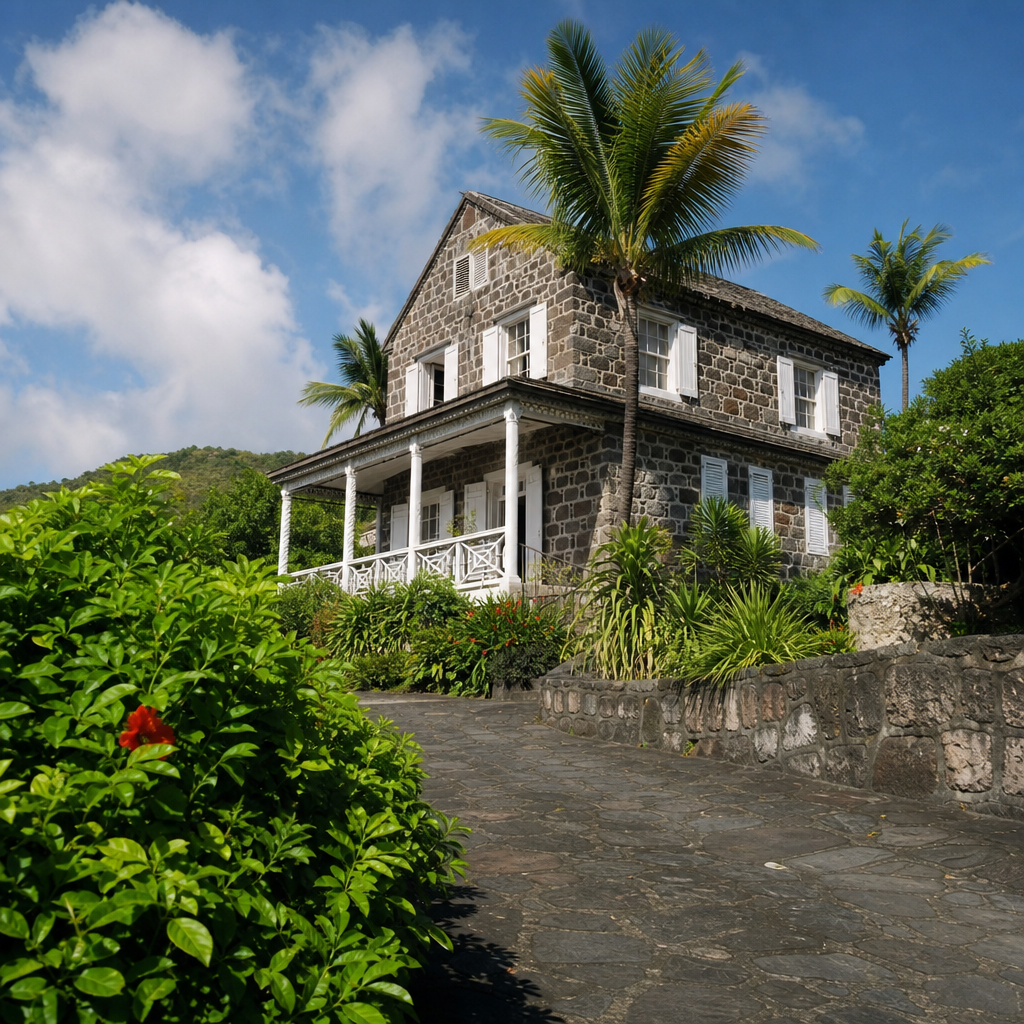
Visiting the historic homes of Nevis’ residents opens a rare window into Caribbean life that most island guides overlook. Nevis is often introduced through beaches, resort stays, and the birthplace of Alexander Hamilton, yet its most revealing landmarks are the houses, estates, courtyards, and village streets where generations of Nevisians have built family life. In this context, historic homes does not only mean museum properties with ropes and placards. It includes plantation great houses, former merchant residences in Charlestown, vernacular wooden cottages in villages such as Gingerland and Cotton Ground, and preserved family compounds that still shape local identity. For travelers interested in local life and experiences, these homes are the clearest record of how architecture, labor, migration, religion, and climate have influenced the island.
Nevis is a small island in the Federation of Saint Kitts and Nevis, but its domestic architecture carries centuries of layered history. British colonial settlement, the sugar economy, emancipation, seafaring trade, hurricane exposure, and volcanic geography all left visible marks on how residents built and adapted their homes. Thick stone walls, deep galleries, louvered shutters, elevated foundations, and detached kitchens were not decorative choices alone; they were practical responses to heat, rain, and social conditions. I have found that travelers understand Nevis much faster when they stand on a gallery, notice the trade winds moving through timber jalousies, and hear a resident explain why a family home expanded room by room over decades. A historic home turns abstract history into something human and specific.
This hub article covers the miscellaneous side of local life by showing how to visit historic homes respectfully, what types of properties you may encounter, what architectural details matter, and how these visits connect to broader Nevis culture. It also explains the limitations. Many significant homes are private residences, not attractions with regular opening hours, and some are best appreciated from the street or through community events, heritage tours, and local introductions. That reality is part of the value. Historic homes on Nevis are not isolated monuments. They remain embedded in living neighborhoods, family memory, and everyday routines, which makes them one of the strongest ways to experience the island beyond the standard itinerary.
Why Historic Homes Matter in Understanding Nevis
Historic homes matter because they connect the island’s biggest historical forces to everyday life. Nevis was once one of the wealthiest sugar colonies in the British Caribbean, and that wealth concentrated around estates and merchant activity. The traces remain in stone estate houses, ruins of mills, and town residences linked to commerce. At the same time, the majority story of Nevis lies in the homes of ordinary residents: craftspeople, estate workers, schoolteachers, fishermen, shopkeepers, and migrants who returned after working abroad. Looking at both elite and vernacular housing gives a truer picture of the island than plantation history alone.
These homes also reveal how communities adapted after emancipation in 1834. Land access, wages, church life, and village formation changed where and how people built. In places like Gingerland, family compounds often grew incrementally, reflecting practical economics rather than formal planning. A house might begin as a small timber structure and later gain a concrete room, a veranda enclosure, or a separate cistern. Those additions tell a story of resilience, remittances, and family continuity. If you want to understand Nevisian identity, you need to pay attention to those ordinary modifications as closely as you would a grand Georgian façade.
For visitors, this matters because it changes the purpose of sightseeing. Instead of asking only which house is oldest or prettiest, ask what a home says about status, climate, labor, and kinship. Why are shutters designed that way? Why is the kitchen detached on some older sites? Why do some village homes sit within shared yards? Those questions lead naturally into conversations with guides, museum staff, artisans, and residents. They also create stronger internal links across a wider local-life itinerary, connecting home visits with food traditions, genealogy, churchyards, estate ruins, village walks, and cultural festivals.
Types of Historic Homes You Can Visit or Interpret on Nevis
Nevis offers several distinct categories of historic homes. The best known are plantation great houses and estate residences. These properties, sometimes preserved as inns or heritage sites, illustrate the island’s eighteenth- and nineteenth-century plantation economy. They often feature stone construction, symmetrical layouts, broad verandas, and commanding positions chosen for breeze and oversight. Even when altered for hospitality use, they can still teach visitors about estate hierarchy, imported building conventions, and local adaptation. Montpelier, for example, is widely recognized for its historic estate setting and layered colonial architecture.
A second category is urban and small-town residences in Charlestown. These structures may include former merchant houses, administrative residences, and mixed-use buildings where business occurred at street level and family life unfolded behind or above. Their significance lies in location as much as design. Walking Charlestown reveals how close domestic life was to trade, government, church activity, and the waterfront. In many Caribbean towns, fires, storms, and rebuilding changed the architectural record repeatedly, so surviving older homes are especially important evidence.
The third category, and often the most meaningful for local-life travelers, is vernacular village housing. These homes are usually modest in scale but rich in cultural detail. Timber frames, board siding, fretwork, corrugated roofing, jalousie windows, painted concrete steps, and front galleries all tell stories about available materials and evolving taste. You may also see homes that combine older timber rooms with later concrete additions. That blend is not architectural confusion. It is a practical record of how families improved property over time as resources allowed.
| Home type | Where you may encounter it | What it reveals |
|---|---|---|
| Plantation great house | Former estates, heritage inns, guided sites | Sugar economy, colonial hierarchy, climate adaptation |
| Merchant or town residence | Charlestown streets and civic core | Trade networks, mixed domestic and commercial life |
| Vernacular village home | Gingerland, Cotton Ground, Bath area, rural roads | Family continuity, practical building methods, post-emancipation life |
| Compound or courtyard residence | Established family plots across villages | Kinship patterns, shared space, incremental growth |
A fourth category includes family compounds and courtyard properties that may not look monumental at first glance. On Nevis, these are essential. Several structures may share one plot, reflecting generations of related residents, caregiving patterns, and inherited land. Visitors should understand that these are usually private spaces, not attractions. Still, when viewed respectfully on a community walk or interpreted by a local guide, they provide one of the clearest explanations of how social life is organized on the island.
What Architectural Details to Notice
The most useful way to visit a historic home is to look closely at function before style. Start with orientation. Many older Nevis homes were positioned to catch cross-ventilation from prevailing breezes, reduce solar gain, and manage runoff during heavy rain. Verandas or galleries were central living spaces, not decorative appendages. They created shade, allowed people to work and socialize outdoors, and formed a buffer between public road and private rooms. On a hot day, the logic is immediate: a shaded veranda can feel dramatically cooler than an enclosed interior.
Materials also tell a clear story. Stone and masonry appear in older estate houses and some substantial town buildings, partly because of status and durability. Timber appears widely in vernacular housing because it was practical, repairable, and suited to local building knowledge. Later concrete additions often reflect twentieth-century aspirations for permanence and storm resistance. None of these materials should be judged in isolation. A timber house may be more historically revealing than a larger masonry building because it shows how most residents actually lived.
Pay attention to windows, shutters, and rooflines. Louvered shutters and jalousies improve airflow while managing glare and rain. High ceilings release heat. Roof overhangs protect walls and create dry circulation areas during downpours. Detached kitchens, where they survive or are remembered, reduced heat and fire risk in the main dwelling. Cisterns, stone steps, outbuildings, bread ovens, and yard walls add more clues. When I walk visitors through historic neighborhoods, these small elements usually produce the best questions because they show how architecture served daily habits rather than abstract design theory.
Decoration matters too, especially in gingerbread trim, porch balustrades, paint colors, and handmade joinery. These choices express pride, family identity, and the circulation of tastes across the Caribbean and beyond. A returning migrant might finance a renovation, altering a façade while preserving the old plan. In that sense, a Nevis home is often a living document rather than a frozen period piece. The visible layers are part of the history, not damage to it.
How to Visit Respectfully and Find Access
The first rule is simple: assume a historic home is private unless clearly presented as open to the public. Nevis is not a place where every old house functions as a museum. Many meaningful properties are lived in, inherited, rented, or only occasionally opened for events. Do not enter yards uninvited, photograph residents without permission, or treat villages as open-air exhibits. Respectful viewing from public roads, combined with informed interpretation, is often the correct approach.
The best access usually comes through local guides, heritage organizations, hotel concierges familiar with community tours, and cultural events that include open-house elements. The Nevis Historical and Conservation Society is an important starting point because it supports interpretation and preservation across the island. Museum visits in Charlestown can provide context before you explore residential areas. That sequence matters. When visitors learn the social history first, they are less likely to reduce homes to picturesque scenery.
If you are staying in a historic inn or estate property, ask detailed questions. What parts of the structure are original? Which rooms were altered? How did the estate function historically? A good host or guide should be able to explain restoration choices, hurricane repairs, and adaptive reuse. These conversations are valuable because many Caribbean heritage properties survive only by balancing preservation with economic use. A restored great house that operates as a hotel is not a perfect time capsule, but it can still preserve craftsmanship and historical setting better than abandonment would.
Timing also affects access. Heritage weeks, art events, and community celebrations sometimes create opportunities to see properties or neighborhoods in a more organized way. Even when homes are not open, combining a house-focused walk with stops at churches, cemeteries, former estates, and village shops creates a fuller picture. In practice, that is how most travelers should approach visiting the historic homes of Nevis’ residents: as part of a network of lived places rather than a checklist of buildings.
Connecting Home Visits to Broader Local Life and Experiences
Historic homes are a hub topic because they connect naturally to almost every other local experience on Nevis. Food is one example. A family yard, kitchen outbuilding, bread oven, fruit tree, or gallery dining space explains local cooking more vividly than a menu alone. The architecture of domestic life supports the rhythms of preparing goat water, baking, preserving fruit, or hosting relatives after church. When residents describe how a grandmother used a yard or kitchen, the island’s culinary culture becomes concrete.
Music, storytelling, and religion also come into focus through homes. Front galleries and shared yards are traditional social spaces where neighbors talk, children learn family stories, and seasonal events are planned. Village homes often sit within walking distance of churches that anchor community identity. During festive periods such as Culturama, domestic spaces can become staging grounds for costumes, food preparation, and gatherings. A visitor who understands the role of the home sees the festival not as an isolated performance but as an extension of household and neighborhood life.
Genealogy and migration are another strong link. Many Nevisian families have connections to Saint Kitts, the United Kingdom, the United States, and other Caribbean islands. Homes record those movements through additions funded by overseas work, imported furnishings, or the return of retired relatives. A modest house with a later upper room or a rebuilt concrete frontage can reflect decades of sacrifice abroad. That makes residential history one of the clearest ways to understand how global migration shaped this small island.
For travelers building a deeper Nevis itinerary, house visits pair well with estate trails, museum stops, village walks, local dining, and conversations with craftspeople or historians. This miscellaneous hub exists for that reason. Historic homes are not a niche curiosity. They are the connective tissue between architecture, memory, labor, landscape, and family life across Nevis.
Preservation Challenges and Why Responsible Tourism Helps
Preserving historic homes on Nevis is not simple. Heat, salt air, termites, heavy rainfall, and hurricanes constantly pressure buildings. Maintenance costs are high, especially for traditional timber work, lime-based materials, or detailed joinery that requires skilled labor. Ownership can be fragmented across extended families, and inherited properties may carry emotional importance without the funds needed for full restoration. On a small island, those constraints are real and recurring.
There are also difficult historical questions. Some of the island’s most architecturally impressive homes are tied to plantation wealth and enslavement. Interpretation should never romanticize that past. A balanced visit acknowledges beauty in craftsmanship while stating clearly who labored under coercive systems that made those houses possible. At the same time, preservation should not focus only on elite structures. Safeguarding vernacular homes and village landscapes is equally important because they represent the majority experience.
Responsible tourism helps when it directs spending toward knowledgeable guides, locally owned heritage businesses, museums, craftspeople, and accommodations that maintain historic fabric carefully. It also helps when visitors share accurate stories afterward instead of repeating clichés about Caribbean islands as timeless playgrounds. Nevis is a living community with a built environment shaped by struggle, adaptation, and pride. Seeing that clearly is the point.
Visiting the historic homes of Nevis’ residents is one of the most rewarding ways to understand the island beyond its postcard image. These homes explain how people responded to climate, built family networks, navigated colonial history, and adapted through migration and change. From estate houses to village galleries, each structure offers evidence of local life that no general sightseeing stop can replace.
The key takeaway is practical: approach historic homes as living heritage, not just architecture. Learn the difference between public access and private space, notice materials and layout, and connect what you see to food, religion, labor, and family history. When you do that, Nevis becomes more legible and far more memorable.
If you are planning a local-life itinerary, include Charlestown context, a guided village walk, and at least one heritage property stay or visit. Start there, ask better questions, and let the homes of Nevis lead you into the island’s real story.
Frequently Asked Questions
What counts as a historic home in Nevis beyond formal museum houses?
In Nevis, a historic home is not limited to a preserved museum property with signs, guided ropes, and curated exhibits. The term can include plantation great houses, restored family residences, stone cottages, village homes passed down through generations, old estate outbuildings, courtyard compounds, and even streetscapes where domestic architecture still reflects earlier eras of island life. What makes these places historically important is not only age, but continuity. Many homes on Nevis reveal how families adapted to climate, economy, faith, community ties, and changing social conditions over centuries. You may notice thick stone walls, broad verandas, shuttered windows, elevated foundations, galleries designed for airflow, and gardens used for both beauty and practical living.
This broader understanding matters because the island’s story is not told only through public monuments. Some of the most meaningful insights come from neighborhoods and lived-in places where architecture, memory, and daily routines overlap. A house may have connections to the plantation era, emancipation, village formation, migration, craft traditions, or local family histories. Even if a property is modest rather than grand, it can still offer a rich sense of how Nevisians organized domestic life, hosted relatives, cooked, celebrated, mourned, and preserved identity. For visitors, approaching historic homes this way leads to a deeper and more human experience of Nevis than a standard sightseeing checklist ever could.
How can visitors respectfully explore historic residential areas in Nevis?
The best approach is to remember that many historic homes in Nevis are part of living communities, not open-air exhibits. Visitors should treat these areas as neighborhoods first and attractions second. That means walking quietly, asking permission before entering private property, avoiding intrusive photography, and understanding that a beautiful house, courtyard, or veranda may still be someone’s home. If a site is privately owned, do not assume public access simply because it looks historic. When in doubt, ask a local guide, community representative, or property owner whether visits are welcome and under what conditions.
It also helps to engage with the island through local expertise. A knowledgeable guide can explain architectural features, family histories, estate patterns, and village development in ways that casual wandering cannot. They can also help visitors avoid common mistakes, such as trespassing, disrupting community routines, or misreading the significance of a site. Supporting local guides, heritage groups, and community-led tours is one of the most respectful ways to explore, because it keeps interpretation rooted in Nevisian voices rather than outside assumptions. Simple courtesies go a long way as well: dress appropriately, greet people politely, do not block narrow roads or entrances, and be mindful that some places may carry emotional or ancestral importance beyond what is visible to a visitor.
What can you learn from visiting historic homes and estates in Nevis?
Historic homes and estates in Nevis reveal layers of island history that are often missed when the focus stays only on beaches or major colonial landmarks. Through these homes, visitors can better understand how architecture responded to tropical weather, how land ownership shaped social life, how plantation economies influenced settlement patterns, and how families created continuity through generations of change. Estate houses may reflect colonial wealth and agricultural power, while village residences can illuminate post-emancipation community building, local craftsmanship, religious traditions, and everyday resilience. Looking closely at domestic spaces often tells a more balanced story than official monuments alone.
You can also learn a great deal from the details. Construction materials may point to trade links or local resourcefulness. Room layouts can reflect practical adaptation to heat, family structure, and hospitality customs. Gardens, kitchens, cisterns, outbuildings, and boundary walls can say as much about life on Nevis as any formal drawing room. In many cases, oral history is just as important as architecture. A family story about who lived there, how the house changed after a hurricane, or how generations used a shared courtyard can bring the site to life in ways no plaque can. Together, these elements show that Nevisian history is not abstract. It is rooted in homes where people worked, rested, raised children, preserved traditions, and shaped the island’s identity over time.
Are there guided ways to experience Nevis’ historic homes if many are privately owned?
Yes, and this is often the best way to experience them. Because many historically important homes in Nevis are privately held or located within active communities, structured visits through local guides, heritage organizations, cultural groups, or hospitality partners can provide access that independent visitors may not otherwise have. These guided experiences may focus on architecture, village history, family lineages, plantation landscapes, or broader cultural heritage. In some cases, a tour may include exterior viewing only; in others, visitors may be welcomed into select properties, gardens, galleries, or estate grounds by prior arrangement. The exact format depends on ownership, community preferences, and preservation needs.
Guided visits offer more than access. They provide context, which is essential when looking at places that carry complex histories. A trained local guide can explain the relationship between grand houses and labor systems, the evolution of village homes after emancipation, and the ways families preserved older building traditions while adapting to modern life. They may also share stories not found in general guidebooks, including anecdotes about notable residents, craftsmanship, local customs, and neighborhood change. If you are planning this kind of visit, it is wise to arrange ahead, ask about photography rules, confirm transportation, and be open to a slower, conversation-based experience. That pace is often what makes these visits memorable and meaningful.
When is the best time to visit Nevis’ historic homes, and how should you prepare?
The most comfortable time to explore historic homes and residential heritage areas in Nevis is usually during cooler morning or late-afternoon hours, when the light is softer and walking conditions are easier. This is especially important if your itinerary includes village streets, estate grounds, or homes with open outdoor spaces such as courtyards, gardens, and verandas. Seasonal conditions also matter. During wetter periods, paths may be slippery and some outdoor access points less convenient, while bright dry-season weather can be ideal for observing architectural details and taking respectful exterior photographs where permitted. The best timing ultimately depends on whether you are joining a formal tour, visiting a public heritage property, or arranging a private cultural experience.
Preparation should be practical and respectful. Wear comfortable walking shoes, lightweight clothing, sun protection, and carry water. If you expect to enter homes or culturally significant spaces, choose attire that feels appropriate for a community setting rather than a beach outing. Bring cash in case you want to tip a guide, donate to a heritage initiative, or purchase locally made goods. Most importantly, prepare with the right mindset. Visiting historic homes in Nevis is less about rushing through a list of famous addresses and more about paying attention to atmosphere, stories, and the living relationship between people and place. The more curious, patient, and respectful you are, the more rewarding the experience will be.