Saint Kitts’ handicraft traditions reveal how a small Caribbean island has preserved memory, livelihood, and identity through skilled handwork. In Saint Kitts, handicrafts include practical and decorative objects made with manual techniques, often using locally available materials such as clay, straw, wood, cotton, shell, and recycled fibers. Artistry refers to the creative design decisions that turn an object into cultural expression, while skill describes the learned techniques, discipline, and repetition required to produce durable, beautiful work. Together, artistry and skill form a living archive of Kittitian experience, from plantation-era survival strategies to modern tourism markets and community festivals.
I have found that craft traditions in Saint Kitts are best understood not as isolated souvenirs, but as part of a wider cultural system that includes music, foodways, oral history, architecture, and religious celebration. A woven basket carries agricultural knowledge. A carved calabash bowl reflects adaptation to island materials. Embroidered textiles and costume pieces preserve ceremonial aesthetics tied to Carnival and village life. Even newer forms, including jewelry made from sea glass or coconut shell, follow the same pattern: makers transform local resources into objects that communicate place. That is why this subject matters within the broader Culture and History landscape.
Handicrafts also matter economically. Across the Caribbean, small-scale craft production supports household income, informal entrepreneurship, and visitor spending. On Saint Kitts, artisans often sell through markets, heritage events, cruise tourism channels, and direct commissions. Yet commercial value is only part of the story. Craft knowledge is usually transmitted through observation, apprenticeship, church groups, family networks, and community workshops rather than formal academies alone. When those teaching chains weaken, techniques disappear quickly. Understanding Saint Kitts’ handicraft traditions therefore helps explain larger questions about cultural continuity, postcolonial identity, and the practical challenge of keeping handmade industries viable in an era dominated by imported goods.
For readers exploring miscellaneous cultural subjects, this hub serves as a grounding overview. It defines the major craft forms associated with Saint Kitts, explains how materials and history shaped them, and identifies the institutions, events, and market pressures affecting their future. It also points toward related themes such as folk traditions, heritage tourism, festival arts, domestic crafts, and community-based creative enterprise. The core idea is simple: handicrafts are not peripheral to Kittitian culture. They are one of the clearest ways to see how ordinary people have used creativity, discipline, and local knowledge to make meaning from island life.
Historical roots of handicraft in Saint Kitts
Saint Kitts’ craft traditions grew from layered influences rather than a single origin. Indigenous Kalinago knowledge of natural materials predated European colonization, especially in the practical use of plant fibers, wood, and gourds. Colonization, plantation agriculture, and the transatlantic slave trade then reshaped every aspect of daily life. Enslaved Africans brought weaving traditions, carving methods, decorative sensibilities, and a habit of resourceful making under severe constraint. Later, indentured laborers and imported manufactured goods altered what was made, who made it, and which objects survived in household use.
In plantation societies, many handmade objects began as necessities rather than art pieces. Storage containers, mats, market baskets, stools, kitchen utensils, brooms, and simple garments were produced because imported replacements were expensive or unavailable. Over time, practical making developed visual signatures: specific weave densities, preferred plant fibers, recurring motifs, and finishing techniques. I have seen this pattern across Caribbean craft communities. What starts as utility eventually acquires symbolic value because it carries inherited methods. A plain woven item becomes culturally important once people recognize that its construction reflects generations of adaptation.
Religion, emancipation, and village social life further shaped Saint Kitts’ handicraft traditions. Church fundraising fairs encouraged sewing, crochet, embroidery, baking presentation, and decorative household arts. Emancipation opened more room for market exchange, allowing skilled makers to sell goods directly. During the twentieth century, education reforms, migration, and tourism shifted craft production again. Imported plastic containers replaced some woven forms. Factory fabrics reduced homespun necessity. But heritage events and visitor demand created new value for handmade pieces tied to local identity. Today, the strongest traditions are often those able to balance historical authenticity with modern use.
Materials, methods, and signature craft forms
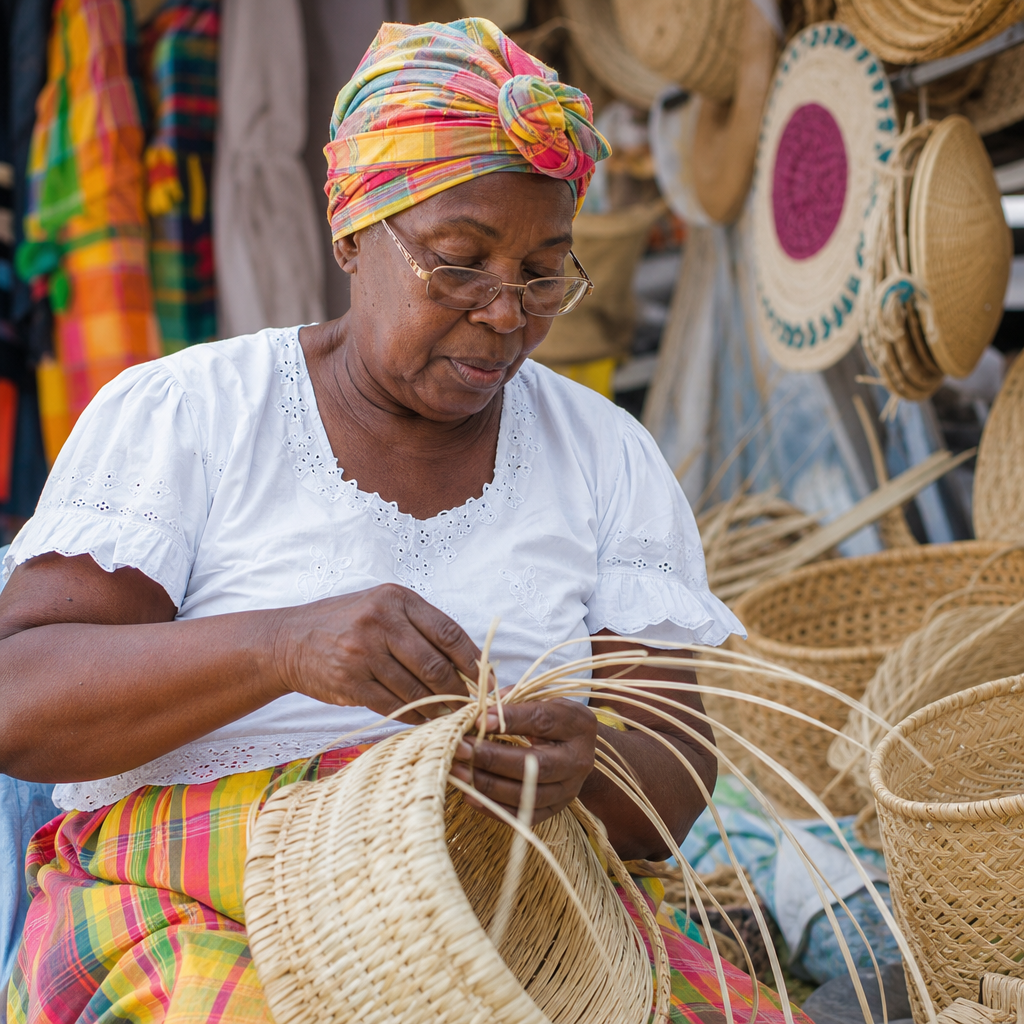
The most distinctive Saint Kitts handicrafts are rooted in material intelligence: knowing what the island offers, how it behaves, and how to work it by hand. Straw and other plant fibers are central to basketry and plaiting. Artisans dry, sort, and sometimes dye fibers before weaving them into hats, bags, mats, and storage vessels. Quality depends on even tension, clean edge finishing, and the maker’s ability to choose the correct thickness for structure. A well-made basket is not simply attractive; it must stand upright, carry weight, and resist fraying in humid conditions.
Woodcraft is another important area, especially for carved utensils, small sculptures, walking sticks, and decorative objects. Local woods vary in hardness and grain, so carving requires species knowledge as much as design ability. Coconut shell and calabash have long been used for bowls, cups, ornaments, and engraved pieces. These materials suit island craft economies because they are accessible, lightweight, and visually distinctive. Shell work and sea-glass jewelry represent a more contemporary extension of traditional resourcefulness, turning shoreline finds into earrings, pendants, and keepsakes that appeal to residents and visitors alike.
Textile-based handicrafts deserve equal attention. Sewing, crochet, embroidery, quilting, and costume construction have deep roots in domestic and community life. In Saint Kitts, these skills appear in church linens, household decor, special-occasion garments, school performance wear, and especially festival costume elements. Carnival design sits at the intersection of craft and performance: beadwork, wire bending, fabric layering, feather attachment, and hand-finishing all require experienced makers. Pottery and clay work exist on a smaller scale than fiber and textile crafts, but they remain culturally significant wherever artisans draw on local clays or regional Caribbean ceramic traditions.
| Craft form | Common materials | Main uses | Skills required |
|---|---|---|---|
| Basketry and plaiting | Straw, grasses, reeds, palm fibers | Baskets, hats, mats, bags | Fiber preparation, tension control, pattern weaving |
| Wood and shell craft | Hardwoods, coconut shell, calabash, shells | Bowls, carvings, utensils, ornaments | Cutting, carving, sanding, finishing |
| Textile craft | Cotton, lace, thread, beads, fabric | Clothing, linens, costume pieces, decor | Sewing, embroidery, fitting, embellishment |
| Jewelry and mixed-media craft | Sea glass, wire, seeds, recycled materials | Pendants, bracelets, souvenirs | Design composition, drilling, wrapping, assembly |
Craft as cultural memory and community practice
Handicraft in Saint Kitts functions as cultural memory because making is often tied to storytelling. Techniques are taught alongside family histories: who learned to weave from a grandmother, who stitched church cloths for decades, who carved tools for cane work, who designed costumes for troupe performances. These stories matter because they connect objects to lived experience. A handmade item gains meaning when its method, maker, and social setting are known. That is why craft documentation should record oral testimony, not just finished products.
Community practice is equally important. Many crafts survive because they are embedded in group activity rather than individual studio work. Women’s organizations, schools, church circles, cultural workshops, and festival committees create spaces where skills are exchanged and standards are maintained. In my experience, these environments also preserve the vocabulary of craft: local names for stitches, materials, tool parts, and decorative techniques. Once that language fades, technical understanding tends to fade with it. Preservation is therefore not only about saving objects in display cases; it is about keeping the teaching environment active.
Crafts also help Saint Kitts present itself to the world without reducing culture to cliché. Visitors often seek something tangible that feels rooted in place, and handicrafts can meet that demand when they are interpreted well. The risk, however, is oversimplification. Mass-produced imports labeled as Caribbean can crowd out authentic local work. Serious cultural presentation requires provenance, maker profiles, and context about materials and methods. When artisans are named and their processes explained, buyers understand why handmade goods cost more and carry greater cultural value than anonymous factory substitutes.
Tourism, markets, and the business of handmade work
The market for handicrafts in Saint Kitts sits at the intersection of heritage and commerce. Cruise tourism can generate significant foot traffic, but sales are uneven and often seasonal. Artisans must price for labor, material costs, and stall fees while competing with imported souvenirs sold at lower prices. This tension is common across island economies. A handwoven bag that takes several hours to complete cannot compete on price with a factory-made imitation, so successful makers compete on story, quality, originality, and direct customer engagement instead.
Heritage tourism offers stronger long-term potential than generic souvenir retail. Demonstrations at cultural sites, workshops during festivals, and collaborations with hotels or museums allow artisans to sell both products and experience. Visitors who watch basketry, carving, or costume assembly are more likely to appreciate workmanship and pay fair prices. Destination management research consistently shows that experiential tourism increases perceived value. For Saint Kitts, that means craft villages, market days, and curated exhibitions can do more than display objects; they can convert cultural knowledge into sustainable economic activity.
Digital channels now matter as much as physical markets. Social platforms, small e-commerce shops, and messaging apps let artisans reach diaspora buyers and repeat visitors after they leave the island. Good craft marketing depends on clear photography, dimensions, material descriptions, and transparent shipping policies. It also depends on authenticity. Buyers increasingly want to know whether an item is handmade in Saint Kitts, assembled from imported components, or inspired by but not directly linked to local tradition. Clear labeling builds trust and strengthens the reputation of the wider handicraft sector.
Preservation, education, and the future of Saint Kitts’ handicraft traditions
The biggest challenge facing Saint Kitts’ handicraft traditions is not lack of creativity. It is interruption of transmission. Older artisans may hold specialized knowledge about fiber preparation, pattern memory, or hand-finishing that has never been formally documented. If younger people see craft only as low-margin labor, they may not invest the years needed to master it. Preservation therefore requires a combined strategy: documentation, training, market development, and public recognition. One measure alone is not enough.
Effective preservation starts with inventory work. Cultural agencies, schools, and heritage organizations should record techniques, tools, maker biographies, and terminology through interviews, photography, and video. UNESCO’s approach to intangible cultural heritage offers a useful framework here: safeguard living practices by supporting communities that carry them, not merely by archiving artifacts. Apprenticeship programs can then pair experienced artisans with students. Small grants for tools and materials matter more than many policymakers realize, because craft knowledge is easiest to teach through repeated practice, not one-off demonstrations.
Education should place handicraft within history, design, and entrepreneurship. Students need to see that weaving, sewing, carving, and jewelry making involve mathematics, pattern logic, material science, and business planning. Public exhibitions, school competitions, and museum interpretation can raise status. So can stronger links between artisans and the hospitality sector, where locally made decor, gifts, and uniforms could create steady demand. The future of Saint Kitts’ handicraft traditions will depend on treating them as a serious cultural industry and a heritage responsibility at the same time.
Saint Kitts’ handicraft traditions show how culture survives through the skilled work of hands as much as through monuments or official records. Basketry, woodcraft, shell work, textiles, costume design, and mixed-media making all express the island’s history of adaptation, creativity, and community exchange. They connect indigenous material knowledge, African diasporic resilience, village practice, church culture, festival energy, and modern entrepreneurship into a single visible tradition. That is why handicraft belongs at the center of any serious understanding of Kittitian culture and history, not at the margins.
As a hub topic within miscellaneous cultural studies, handicraft opens pathways to many related subjects. Readers interested in domestic life can explore textiles and household objects. Those studying tourism can examine artisan markets and heritage branding. Researchers focused on performance culture can follow the craft of Carnival costume production. Educators can use handicrafts to teach sustainability, design thinking, and oral history. The category is broad, but the unifying principle remains clear: handmade objects preserve practical knowledge and social memory in ways few other cultural forms can match.
The main benefit of studying Saint Kitts’ handicraft traditions is perspective. You begin to see everyday objects as evidence of how people learned from the land, supported families, marked celebrations, and carried forward identity under changing economic conditions. If you are building out a deeper Culture and History resource, use this hub as your starting point and follow the threads into festival arts, folk practices, community heritage, and artisan enterprise. Most importantly, when you encounter authentic Kittitian craft, learn the maker’s story and support the work directly.
Frequently Asked Questions
What kinds of handicrafts are traditionally associated with Saint Kitts?
Saint Kitts is known for a rich variety of handicrafts that reflect both everyday necessity and artistic expression. Traditional crafts have included pottery and clay items, straw weaving, wood carving, textile work, shell craft, and objects made from recycled or repurposed natural fibers. Many of these forms developed from practical island life, where artisans relied on locally available materials to create baskets, hats, mats, household containers, decorative carvings, and personal adornments. Over time, these useful objects also became carriers of style, symbolism, and local identity.
What makes Kittitian handicrafts especially meaningful is the way they combine function with cultural memory. A woven basket, for example, is not only a tool for carrying goods but also a reflection of knowledge passed between generations about plants, preparation methods, and weaving patterns. Similarly, carved wooden items or hand-shaped clay pieces often reveal the maker’s sense of form, patience, and connection to place. In Saint Kitts, handicrafts are best understood not as isolated souvenirs, but as part of a living tradition in which materials, technique, and creativity come together to tell the story of the island and its people.
Why are handicraft traditions important to the cultural identity of Saint Kitts?
Handicraft traditions matter deeply to Saint Kitts because they preserve history in a form people can see, touch, and use. On a small island, culture is often sustained through practices that are shared in homes, workshops, markets, and community settings rather than only through written records. Handcrafted objects carry evidence of ancestry, adaptation, resourcefulness, and local taste. They show how generations of Kittitians have responded to their environment, used available materials wisely, and transformed ordinary resources into meaningful creations.
These traditions also strengthen identity by linking craftsmanship to memory and belonging. The skills involved in shaping clay, weaving straw, or carving wood are not just technical actions; they are learned behaviors shaped by discipline, observation, and repetition. When artisans continue these practices, they help keep older knowledge alive while also adapting it for new audiences. That balance between preservation and innovation is central to cultural resilience. In Saint Kitts, handicrafts support a sense of pride because they demonstrate that heritage is not static or distant; it is actively made and remade through the hands of people who value the island’s character and wish to pass it forward.
What materials are commonly used in Saint Kitts’ handicrafts, and why do they matter?
Traditional handicrafts in Saint Kitts often draw from materials that are accessible within the island environment or through everyday community life. These commonly include clay, straw, wood, cotton, shells, and recycled fibers. Each material has practical value, but each also shapes the appearance, durability, and cultural meaning of the finished object. Clay can be molded into vessels and decorative forms; straw can be woven into baskets, mats, and hats; wood can be carved into utensils, ornaments, or sculptural pieces; cotton supports sewing and textile arts; shells contribute texture and coastal symbolism; and recycled fibers demonstrate ingenuity and sustainable thinking.
These materials matter because they reflect the longstanding relationship between artisans and the local landscape. Craft traditions are often built around knowing when to gather, how to prepare, and how to work with materials so they remain strong and visually appealing. That knowledge is itself a form of heritage. The use of natural and repurposed resources also highlights a longstanding ethic of practicality and creativity, especially in island communities where making do with what is available has often been essential. In Saint Kitts, the material choices behind handicrafts are not incidental; they are part of the story. They reveal environmental awareness, economic resourcefulness, and a design tradition rooted in local experience.
How do artistry and skill work together in Kittitian handicraft traditions?
In Saint Kitts’ handicraft traditions, artistry and skill are inseparable. Skill refers to the trained ability required to handle materials properly, repeat techniques consistently, and achieve a durable result. It includes things like precise weaving tension, controlled shaping, steady carving, careful stitching, and knowledge of finishing methods. These are learned capacities that usually come through practice, observation, correction, and patience over time. Without skill, a handcrafted item may not hold its form, function well, or last long.
Artistry, on the other hand, is what gives the object character, expression, and cultural resonance. It appears in design choices such as pattern, proportion, texture, color, motif, and overall composition. Artistry is what transforms a simple object into something distinctive and memorable. In Kittitian craft, artistry may draw from local landscapes, inherited aesthetics, community values, or personal interpretation. The most accomplished artisans bring both elements together: the technical discipline to make something well and the creative vision to make it meaningful. This combination explains why handicrafts are valued not only as practical goods, but also as cultural works that communicate identity, care, and imagination.
How do handicrafts support livelihoods and the future of heritage in Saint Kitts?
Handicrafts support livelihoods in Saint Kitts by creating opportunities for artisans to earn income through local markets, cultural events, tourism, commissions, and small business activity. For many makers, handicraft production is more than a hobby; it can be an important supplement to household income or even a primary occupation. Because handcrafted items often carry a strong sense of place, they can appeal to both residents and visitors seeking objects with authenticity and cultural significance. This economic role helps keep traditional knowledge relevant in the present rather than confining it to the past.
Just as importantly, handicrafts support the future of heritage by encouraging the transmission of knowledge across generations. When younger people see that craft skills are respected, marketable, and tied to community pride, they are more likely to learn and sustain them. Workshops, demonstrations, school programs, artisan networks, and heritage-centered events can all help strengthen this continuity. The future of Saint Kitts’ handicraft traditions depends on recognizing artisans not simply as producers of objects, but as custodians of cultural knowledge. By valuing their work economically and culturally, the island helps ensure that memory, identity, and skilled handwork remain part of its living heritage for years to come.