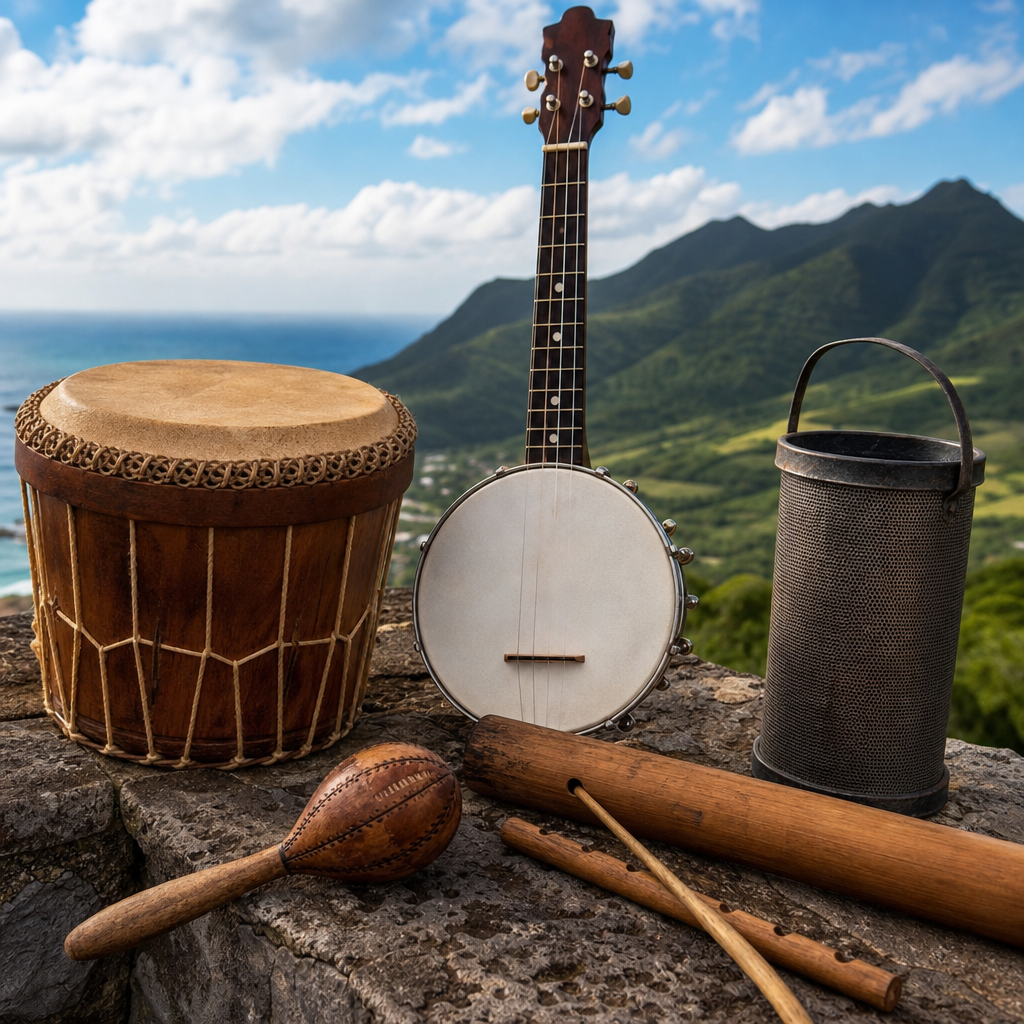
Saint Kitts’ traditional music instruments carry the island’s memory in wood, skin, metal, and bamboo, preserving African retentions, European military influences, and local festival practices in forms that still shape community identity today.
To understand these instruments is to understand how culture and history live in everyday sound. In Saint Kitts, often called St. Kitts, traditional music is not limited to concert stages or museum displays. It appears in Carnival troupes, Christmas sports, street parades, village gatherings, church-adjacent celebrations, and family events where rhythm organizes movement as much as melody. Instruments are practical cultural tools: they call dancers into formation, support storytelling, mark ritual time, and signal belonging.
Traditional music instruments in Saint Kitts can be grouped broadly into percussion, fife-and-drum combinations, stringed folk instruments, and improvised sound-makers. Key terms matter here. A membrane drum creates sound through a stretched skin. An idiophone, such as a triangle or shaker, sounds through the vibration of its own material. Aerophones like fifes and bamboo whistles produce tone through moving air. In the Kittitian context, these categories overlap with social use, because the same instrument may serve Carnival, folk performance, and community ceremony.
This subject matters because Saint Kitts’ musical traditions are a record of survival and adaptation. Enslaved Africans and their descendants preserved rhythmic structures, call-and-response patterns, and drumming practices despite colonial restrictions. European instruments entered local ensembles but were repurposed through African Caribbean technique and performance style. Over time, Kittitians built a sound world that is recognizably Caribbean yet specific to Saint Kitts. When younger musicians learn these instruments, they are not only learning songs; they are inheriting a way of organizing community life.
As a hub within Culture and History, this article covers the miscellaneous range of instruments and practices that connect festival music, folk memory, craftsmanship, and education. It also points toward related areas such as masquerade, string band traditions, quadrille performance, and Carnival percussion. The goal is simple: provide a clear guide to the instruments most associated with Saint Kitts’ traditional music, how they are made, how they are played, and why they remain culturally important even as amplified bands and digital production dominate popular music.
Drums, rhythm, and the backbone of Kittitian traditional sound
The drum is the central traditional instrument in Saint Kitts. In my experience studying Eastern Caribbean festival ensembles, whenever people describe “old-time music,” they usually begin with rhythm, not melody, because drumming carries the energy of processions, dances, and masquerade displays. In Saint Kitts, goatskin and other animal-hide drums have long been used in folk performance. Their construction is functional: a wooden shell, a stretched skin head, rope or pegs for tensioning, and hand or stick technique depending on the ensemble. What matters most is projection, pulse, and tonal contrast.
Different drums serve different roles. A deeper bass drum establishes the foundational beat and keeps outdoor groups together during movement. A higher-pitched lead drum adds syncopation, accents transitions, and responds to dancers’ steps. In street contexts, players often favor patterns that can be heard over crowd noise rather than intricate phrases meant for seated listening. This is one reason traditional Caribbean drumming often feels physically direct: the music was designed for open air, procession, and dance interaction.
In Saint Kitts, drumming is especially tied to Carnival and Christmas season traditions. Masquerade performances, mummers, and other folk forms rely on percussion to maintain momentum and cue costume movement. The drum is not decorative. It directs the performance. A skilled drummer can stretch tension, signal a turn, or change the emotional temperature of a crowd with subtle variations in density and emphasis. That leadership role is common across the region, but in Saint Kitts it remains particularly visible in community festival settings where dancers and drummers work in close proximity.
Craftsmanship also matters. Traditional drum makers select hardwood or available local timber for durability and resonance. Skins are cured, scraped, and fitted with attention to humidity, because Caribbean climate affects tension dramatically. Before a parade or outdoor performance, players may warm a drumhead to tighten pitch. This practical knowledge rarely appears in tourist summaries, yet it is essential to authentic performance. Without proper preparation, the sound becomes flat, and the ensemble loses clarity.
Fife, flute, and melody instruments in parade traditions
While drums dominate public memory, Saint Kitts’ traditional music also includes important wind instruments, especially the fife. The fife is a small transverse flute, historically linked to military bands, but in the Caribbean it was absorbed into folk ensembles and reinterpreted through local rhythm. In Kittitian use, the fife often rides above percussion with short, piercing melodic phrases that can cut through an outdoor procession. Its practical advantage is obvious: in a crowded street, delicate instruments disappear, but a fife remains audible.
Local versions may be made from bamboo, cane, or manufactured materials, depending on period and availability. Earlier community musicians often fashioned playable instruments from what they had on hand, which is why traditional music studies must include improvisation and resourcefulness, not only formal instrument categories. A bamboo flute may not look standardized, yet in skilled hands it can carry a recognizable repertory tied to dance and seasonal celebration.
The melodic role of these instruments is usually concise rather than harmonically dense. Traditional parade music in Saint Kitts is built for movement. The fife leads with repeated motifs, signals changes, and reinforces the identity of a tune. This differs from orchestral melody, where extended development is expected. Here, clarity and memorability matter more. A four-bar phrase, repeated with rhythmic insistence, can animate an entire masquerade route.
Fife-and-drum structures also reveal the island’s layered history. The instrumentation reflects contact with British military practice, but the phrasing, accent, and performance environment are distinctly Caribbean. This is a recurring pattern in Saint Kitts’ cultural history: imported forms were not simply copied; they were localized through African-derived rhythm, communal participation, and festival use. That process created a musical vocabulary that belongs to the island rather than to colonial models.
String bands, folk accompaniment, and social dance
Saint Kitts has also sustained string-based folk traditions, especially in contexts connected to social dance, village entertainment, and semi-formal gatherings. Instruments such as guitar, cuatro-style variants in the wider region, banjo-type instruments, and improvised bass support repertories associated with quadrille, big drum-related festivities, and domestic celebrations. Exact instrumentation varies by community and period, but the principle is stable: strings provide harmonic structure, rhythmic drive, and melodic accompaniment where drums alone would not suit the occasion.
In many Caribbean islands, the string band became a flexible ensemble type because it could adapt European dance forms to Afro-Caribbean performance practice. Saint Kitts followed that pattern. A guitar might outline chord changes for a quadrille figure, while percussion adds syncopated lift that changes the character of the dance entirely. The result is not a replica of European ballroom music. It is a creolized local form shaped by island timing, accent, and social meaning.
One reason these instruments deserve attention in a miscellaneous hub is that they often sit between categories. They are neither the most visibly “traditional” in the tourist sense nor fully modern in the commercial band sense. Yet they have been crucial in bridging household music-making and public cultural performance. Older musicians frequently learned by observation rather than notation, memorizing chord patterns, dance sequences, and tune order from repeated attendance at events. That oral method remains one of the strongest features of Kittitian traditional music culture.
Another important point is portability and maintenance. String instruments could travel to homes, schoolyards, and community halls more easily than large drums, and they supported singing. In practical terms, this made them valuable for a wide range of social functions. A village musician with a guitar could accompany folk songs, dance music, and devotional-adjacent repertoire across a single season, preserving continuity between sacred, secular, and festive life.
Common traditional instruments in Saint Kitts and their uses
The following comparison highlights the instruments most often associated with Saint Kitts’ traditional music practices and the settings where they are typically heard.
| Instrument | Type | Primary use | Typical setting |
|---|---|---|---|
| Goatskin drum | Percussion | Core rhythm, dance cues, procession timing | Carnival, masquerade, street performance |
| Bass drum | Percussion | Foundation pulse and ensemble coordination | Parades, outdoor festivals |
| Fife or bamboo flute | Wind | Lead melody, tune signaling, crowd penetration | Fife-and-drum bands, seasonal celebrations |
| Triangle | Idiophone | Bright timekeeping accents | Folk ensembles, dance accompaniment |
| Shac-shac or maracas | Idiophone | Texture, pulse reinforcement | String bands, community gatherings |
| Guitar | String | Harmony, rhythm support, song accompaniment | Quadrille, house gatherings, folk events |
Although this list is not exhaustive, it covers the core sound sources most readers will encounter when exploring Saint Kitts’ traditional music instruments. It also shows that “miscellaneous” does not mean marginal. These instruments work together across different social environments, and each contributes a specific musical function.
Improvised instruments, local materials, and the culture of making do
One of the most revealing aspects of traditional music in Saint Kitts is the use of improvised or semi-improvised instruments. Across the Caribbean, communities have long transformed available materials into sound tools, and Saint Kitts is no exception. Bamboo, gourds, tins, scrap metal, bottle-and-spoon combinations, and homemade shakers all appear in folk contexts. These are not lesser substitutes for “real” instruments. They are part of a long-standing aesthetic of ingenuity shaped by limited access to imported goods and by a strong tradition of handcraft.
Improvised instruments are culturally important because they show how music remains accessible. A child does not need formal conservatory training or expensive equipment to enter the island’s rhythm culture. A simple shaker can teach pulse. Two sticks can teach interlocking patterns. A piece of bamboo can introduce breath control and melody. In communities where knowledge passes through observation and participation, these low-barrier instruments are educational tools as much as performance devices.
There is also a historical dimension. Under plantation economies and colonial inequality, Afro-Caribbean communities often had to create expressive culture from restricted means. The resulting instrument traditions carry evidence of that reality. What outsiders may call rustic is, in fact, technologically smart: local materials are chosen for durability, volume, and repairability. A handmade drum or shaker can be maintained locally without dependence on imported parts.
This culture of making do continues to matter in heritage education. Schools, youth groups, and cultural organizations can use accessible instrument-building workshops to connect history with practice. When students construct a simple percussion instrument and then learn the rhythm attached to it, they understand heritage in a tangible way. That approach is often more effective than teaching dates and labels alone.
Preservation, performance, and why these instruments still matter
Traditional instruments in Saint Kitts survive because they remain useful, not because they are frozen artifacts. Cultural groups, festival committees, schools, and elder musicians continue to teach repertories linked to masquerade, Carnival, folk dance, and Christmas traditions. At the same time, preservation faces clear challenges. Amplified soca, reggae, dancehall, and global pop dominate commercial listening. Handmade instruments require maintenance. Apprenticeship takes time. Younger performers may be drawn to digital production rather than folk ensemble discipline.
Even with those pressures, traditional instruments still matter for several concrete reasons. First, they anchor national identity. A recorded pop track can be made anywhere, but the sound of a local drum-and-fife ensemble immediately places the listener in a Kittitian cultural landscape. Second, they preserve embodied knowledge. Rhythm patterns, stick technique, breath phrasing, costume timing, and dance cues cannot be fully archived on paper; they have to be practiced. Third, they support cultural tourism when presented responsibly. Visitors seeking depth respond strongly to live, contextualized heritage performance rather than generic entertainment.
Preservation works best when instruments stay in use. Documentation is essential, but archives alone are not enough. Effective cultural policy includes instrument-making workshops, school partnerships, festival stages for traditional ensembles, oral history recording, and support for elder practitioners who can teach repertoire in context. Organizations across the Caribbean increasingly recognize this, and Saint Kitts benefits when heritage work treats musicians as knowledge bearers rather than as symbolic performers trotted out for ceremony.
For readers exploring Saint Kitts under the broader Culture and History theme, these instruments offer an ideal hub into related subjects: masquerade costumes, quadrille dance, Carnival traditions, colonial and post-emancipation social life, village celebrations, and oral transmission. Listen closely to the instruments, and the island’s history becomes easier to hear. Learn who plays them, who builds them, and where they are performed. That is the most direct way to keep Saint Kitts’ traditional music alive for the next generation.
Frequently Asked Questions
What are the most important traditional music instruments in Saint Kitts?
Saint Kitts’ traditional music culture is shaped by a small but deeply expressive group of instruments that reflect the island’s layered history. Among the most important are drums, fifes, triangles, and bamboo instruments, all of which have played visible roles in public celebrations, folk performance, and community gatherings. Drums are especially central because they carry rhythm, authority, and collective energy. In many traditional settings, the drum is not just accompaniment; it directs movement, supports dance, and helps define the emotional character of a performance.
The fife is another key instrument, often associated with older parade and military-style traditions that developed through European influence but were adapted locally over time. Its piercing, bright sound allows it to lead melodies outdoors, making it ideal for processions, street performance, and festival use. The triangle, though simple in appearance, contributes a sharp metallic pulse that helps organize tempo and texture. Bamboo instruments, whether struck, shaken, or used percussively in ensemble contexts, point to older Afro-Caribbean sound practices rooted in resourcefulness and communal music-making.
Together, these instruments reveal how Saint Kitts built a musical identity from multiple sources. African retentions shaped rhythmic thinking, call-and-response sensibilities, and the social role of percussion. European influence introduced military and ceremonial instrumentation, especially in marching and parade formats. Local festival culture then fused these elements into something distinctly Kittitian. That is why these instruments matter: they are not simply tools for making sound, but living evidence of how the island translated history into everyday cultural expression.
How do Saint Kitts’ traditional instruments reflect the island’s cultural history?
Traditional instruments in Saint Kitts reflect the island’s history because they embody the meeting, tension, and blending of African and European cultural systems under colonial conditions. The island’s sound world developed in a society shaped by enslavement, plantation life, resistance, religious practice, military presence, and public celebration. Instruments made from wood, skin, metal, and bamboo preserve this story in physical form. Their materials, performance settings, and playing styles reveal how people used music to survive hardship, maintain memory, and create community.
African retentions are especially visible in the importance of rhythm, repetition, layered percussion, and communal participation. Drumming traditions across the Caribbean often served purposes beyond entertainment, including ceremony, identity-making, and social cohesion, and Saint Kitts is no exception. Even where direct lines to specific African ethnic traditions became fragmented through colonial violence, the broader musical logic remained powerful. You can hear that continuity in the emphasis on groove, movement, and the relationship between musicians and dancers.
At the same time, European military influence helped shape some of the island’s melodic and parade-oriented traditions, especially through instruments like the fife and the use of marching structures in festival performance. These elements did not remain purely European once adopted locally. Kittitian communities reinterpreted them through local taste, occasion, and experience. Carnival, Christmas activities, and village celebrations became spaces where inherited forms were remade into local tradition.
That is what makes these instruments so historically important. They show that culture in Saint Kitts was not passively received; it was actively transformed. Traditional instruments preserve the memory of adaptation. They remind listeners that history does not live only in documents and monuments. It also lives in the sounds people continue to make together.
Where are traditional music instruments still used in Saint Kitts today?
Traditional instruments in Saint Kitts are still used in spaces where culture remains public, shared, and community-driven. They are especially present during Carnival activities, Christmas sporting events, folk presentations, heritage celebrations, school performances, and village festivities. In these settings, traditional sound is not treated as something distant or purely historical. Instead, it functions as part of lived culture, where music supports procession, dance, competition, storytelling, and collective identity.
Carnival is one of the clearest places to hear and see these instruments in action. Festival troupes, street parades, and performance groups often draw on traditional rhythmic and melodic patterns that connect current celebration to older island practices. During Christmas and other seasonal events, instruments may appear in community-based performance traditions that emphasize participation over formality. This is important because it shows that traditional music in Saint Kitts has not been confined to concert halls or heritage exhibits. It continues to exist in motion, in public sound, and in social ritual.
Traditional instruments also appear in educational and cultural preservation contexts. Schools, community organizations, and heritage groups may include them in performances, workshops, or demonstrations designed to teach younger generations about Kittitian identity. This type of use is especially valuable because it keeps instrument knowledge active rather than merely archival. Children and young performers learn not only the names of the instruments, but also the occasions, meanings, and performance styles associated with them.
In that sense, traditional instruments remain relevant because they still help mark belonging. Whether heard in a parade, a seasonal celebration, or a cultural showcase, they continue to connect people to memory, place, and one another. Their modern presence proves that tradition in Saint Kitts is not static; it is practiced.
Why are drums so significant in Saint Kitts’ traditional music?
Drums hold special significance in Saint Kitts because they anchor both the musical structure and the social meaning of traditional performance. At the most basic level, drums provide rhythm, tempo, and momentum. But in Kittitian cultural life, their role goes much deeper. The drum often acts as a carrier of memory, a signal for movement, and a force that organizes people into shared experience. When drums sound in public celebration, they do more than accompany a tune; they create an atmosphere of recognition, energy, and continuity.
This importance is closely tied to African-derived musical values that survived and evolved in the Caribbean. In many Afro-Caribbean traditions, percussion is central because it supports communal participation, layered timing, and bodily engagement through dance and procession. Saint Kitts reflects that legacy. Drums help create the pulse that dancers follow, that other instruments lock into, and that audiences respond to physically as much as aurally. Their patterns can be repetitive, driving, conversational, and expressive all at once.
Drums are also significant because of what they symbolize historically. In societies shaped by slavery and colonial control, drumming could represent continuity with ancestral practices, forms of coded communication, and a means of cultural survival. Even where specific original traditions changed over time, the drum remained one of the strongest vehicles for collective identity. In modern Saint Kitts, this symbolic force still matters. The drum connects present-day celebration with historical resilience.
That is why drums remain indispensable in discussions of Saint Kitts’ traditional instruments. They are not just widely used; they are culturally foundational. To understand the role of drums is to understand how sound, history, and community intersect on the island.
Why is it important to preserve Saint Kitts’ traditional music instruments and the knowledge around them?
Preserving Saint Kitts’ traditional music instruments is important because these instruments hold cultural knowledge that cannot be fully captured through written history alone. They preserve ways of making, playing, listening, gathering, and remembering that are central to the island’s identity. An instrument is never just an object. It carries information about local craftsmanship, available materials, social customs, ceremonial timing, and performance practice. If the instrument disappears, much of that wider knowledge can disappear with it.
Preservation also matters because traditional instruments help younger generations understand that culture is something embodied and practiced, not just studied. When people learn how a drum is built, why a fife leads outdoor melody, or how metallic and bamboo textures support ensemble rhythm, they gain insight into the island’s historical creativity. They begin to see how Saint Kitts transformed African retentions, European influences, and local festival traditions into its own sound. That understanding strengthens cultural confidence and continuity.
There is also an important community dimension. Traditional music creates intergenerational connection. Elders, performers, instrument makers, teachers, and young learners all play a part in keeping the tradition alive. Preserving instruments therefore means preserving relationships and social memory. It encourages communities to value heritage not as nostalgia, but as an active resource for identity, education, and artistic expression.
Finally, preservation ensures that Saint Kitts’ cultural voice remains distinct in a rapidly globalizing world. Modern music can coexist with traditional practice, but without intentional support, local instrument traditions may be overshadowed. Protecting them through performance, teaching, documentation, and public celebration helps maintain a soundscape that is unmistakably Kittitian. In that sense, preserving traditional instruments is really about preserving the island’s living cultural intelligence.